Elevated dog bowls are usually sold on comfort. Less bending, better posture, kinder on an older neck. The claim sounds reasonable, and for a small number of dogs it is genuinely correct. For one specific group of dogs, though, the best available study points the other way, and it is a group that buys raised feeders more often than any other: large and giant breeds.
This guide separates the three questions that usually get mixed together. What does the research actually say about raised bowls and bloat? Which dogs have a documented reason to eat with their head up? And if you do raise the bowl, how high should it go? Nothing here replaces a conversation with your own veterinarian, and the sources for every claim are linked so you can check them yourself.
Header photo: BrokenSphere, Wikimedia Commons, CC BY-SA 4.0.
What an Elevated Dog Bowl Is, and What It Is Sold As
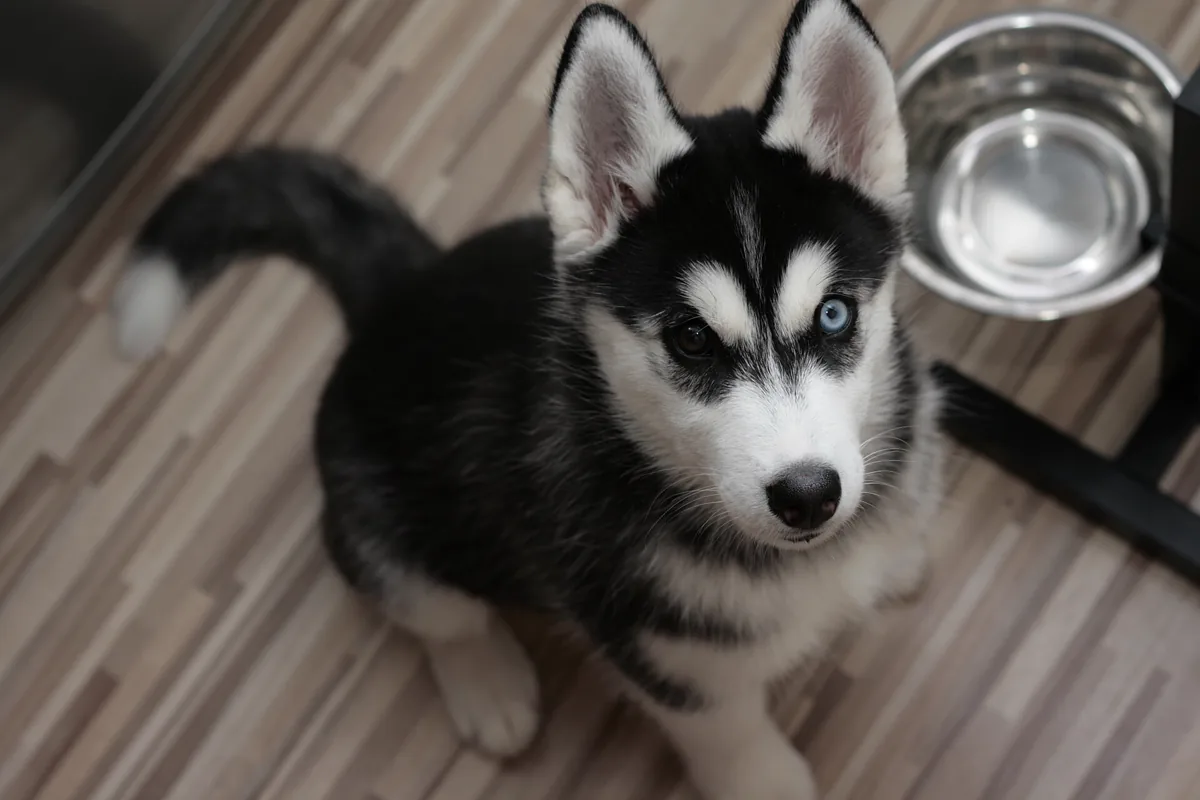
An elevated dog bowl is any feeding setup that lifts the dish off the floor, usually a stand, a frame or a wooden box with one or two bowls dropped into it. Heights on the market run from a few centimetres for small breeds up to knee height for giant ones, and most products are sold by breed size rather than by any measurement of the individual dog. That is the first weakness worth noticing, because two dogs of the same weight can differ considerably in leg length.
The marketing usually promises three things: better digestion, less mess and less strain on the neck and shoulders. Of those, mess is the only one that is obviously true. A raised bowl does not slide as far across a tiled floor, it stays cleaner in a dusty utility room, and it collects less kicked water. Those are real conveniences, and they are worth having, but they are conveniences rather than health benefits.
Bowls and stands are separate purchases in practice, even when sold together. The stand determines the height and stability, the bowl determines what the food touches, and the two decisions should be made independently. Our stainless steel dog bowls guide covers the material side in detail, and our broader dog bowls guide covers shape and size.
The photograph at the top of this section shows the setup most owners recognise: a stainless dish dropped into a low black stand beside a growing puppy. It is a perfectly ordinary arrangement, and for a small or medium dog with no health problems it is neither harmful nor particularly helpful. The question that matters is what happens when the same arrangement is scaled up to a dog that weighs sixty kilos.
The Raised Bowl and Bloat: What the Purdue Study Found
Gastric dilatation volvulus, commonly called bloat, is a sudden condition in which the stomach fills with gas and can twist on itself. The American Kennel Club describes it as a fast moving emergency: without treatment, within only an hour or two the dog is likely to go into shock, with a rising heart rate and a weakening pulse. It is one of the few genuine same hour emergencies in dog ownership.
If you want even more options, check out our guide to dog bowls.
In 2000 a team at Purdue University published a prospective cohort study in the Journal of the American Veterinary Medical Association, following 1,637 dogs aged six months and over across eleven large and giant breeds including Great Danes, Irish Wolfhounds, Saint Bernards, Rottweilers, Weimaraners and Standard Poodles. Cumulative incidence of bloat during the study was 6 percent. Four factors were significantly associated with increased risk: increasing age, having a first degree relative with a history of bloat, a faster speed of eating, and having a raised feeding bowl.
The figure that made the study famous is the last one. Approximately 20 percent of bloat cases among the large breed dogs, and approximately 52 percent among the giant breed dogs, were attributed to having a raised feed bowl. You can read the abstract on PubMed. Two caveats belong with it. This is an observational cohort, so it establishes association rather than proven cause, and the dogs studied were all large or giant breeds, so the finding cannot simply be extended to a terrier.
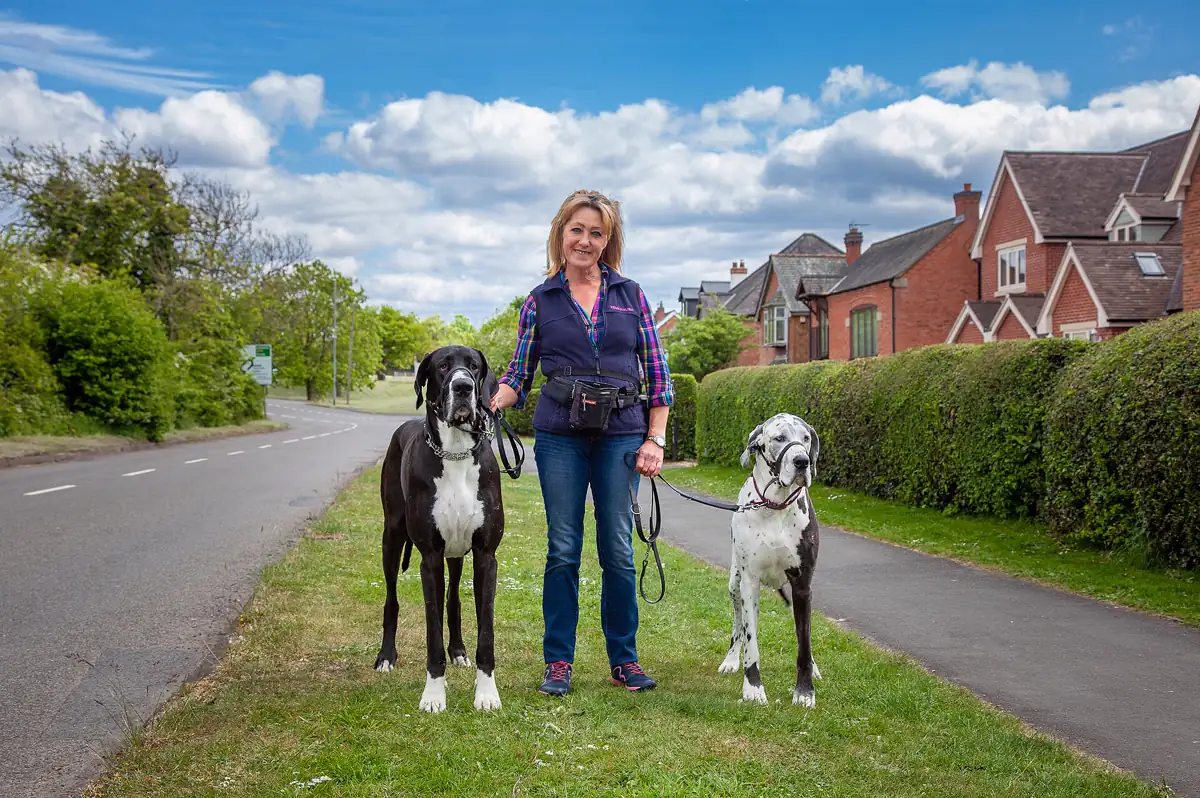
Conformation is the background risk that raised bowls sit on top of. The AKC guidance on bloat notes that dogs with a deep, narrow chest, tall rather than wide, suffer most often, and that Great Danes, with their high height to width ratio, are five to eight times more likely to bloat than dogs with a low ratio. The two dogs in the photograph at the top of this section are exactly that shape. If yours looks like this, the raised bowl question is not academic.
Dogs That Genuinely Need to Eat With Their Head Up
There is one condition where raised feeding is not a preference but the core of treatment. In megaesophagus the oesophagus loses the muscular tone that normally pushes food down, so food and water sit in it and come back up. The AKC describes the primary sign as regurgitation of undigested food or water soon after eating, with the regurgitated material typically tubular and lacking bile, and names aspiration pneumonia as the major danger.
For those dogs, AKC guidance is specific. Feeding management is the cornerstone of care, and the dog must eat and drink in an upright position, with the head and forequarters elevated to vertical or near vertical relative to the floor. Veterinarians typically recommend a Bailey chair for medium and large dogs, a tall narrow box that holds the dog in an upright begging position, and the dog needs to stay upright for 10 to 15 minutes after eating, drinking or taking medication so that gravity can move material into the stomach.
Notice how far that is from a shop bought raised feeder. A stand that lifts a bowl to elbow height does not put a dog vertical, and it does not keep it there for a quarter of an hour afterwards. Buying a raised bowl for a dog with suspected megaesophagus is not the same intervention, and a dog regurgitating undigested food needs a veterinary diagnosis rather than a new accessory.
The other group worth taking seriously is dogs with mobility or neck pain that makes lowering the head genuinely difficult, whether from advanced arthritis, a cervical problem or a recovery period after surgery. Here the right move is to ask the vet who is already treating the dog, because the decision depends on the diagnosis. If you are adjusting the whole home for an older dog, our guides to dog stairs for bed and the orthopedic dog bed cover the other changes that usually matter more than bowl height.
If You Do Raise the Bowl, How High Should It Go?
There is no published height standard, and any article that gives you a precise number in centimetres by breed is inventing it. What is reasonable, and what most veterinary advice converges on in practice, is to work from the dog in front of you rather than from a size chart on a box.
You might also find our slow feeder dog bowl article helpful when shopping.
Measure with the dog standing square and relaxed on a level floor, and take the height from the floor to the point of the shoulder, or to the elbow if that is easier to find. A raised bowl is generally set so the rim sits below shoulder height, which lets the dog tilt the head down slightly rather than reaching up or craning. A bowl the dog has to lift its chin towards is too high, whatever the packaging says.
Watch the dog eat before you settle on a height. Feet planted, neck relaxed, no shuffling backwards and no bracing against the stand is what you are looking for. If the dog is stepping back to reach, spilling more than before, or bracing a front leg to steady itself, the stand is wrong for that dog and the height should come down.
Puppies complicate this, because they outgrow a fixed stand quickly and the whole feeding setup changes anyway as they move off puppy portions. Adjustable stands exist and are worth the small premium if you have a fast growing dog. Whatever you choose, keep the feeding station level, because a stand rocking on an uneven floor teaches the dog to eat in a hurry.
For Most Dogs, Eating Speed Matters More Than Height
Speed of eating came out of the Purdue cohort as a risk factor in its own right, alongside the raised bowl, and it is far easier to change. A dog that inhales a meal in forty seconds is swallowing air with it, and that is true regardless of how far off the floor the dish sits. If you only change one thing about your dog's feeding setup, slow the meal down.
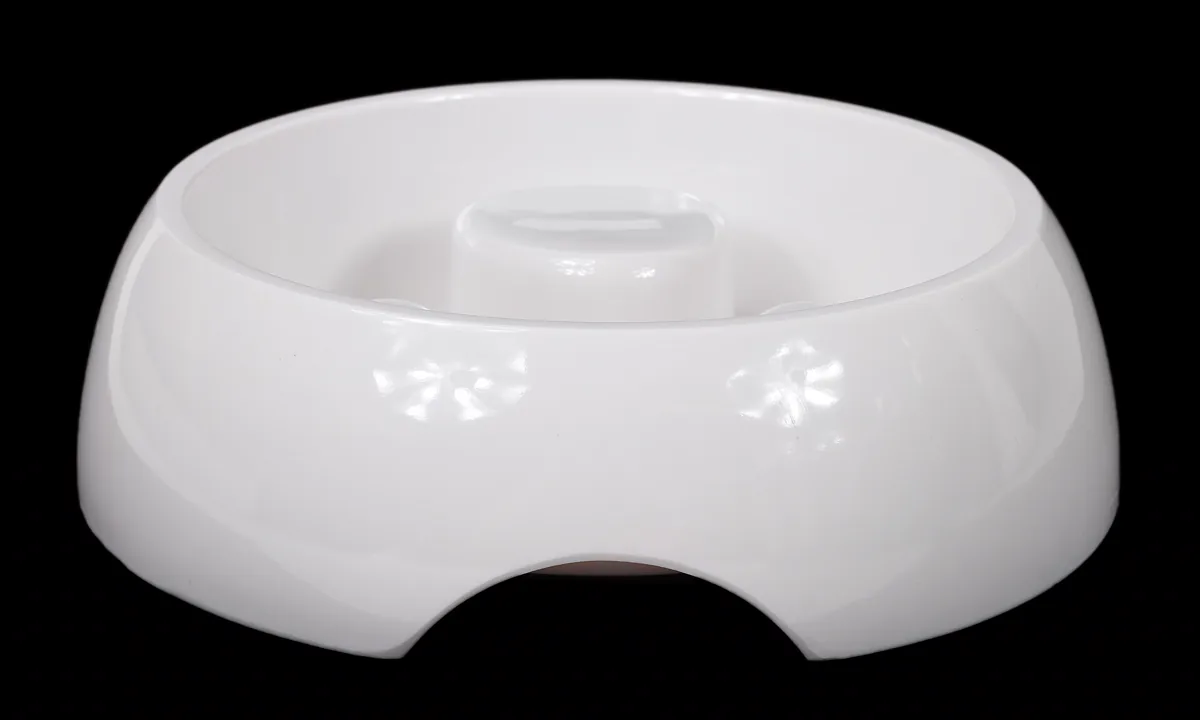
The simplest tool is a slow feeder bowl, the moulded dish with ridges, spirals or a central obstruction that forces the dog to work food out of channels rather than scoop it. The one photographed here uses a single raised centre column, which is the gentlest pattern and a sensible starting point for a dog that has never used one. Our slow feeder dog bowl guide compares the patterns, and slow eating dog bowl covers introducing one without frustrating the dog.
You do not need a special bowl to achieve the same result. Splitting the daily ration into more, smaller meals, scattering kibble across a mat, or putting part of the meal into a puzzle all stretch the same food over more minutes. Our puzzle feeders for dogs, snuffle mat for dogs and lick mat for dogs guides all describe versions of this, and each works whether the bowl is on the floor or on a stand.
Competition is the other accelerator. In a multi dog household, the dog that eats fastest is often the dog that learned it had to. Feeding in separate rooms or behind a baby gate removes the reason to rush more reliably than any bowl design. Our dog feeding bowl guide goes into the household side of this.
Stand Stability, Materials and Cleaning
A raised feeder has a failure mode that a floor bowl does not: it can tip. Check the footprint against the dog's enthusiasm, not against the dog's weight. A wide base, a low centre of gravity, and rubber feet that grip tile or laminate are what keep the setup still, and a stand that wobbles when you nudge it will wobble harder when a large dog leans in.
For related picks, take a look at our stainless steel dog bowls roundup.
The bowl itself should lift out. Fixed bowls, or bowls glued into a wooden frame, are difficult to clean properly and tend to trap food residue in the gap between dish and frame. Removable stainless inserts are the easy answer, since they go in the dishwasher and do not scratch the way plastic does, a point covered in our stainless steel dog bowls guide.
Wash food bowls after every meal and water bowls daily, and pay particular attention to the recess in the stand where crumbs collect out of sight. Elevated setups feel cleaner than they are, because the visible surface is the rim rather than the base. Wooden stands need a sealed, wipeable finish or they absorb spills, and an unfinished frame under a water bowl will eventually go soft.
If your dog drinks more than it eats, or you are trying to increase water intake, the height question is separate from the filtration question. Our dog water fountain guide covers what does and does not affect how much a dog actually drinks, and the honest answer there is also less dramatic than the marketing.
When to Leave the Bowl on the Floor
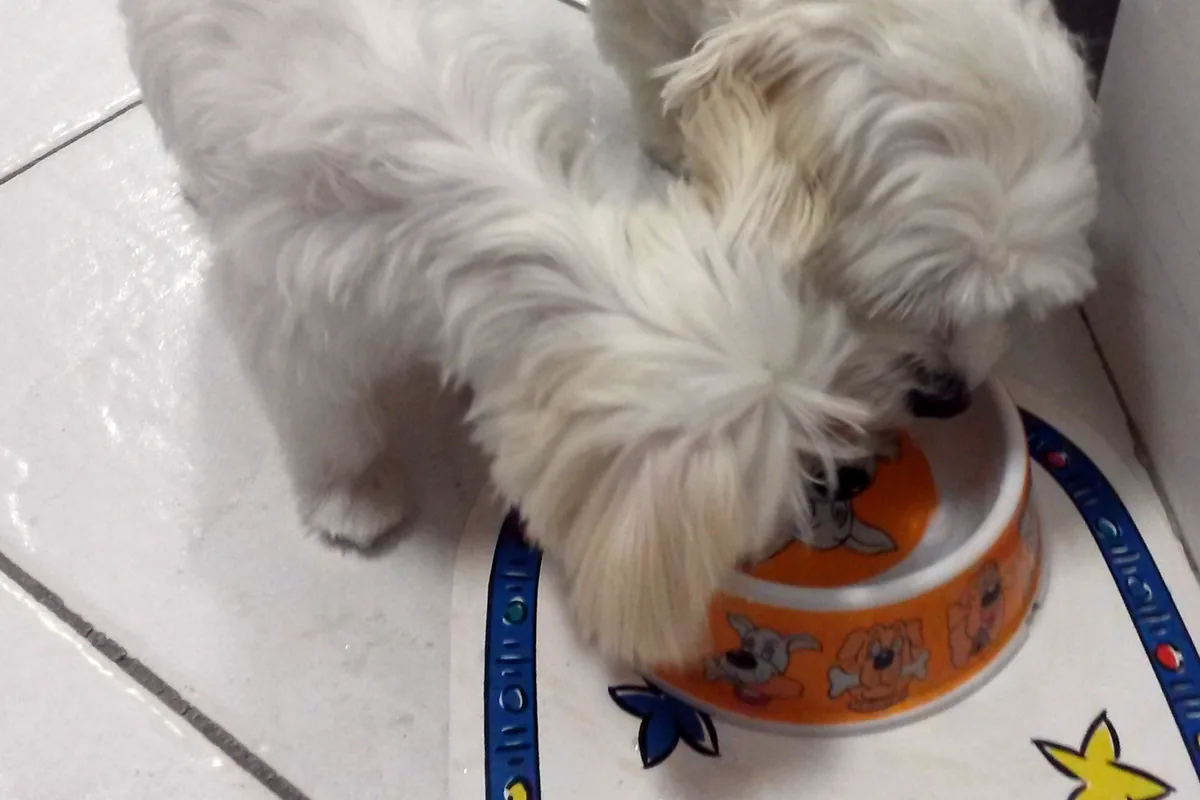
For a healthy dog with no swallowing or mobility problem, the floor is the default and there is no evidence it needs changing. Dogs are built to eat with the head down, and the two small dogs in the photograph at the top of this section are doing exactly what most dogs do without difficulty for their whole lives. Convenience reasons for raising a bowl are legitimate, but they should be called what they are.
For a large or giant breed dog, particularly one with a deep narrow chest or a relative with a history of bloat, the Purdue association is a reason to think hard before raising the bowl at all, and a reason to discuss it with your vet rather than with a product description. The risk factors that study identified are not evenly distributed, and this is the group they were measured in.
Learn the emergency signs regardless of what you decide, because the raised bowl question is far less important than recognising the problem in time. The AKC lists enlargement of the abdomen, retching, salivation and restlessness, and notes the dog will feel pain and may whine if you press on the belly. Any combination of those is an immediate veterinary emergency, not a wait and see.
Finally, keep the feeding station boring and predictable. Same place, same routine, no competition, no exercise immediately around meals for a high risk dog, and a bowl the dog cannot pick up and carry off. Chewers who treat the dish as a toy should eat from something they cannot destroy, and the material notes in our dog toys for aggressive chewers guide apply to bowls too.
What to Ask Your Veterinarian Before You Raise the Bowl
Bring four questions to the appointment. Does this dog have a diagnosed reason to eat with the head raised? Given its breed, conformation and family history, does the bloat association apply here? What height would you set for this dog specifically? And is there anything about the current feeding routine, rather than the bowl, that you would change first?
Bring evidence rather than impressions. A short phone video of the dog eating at its normal bowl tells a vet more in ten seconds than a paragraph of description, and if regurgitation is the reason you are asking, note when it happens relative to the meal and what the material looks like. The AKC notes that regurgitated material in megaesophagus is typically tubular and lacks bile, which is the sort of detail that changes a diagnosis.
If your dog is older and the real issue is general comfort, the bowl is rarely the biggest lever. Body weight, joint management, flooring traction and where the dog sleeps usually matter more. Our senior dog toys and best toys for old dogs guides cover keeping an older dog active, and premium pet food and dog food topper cover the appetite side of the same problem.
The short version: elevated dog bowls are a convenience for most dogs, a medical tool for a small number of specific diagnoses, and a question worth asking twice if you own a large or giant breed with a deep chest. None of that makes them villains. It makes them a decision that should be made about your dog rather than about a product category.
If you want to dig deeper into the research, the ASPCA pet care library publishes practical, expert-reviewed resources for pet owners.
Frequently Asked Questions
Do elevated dog bowls cause bloat?
The honest answer is that a raised bowl is associated with higher bloat risk in large and giant breeds, but association is not the same as proven cause. The 2000 Purdue study published in the Journal of the American Veterinary Medical Association followed 1,637 large and giant breed dogs and found that having a raised feeding bowl was significantly associated with increased risk, with roughly 20 percent of large breed cases and 52 percent of giant breed cases attributed to it. It was an observational cohort, not an experiment, and the dogs were all large or giant breeds.
Should a Great Dane use an elevated dog bowl?
This is the breed where the question matters most, so it belongs with your veterinarian rather than with a product page. The AKC notes that Great Danes, because of their high height to width ratio, are five to eight times more likely to bloat than dogs with a low ratio, and the Purdue study attributed around 52 percent of giant breed bloat cases to a raised feed bowl. Both of those point the same direction, and both argue for a specific conversation about your individual dog.
Which dogs actually need a raised bowl?
The clearest case is megaesophagus. AKC guidance states the dog must eat and drink in an upright position with the head and forequarters elevated to vertical or near vertical, usually in a Bailey chair for medium and large dogs, and must stay upright for 10 to 15 minutes afterwards. Dogs with arthritis, cervical pain or post surgical restrictions may also benefit, but that decision belongs to the vet treating the dog, not to a size chart.
How high should an elevated dog bowl be?
There is no published standard, so measure the dog rather than trusting the box. Stand the dog square on a level floor and measure from the floor to the point of the shoulder or the elbow, then set the rim of the bowl below shoulder height so the dog tilts its head slightly down rather than reaching up. Then watch it eat. Planted feet and a relaxed neck mean the height is right; stepping back, craning or bracing means it is too high.
What are the warning signs of bloat in dogs?
The AKC lists enlargement of the abdomen, retching, salivation and restlessness, and adds that the dog will feel pain and may whine if you press on the belly. It also warns that without treatment the dog is likely to go into shock within only an hour or two, with a rising heart rate and a weakening pulse. Treat any combination of these as an immediate emergency and call a veterinary practice or emergency clinic straight away.
Does a raised bowl help a dog that eats too fast?
No. Height and speed are separate problems, and the Purdue study identified faster eating as its own risk factor alongside the raised bowl. To slow a meal down, use a slow feeder bowl with ridges or a central obstruction, split the ration into more and smaller meals, scatter part of it on a mat, or move some of it into a puzzle feeder. In multi dog homes, feeding in separate rooms usually does more than any bowl design.
Are elevated dog bowls better for large breeds in general?
That is the marketing claim, and it is the claim the Purdue data sits most awkwardly against, since large and giant breeds are precisely the population where the raised bowl association was measured. Large dogs do benefit from a stable, non slip, appropriately sized bowl and a calm feeding routine, but size on its own is not a reason to lift the dish off the floor.
What material should the bowl in an elevated stand be?
Stainless steel is the practical default because it is non porous, dishwasher safe and does not scratch the way plastic does, and scratches are where bacteria and old food collect. Whatever the material, insist that the bowl lifts out of the stand. Fixed or glued in bowls trap residue in the gap between the dish and the frame, which is the part of an elevated feeder that gets cleaned least.
Browse Dog Toys
Free worldwide shipping on every order. No minimum purchase required.
Browse Dog Toys →