A slow eating dog bowl, also called a slow feeder bowl, is a food bowl with raised ridges, channels, or separate compartments that make a dog take smaller bites and work around simple obstacles. It can be a practical choice for a healthy dog who rushes through meals, gulps air, or needs a calmer feeding routine. Choose one that fits your dog's face and meal size, introduce it gradually, supervise the first meals, and stop if your dog bites the bowl, becomes distressed, or cannot reach the food comfortably. A slow feeder is a mealtime tool, not a treatment for vomiting, swallowing trouble, abdominal swelling, or any other medical concern.
This guide focuses specifically on bowls for slowing food intake. It explains how slow feeders work, which designs suit different dogs, how to introduce one without frustration, and how to keep it sanitary. It also separates realistic benefits from claims a bowl cannot prove. If your dog suddenly starts eating unusually fast, acts ravenous despite adequate food, loses weight, coughs during meals, or repeatedly brings food back up, call your veterinarian before treating the behavior as a bowl problem.
What Is a Slow Eating Dog Bowl and How Does It Work?
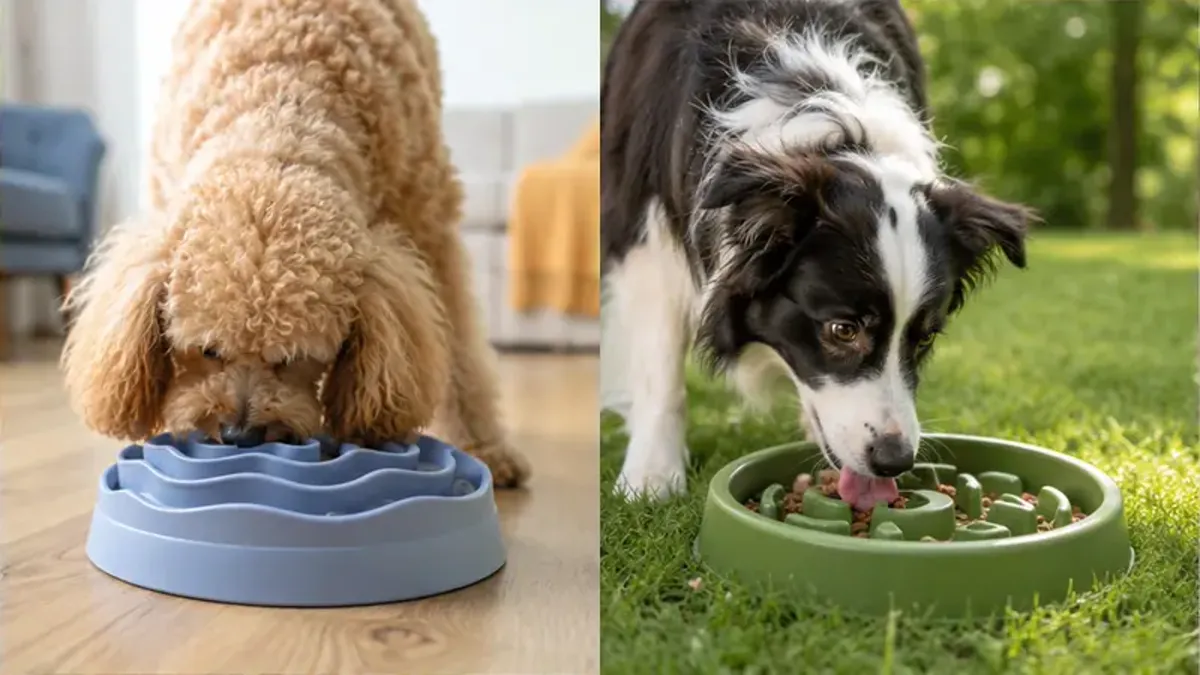
A standard bowl presents the entire meal in one open area. A slow feeder changes the layout. Food settles between fixed ridges, around a center mound, or inside shallow pockets, so the dog must reposition the tongue and muzzle to collect it. The bowl does not need moving parts, hidden pieces, or complicated mechanisms. Its job is simply to reduce easy access to a large mouthful.
The best design creates a manageable challenge. Your dog should still be able to see, smell, and reach the food. The obstacles should encourage licking and smaller bites without scraping the face or trapping the jaw. A dog may take longer to finish, but the goal is a relaxed pace, not the longest possible mealtime. If the pattern is so difficult that your dog paws, flips, chews, or walks away hungry, it is the wrong match.
Slow feeders can hold dry food, wet food, or a combination if the label permits that use and every groove can be cleaned. They are different from timed automatic feeders, which control when or how much food is released. They are also different from enrichment products designed for unsupervised chewing. If you are comparing feeding formats, the Livehappypet guide to dog bowls provides a useful overview, while the guide to a slow feeder dog bowl stays focused on obstacle patterns.
Slow Eating Dog Bowl Benefits and Important Limits
The clearest benefit is mechanical: food is spread through a pattern rather than piled in an open bowl. For many eager eaters, that setup encourages smaller pickups and pauses as they move to a new channel. A slower, more deliberate routine may also make meals feel less chaotic in a busy home. You can observe whether it works for your individual dog by comparing behavior, comfort, and approximate meal duration over several supervised feedings.
A bowl can also add light mealtime engagement. Sniffing and searching within visible channels asks a little more of the dog than eating from an open dish. That does not replace walks, training, social contact, or species appropriate daily activity. For broader ideas that do not depend on making meals difficult, see these dog enrichment activities.
It is equally important to understand what slow feeders cannot promise. They do not diagnose or cure digestive disease. They do not make an unsuitable diet complete and balanced. They do not guarantee prevention of choking, vomiting, regurgitation, or gastric dilatation and volvulus, commonly called GDV or bloat. Published veterinary guidance describes GDV as a rapidly progressive, life threatening emergency with multiple risk factors. The American College of Veterinary Surgeons explains the condition and its emergency signs, while the Merck Veterinary Manual reviews risk factors, diagnosis, and treatment.
Seek urgent veterinary care if a dog has a swollen or painful abdomen, repeated unsuccessful attempts to vomit, heavy drooling, weakness, restlessness, pale gums, or collapse. Do not wait to see whether changing bowls helps. VCA Animal Hospitals and the American Kennel Club both emphasize that suspected bloat requires immediate veterinary attention.
| Situation | Reasonable next step | What not to assume |
|---|---|---|
| Healthy dog empties an open bowl in a rush | Try an easy slow feeder under supervision | Faster eating always means illness |
| Dog takes huge mouthfuls but stays comfortable | Use broad, shallow channels and monitor bite size | The hardest maze is the best choice |
| Dog coughs, gags, or repeatedly brings food up | Pause and contact a veterinarian | A new bowl is adequate treatment |
| Dog has a swollen abdomen or tries to vomit without producing anything | Seek emergency veterinary care now | Waiting for the next meal is safe |
How to Choose a Slow Eating Dog Bowl
Start with the dog, not the most intricate pattern. Consider muzzle length and width, body size, normal eating style, food texture, dental comfort, and mobility. A broad faced dog may struggle to reach narrow channels intended for a long, slim muzzle. A dog with vision loss, facial sensitivity, missing teeth, arthritis, or neck discomfort may need a very shallow layout and advice from a veterinarian.
Choose an appropriate difficulty
Begin with a few wide obstacles or gently curved channels. Food should remain visible and accessible. Tight spirals and deep pockets may be appropriate only after a dog shows calm, successful use of an easier model. Difficulty is not a quality score. A simple bowl that produces comfortable small bites is more useful than an elaborate one that causes frustration.
Match capacity to the measured meal
Check usable capacity, not just the outside diameter. Ridges occupy space, so a bowl that looks large may not hold the normal portion without food mounding above the obstacles. Food piled over the ridges defeats the slowing function. Measure the meal according to your veterinarian's or food label's guidance, place it in the bowl, and confirm that it distributes in a single layer through several sections.
Match the pattern to the food
Dry kibble moves easily through most ridges. Wet food works better in shallow, open curves that a tongue can clear. Mixed meals need a bowl that does not leave sticky residue in inaccessible corners. Food toppers should count toward the total meal rather than becoming an unmeasured bonus. Our dog food topper guide offers practical context for keeping additions purposeful.
Prioritize stability
A broad base, nonslip ring, or secure holder can keep the dish from traveling across the floor. Stability matters because chasing a sliding bowl can turn a calm meal into a frantic one. Check the base regularly. Replace loose rubber rings or damaged suction parts that could detach.
Materials, Sizing, and Safety for Everyday Use
Common slow feeder materials include stainless steel, food contact plastic, silicone, and ceramic. No material is automatically perfect for every household. Construction quality, condition, cleanability, and the manufacturer's care directions matter as much as the label on the material.
| Material | Potential advantages | Points to inspect |
|---|---|---|
| Stainless steel | Durable, nonporous, often easy to wash | Sharp seams, loose bonded bases, dents, and whether the pattern is deep enough to work |
| Food contact plastic | Lightweight and available in many patterns | Cracks, deep scratches, chewed edges, odor retention, and dishwasher instructions |
| Silicone | Flexible, quiet, and often nonslip | Tears, folding during use, chewing, and whether grooves turn fully clean |
| Glazed ceramic | Heavy and stable with a smooth surface | Chips, hairline cracks, glaze damage, weight, and safe handling |
Whatever you choose, buy from a seller that identifies the manufacturer and provides use and cleaning instructions. The bowl should have smooth, rounded food contact surfaces. Avoid peeling coatings, mystery materials, sharp molding flash, deep cracks, or separate decorative pieces. Remove a damaged bowl promptly. A dog who persistently chews the feeder needs a different approach, not tougher access to the same object.
Size includes more than capacity. The inside diameter should allow the dog's muzzle to move without being wedged. Obstacles should be lower than the depth of comfortable tongue reach. The outer bowl should remain stable when the dog works around the edge. For puppies, allow room for growth and reassess often. The new puppy essentials guide can help place feeding equipment within a broader setup for a new arrival.
How to Introduce a Slow Eating Dog Bowl Without Frustration
Make the first experience easy. Let your dog inspect the clean, empty bowl while you are present. Add a few pieces of the regular food to the widest, shallowest sections. When the dog calmly finds them, add the rest of a normal measured meal. Do not press food tightly into deep corners during the introduction.
For the first several meals, stay nearby and watch body language. Comfortable use looks like steady sniffing, licking, and repositioning. Signs of mismatch include frantic pawing, hard biting, repeated flipping, retreating from the bowl, facial rubbing, whining, or giving up while a meaningful portion remains inaccessible. Pick up the bowl if use becomes unsafe. At the next meal, return to an open bowl or a much easier pattern.
You can make the transition more gradual by dividing the measured meal between the old bowl and the slow feeder, then increasing the slow feeder share as the dog succeeds. Do not add extra food just to encourage interaction. Use the normal portion so that changing equipment does not quietly change calorie intake.
In a home with multiple pets, feed separately. Competition can encourage rushing, guarding, and attempts to steal from another bowl. Each dog also needs an individual fit. The bowl that works for one may be uncomfortable for another, even when the dogs weigh about the same.
- Wash the new bowl before first use.
- Place it on a level, nonslip surface in a quiet feeding area.
- Offer a small amount in the easiest channels.
- Serve the normal measured portion once your dog understands the layout.
- Supervise and note comfort, bite size, and whether food remains trapped.
- Wash the bowl after the meal and inspect it for damage.
Build a Calmer Routine Around the Bowl
A slow feeder works best as one part of a predictable feeding plan. Measure meals rather than filling by eye. Use the amount appropriate for the dog's food, life stage, body condition, activity, health, and veterinary advice. A patterned bowl does not change the calorie content of what goes into it.
Feed in a low traffic location where children and other pets will not crowd the dog. Set the bowl down only when the dog can approach safely. If your dog guards food, do not reach into the bowl or repeatedly take it away as a test. Get individualized help from a qualified reward based professional. For a foundation in kind, clear teaching, see positive reinforcement dog training.
Keep meal timing reasonably consistent, but follow medical instructions when a veterinarian has prescribed a particular schedule. Some dogs do better with portions divided across more than one feeding, but the right frequency depends on the individual. Ask your veterinarian before changing meal frequency for a puppy, a dog with a medical condition, or a dog with a known GDV risk.
Watch the whole dog, not only the clock. A successful routine is calm and comfortable, with the dog able to access the full measured portion. There is no universal target number of minutes that every dog must spend eating. A noticeable reduction in gulping with relaxed body language is more meaningful than stretching dinner to an arbitrary duration.
Dental care remains separate from slow feeding. Ridges do not brush teeth, and scraping food from a maze should not be marketed as a replacement for oral care. The dog toothbrush guide explains equipment choices to discuss as part of an at home dental routine.
Cleaning and Maintaining a Slow Feeder Bowl
Slow feeders have more surface area, seams, and corners than open dishes, so careful cleaning matters. The US Food and Drug Administration advises washing pet food bowls and scooping utensils with soap and hot water after each use. Its pet food safety guidance also recommends washing hands before and after handling pet food and treats.
Follow the bowl manufacturer's directions. If it is dishwasher safe, position it so water reaches the channels and let it dry completely. For hand washing, use hot water, dish soap, and a brush that reaches every groove. Rinse away all soap and air dry fully before the next meal. Clean wet or raw food residue promptly, and follow veterinary guidance for any special diet handling needs.
Inspect while cleaning. Run a finger carefully along each ridge and edge. Look for cracks, chips, rough scratches, peeling surfaces, swollen areas, trapped residue, mold, and loose nonslip components. Replace a damaged feeder rather than trying to seal a food contact surface with a household adhesive.
Keep pet dishes and cleaning tools organized in a way that reduces cross contamination with family food preparation. The FDA advises against washing pet dishes in a bathtub or bathroom sink because of the risk of cross contamination. If you use a kitchen sink, clean and disinfect the sink and surrounding area afterward according to appropriate household product directions.
Troubleshooting Common Slow Feeder Problems
My dog flips the bowl
Place it on a level nonslip mat and check whether the base is wide enough. Flipping may also mean the maze is too difficult or the bowl is too light. Choose fewer obstacles rather than turning mealtime into a contest of strength. Do not permanently attach a bowl in a way that prevents thorough washing.
My dog chews the ridges
End the meal session and inspect for damage. Chewing can create broken pieces or sharp surfaces, especially in flexible plastic or silicone. Try a smoother, lower pattern made for feeding, and supervise closely. If chewing continues, an open bowl combined with veterinarian approved portioning or feeding changes may be safer.
Food is always left behind
Test whether you can easily reach the remaining food with your fingertips or a cleaning brush. If not, the channels are probably too narrow or deep for your dog. Leftovers can also reflect reduced appetite, dental pain, nausea, or another concern. A sudden appetite change deserves veterinary attention rather than a more challenging bowl.
My flat faced dog cannot reach the food
Switch to a wide, shallow feeder with low, rounded dividers and generous spacing. Avoid deep wells that press around the eyes or nose. Closely monitor breathing and comfort. Ask your veterinarian for guidance if facial anatomy, airway concerns, or neck position complicates feeding.
My dog still eats quickly
Confirm that the meal is distributed between the obstacles instead of sitting above them. If fit and food placement are correct, ask your veterinarian about safe options such as dividing the daily ration into an appropriate schedule. Do not improvise with loose objects in an ordinary bowl. They can create choking, ingestion, or sanitation hazards. Our guide to a dog feeding bowl for slow meals discusses additional bowl layouts without relying on removable obstacles.
My dog suddenly seems ravenous
Do not assume enthusiasm is merely a habit. Increased appetite can occur for many reasons, including changes in activity, food, medication, or health. Record when the change began, how much is offered, weight or body condition changes, stool changes, vomiting, and drinking or urination changes. Share those observations with your veterinarian.
Frequently Asked Questions About Slow Feeder Bowls
They are designed to reduce direct access to the whole meal, and many dogs take smaller pickups while navigating the fixed pattern. Results vary by dog, food, and design. Watch a supervised meal rather than relying on marketing claims. The bowl is doing its job if your dog eats at a calmer pace and remains comfortable, not simply if the meal takes as long as possible.
No single design fits every dog. Very young puppies, flat faced dogs, dogs with dental or swallowing problems, and dogs with neck, vision, or mobility limitations may need a shallow pattern or a different feeding plan. Ask your veterinarian when health or anatomy affects eating. Stop using any bowl that causes biting, facial rubbing, distress, coughing, or an inability to reach the meal.
Do not treat a slow feeder as a guarantee against GDV. GDV is a complex veterinary emergency with multiple risk factors. Discuss individual prevention strategies with your veterinarian, especially for a large, deep chested dog or a dog with family history. Abdominal swelling, unproductive retching, weakness, restlessness, or collapse requires immediate emergency care.
Yes, if the manufacturer allows it and the pattern is shallow enough for your dog to lick clean. Spread the measured portion loosely rather than packing it into tight recesses. Wash the bowl with soap and hot water after the meal, rinse thoroughly, and let it dry. Choose another design if residue remains in corners that a brush cannot reach.
Start easy, with low ridges and broad channels. Your dog should be able to understand the layout during the first supervised introduction and reach the complete portion without frantic pawing or chewing. Increase complexity only if the current bowl is comfortable and barely changes the pace. A harder maze is not automatically healthier.
Wash it after each use with soap and hot water, consistent with FDA pet food safety guidance, and follow the manufacturer's care instructions. The extra grooves need particular attention. Rinse completely, dry the bowl, and inspect for cracks, scratches, chips, trapped food, or loose parts before using it again.
Pick it up calmly and use the regular bowl for that meal or offer an easier slow feeder. At the next introduction, place a few pieces in the widest sections and supervise. Never withhold a meal to force a dog to solve a difficult pattern. Ongoing refusal, a sudden appetite change, or signs of mouth or swallowing pain should be discussed with a veterinarian.
Choosing a Slow Eating Dog Bowl With Confidence
The right slow eating dog bowl is simple, stable, easy to sanitize, and appropriately challenging for the dog in front of you. Favor broad, reachable channels over dramatic maze complexity. Match the bowl to muzzle shape, food texture, measured meal size, and physical comfort. Introduce it in small steps, supervise early use, and judge success by relaxed eating rather than a stopwatch.
Keep expectations grounded. A slow feeder can shape how food is accessed, but it cannot correct an unsuitable diet, replace dental care, or diagnose digestive and swallowing problems. For more feeding context, explore the Livehappypet guides to puzzle feeders for dogs and premium pet food, then bring questions about portions, sudden appetite changes, repeated regurgitation, or medical risk to your veterinarian.
A thoughtful choice should make dinner feel calmer, not harder. When the bowl fits well, the food is reachable, cleanup is straightforward, and your dog approaches it comfortably, you have found a useful everyday tool.