Words like premium, gourmet and super premium sell a lot of pet food, but they tell you very little about what is in the bag. The parts of the label that actually describe the food are smaller and on the back. This guide shows you how to read them, so you can judge any premium pet food on what it contains rather than how it is marketed.
Quick Answer: Is Premium Pet Food Better for Your Pet?
Premium pet food is only better if the label backs it up. Look for a nutritional adequacy statement saying the food is complete and balanced for your pet's species and life stage, ideally proven by feeding trials, then compare ingredients and guaranteed analysis. A higher price or premium wording alone does not guarantee better nutrition.
Updated October 4, 2026- The back label matters most. The nutritional adequacy statement is the key line.
- Species and life stage. Dog and cat foods are not interchangeable.
- Compare like with like. Wet and dry food need a dry matter conversion.
- Store it well. Even the best food degrades with heat, moisture and poor handling.
Does Premium Pet Food Mean Better Nutrition?
Answer: Not by itself. Premium describes positioning and price, not a nutrition standard you can check. What you can check is whether the food is complete and balanced for your pet's life stage, how that was established, and what the ingredient list and guaranteed analysis show. Judge every premium food on those label facts instead.
AAFCO advises owners to read the label correctly, choose a food labeled for the pet's species, life stage and condition, and follow the feeding directions. It also notes that foods from grocery stores, specialty shops and websites that comply with regulatory requirements should all be safe and nutritious. In other words, where you buy and how much you pay are not the test.That does not mean premium foods are a waste. Some use different ingredients, run feeding trials or suit picky eaters better. It means the reasons to pay more should be visible on the label or in information the company will share, not only in the branding.

How Do You Read the Nutritional Adequacy Statement?
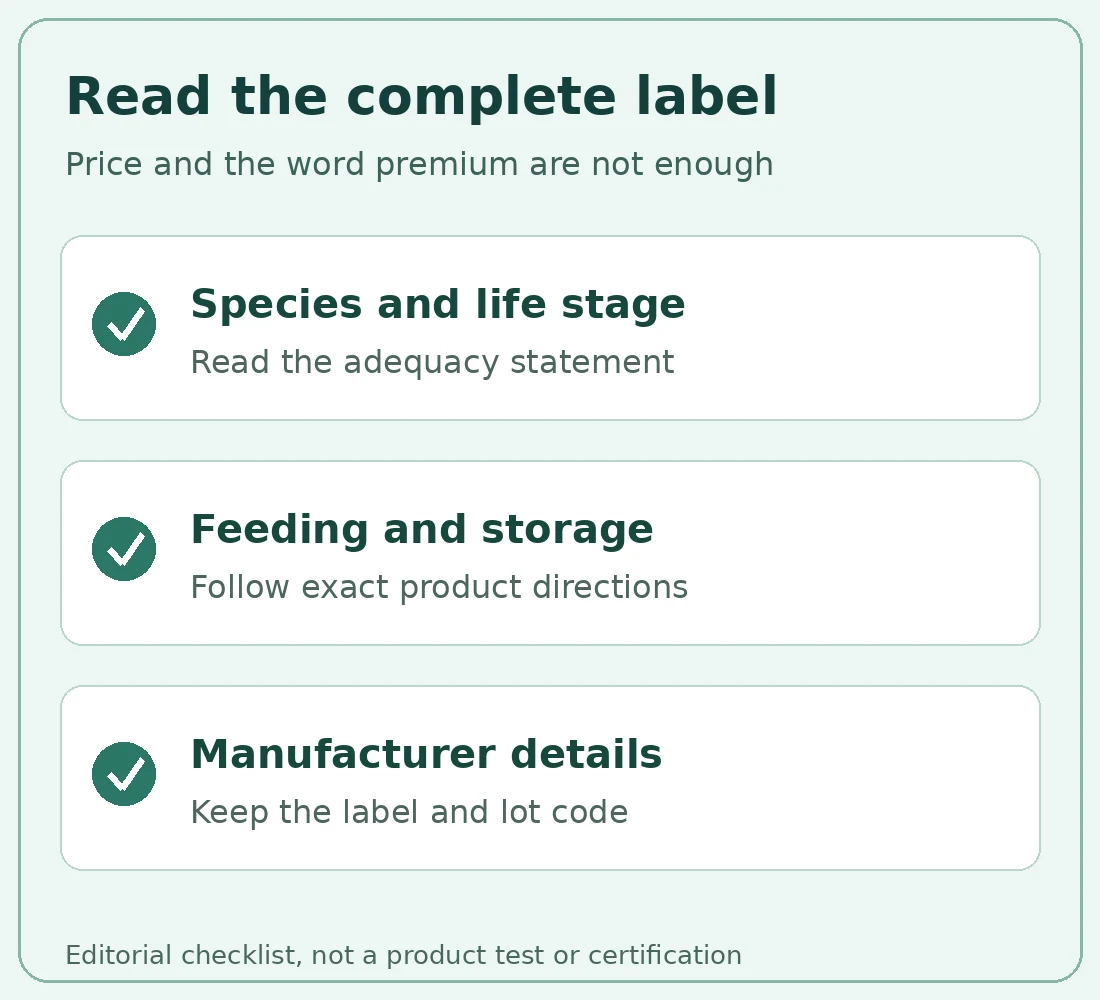
Use the package in front of you when comparing foods, rather than relying only on a retailer's headline or a photograph of an older label. Keep the product name, intended species, life-stage statement and feeding directions together in your notes. If you are comparing products for different pets, maintain a separate record for each animal so a recommendation for a dog is not accidentally treated as a cat-food recommendation. Check which package and formulation the manufacturer is describing, and ask for clarification when the label and website differ. Your veterinarian can help with individual dietary questions; a marketing category or this buying checklist cannot make that decision for your pet.
Answer: Find the small statement on the back or side of the bag. It tells you whether the food is complete and balanced, for which species and for which life stage. It also tells you how that was shown: formulated to meet an AAFCO nutrient profile, or tested in animal feeding trials using AAFCO procedures, which VCA describes as preferable.
AAFCO calls this statement perhaps the most important part of a label, and notes it almost always sits on the back or sides of the package in small print. Because the wording is standardized, there are only a few versions, which makes comparisons between products straightforward.The FDA explains the two routes to a complete and balanced claim: meet one of the AAFCO dog or cat food nutrient profiles, or pass a feeding trial using AAFCO procedures. VCA Animal Hospitals calls the feeding test wording preferable. If a premium food has no adequacy statement at all, it is likely a treat, topper or supplement rather than a complete diet.
What Do the Ingredient List and Guaranteed Analysis Show?
Answer: The ingredient list shows everything in the food in descending order by weight, so it tells you what dominates the recipe. The guaranteed analysis shows minimum crude protein and fat and maximum crude fiber and moisture. Neither tells you about quality or digestibility on its own, so read them alongside the adequacy statement.
AAFCO requires ingredients to be listed in descending order of predominance by weight. That is useful, but ingredients with a lot of water weigh more, so position in the list is a rough guide rather than a precise measure of how much nutrition each one supplies.
AAFCO lists four basic guarantees for pet-food products: minimum crude protein, minimum crude fat, maximum crude fiber and maximum moisture. Here, crude refers to the analytical method, not an ingredient-quality rating. Additional guarantees have their own labeling rules. Source: AAFCO, Reading Labels.
How Do You Compare Wet and Dry Premium Foods Fairly?
Answer: Convert both to a dry matter basis first, because the guaranteed analysis is printed on an as fed basis that includes water. Subtract the moisture percentage from one hundred to get dry matter, then divide each nutrient percentage by that figure and multiply by one hundred. Only then are wet and dry numbers comparable.
The FDA explains that nutrient profiles use a dry-matter basis while labels report nutrients as fed. It lists canned pet food as typically 75 to 78 percent moisture and dry food as 10 to 12 percent. Convert to a comparable dry-matter basis before comparing their label nutrient levels. Source: FDA, Complete and Balanced Pet Food.
Foods with similar moisture can be compared directly. For anything else, do the conversion before deciding which premium food offers more protein or fat, and remember that more is not automatically better for every pet.
Does a Premium Food Suit Every Pet and Life Stage?
Answer: No. Dogs and cats need different nutrients, and puppies, kittens, adults and nursing mothers need different amounts. Choose a food labeled for your pet's species and life stage, be cautious with all life stages foods for adult pets, and ask your veterinarian about foods for medical conditions rather than relying on premium wording.
AAFCO notes that cats require nutrients such as taurine and preformed vitamin A that dogs do not, so a dog food is not a safe substitute for a cat, however premium it is. The recognized life stages are gestation or lactation, growth, maintenance and all life stages, and each needs different quantities and ratios of nutrients.
VCA Animal Hospitals cautions that all life stages foods are formulated to cover puppies and kittens and pregnant or nursing pets, which need high-calorie diets, so they can be more than a typical adult needs. If your pet has a health condition, a veterinary therapeutic diet chosen with your veterinarian is a different category from any premium retail food.
How Should You Store and Serve Premium Pet Food?
Answer: Keep dry food in its original bag with the top folded down, in a cool, dry place out of your pet's reach. Refrigerate or discard opened canned and pouched food promptly and cover it tightly. Wash your hands, bowls and scoops after feeding, and never use the bowl as a scoop. Keep the bag for recall lot numbers.
The FDA advises keeping dry pet food below 80 degrees Fahrenheit and refrigerating opened canned or pouched food at 40 degrees Fahrenheit or below. Excess heat or moisture can break down nutrients. Follow safe handling instructions and wash bowls and utensils after use. Source: FDA, Tips for Safe Handling of Pet Food and Treats.
When you change to a premium food, do it gradually over one to two weeks so your pet's stomach can adjust, and follow the feeding directions as a starting point. AAFCO reminds owners that feeding directions are guidelines that may need adjusting for an individual animal's activity and condition. A slow feeder bowl can help fast eaters.

What Do Owners Ask About Premium Pet Food?
Answer: Owners often ask whether premium means healthier, whether grain-free or natural labels matter, how to tell a complete food from a topper, whether a dog food can feed a cat and how to switch. The answers below return to the parts of the label that are standardized and checkable, rather than the marketing words on the front.
Is premium pet food healthier than regular pet food?
Not automatically. Price and premium wording do not prove better nutrition. Check that the food is complete and balanced for your pet's species and life stage, see how that was established, and compare the ingredient list and guaranteed analysis.
What is the most important part of a pet food label?
AAFCO calls the nutritional adequacy statement perhaps the most important part. It says whether the food is complete and balanced, for which species and life stage, and whether that was shown by nutrient profile or feeding trials.
How can I tell if a premium product is a full diet or a topper?
Look for a nutritional adequacy statement saying it is complete and balanced. Treats, snacks and supplements are typically not intended to be a pet's sole diet, so a product without that statement should not replace your pet's main food.
Can my cat eat my dog's premium food?
Not as a regular diet. AAFCO notes cats need nutrients such as taurine and preformed vitamin A that dogs do not, so foods must be formulated for the right species. Feed each pet food made for its own species.
Why does canned food show less protein than dry food?
Labels show nutrients on an as fed basis, and canned food contains much more water. Convert both foods to a dry matter basis before comparing, as the FDA explains, and the difference is often much smaller than it first appears.
How should I switch my pet to a premium food?
Change gradually over one to two weeks, mixing more of the new food in each day. VCA Animal Hospitals advises slowing down if you see loose stools, vomiting or reduced appetite and calling your veterinarian if it does not settle.
Written by the Livehappypet Editorial Team. General information for pet owners, not veterinary advice. Sources are linked in the text.
Shop Feeding Supplies
Free US shipping on every order. No minimum purchase required.
Browse Pet Supplies →