A dog feeding bowl slow eating design can help a dog take smaller bites, pause between mouthfuls, and turn a rushed meal into a steadier routine. Choose a stable bowl with channels wide enough for your dog’s muzzle, add the normal measured portion, and supervise the first several meals. The goal is not to make dinner frustrating. It is to create gentle obstacles that slow access to food while allowing comfortable breathing, licking, and chewing.
A slow feeder is especially practical for a healthy dog who routinely clears a standard bowl in a hurry. It is not a treatment for vomiting, trouble swallowing, a swollen abdomen, pain, appetite changes, or other medical concerns. Those signs deserve veterinary guidance. This guide explains how to choose, introduce, clean, and troubleshoot a slow feeding bowl, plus simple ways to slow meals when a special bowl is not the best fit.
Why Dogs Rush Their Meals and When It Matters
Some dogs simply approach food with enthusiasm. A dog may also hurry because another pet is nearby, because meals are unpredictable, because the portion is offered as one large daily serving, or because the dog learned to compete for food earlier in life. Puppies in a busy household can develop a habit of diving into the bowl even when nobody is actually taking their dinner. In other cases, a sudden increase in hunger can accompany medication changes or health problems.
Start by looking at the pattern. Has your dog always eaten quickly, or is this new? Does the behavior happen with every meal or only when another animal is present? Is body weight stable? Are stools normal? Is food coming back up, and if so, does it happen effortlessly or with repeated abdominal effort? Your observations can help a veterinarian distinguish a training or setup issue from a medical concern. Do not diagnose the cause from eating speed alone.
Fast eating can lead to coughing, gagging, regurgitation, or vomiting in some dogs, but those signs should not automatically be blamed on speed. Repeated episodes require a veterinary conversation. A slow bowl can change access to food, yet it cannot correct dental pain, swallowing disease, gastrointestinal illness, parasites, or abnormal hunger. For broader mealtime basics, the ASPCA dog nutrition guidance discusses life stage, feeding schedules, and portion awareness.
Pet owners often worry about gastric dilatation and volvulus, commonly called GDV or bloat. GDV is a life threatening emergency in which the stomach dilates and may twist. A slow feeder should never be presented as a guarantee against it. The VCA overview of GDV describes warning signs such as restlessness, unproductive retching, drooling, and abdominal enlargement. The Merck Veterinary Manual GDV reference also explains that this condition requires rapid veterinary treatment.
Emergency reminder: A distended or painful abdomen, repeated attempts to vomit without producing anything, collapse, pale gums, marked drooling, or severe restlessness can signal an emergency. Do not wait for a slow bowl to help. Contact an emergency veterinarian immediately.
How a Dog Feeding Bowl Slow Design Changes Mealtime
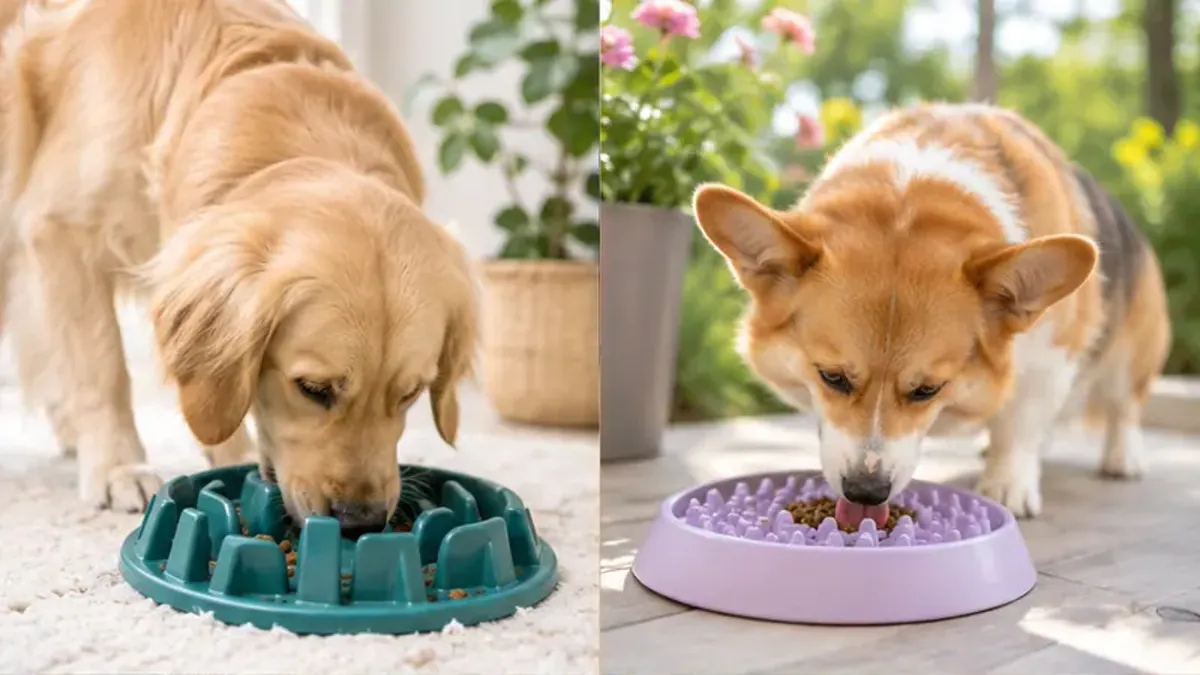
A dog feeding bowl slow design uses ridges, posts, curves, or shallow compartments to reduce how much food the dog can reach in one mouthful. Instead of lowering the muzzle into an open pile, the dog works around the pattern with the tongue and front teeth. This usually adds pauses and encourages smaller pickups. It is a feeding tool, not a chew item, and it should be removed after the meal if your dog is likely to gnaw it.
Patterns range from one simple center mound to a dense maze. More complicated is not automatically better. A mild center obstacle may be enough for a large dog with a broad muzzle, while a shallow spiral can suit a smaller dog. Very narrow channels can be uncomfortable for a flat faced dog, and tall pegs can rub the face or eyes. The right difficulty lets the dog keep eating calmly without biting the bowl, pawing wildly, walking away, or showing distress.
Slow bowls work with many dry and moist diets, provided the material and pattern are suitable. Kibble rolls easily through broad channels. Canned food can be pressed lightly into shallow sections, but deep crevices may make cleaning harder and can leave food behind. Rehydrated or fresh food needs a design without inaccessible seams. Always follow safe storage and handling directions for the specific diet.
A slow feeder is different from an automatic feeder, which controls when or how much food is released, and from a puzzle feeder, which may require moving parts or a more complex problem. If you want a closer comparison, see our guides to everyday dog bowls, slow feeder dog bowls, and puzzle feeders for dogs. For a dog who becomes frustrated by puzzles, a simple ridged bowl is often the gentler starting point.
How to Choose the Right Dog Feeding Bowl Slow Option
Fit comes first. Measure the widest part of your dog’s muzzle and look at the actual usable channel width, not only the outside diameter. The nose should reach food without being wedged between ridges. A short nosed dog generally needs broad, shallow spaces. A dog with long ears may benefit from a narrower outer shape that keeps ears away from food, as long as the eating area still fits the muzzle comfortably.
Next, consider capacity. The bowl must hold the dog’s full measured meal without food spilling over the ridges. Product capacity may describe liquid volume to the rim, which does not always equal practical food capacity. Check dimensions and return terms before buying. If the bowl is filled above the obstacles, it will function like an ordinary dish until the top layer is gone.
Stability matters because sliding can turn a calm meal into a chase. A wide base, meaningful weight, or intact nonslip ring can help. Place the feeder on a washable nonslip mat on the floor unless your veterinarian recommends another setup for a specific condition. An elevated stand is not a universal solution and should not be treated as one.
Choose a surface that is smooth, food contact appropriate, and easy to inspect. Stainless steel is durable and usually easy to clean, though designs may be less intricate. Ceramic can be heavy and stable but should be retired if chipped or cracked. Silicone can be quiet and flexible, but a dog who chews the bowl needs close supervision. Plastic is lightweight and available in many patterns; discard it if it develops deep scratches, cracks, sharp edges, or loose pieces.
| Feature | Good sign | Potential mismatch | Best next step |
|---|---|---|---|
| Channel fit | Muzzle enters comfortably | Nose or face rubs the ridges | Choose wider, shallower channels |
| Difficulty | Steady licking and small bites | Biting, frantic pawing, or quitting | Use a simpler pattern |
| Base | Stays flat and still | Tips, spins, or slides | Add a mat or select a wider base |
| Surface | Smooth and fully washable | Cracks, rough seams, or trapped residue | Replace the bowl |
| Capacity | Meal sits below ridge tops | Food covers the obstacles | Choose a larger usable capacity |
If your new family member is still settling in, mealtime equipment is only one part of the setup. Our new puppy essentials checklist can help you organize the rest without overlooking a regular water bowl, secure food storage, and veterinarian recommended nutrition.
How to Introduce and Use a Slow Feeder Step by Step
Begin when the home is quiet. Wash and rinse the new bowl, inspect it, and put it on a level nonslip surface. For the first meal, use a familiar food and an easy pattern. You can place some of the portion in the widest sections so the first bites are obvious. Avoid adding rich extras just to persuade the dog, especially if those extras are not part of the dog’s usual calorie plan.
- Measure the normal meal. A slow feeder changes delivery, not nutritional needs. Use the portion recommended for your individual dog and adjust only with veterinary guidance.
- Spread food through the channels. Do not heap kibble over the ridges. For moist food, apply a loose layer rather than packing every deep corner tightly.
- Give the dog space. Feed pets separately so nobody feels pressure to defend food or race a housemate.
- Watch the whole meal. Look for comfortable breathing, normal swallowing, relaxed posture, and steady progress. Stop if the dog bites the bowl, damages it, or appears distressed.
- Check the result. A useful bowl makes the meal noticeably calmer without making it exhausting. There is no universal target number of minutes.
- Remove and wash the bowl. Pick up leftovers according to food safety guidance and clean every channel before the next use.
Keep the first sessions low pressure. If your dog looks confused, scatter a few pieces in the broadest channels and point them out without pushing the face toward the dish. Praise calm investigation. If the dog walks away, offer the regular diet in an easier setup rather than allowing a prolonged standoff. A feeder should support reliable nutrition, not interfere with it.
A helpful benchmark: Look for a calmer pattern, smaller mouthfuls, and no frustration. Do not chase a specific meal duration found online. Dogs differ in muzzle shape, diet texture, portion size, age, and comfort.
Ways to Slow Dog Meals Without a Special Bowl
A dedicated slow feeder is convenient, but it is not the only responsible option. Dividing the daily amount into more meals can reduce the volume offered at once when that schedule fits the dog’s nutritional plan. Confirm the total daily portion first so an extra meal does not quietly become extra food. Puppies, dogs with medical conditions, and dogs taking medication may need a veterinarian directed schedule.
You can also divide one measured meal among two or three ordinary bowls placed several feet apart in a quiet room. The dog must walk between small portions, but the food remains easy to access. This can be useful for a dog whose face does not fit maze channels. Do not use this approach where another pet can enter and create competition.
Hand feeding part of the meal during short positive reinforcement practice can add pauses and strengthen calm manners. Use only food already counted in the daily allowance. Ask for easy, familiar behaviors and keep the session upbeat. This is not appropriate if the dog guards food from people or takes food roughly. A qualified reward based trainer or veterinary behavior professional can help with those concerns. Our guide to positive reinforcement dog training explains the basic approach.
For dogs who enjoy sniffing, some measured kibble can be delivered through an appropriate fabric foraging mat. Read and follow the product directions, supervise use, and remove it when the food is gone. A dog who shreds or swallows fabric needs another method. Learn how this format differs in our snuffle mat guide. Moist food may work on a shallow food grade licking surface, covered in our lick mat guide, but a lick mat should not be left with a chewer.
| Method | Works well when | Main caution |
|---|---|---|
| Simple slow bowl | Dog needs mild obstacles and easy cleanup | Must fit the muzzle and remain stable |
| Several plain bowls | Dog dislikes ridges but can move comfortably | Feed away from other pets |
| Training rewards | Dog takes food gently and enjoys practice | Count every piece in the daily portion |
| Sniffing mat | Dog enjoys foraging for dry food | Not suitable for fabric shredders |
| More scheduled meals | Smaller servings fit the dog’s plan | Keep the daily total unchanged |
Slow Feeder Safety, Cleaning, and Portion Control
Supervision is important at first and remains important for dogs who mouth, flip, or chew feeding equipment. Inspect the feeder before every meal. Retire it if you find a crack, chip, sharp spot, separating nonslip ring, or missing piece. A bowl that has become a chew target is no longer functioning safely as a feeding dish.
Wash food bowls after use with hot, soapy water, then rinse and dry them thoroughly. Follow the manufacturer’s dishwasher instructions if applicable, and make sure spray reaches the full maze. The FDA safe handling tips for pet food advise washing pet food bowls and scooping utensils with soap and hot water after each use. The same guidance also covers clean hands, pet food storage, and prompt handling of leftovers.
Pay special attention to the corners under ridges. Dried canned food can remain where it is hard to see. Use a dedicated soft brush that reaches the channels without scratching the surface. After washing, run a clean finger around seams to check for residue and damage. Do not rely on a quick water rinse, and do not keep topping up an unwashed bowl.
Keep the dog’s water separate and freely available unless a veterinarian has given different instructions. A slow food bowl is not a reason to restrict drinking. Use a clean, accessible water bowl rather than a maze that makes hydration difficult.
Finally, prevent portion creep. A bigger maze can look half empty even when it contains the full serving. Measure by weight when precision is needed, or use a consistent measuring method recommended by your veterinarian. Feeding directions on a package are a starting point, not a personalized prescription. The World Small Animal Veterinary Association nutrition resource explains why an individual animal’s needs and body condition matter when evaluating a diet. For context on diet quality and feeding decisions, see our premium pet food guide.
Keep the calories steady: A new feeder should change pace, not portion size. Count kibble used for training, food spread on a mat, toppers, and treats as part of the day’s intake.
Troubleshooting a Dog Feeding Bowl Slow Routine
The dog flips or pushes the bowl
Move it to a level floor and add a washable nonslip mat. If the bowl is still easy to overturn, choose a wider, heavier model. Do not improvise with loose objects, clips, or weights that could be swallowed. Some dogs push because the pattern is too difficult, so also try wider channels.
The dog bites the ridges
End the session and inspect for damage. Biting often means the bowl is frustrating, unstable, or too deep. Switch to a simpler design or divide the meal among plain bowls. Do not leave the feeder down as an entertainment item after dinner.
The dog gives up before eating enough
Offer the normal diet in an accessible bowl and reassess. Try a shallow pattern at the next scheduled meal, but contact your veterinarian if reduced appetite is new, persists, or comes with pain, lethargy, vomiting, diarrhea, weight change, or trouble chewing. Maintaining nutrition matters more than winning a battle with a maze.
The dog is still finishing very quickly
Make sure food is spread below the ridge tops and that the bowl is not oversized. A slightly more complex pattern may help if it still fits comfortably. You can also divide the measured meal between the feeder and a calm training session. Avoid stacking multiple difficult methods in a way that creates frustration.
One pet steals another pet’s food
Feed animals in separate rooms with closed doors and pick up bowls when each meal ends. A slow feeder can place its user at a disadvantage if a faster housemate has access. Resource guarding, staring, blocking, or rushing around food deserves help from a qualified professional rather than forced shared meals.
Keep brief notes for a week: food and amount offered, setup, whether the bowl moved, signs of frustration, leftovers, and any regurgitation or vomiting. This is more useful than chasing an arbitrary stopwatch goal. It also gives your veterinarian concrete context if the problem continues.
Frequently Asked Questions About Slow Feeder Dog Bowls
No. Many healthy fast eaters can use a well fitted slow feeder, but dogs with dental pain, swallowing problems, impaired vision, facial sensitivity, severe anxiety around food, or certain medical needs may require another setup. Ask your veterinarian if your dog has symptoms or a condition that affects eating.
There is no evidence based universal time that suits every dog. Look for smaller mouthfuls, pauses, relaxed posture, comfortable breathing, and steady completion of the meal. If the dog is frantic or gives up, the pattern is too difficult even if the session lasts longer.
Do not rely on a slow feeder to prevent GDV. It may help modify eating pace, but GDV has multiple risk factors and remains an emergency. Ask your veterinarian about your individual dog’s risk, and seek emergency care for unproductive retching, abdominal swelling, collapse, or severe restlessness.
Usually, if the manufacturer says the bowl is suitable for food and the pattern can be cleaned completely. Use shallow channels, spread the normal measured portion loosely, refrigerate or discard leftovers according to the food directions, and wash the bowl promptly with hot, soapy water.
A broad, shallow design with low obstacles is generally easier for a short muzzle than narrow, deep channels. Watch for rubbing around the nose and eyes, noisy or difficult breathing, and inability to reach food. Your veterinarian can help if facial anatomy or breathing disease complicates eating.
Wash it after each use with soap and hot water, rinse well, and dry it. Check all crevices for residue and follow the maker’s dishwasher instructions. Replace a scratched, cracked, chipped, or otherwise damaged bowl that can no longer be cleaned safely.
Try a simple center mound bowl, divide the measured meal among several plain bowls, use some kibble for calm reward based practice, or discuss smaller scheduled meals with your veterinarian. The best method slows access without causing fear, frustration, or missed nutrition.
Conclusion: Make a Dog Feeding Bowl Slow, Safe, and Comfortable
The best dog feeding bowl slow solution is the one your dog can use calmly and safely. Match the channel width to the muzzle, choose a stable and washable material, keep the usual measured portion, spread food below the ridges, and supervise. A simpler pattern that creates gentle pauses is better than a dramatic maze that makes the dog bite, paw, or abandon dinner.
Remember the limits of the tool. A slow feeder can change access to food, but it cannot diagnose a sudden appetite change, cure regurgitation, or guarantee protection from GDV. Keep water accessible, separate pets at meals, wash the bowl after each use, and involve your veterinarian when eating behavior changes or symptoms appear. With those basics in place, slowing meals can be a small, practical improvement to your dog’s everyday routine.