Puzzle feeders for dogs can turn part of a normal meal into a food-finding task. Start with your dog's usual food, an easy opening, and supervision, then check that the food actually gets eaten. The right arrangement suits your dog's abilities and your cleaning routine. A regular bowl remains a valid choice when a puzzle creates difficulty rather than enjoyment.
Reserve the meal before filling the feeder
Measure the food you would normally serve before choosing how much goes into a puzzle. Set aside a small portion for the first attempt and keep the rest available for ordinary feeding. Filling a device is a different way to deliver dinner, not a reason to add another dinner on top.
VCA's guidance on enrichment and foraging toys allows a regular meal or part of it to be used, provided the dog receives its full daily ration. If several people feed your dog, tell them what has already been allocated. Include food used in training or other feeding activities when discussing the overall plan with your veterinarian.
Keep familiar food as the starting point. A dog on a prescribed diet should not receive different fillings simply because a recipe looks appealing. Ask the veterinary team before changing ingredients or quantities. Notice leftovers, too: food stuck inside the feeder has not necessarily reached your dog.
A simple meal record can distinguish food served in the bowl, food placed in the puzzle, and food discarded afterward. This is useful when different family members handle different meals. Avoid guessing that an apparently empty device means the entire serving was eaten.
Check comfort and access before difficulty
Look at the action required to reach the food. Can your dog comfortably lower its head, lick the surface, or nudge the opening without stretching awkwardly? A puzzle that requires forceful pawing or repeated lifting may be a poor match even if the package calls it suitable for beginners.
VCA advises selecting equipment that cannot be swallowed and does not easily break into swallowable pieces. Check the whole item and its lids, plugs, sliders, and fabric strips. Removable pieces make a puzzle unsuitable for a dog that grabs and eats objects. No durability label removes the need to watch how this particular dog uses it.
Choose for present ability, not a breed's reputation for intelligence. An older dog or a dog with limited movement may find a stationary, accessible surface more comfortable than a rolling dispenser. If a previously comfortable dog suddenly avoids manipulating a feeder, pause and ask your veterinarian about possible pain rather than assuming stubbornness.
Pair the food texture with a washable design
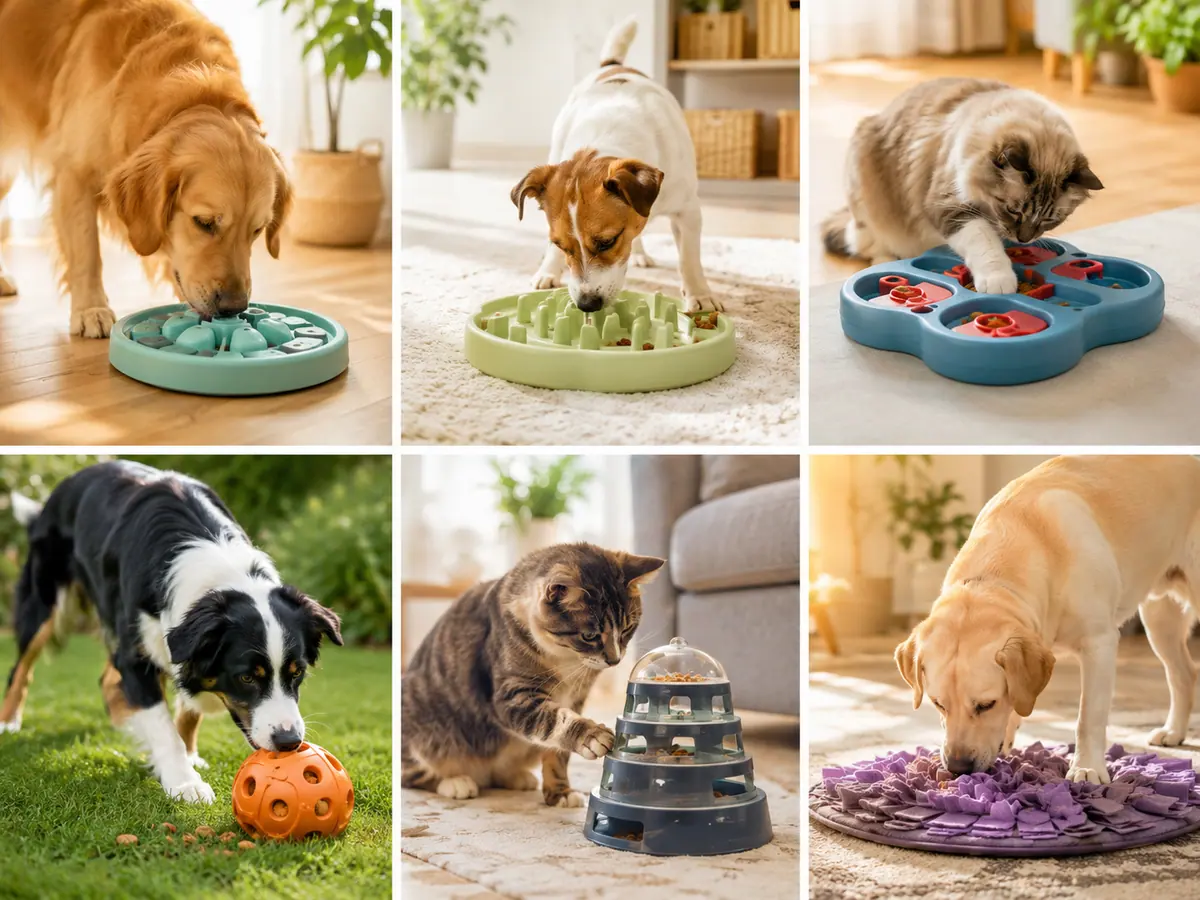
Food compatibility is a practical constraint, not a competition between feeder styles. VCA's interactive-feeder overview describes rolling kibble dispensers, compartment puzzles, fabric searching surfaces, and designs that accept canned food. That does not mean every individual product accepts every food.
- Dry kibble: Check that pieces can pass through the intended outlet without wedging. For a fabric search surface, see the separate snuffle mat guide.
- Wet food: Use a design whose instructions permit moist fillings and whose food-contact surfaces you can reach for washing. Shallow grooves may be easier to inspect than enclosed chambers.
- Mixed textures: Adding sticky food can make extraction harder and cleaning more involved. Do not use it simply to stop kibble falling out.
For surface feeding, the lick mat guide covers that format separately. Start with an unfrozen, accessible serving. Freezing is an optional later adjustment for compatible equipment, not an entry requirement or a substitute for checking whether your dog can get the food.
Make the first serving deliberately simple
Choose a quiet feeding area with room for the dog to move away. Prepare the feeder according to its instructions, leaving adjustable difficulty at its easiest setting. Put a little familiar food where it can be reached without solving a sequence. The first lesson is that gentle investigation makes food available.
Demonstrate the release action once while the dog watches, then let the dog approach voluntarily. VCA recommends making initial puzzles easy enough to maintain interest and avoid frustration. Opening a permitted cover or exposing food can be more useful than repeatedly pointing at an inaccessible compartment.
Stay nearby and observe the result. Successful feeding means food is obtained comfortably, not that the dog remains occupied for a particular number of minutes. Offer the reserved meal normally if interest fades. Do not skip meals to make the puzzle more attractive. At a later meal, repeat the easy arrangement before changing just one feature, such as partly covering an already familiar compartment.
Solve spills and frustration before adding challenge
A rolling dispenser may scatter food beyond the feeding area, while a lightweight tray may slide away whenever it is touched. Use a clean, nonslip location away from stairs and household traffic. If the design still sends food under furniture, choose a stationary format instead of expecting your dog to retrieve inaccessible pieces.
Check what remains after each attempt. A nearly empty feeder can conceal a floor covered in uneaten kibble. Do not automatically refill it when you cannot tell how much was consumed. Start with a smaller serving next time so collection and meal accounting remain manageable.
Repeated forceful biting, frantic pawing, barking at the device, or abandoning food are reasons to pause and reassess, not proof of a specific diagnosis. Lower the difficulty or return to the bowl. If the problem is simply wanting a more contained feeding surface, consider the slow feeder bowl format, while checking access and cleaning just as carefully. Harder puzzles are not inherently better meals.
Keep supervision separate from independence
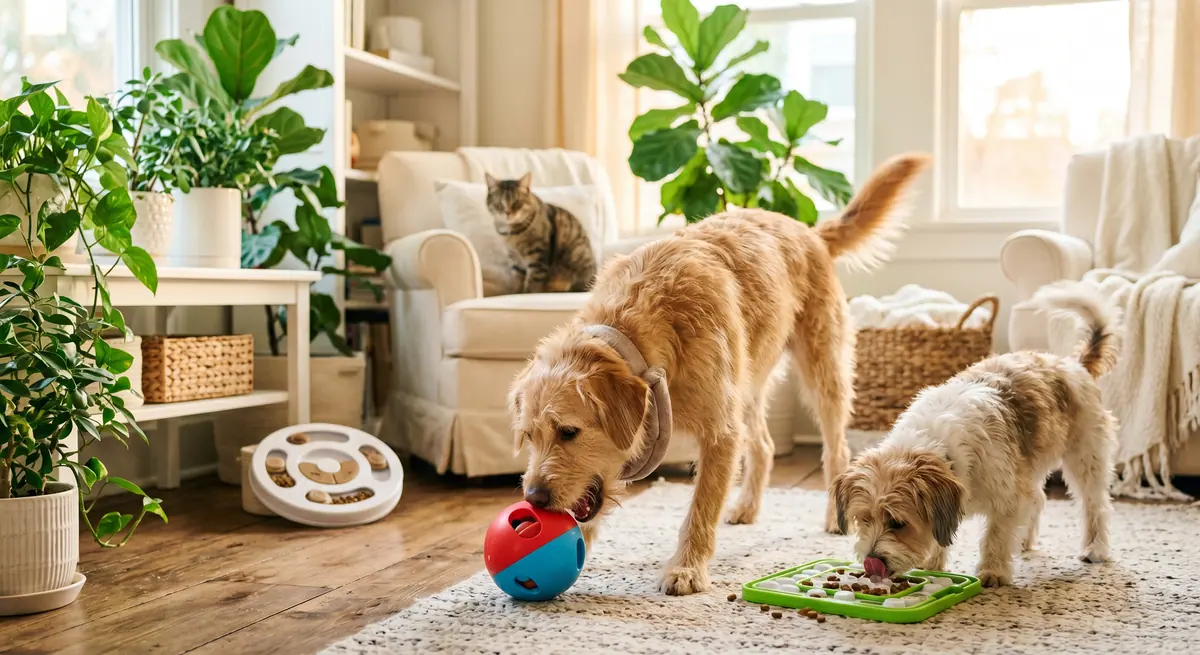
Being able to solve a puzzle does not establish that a dog can safely be left with it. Supervise introductions and continue watching any setup with detachable parts or a history of destructive chewing. Remove damaged equipment from use. If pieces are missing and swallowing is possible, contact your veterinarian rather than assuming they will pass safely.
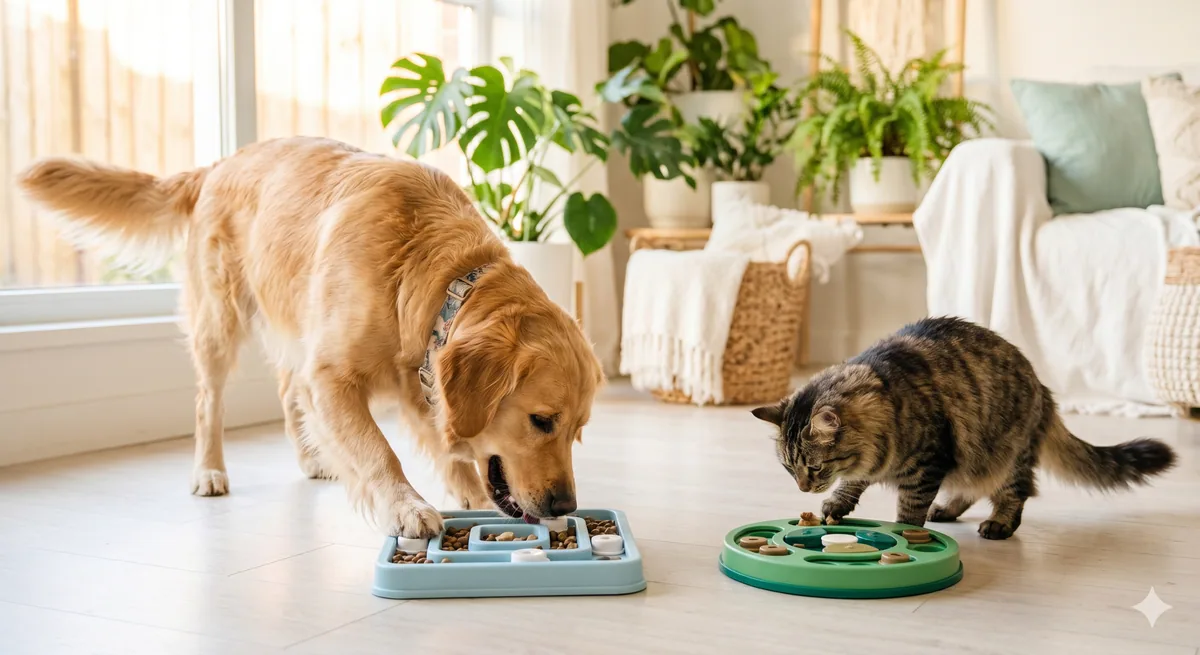
Arrange separate feeding spaces for household pets. VCA notes that food-filled toys can be guarded and advises professional help when aggression occurs around them. Keep children away from occupied feeding stations. Do not reach into a guarding dog's space to demonstrate a mechanism or take the item by force.
AAHA's indoor enrichment advice emphasizes matching equipment to size and chewing style, supervising new items, and discarding damaged toys that present choking or swallowing hazards. A feeder is a supervised meal activity here, not a promise of safe entertainment during an absence.
Clean every food-contact part and dry it
Empty the feeder after use and take apart the components the instructions allow you to remove. Wash chambers, lid undersides, grooves, and outlets, not just the visible top. Rinse thoroughly and dry every part before storage. VCA specifically recommends cleaning and drying activity toys after each use.
The RSPCA's dog-environment guidance recommends brushing debris from hard toys, washing with warm soapy water, rinsing, and drying fully. Check the manufacturer's instructions before using a dishwasher, washing machine, or heat. If residue remains trapped where you cannot clean it, choose a simpler feeder.
Prepare only what you plan to offer while you are watching. Keep unused food stored as its packaging directs, rather than filling several devices and leaving them around the house. An occupied dog is not a reason to extend a perishable food's storage limits.
Follow the FDA's pet-food handling advice: wash hands and utensils, promptly refrigerate or discard unused canned food, and throw away spoiled food. Do not leave moist fillings available indefinitely. AAHA also cautions that broth ingredients such as onion and garlic are unsafe for dogs. Familiar, veterinary-approved food avoids unnecessary recipe experiments; raw fillings carry additional contamination concerns identified by the FDA.
Know when the bowl is the better answer
Use an ordinary bowl when your dog prefers it, struggles to obtain enough food, or cannot use the available puzzle comfortably. It is also the practical choice when you cannot supervise or thoroughly clean the equipment. Feeding dinner accessibly takes priority over completing a game.
A puzzle may offer foraging opportunities and alter eating pace, but it does not guarantee weight loss, prevent digestive disease, or treat anxiety. Food quantities, medical needs, and behavior concerns still require individual assessment. Do not use a new device to explain away reduced appetite, discomfort, or a sudden change in eating.
You can keep enrichment separate from meals through suitable sniffing, gentle training, or social interaction. Alternatively, serve a small accessible puzzle portion and the remainder in a bowl. Neither arrangement needs to become progressively harder. The useful endpoint is a dog that can comfortably eat its allocated food, with equipment you can safely supervise and keep clean.
Put this guide in context
Choose the next guide for the care question you actually have: mental stimulation for dogs; mental stimulation dog toys; dog enrichment toys; interactive puzzle toys for cats. These pages cover different decisions, rather than interchangeable products or a prescribed schedule.
Frequently Asked Questions
Can puzzle feeders replace a dog's regular food bowl?
They can deliver some or all meals when a dog uses them safely and receives its full daily food allocation. Begin with a small portion and check actual intake. Keep an ordinary bowl available if food becomes inaccessible, the dog loses interest, or supervision and cleaning are impractical.
What food should I put in a puzzle feeder first?
Start with the food your dog already eats, using a portion reserved from its normal meal. Match the texture to the feeder's instructions. Do not introduce rich toppings just to increase interest. Ask your veterinary team before changing ingredients for a dog with dietary restrictions or a prescribed diet.
Can wet dog food go in a puzzle feeder?
Only use wet food in a design intended for moist fillings, with surfaces you can clean thoroughly. Offer an accessible, unfrozen serving initially. Remove leftovers promptly, follow food storage instructions, and wash the feeder after use. Do not assume a kibble dispenser or fabric mat is suitable for canned food.
What if my dog tips the feeder over or chews it?
Pause and check stability, food access, and difficulty. A stationary option may suit a dog that scatters food with rolling equipment. Stop using a device that the dog damages or pulls apart. If pieces are missing and swallowing is possible, contact your veterinarian instead of offering the same item again.
How often should I wash a dog puzzle feeder?
Clean and dry it after each use. Remove permitted components so food is not left beneath covers or inside outlets. Follow the equipment's washing instructions, rinse thoroughly, and let all parts dry before storage. Replace a design you cannot clean effectively rather than repeatedly adding fresh food over residue.
Will a puzzle feeder help my dog lose weight?
A feeder does not guarantee weight loss. Using the existing meal allocation rather than extra treats helps avoid adding unplanned food, but body weight management needs an individual veterinary feeding plan. Do not assume longer feeding time means fewer calories were eaten or that a harder puzzle provides adequate exercise.