A tired dog is a good dog, and the most efficient route to a tired dog is not always a longer walk. Mental stimulation dog toys engage the cognitive systems that physical exercise leaves untouched: problem-solving, olfactory processing, pattern recognition, and inhibitory control. Research in canine behavioral science consistently shows that 15 minutes of intensive mental engagement produces fatigue comparable to 30-40 minutes of moderate physical activity. For dogs who are physically limited by age or injury, cognitively under-challenged, or simply wired with more intelligence than their daily routine can absorb, mental stimulation toys are transformative.
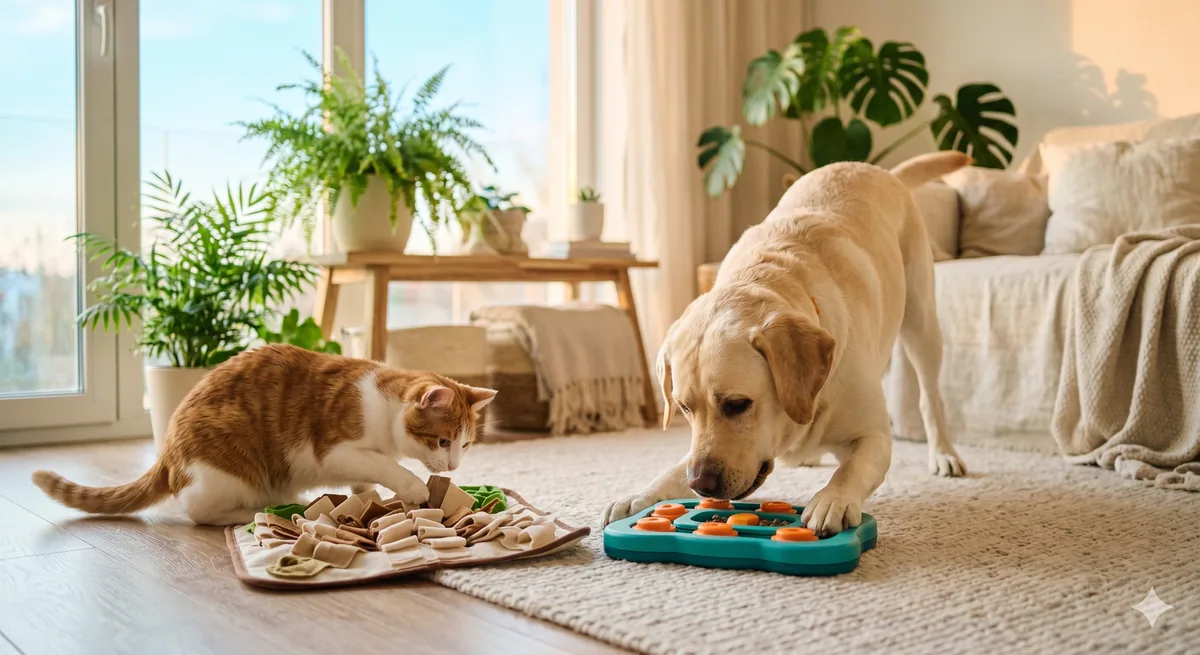
The category has expanded dramatically in recent years, from simple treat balls to multi-step puzzle boards, professional-grade nose-work kits, and app-integrated interactive systems. Knowing which format suits your dog, and at what difficulty level, determines whether you get 30 minutes of focused engagement or 90 seconds of casual disinterest. This guide covers the 10 best mental stimulation dog toys available in 2026, with guidance on matching each to your dog's needs. For background context, see the reference at PetMD.
This article is for general informational purposes only and is not a substitute for professional veterinary advice, diagnosis, or treatment. Always consult your veterinarian about any health concerns, dietary changes, medication, or product safety questions specific to your pet. If your pet shows signs of distress, illness, or injury, contact a licensed veterinarian or emergency animal hospital immediately.
Why Mental Stimulation Is Essential for Dogs
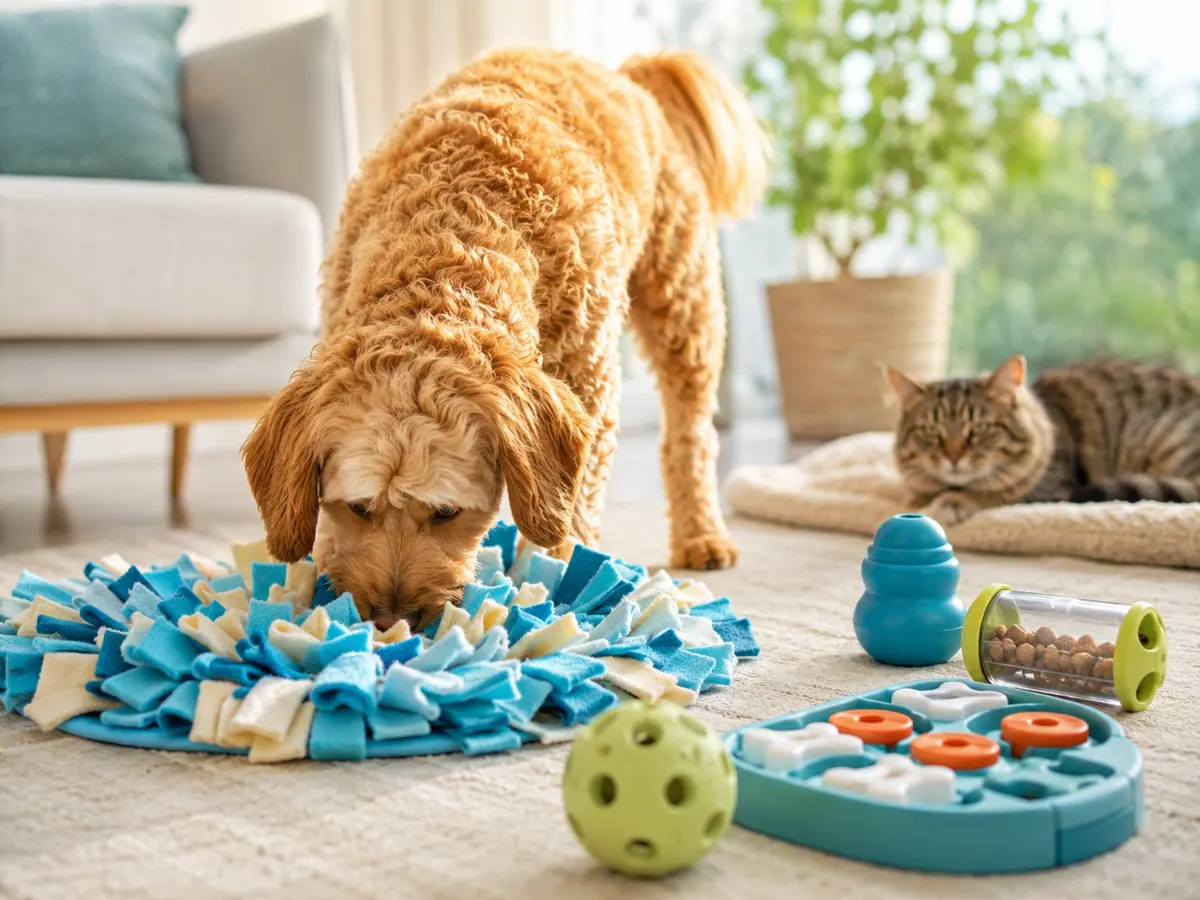
Dogs are descended from highly intelligent social predators who solved complex environmental problems to survive. Domestication has changed their physical environment dramatically but has not altered the cognitive architecture underlying those behavioral drives. A dog's brain remains calibrated for problem-solving, information gathering, and task completion, even when the daily demands of suburban life offer none of these.
In our experience reviewing dozens of mental stimulation dog toys for the Livehappypet team, we've found that the best options share three traits: durable materials, appropriate sizing, and clear safety markings.
If you want even more options, check out our guide to best rope toys for dogs.
Chronic under-stimulation produces measurable behavioral and physiological changes in dogs: increased reactivity, hyperarousal, stereotypic behaviors (repetitive pacing, spinning, tail-chasing), and immune system effects linked to chronic stress. Mental enrichment is not an optional extra for 'difficult' dogs, it is a welfare requirement for all dogs, adjusted to the individual's capacity.
The most effective mental stimulation toys share common features: they require the dog to invest effort, they deliver variable rewards (not always the same outcome each attempt), and they engage the dog's highest-developed sensory system, the nose. Dogs can distinguish millions of individual scent compounds; any toy that activates olfactory processing will engage the dog more deeply and for longer than a purely visual or tactile toy.
10 Best Mental Stimulation Dog Toys
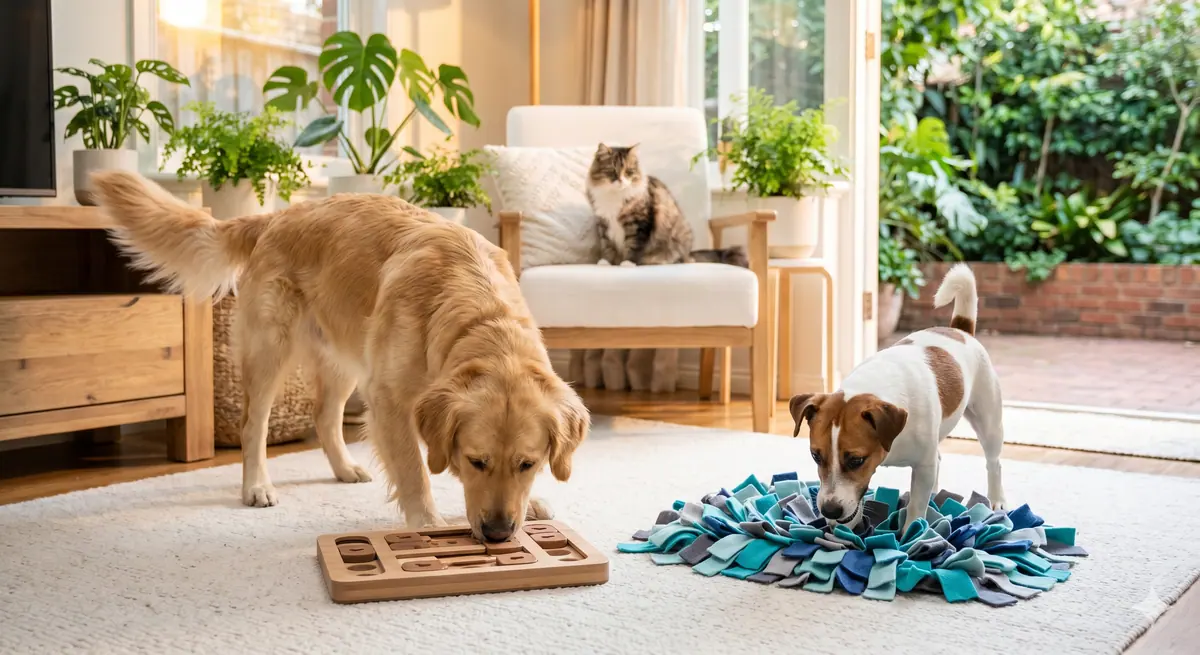
1. Nina Ottosson Dog Tornado: A multi-level puzzle board where the dog must spin rotating discs to reveal food compartments and lift lids to access treats. The interaction of rotation and lifting creates genuine multi-step problem-solving. Available in difficulty levels 1-4; most dogs should begin at Level 1-2. The Dog Tornado is one of the most consistently effective cognitive engagement toys across all breed sizes.
2. Snuffle Mat: Deceptively simple but extraordinarily effective. The irregular fabric surface hides kibble in a way that demands intensive olfactory searching. Dogs must use their nose, not their paws or eyes, to locate every piece of food. A full meal scattered through a good snuffle mat can take 15-25 minutes to fully extract, and the olfactory effort produces genuine cognitive fatigue. One of the best mental stimulation purchases for any dog.
Honestly, when we first started covering mental stimulation dog toys, we underestimated how much sizing and material would matter to long-term safety. We've since adjusted how we recommend products.
3. KONG Classic (Stuffed and Frozen): The KONG's value as a mental stimulation toy comes from the effort required to extract frozen contents. A KONG stuffed with a mixture of wet food, kibble, peanut butter, and plain yogurt and frozen overnight requires sustained licking, nibbling, and paw-working to empty, a 30-45 minute cognitive and sensory session. Prepare 5 at a time and rotate from the freezer.
You might also enjoy our recommendations for dog toys for heavy chewers.
4. iFetch Interactive Ball Launcher: Teaches dogs to initiate and play fetch independently. Once the dog learns to drop balls into the launcher (typically 1-3 training sessions), the toy enables self-directed play that combines physical movement with the cognitive anticipation of where the ball will land. Adjustable launch distances from 10 to 40 feet. Best for high-energy breeds that need more physical output than foraging toys provide.
5. Outward Hound Hide-A-Squirrel: A plush log containing 3-6 squeaky squirrel toys that the dog must extract. Dogs quickly learn that the log contains something desirable but must work to remove each squirrel, satisfying their predatory instinct in a controlled format. The squeaky reward reinforces the extraction behavior. Not suitable for heavy chewers who will disembowel the squirrels immediately, but excellent for moderate chewers who enjoy searching and extracting.
6. Trixie Activity Board: A multi-action puzzle board with sliders, turning knobs, and flip panels that each conceal food rewards independently. The variety of actions on a single board prevents the dog from learning a single solution and repeating it mechanically. One of the better options for dogs who have mastered single-action puzzle boards and need the next challenge level.
7. Nosework Starter Kit (Birch Scent): Formal nose-work training begins with teaching the dog to find a specific target scent (birch oil) hidden in a small container in progressively more complex environments. Starter kits include the scent, sample tin holders, and a training guide. This is the highest-difficulty mental engagement available to most dog owners, competition-level nose-work dogs can search entire buildings for a hidden target. Even introductory nose-work produces significant cognitive fatigue.
8. West Paw Toppl (Interlocked Pair): Two Toppl toys interlocked significantly increase food capacity and extraction difficulty compared to a single Toppl. The wide opening makes loading straightforward; the narrow inner chamber requires effort to access. Freezing the loaded pair extends engagement. West Paw's guarantee against destruction, replacing any toy the dog successfully breaks, makes this a low-risk investment.
For related picks, take a look at our best plush dog toys roundup.
9. PetSafe Ricochet Interactive Dog Toy: An electronic two-unit toy where one unit beeps and lights up, and the dog must touch it to activate a reward dispense in the other unit, which then moves. The randomness of which unit will become active next prevents the dog from learning a fixed sequence. This requires genuine active searching and engagement rather than learned mechanical repetition.
10. Bully Stick or Yak Chew: Extended chewing is mentally engaging in its own right, the repetitive motor action, scent processing, and jaw effort all require cognitive investment. A high-quality long-lasting chew like a yak chew or properly sized bully stick provides 20-60 minutes of focused engagement and is particularly effective as an afternoon enrichment session when post-exercise alertness transitions to pre-rest restlessness.
How to Match Mental Stimulation Toys to Your Dog's Level
Difficulty calibration determines whether a toy produces engagement or frustration. A dog that solves a puzzle in 90 seconds will abandon it; a dog that cannot understand a puzzle after 5 minutes will disengage in frustration. The target window is 10-30 minutes of sustained, successful-enough-to-be-reinforcing effort. Watch your dog during the first session: if they solve it faster than 5 minutes, increase difficulty; if they give up after 2-3 attempts, decrease it.
Begin new toy introductions with guidance. Show your dog where a treat is hidden, let them see you place food in a compartment, or load the toy in front of them so they understand the relationship between the object and food. Dogs who have never encountered an enrichment toy may need 2-3 guided sessions before they engage independently. This is not a sign of low intelligence, it is an unfamiliarity with the format.
Rotate toys between difficulty levels. A dog should not face maximum-difficulty challenges every session, easy wins are reinforcing and build confidence. A good rotation might include: one high-difficulty puzzle feeder per week, two medium-difficulty sessions (snuffle mat, Bob-a-Lot), and daily low-difficulty enrichment (scatter feeding, frozen KONG, chew). This distribution keeps mental engagement sustainable without producing the frustration and avoidance that comes from chronic over-challenge.
Comparison: Budget vs Mid-Range vs Premium
This quick comparison helps you understand what you actually get at each price band, so you can decide where to spend and where to save without compromising safety.
Comparison reflects typical US retail ranges as of 2026. Always verify safety labels before purchase.
Puzzle toys work best as one part of a balanced set. Our best dog toys 2026 shortlist shows how a puzzle fits alongside a rubber chew, a tug rope and a fetch ball, and on hot afternoons the indoor brain games in our summer dog toys guide stand in for a long walk.
Conclusion
Picking the right option for your dog is less about finding a single "best" product and more about matching the choice to your dog's size, age, play style, and your home environment. The recommendations above cover the main scenarios most pet owners run into, so use them as a checklist when comparing options.
Start with one or two changes, watch how your dog responds for a week or two, then iterate. Pets show you very quickly what works for them. If a toy, feeder, or routine is ignored or causes stress, swap it out without hesitation. The goal is a happier, healthier dog every day.
For more independent, vet-reviewed guidance on this topic, the American Kennel Club expert advice center is an excellent place to start.
Frequently Asked Questions
What is the best mental stimulation toy for dogs?
Puzzle feeders and snuffle mats consistently produce the longest and most cognitively demanding engagement across a wide range of breeds. Puzzle feeder boards (Nina Ottosson Dog Tornado, Trixie Activity Board) require genuine multi-step problem-solving; snuffle mats engage the dog's primary sensory system, olfaction, in a way that produces deep cognitive fatigue from relatively short sessions. For dogs who have mastered commercial puzzle toys, introducing nose-work training (searching for a specific target scent) provides the highest available difficulty ceiling.
How often should I give my dog mental stimulation?
Daily mental enrichment is ideal for most dogs. Two sessions per day, 15-20 minutes each, provides baseline cognitive engagement for most adult dogs. High-energy working breeds may benefit from 3-4 daily sessions. The total duration matters less than consistency: irregular large doses of enrichment are less effective than shorter daily sessions. Even 10 minutes of snuffle mat foraging each morning makes a measurable difference in behavioral outcomes over weeks.
Can mental stimulation replace physical exercise?
Mental stimulation and physical exercise serve complementary but distinct functions. Physical exercise depletes energy and provides cardiovascular benefit; mental stimulation produces cognitive fatigue and satisfies problem-solving needs. Neither fully substitutes for the other. The ideal daily structure includes both, sequenced with exercise first (to reduce arousal so the dog can focus on cognitive tasks) followed by mental enrichment. However, when physical exercise is limited by weather, injury, or time, additional mental enrichment can significantly reduce the behavioral effects of insufficient physical activity.
Are smart dog toys worth it?
Quality mental stimulation toys provide measurable behavioral benefit for most dogs, reduced destructive behavior, improved rest quality, and lower baseline arousal. The investment is justified if enrichment is used consistently. A $25 snuffle mat that is used daily for a year delivers more behavioral value than a $200 toy used occasionally. Prioritize toys your dog will actually interact with (test format preferences with budget options first) and that are durable enough to last through regular use.
What breeds need the most mental stimulation?
Working and herding breeds have the highest cognitive demands: Border Collies, Belgian Malinois, German Shepherds, Siberian Huskies, Australian Shepherds, Jack Russell Terriers, and Standard Poodles are among the most cognitively active dogs and most likely to develop boredom-related behavioral issues without structured enrichment. Gun dog breeds (Labradors, Spaniels, Retrievers) have strong scent-work drives and respond excellently to nose-work enrichment. Even 'lower energy' breeds like Bulldogs and Basset Hounds benefit from daily gentle enrichment calibrated to their pace and capacity.
Should I consult a veterinarian about my pet's play and enrichment needs?
Yes, especially if your pet shows signs of anxiety, sudden behavior changes, or destructive habits that may indicate a medical issue. A licensed veterinarian or veterinary behaviorist can rule out pain, dental problems, or cognitive decline before you adjust toys or routines. The guidance in this article is educational, not a substitute for professional veterinary advice.
How long does it take to see results from new toys or enrichment?
Most pet owners notice small changes within a week (calmer evenings, less destructive chewing, more interest in mealtime puzzles) and clearer behavior shifts within 4 to 6 weeks of consistent rotation. Older pets and rescues may take 8 to 12 weeks to adjust. Keep a short weekly journal so you can track real progress instead of relying on memory.
Shop Premium Dog Toys
Free US shipping on every order. No minimum purchase required.
Browse Dog Toys →Recommended enrichment path
Pair this guide with interactive dog toys, durable chew toys, and the our dog shop when your dog needs safe mental work plus chew time.
Shop interactive dog toys →