Mental stimulation for dogs means giving them safe opportunities to sniff, search, learn and make choices, alongside suitable movement, companionship and uninterrupted rest. Start with activities your dog can succeed at, then adjust to their interest, health and confidence. A satisfying day does not require expensive toys, a fixed timetable or a dog pushed to exhaustion.
Better days start with choice
Enrichment improves a dog's everyday experience by providing outlets for natural behavior. A slower walk, an easy food search or choosing a quiet resting place can all count. Dogs Trust's enrichment guidance emphasizes individual preferences, safe choices and watching whether an activity is enjoyable or frustrating.
Think about what your dog already chooses: investigating hedges, carrying a soft toy, learning beside you or resting nearby. Offer safe versions of those experiences rather than assuming every dog wants the same puzzle. Walking away should be an available option, not a failure that earns another command.
This guide is an everyday enrichment framework, not a toy comparison or shopping list. Equipment can support a search or game, but choosing a product is a separate decision. First identify the need, the dog's abilities and the space available. A familiar activity done comfortably may be more useful today than a complicated new challenge.
Try offering a choice between an easy search and quiet company, with room to decline both. Notice whether preferences change after a busy outing or a noisy morning. Choice does not mean unlimited access to unsafe things; it means giving the dog meaningful control inside boundaries you can safely manage.
Let the nose set the pace
Sniffing is information gathering, not wasted walking time. The RSPCA's dog sniffari activity explains that smells help dogs explore their surroundings and recommends allowing them to investigate safe scents without rushing them along. Physical activity and sniffing both matter; neither needs an invented exercise-equivalence formula.
On a familiar route, pause at an accessible verge and allow a loose lead where safe. Follow your dog's interest within the limits of traffic, local rules and wildlife protection. A quieter route may offer more comfortable exploration than a crowded park. Novelty is optional if a new location feels overwhelming.
At home, let your dog watch you place a favorite toy nearby, then invite a simple search. Keep the first hiding place obvious. Avoid scented oils, chemicals or unfamiliar plants as enrichment props. The useful feature is an opportunity to investigate, not the strongest possible smell or the longest possible search.
Turn everyday meals into easy searches
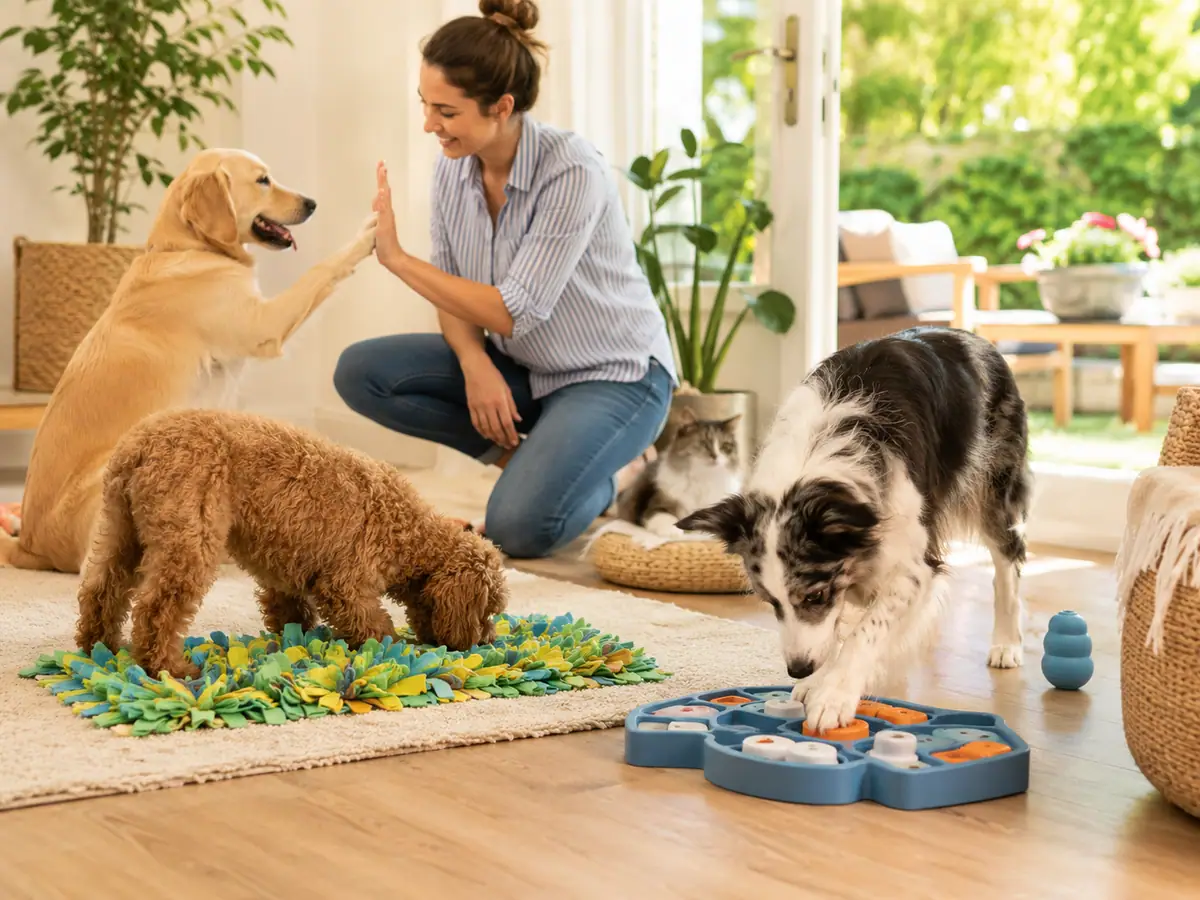
Foraging gives food a searching component. Begin by placing a little of your dog's normal food in plain sight on a clean, safe surface. Once that is comfortable, spread pieces slightly farther apart or use an open, shallow container. Change one feature at a time so success remains accessible.
Dogs Trust recommends supervising food enrichment and counting that food within the daily allowance. Reserve a portion of a normal meal rather than adding an unplanned second meal. Follow veterinary dietary advice when allergies, weight management or a medical diet limit ingredients. Keep water freely available.
Homemade does not automatically mean safe. Skip fabric, cardboard or loose parts if your dog swallows them, and separate dogs for food searches if sharing could cause tension. Do not scatter food near pesticides, litter or unsafe plants. Offer an ordinary meal if your dog does not want to search: access to necessary food should not depend on solving a puzzle.
Clean the search area and equipment after use, especially when using moist food. Keep the setup simple enough to inspect and remove promptly. If your dog guards food or equipment, do not reach in to test the reaction; arrange professional help and use a safer feeding setup.
Make learning rewarding, not demanding
Training can enrich the day when it is understandable and rewarding. The AVSAB explanation of humane training supports reward-based methods and advises against aversive techniques. Use food from the allowance, a wanted game or another reward the individual dog values. Our positive reinforcement training guide explores the broader approach.
For a simple hand target, offer an open hand near your dog's nose without pushing it forward. Mark a voluntary investigation with a consistent word, then reward. Repeat only while your dog remains comfortable and interested. Move the hand slightly only when the first step is easy.
Choose skills compatible with the dog's body. A nose target does not require jumping, balancing or repeated sitting. If progress stalls, simplify the task or finish. Repeating commands, withholding a needed meal or using leash corrections turns an optional learning opportunity into pressure. Finishing after an easy success is enough.
Protect connection and genuine downtime
Social enrichment means comfortable connection, not compulsory greetings. A familiar person's quiet company, a mutually enjoyed game or time with a compatible dog may suit different individuals. Let the dog create distance and stop interaction when they disengage. A dog avoiding unfamiliar dogs does not need a busier dog park to complete an enrichment checklist.
Rest belongs in the same plan. The RSPCA's advice on dog resting places recommends comfortable options, including somewhere quiet, and leaving sleeping dogs undisturbed. A nearby resting place can allow companionship without constant handling.
Make sure children and visitors understand that a resting dog is unavailable for play. Give household dogs their own suitable resting spaces rather than making them compete. After an outing, offer a quiet transition rather than immediately presenting another challenge. Being able to settle without interruption matters more than keeping a dog occupied whenever they are awake.
Build a flexible day around your dog
Use everyday transitions as reminders to offer opportunities, not as a prescribed schedule. The following examples are interchangeable. Adapt them to work patterns, weather, toilet needs and the dog's response; there is no requirement to complete every row.
| Daily anchor | Possible opportunity | When to simplify |
|---|---|---|
| After waking | A toilet outing with safe sniffing choices. | Choose a familiar quiet spot if the surroundings are busy. |
| At a meal | An easy search using part of the normal allowance. | Serve the meal normally if searching is difficult or unwanted. |
| When together | A familiar game or a manageable reward-based skill. | Offer quiet company if the dog is tired or distracted. |
| After activity | Water and access to an undisturbed resting place. | Remove household interruptions rather than adding another task. |
Observe what happened before, during and after an activity. Did the dog approach willingly? Was the challenge accessible? Could they disengage afterward? Keep a brief note of preferences, not a score for how much energy you removed. Repeat what works and leave room for an ordinary, uneventful afternoon.
For example, on a day with visitors, choose a familiar sniffing outing and quiet rest instead of introducing a new game. On a quieter day, offer a little learning or a food search if your dog is interested. These are alternatives to fit the situation, not extra tasks to stack together.
Match activities to comfort and confidence
For puppies, keep discoveries easy, supervise closely and protect sleep. For older dogs or dogs with limited mobility, use reachable food placements, secure footing and comfortable positions. Avoid making access depend on stairs, jumping or awkward bending. Ask your veterinarian which movements and outdoor activities fit an illness, injury or recovery plan.
Readiness also changes from day to day. Meet toilet, drinking and comfort needs first, then offer something familiar in a quiet setting. Dogs Trust recommends making enrichment easier if the dog seems confused or frustrated. Repeated unsuccessful attempts, forceful biting at equipment, tension or leaving the activity are reasons to pause and reassess, not increase difficulty.
These observations need context and do not diagnose an emotion or illness. Remove the obstacle, offer an easier option or stop altogether. A dog that declines food or play may need rest, a different reward or medical attention, depending on the wider picture.
Know when more enrichment is not the answer
Chewing, barking or restlessness cannot establish boredom on their own. Our guide to possible dog boredom signs is a starting point for observation, not diagnosis. VCA's medical and behavioral assessment guidance explains that pain, sensory changes and other health conditions can affect behavior. Contact your veterinarian about abrupt behavior changes, new handling sensitivity, altered appetite or unusual withdrawal.
Enrichment is also not a cure for separation anxiety. VCA describes separation-related distress that may include vocalization, salivation, escape attempts or refusing food when alone. A food activity does not make a panicking dog comfortable. Seek veterinary and qualified behavior support rather than adding harder puzzles or longer absences. Our separation anxiety training guide covers that separate topic.
The aim is a dog whose needs are met, with enjoyable options and adequate recovery. Do not chase exhaustion as proof that a day was successful.
Put this guide in context
Choose the next guide for the care question you actually have: mental stimulation dog toys; dog enrichment toys; puzzle feeders for dogs; interactive puzzle toys for cats. These pages cover different decisions, rather than interchangeable products or a prescribed schedule.
Frequently Asked Questions
Does my dog need a set number of enrichment minutes?
There is no single enrichment timetable that fits every dog. Offer manageable opportunities around normal routines, watch engagement and leave space for rest. Health, age, environment and preferences change what is suitable. Ask your veterinarian about physical activity limits rather than using a mental-to-physical exercise conversion.
Can a normal sniffing walk count without a puzzle toy?
Yes. Sniffing allows a dog to investigate the environment and is a valid enrichment opportunity. Give them safe chances to pause and explore instead of measuring success only by distance. Appropriate physical exercise still matters, but neither a purchased toy nor an increasingly demanding route is required.
What if my dog walks away from an activity?
Allow them to leave. The activity may be too hard, unappealing or badly timed, or your dog may simply prefer rest. Offer something easier later without pressure. If disengagement is sudden, persistent or accompanied by appetite changes, pain signs or unusual withdrawal, contact your veterinarian.
How can I offer enrichment when movement is restricted?
Ask your veterinarian what the restriction permits, then choose activities that avoid prohibited movement. Easy reachable food searches, gentle nose targets or quiet company may be appropriate. Provide stable footing and comfortable access, and stop if the dog seems uncomfortable. Recovery instructions take priority over completing an activity.
Do food searches have to replace every bowl meal?
No. Food searches are optional opportunities, not a requirement to earn every meal. Use some of the normal allowance, supervise and respect dietary restrictions. Make the food easy to reach while the dog learns. An ordinary bowl meal remains appropriate when searching is unwanted or unsuitable.
Will more enrichment fix distress when my dog is alone?
Not by itself. Enrichment can support everyday welfare, but separation-related panic needs an individual assessment and behavior plan. Some distressed dogs cannot eat or engage with toys when alone. Discuss the signs with your veterinarian and seek qualified behavior support instead of relying on tiring the dog out.