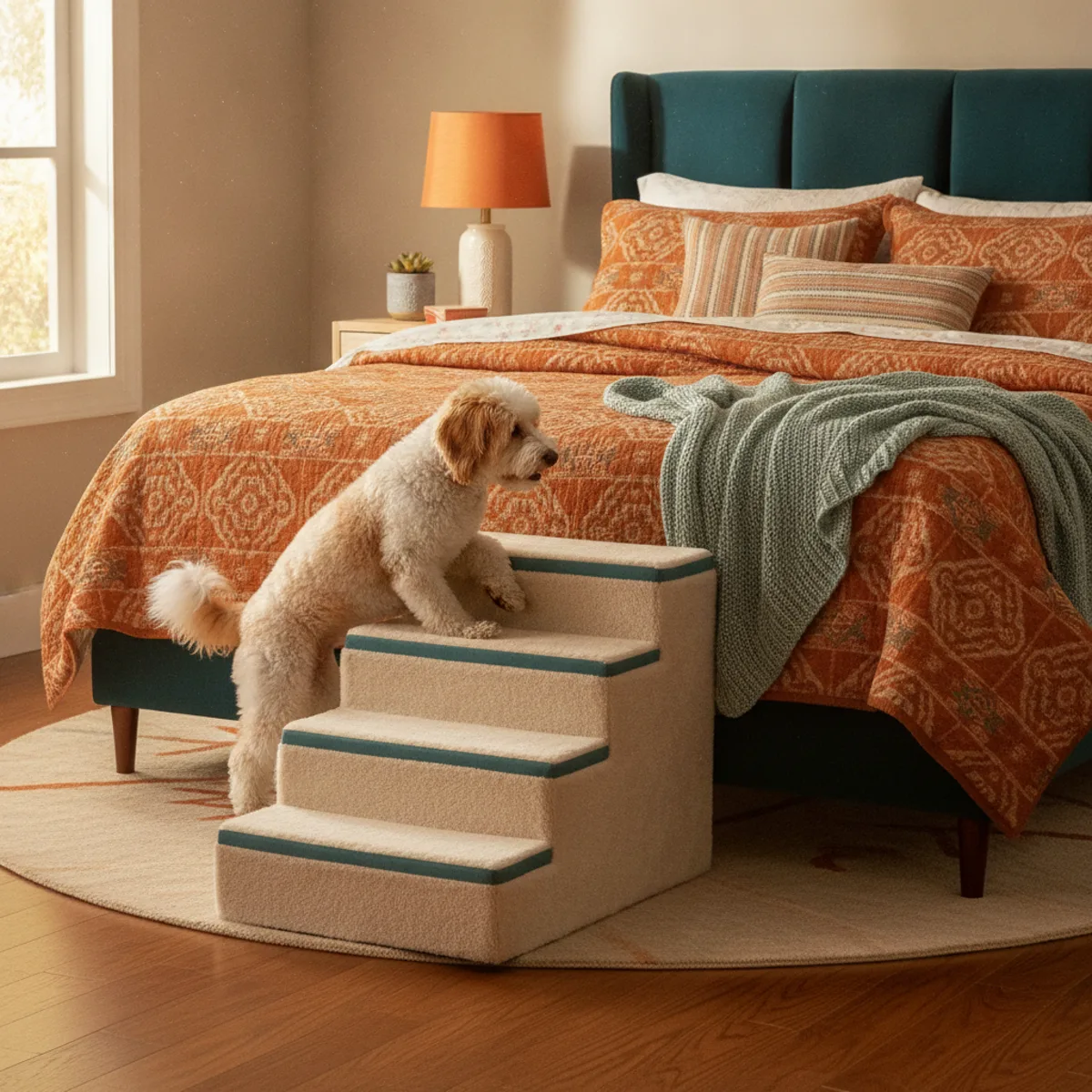
Dog stairs for bed help dogs reach a favorite sleep spot without relying on repeated jumping or constant lifting. The right stairs can support small breeds, senior dogs, cautious dogs, and pets that need a predictable path to the bed. The wrong stairs can wobble, slide, feel too steep, or encourage a risky leap from the side.
This guide explains how to choose bedside dog stairs safely, when a ramp may be better, what to measure before buying, and how to train your dog to use the setup calmly. It is written for pet parents who want comfort, but also want to protect joints, backs, and confidence.
This article is for general informational purposes only and is not a substitute for professional veterinary advice, diagnosis, or treatment. If your dog has pain, limping, weakness, back problems, surgery recovery needs, or sudden mobility changes, consult a veterinarian before using stairs or ramps.
Why Dogs Need Stairs for Bed
A set of dog stairs for bed can turn a nightly struggle into a calm routine. Many dogs want to sleep near their people, curl up beside a familiar blanket, or reach a favorite resting spot without being lifted every time. The problem is that a human bed can be a very high surface from a dog's point of view, especially for toy breeds, short legged breeds, puppies, senior dogs, and dogs with limited confidence. Repeated jumping may look harmless in the moment, but it can add stress to small joints, backs, hips, knees, and shoulders over time.
Dog stairs are not only for older dogs. They can help young small dogs build safer habits before jumping becomes their default. They can help a recovering dog avoid sudden impact during a vet approved return to normal movement. They can also help pet parents avoid awkward lifting, especially when a dog is tired, slippery after a bath, or too heavy to pick up comfortably.
The goal is not to make every dog climb furniture. The goal is to give your dog a safer path when bed access is already part of family life. A good stair setup should feel stable, easy to understand, and appropriate for your dog's body. If the stairs wobble, the steps are too tall, or the surface is slick, your dog may leap from the side instead of using them. That defeats the purpose. The best dog stairs for bed are the ones your dog will use slowly and confidently every day.
Before buying, look at your dog as an individual. A healthy seven pound toy poodle, a long backed dachshund, a cautious rescue dog, and a large senior Labrador do not need the same setup. Stairs can be excellent for some dogs, while a ramp may be safer for others. This guide walks through the choice in practical detail so you can match the product to your dog, your bed, and your room layout.
Dog Stairs vs Ramp: Which Is Safer?
Dog stairs and ramps solve a similar problem, but they do it in different ways. Stairs use individual steps. A ramp uses a continuous incline. Stairs can be easier to fit beside a bed because they take less floor space, while a ramp usually needs more length to keep the slope gentle. That space difference is one reason dog stairs remain popular in bedrooms, apartments, and guest rooms.
For many small, agile dogs, stairs work well. They allow a dog to step up in a familiar pattern and can be easier to train if the dog already understands household steps. Foam stairs can feel soft under the paws, while wooden or plastic stairs may feel more solid if they have carpeted treads. Stairs are often best for dogs that move well, have good balance, and are not dealing with significant back or joint pain.
Ramps are often gentler for dogs with arthritis, back problems, neurological concerns, post surgery restrictions, or larger bodies. A ramp reduces the need to lift each leg onto separate steps, which can be easier on sore hips or knees. The tradeoff is that the ramp must not be too steep. A short ramp to a tall bed can become intimidating or slippery. If your dog scrambles, slides, or rushes, the ramp is not helping enough.
The American Kennel Club notes that stairs and ramps can be useful for dogs with mobility issues, small dogs, large dogs, puppies, and dogs recovering from injury or surgery. Their guidance also emphasizes choosing the safest option for the individual dog and placing the aid where it is stable and easy to use. You can read more in the AKC guide to dog stairs and ramps.
If you are unsure, watch your dog's normal movement. Does your dog climb regular stairs easily and slowly? Stairs may be fine. Does your dog hesitate, bunny hop, drag the back legs, or avoid steps? A ramp or veterinary advice may be better. If your dog has known arthritis, IVDD risk, luxating patella, hip pain, back pain, recent surgery, or unexplained limping, ask your veterinarian before relying on any bed access product. For deeper context, VCA explains common signs and management options for arthritis in dogs, while the American College of Veterinary Surgeons outlines why intervertebral disc disease needs careful movement control.
Dog Step for Bed: When One Step Is Enough
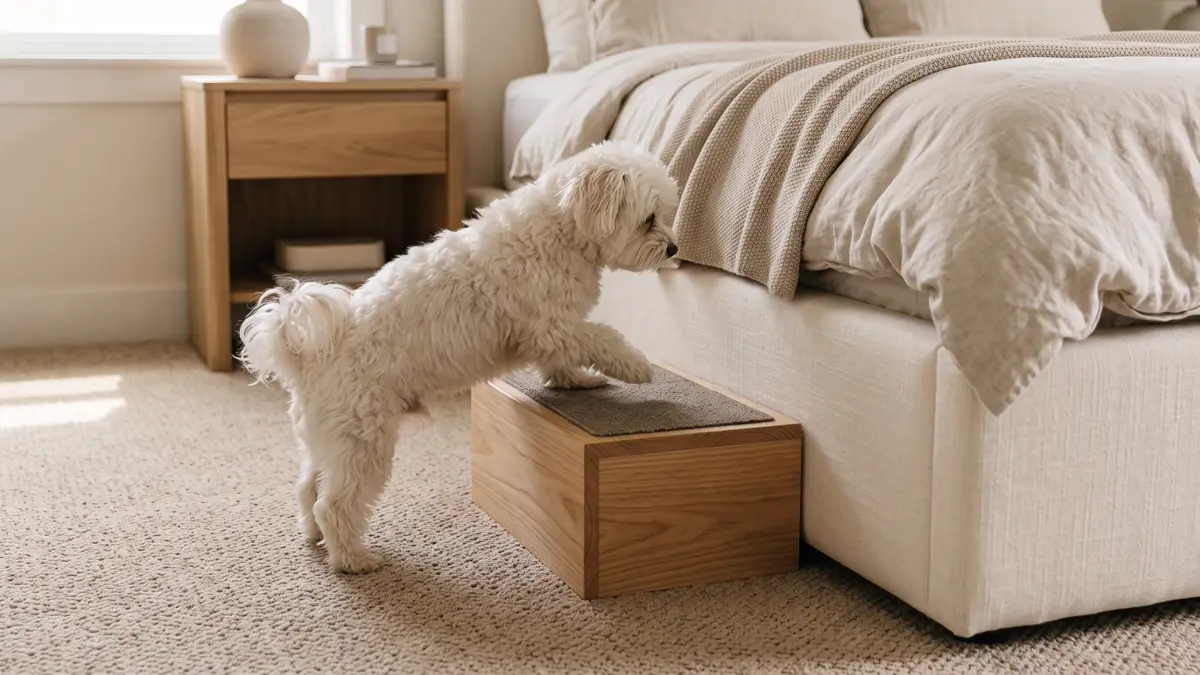
Search for a dog step for bed and two very different products come back in the same list. One is a single riser, sold as a pet step, a bedside step stool, or a foam block. The other is a small staircase with two, three, or four treads. Owners buy both to solve the same problem, but they behave differently the moment a dog stands in front of them, and choosing between them is arithmetic more than taste.
A single step does not remove the jump. It shortens it. Your dog still leaves the floor once on the way up and lands once on the way down, only from a lower starting point. A staircase replaces that jump with a sequence of smaller movements, which is why it needs more floor space and more patient training. PetMD draws the same line in its guide to dog stairs and dog ramps, noting that pet parents may use a single step when a dog is more comfortable with that option.
Do the subtraction before you buy
Measure the top of the mattress where your dog actually lands, then subtract the height of the step you are considering. What is left is the gap your dog still has to clear. A mattress top at 24 inches (61 cm) with an 8 inch (20 cm) step leaves a 16 inch (41 cm) gap. For a confident young terrier that may be an easy hop. For a nine year old dachshund it is close to the same jump that sent you shopping for a step in the first place.
Run the subtraction in both directions. Going up is a push, and most dogs manage it. Coming down is a landing, and the force arrives through the front legs and shoulders. If your dog uses the step to climb but still launches past it on the way down, the setup has changed your peace of mind and nothing else. Watch the descent for a week before deciding the problem is solved.
When one step is the right call
A single dog step works best when the remaining gap is genuinely small and your dog is healthy enough to absorb it. Low platform beds, futons, and daybeds often sit close enough to the floor that one riser closes most of the distance. A step also suits a dog that has already refused a staircase: some dogs will not commit to a multi tread climb but will happily use one wide, solid surface they can see the whole of.
One step is also easier to live with. It slides under a bed frame, moves between rooms, travels, and does not dominate a small bedroom the way a four tread staircase does. If your dog only needs a boost rather than a climb, the simpler object is usually the one that stays in place and gets used every night instead of being pushed into a corner.
Think about the landing as well as the launch. A step that delivers your dog onto a mattress edge covered in loose bedding is still an unstable arrival. If the destination is a raised dog bed rather than your mattress, apply the same measurement to that surface: our guides to the elevated dog bed and the orthopedic dog bed cover how height and firmness change what your dog has to do to get on and off.
When one step is not enough
A single step is the wrong product for the dogs that need help the most. The American Kennel Club points out that owners are often advised to use stairs or a ramp for dogs prone to intervertebral disc disease, naming dachshunds, Pembroke Welsh corgis, and basset hounds as breeds predisposed by their anatomy, and it flags the toy breed that has to take a running leap to reach the sofa as a dog already under avoidable joint stress. In both cases the aim is to remove the jarring movement, and a single step keeps most of it.
PetMD is more direct still: where a dog has arthritis or any pre existing joint or back condition, a ramp is recommended over stairs, because stairs still ask the dog to step up and load the legs while a ramp is a continuous incline. If your dog is a senior, is recovering from surgery, has a diagnosis such as luxating patella, or hesitates before every jump, treat a single step as a stopgap rather than the answer. Senior dogs usually need the whole routine softened rather than shortened, from bed access through to how they spend the rest of the day, and our notes on senior dog toys cover the low impact side of that.
Large breeds sit in their own category. A step tall enough to matter for a big dog is tall enough to be unstable, and the dog's own weight makes every landing heavier. For a dog that already needs a large dog bed to rest properly, a ramp or a wide, heavy staircase is the safer purchase.
Stability counts for more on a single step
On a staircase the dog's weight is distributed over several treads and the base is long. On a single step the whole launch and the whole landing happen on one small surface, so the same wobble that would be a nuisance on a staircase becomes the reason your dog refuses to use it. Press down hard on the front edge and on each corner. If it tips, slides on the carpet, or flexes underfoot, it will fail in the dark when your dog is half asleep.
Look for a wide footprint relative to the height, grip on the top surface and on the feet, no folding hinge in the middle, and a weight rating with room to spare rather than one your dog only just meets. Cheap foam blocks compress over months until the effective height drops and the gap quietly grows back. Check the height again a few months after purchase instead of assuming it is the number on the box.
| Option | What it actually changes | Best suited to | Main weakness |
|---|---|---|---|
| Single dog step | Shortens one jump up and one jump down | Low beds, agile dogs, tight rooms, dogs that refuse a staircase | The remaining gap is still a jump, and the landing is unchanged |
| Multi step dog stairs | Replaces the jump with several small step ups | Small and toy breeds that are still steady on their feet | Needs floor space and training, and dogs can still leap from the side |
| Dog ramp | Removes the step up entirely with a continuous incline | Arthritis, back conditions, post surgery recovery, large breeds | Longest footprint of the three, and needs a non slip surface |
The decision rule is short. If the gap left after the step is one your dog clears calmly and lands softly, a single step is a sensible and tidy choice. If the leftover gap still produces a hop, a twist, a hesitation, or a hard landing, buy the staircase or the ramp instead. Spending less on a step your dog has to jump off is not a saving.
How to Measure Your Bed and Your Dog
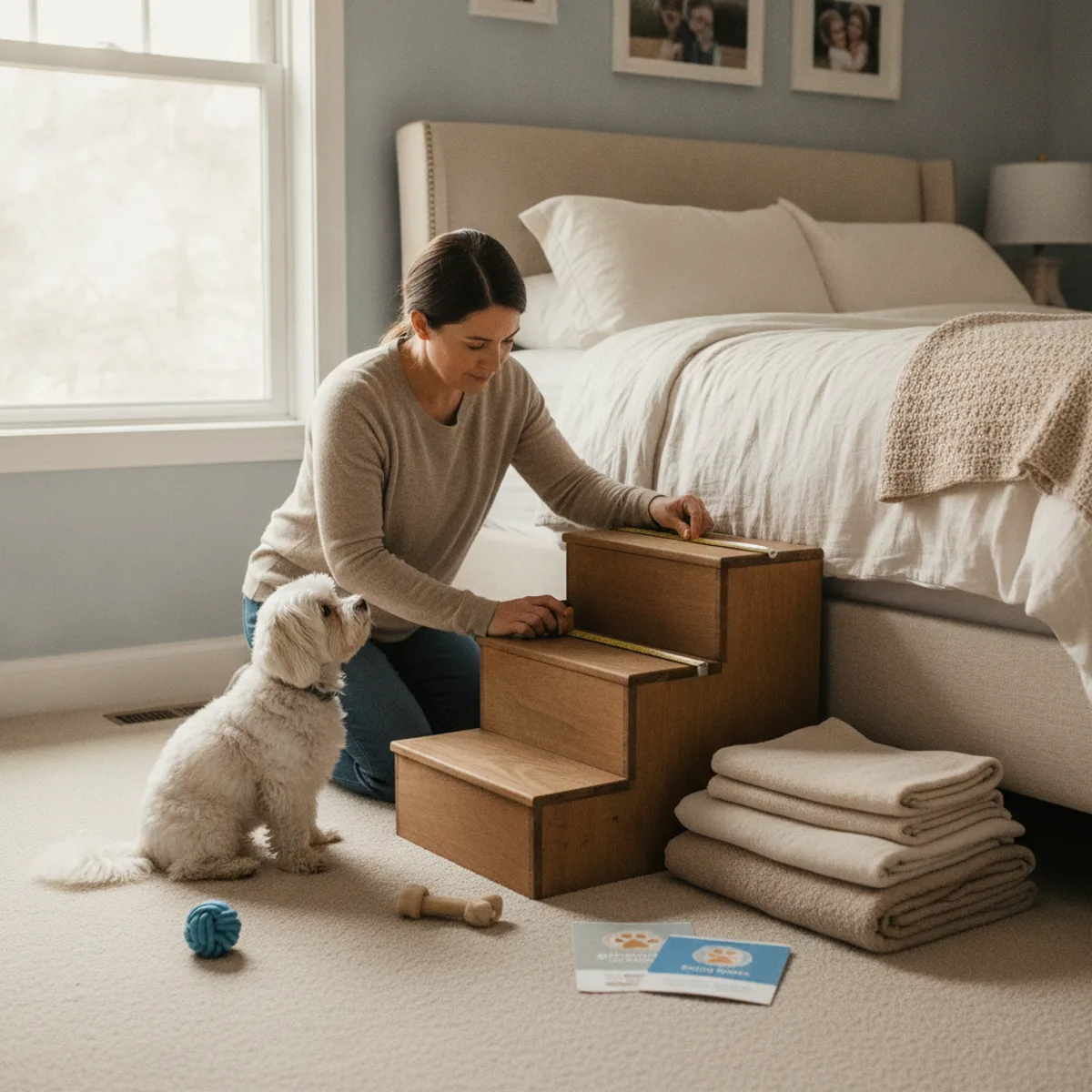
Good fit starts with measurement. Measure from the floor to the top surface where your dog actually lands. For many beds, that means the top of the mattress, not the lower frame. A thick mattress, topper, or tall platform can make the total height much higher than expected. Write this number down before shopping.
Next, compare that height to the total height of the stairs. The top step should sit close to the mattress level. If the final gap is too high, your dog still has to jump at the end. If the stairs are much taller than the mattress, your dog may step down awkwardly. A small height difference is normal, but the landing should feel natural and predictable.
Step rise matters too. Step rise is the height from one step to the next. Small dogs, senior dogs, and short legged breeds usually need a lower rise. Deep steps also matter because they give the whole paw room to land. A narrow step may force your dog to balance on the toes, turn sideways, or rush. Wider stairs can help nervous dogs and dogs with longer bodies, but they take more bedroom space.
Measure your available floor space. Place tape on the floor where the stairs would sit and walk around the room as you normally would. Can you still open drawers, reach the closet, and get out of bed safely at night? A stair set that blocks a walkway will be moved often, and moved stairs are less likely to become part of a consistent dog routine.
Also consider your dog's weight and body length. Check the product weight rating, but do not stop there. A product can technically hold your dog and still feel too narrow or unstable. Long backed dogs need enough step depth to keep the spine aligned. Broad chested dogs may need more width. Nervous dogs often need a wider, heavier base because they lose trust quickly if the stairs shift under them.
A useful rule is simple: choose stairs that let your dog move slowly. If the design encourages hopping, twisting, launching, or skipping steps, it is not the right fit.
Features That Make Dog Stairs Safer
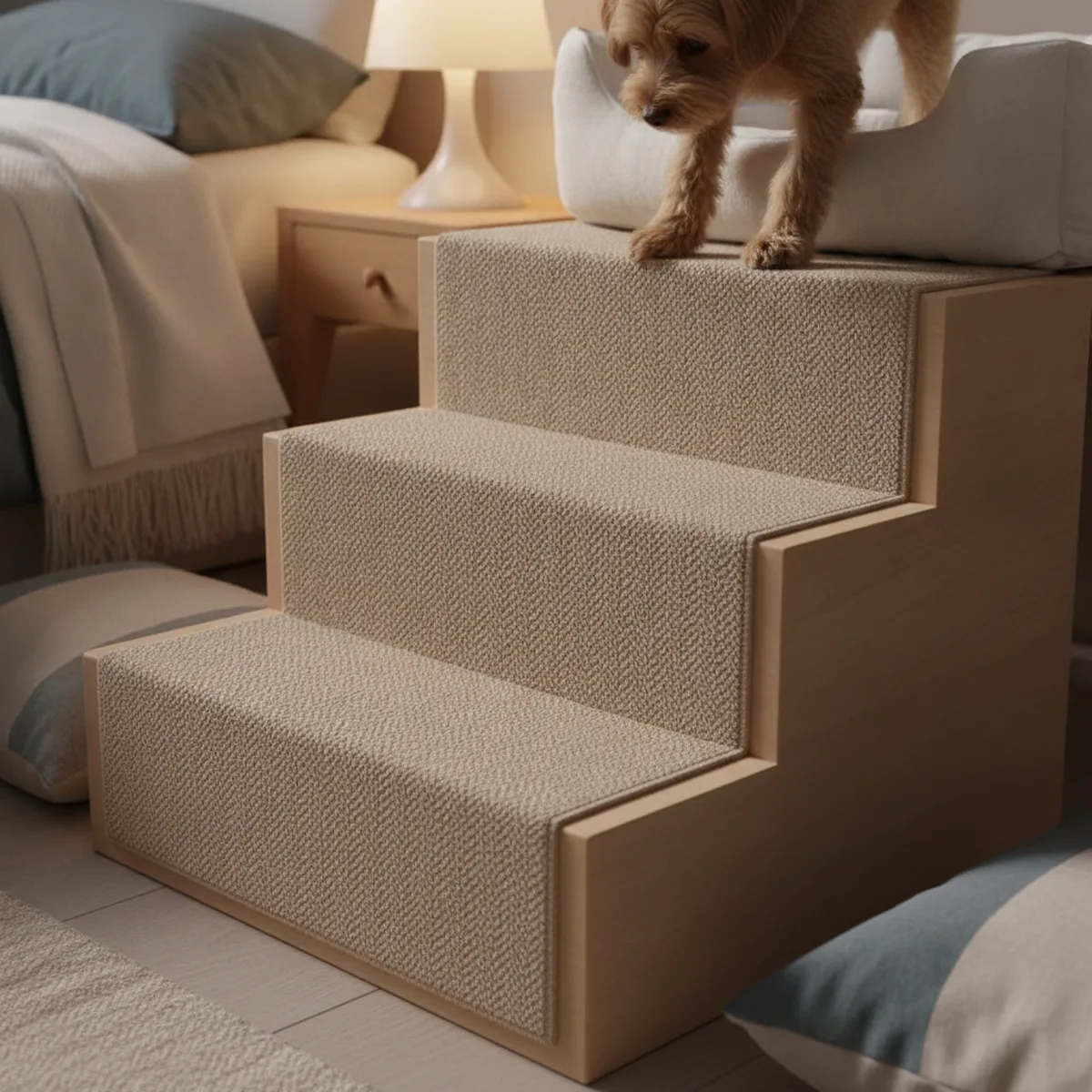
The safest dog stairs for bed usually share a few features. First, they have a non-slip walking surface. Carpeted treads, textured fabric, or rubber grip can help paws feel secure. Slick plastic is risky, especially for dogs with trimmed nails, senior dogs, or dogs that move quickly when excited. If the stairs are washable, make sure the cover still grips after cleaning.
Second, the base should feel stable. Press on the top, middle, and sides. The stairs should not wobble, tip, fold, or slide. Lightweight foam stairs are easy to move and can be comfortable for small dogs, but they may compress too much for heavier dogs. Wooden or plastic stairs can feel sturdier, but they need soft tread coverage and rubber feet to avoid sliding on hard floors.
Third, look at step height and depth together. A low rise with shallow steps may still be awkward. A deep step with a tall rise may still be hard for small dogs. For bedside use, moderate height, deep treads, and a secure top landing are usually more important than fancy storage compartments or decorative fabric.
Fourth, choose materials you can maintain. Bedroom stairs collect fur, dust, paw residue, and sometimes drool. Removable washable covers are convenient. Wipeable frames are helpful. Avoid designs with gaps where paws can get caught or seams that invite chewing. If your dog tends to dig beds, inspect fabric stairs regularly for loose threads and stuffing access.
Fifth, think about visibility. Dogs with reduced vision may need high contrast treads or a consistent placement near the bed. Some pet parents place the stairs against a wall or nightstand so one side has a guide barrier. That can help dogs avoid stepping off the side. Keep the area well lit during training and consider a soft night light if your dog uses the stairs after dark.
Finally, match the stairs to the rest zone. If your dog is using the stairs to reach a supportive bed surface, the destination should also be comfortable. You can pair stairs with a calming sleep area, an orthopedic bed, or a familiar blanket. For bedding ideas, see our guide to the best dog beds.
How to Train Your Dog to Use Bed Stairs
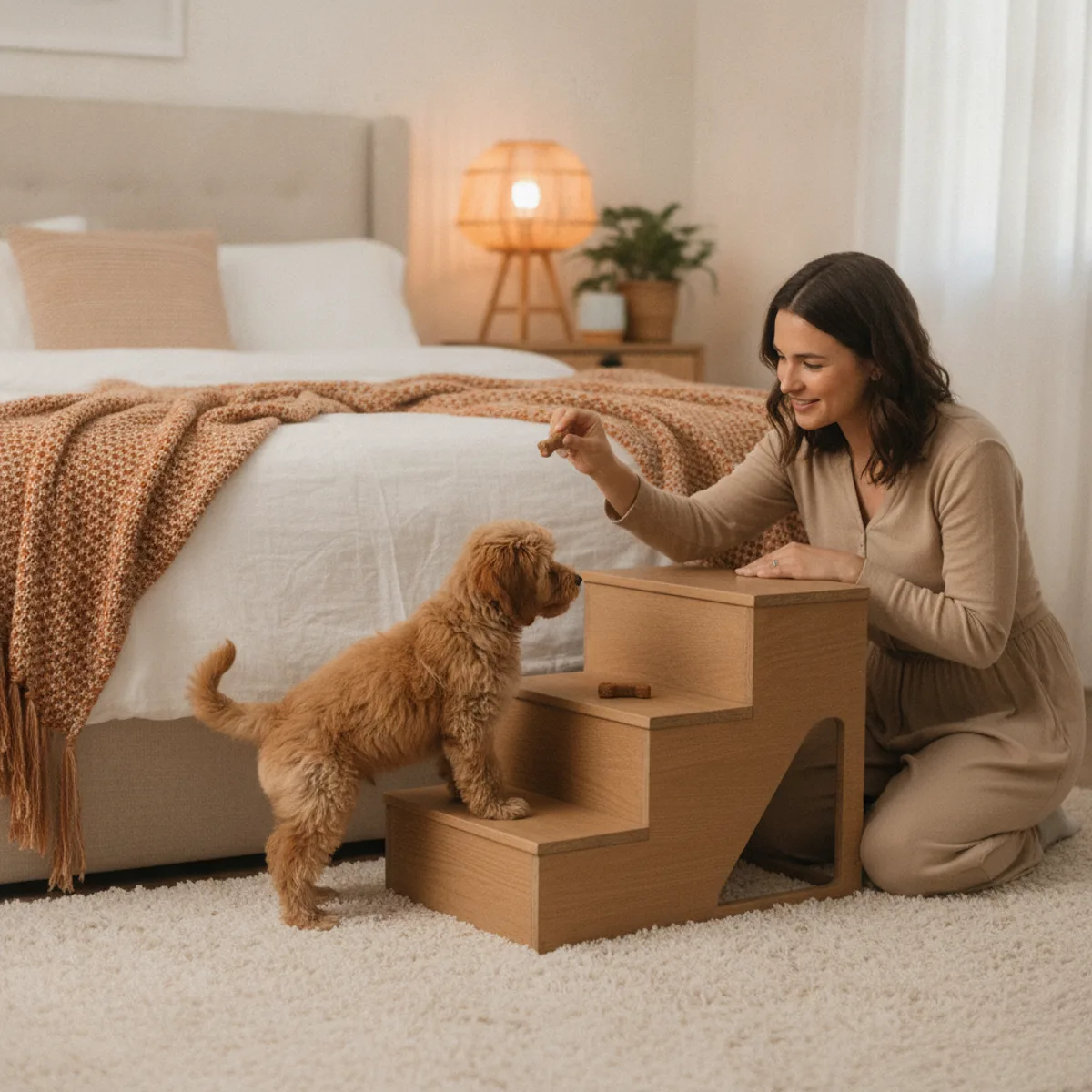
Training should be slow, cheerful, and pressure free. Put the stairs in their final location before training. Dogs learn by context, so practicing in the hallway and then moving the stairs to a dark bedroom can make the setup feel new again. Make sure the stairs are flush with the bed and cannot slide.
Start with exploration. Let your dog sniff the stairs. Reward any calm interest with praise or a small treat. Do not lift your dog onto the top step and expect confidence. For many dogs, being placed on a new surface feels unsafe. Instead, guide from the bottom. Put one treat on the first step, then another on the second step. Keep your hand low and your voice calm.
Practice going up before going down. Many dogs find climbing up easier than descending. Once your dog reaches the bed, reward and allow a short rest. Then guide down one step at a time. Stand beside the stairs so your dog does not leap from the side. If your dog jumps off, reset calmly and make the next attempt easier. You may need to block the side with your body, a pillow, or furniture during early sessions.
Keep sessions short. Three to five successful repetitions are better than twenty stressful tries. End before your dog gets frustrated. If your dog is food motivated, use tiny treats. If your dog loves toys, use a favorite soft toy as a lure. For dogs that get too excited, train after a walk or calm play session when their energy is lower.
Do not punish hesitation. Hesitation is information. It may mean the steps are too steep, the surface feels slippery, the room is too dark, or the dog has discomfort. If your dog repeatedly refuses, reassess the product. PetMD explains that different dogs may need different support options and that ramps are often easier on joints for many dogs with orthopedic concerns. Their overview of dog stairs and dog ramps is a useful veterinary reference.
Once your dog understands the stairs, make use consistent. Encourage stairs every time instead of sometimes allowing jumping. Mixed rules slow learning. If your dog sleeps in your room, keep the stairs in the same spot every night. Confidence comes from repetition.
Common Mistakes to Avoid
The most common mistake is buying stairs based on decor alone. Cute fabric and a matching color are nice, but stability, step depth, traction, and height matter more. A beautiful stair set that your dog avoids is not useful. Choose function first, then pick the best looking option within that safer category.
The second mistake is ignoring pain signals. Dogs do not always cry when movement hurts. They may pause before jumping, go upstairs sideways, land stiffly, lick a joint, sleep more, or avoid furniture they used to love. If you notice behavior changes, stairs might help access, but they do not diagnose or treat the underlying issue. Veterinary guidance is important for limping, sudden reluctance, weakness, or pain.
The third mistake is letting a dog leap from the side. Some dogs climb halfway up and launch. Others use the stairs to go up but jump down. This still creates impact. Place the stairs so the easiest path is straight up and straight down. A wall, bed frame, nightstand, or temporary side barrier can help during training. If your dog already shows stiffness or reluctance, the AVMA overview on getting ahead of osteoarthritis in pets is a useful reminder that pain management starts with early attention, not only new equipment.
The fourth mistake is choosing stairs for a dog that really needs a ramp. Long backed breeds, dogs with significant arthritis, and dogs recovering from surgery may need a gentler incline instead of steps. Stairs still require repeated joint flexion. When in doubt, ask your vet which movement pattern is safer.
The fifth mistake is skipping maintenance. Loose covers, flattened foam, cracked plastic, and sliding rubber feet can turn a safe setup into a hazard. Check the stairs weekly. Wash covers when they smell or collect hair. Tighten screws if the frame uses hardware. Replace stairs that sag, wobble, or no longer support your dog confidently.
The sixth mistake is forgetting enrichment and rest balance. Bed access is only one part of comfort. Dogs also need safe daytime rest, light activity, and mental stimulation. If your dog is resting more because of age or heat, pair easy access with calm enrichment like a dog puzzle toy, a gentle chew, or a cooling rest setup such as a dog cooling mat.
Simple Bedside Setup Checklist
Use this quick setup checklist before you leave the stairs available overnight. Place the stairs on a flat, dry surface. Push the top step close to the mattress so there is no confusing gap. Test the stairs with your hands by pressing down and side to side. If they slide, add a rug pad or choose a design with better rubber feet.
Clear the landing area on the bed. Your dog should not step onto blankets that immediately slip. If your comforter hangs over the top step, tuck it back during training. Make the first few sessions bright enough for your dog to see the edges clearly. Later, if your dog uses the stairs at night, a small night light can help.
Add positive cues. Keep treats on the bedside table during the first week, or use praise every time your dog chooses the stairs instead of jumping. If your dog shares the bed with children or other pets, prevent crowding at the top. Dogs need room to finish the final step without being bumped.
For multi-pet homes, watch how each pet uses the stairs. A confident dog may rush past a nervous dog. A cat may claim the top step. If the stairs become a traffic jam, consider a second access point or a different location. Safety aids work best when they reduce stress, not when they create competition.
If you are building a broader bedroom comfort setup, the Cozy Pet Bed can give your dog a soft alternative when they do not need to be on the human bed. You can also browse the Livehappypet dog collection for toys and accessories that support calmer routines. The best setup gives your dog options: safe access, a comfortable floor level bed, water nearby, and a predictable place to rest.
If the stairs make your dog rush, twist, hop, or jump from the side, change the setup. Safer bed access should slow movement down and make the path easier to understand.
Build a calmer bedside routine
Pair safe access with soft rest, gentle enrichment, and dog essentials that fit your home.
Shop Dog EssentialsFAQ About Dog Steps and Stairs for Bed
Are dog stairs for bed safe?
Dog stairs for bed can be safe when they match your dog, bed height, and room layout. Look for stable construction, non-slip treads, low enough step rise, and enough width. Dogs with pain, arthritis, back problems, or recent surgery should have veterinary guidance before using stairs.
Are stairs or a ramp better for a senior dog?
A ramp is often gentler for senior dogs with joint pain, arthritis, or back concerns because it avoids repeated stepping. Stairs may work for small senior dogs that are still agile and confident. The safest choice depends on your dog's diagnosis, strength, balance, and comfort.
How tall should dog stairs be for a bed?
Dog stairs should reach close to the top of the mattress where your dog lands. Measure from the floor to the mattress top, then choose stairs with a similar total height. Avoid a large final gap because it forces your dog to jump at the end.
Is a dog step for bed better than full dog stairs?
Neither is better in general, because they do different jobs. A single dog step shortens one jump, while a set of stairs replaces the jump with several smaller step ups. Measure your mattress height, subtract the height of the step, and look at the gap that is left. If your dog clears that gap calmly in both directions, a single step is enough. If it still produces a hop, a twist, or a hard landing, choose stairs or a ramp.
How tall should a dog step for bed be?
Tall enough that the leftover gap is one your dog handles without effort, and low enough that your dog can step onto it rather than jump onto it. A single step that your dog has to leap up to has simply moved the problem a few inches higher. If one riser cannot get close to the mattress, the honest answer is that your bed needs stairs or a ramp rather than a taller step.
Is a single dog step safe for a dachshund or a corgi?
Usually not on its own. The American Kennel Club names dachshunds, Pembroke Welsh corgis, and basset hounds as breeds predisposed to intervertebral disc disease because of their anatomy, and the aim with these dogs is to remove the jarring movement rather than shorten it. A ramp or a low rise staircase fits that goal better. Ask your veterinarian before relying on any bed access product for a long backed dog.
What size dog needs bed stairs?
Small dogs, toy breeds, puppies, senior dogs, short legged dogs, and dogs that struggle to jump may benefit from bed stairs. Larger dogs may need a ramp instead, especially if they have joint or back issues. Size matters, but movement quality matters more.
How do I stop my dog from jumping off the bed?
Give your dog one easy path down, train with treats, block side exits during early practice, and reward every calm stair use. Keep the stairs in the same spot. If your dog keeps jumping, the stairs may be too steep, too narrow, unstable, or poorly positioned.
Can puppies use dog stairs for bed?
Puppies can use dog stairs if the steps are low, stable, supervised, and appropriate for their size. Avoid encouraging constant bed jumping or rough play on stairs. For very young puppies, floor level rest may be safer until they are coordinated enough.