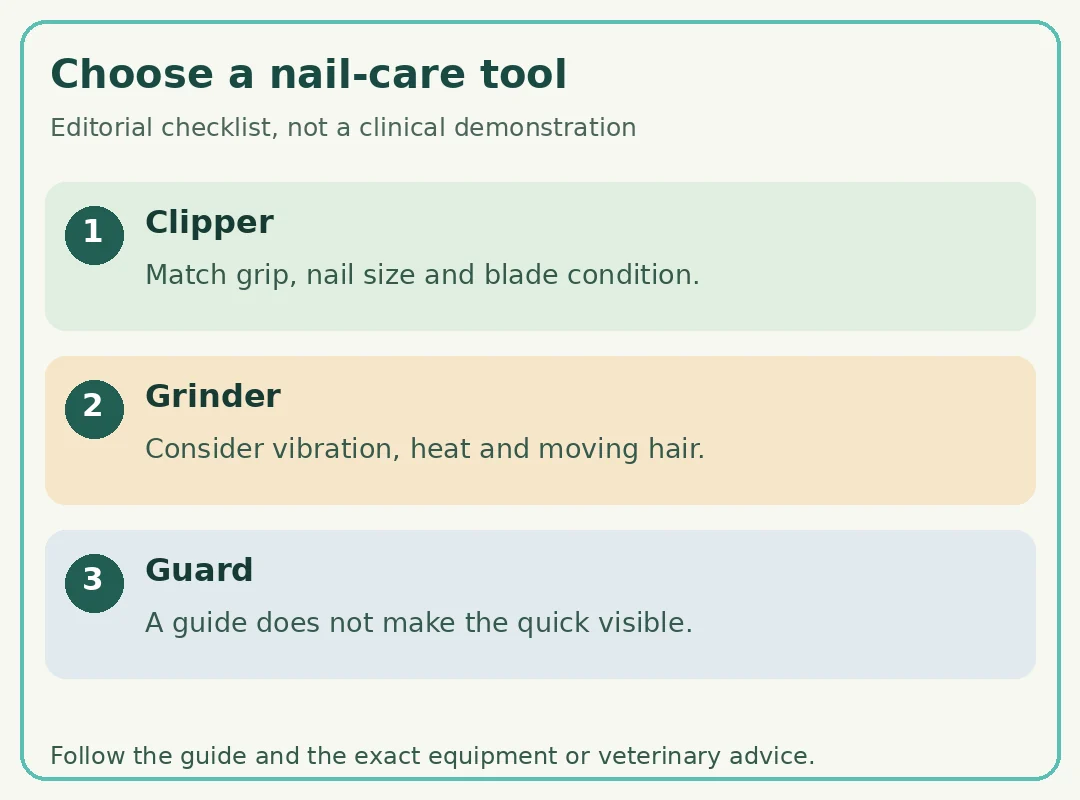
Choose a dog claw trimmer by nail thickness, a stable grip, and your dog's comfort with handling. A sharp, correctly sized scissor or plier clipper is a sensible first option to discuss with your veterinary team. A grinder can remove small amounts and smooth edges if your dog accepts its sound and vibration. Guillotine clippers need careful sizing and positioning. No mechanism, light, or safety guard makes cutting the quick impossible.
This guide helps you select and maintain equipment, not choose a universal cutting depth. For the handling sequence after choosing your tool, read how to trim dog nails without rushing and arrange a practical demonstration if you are new to the task.
In this article
Start with the nail and your hands
Dog claw trimmers, dog toenail trimmers, and canine nail clippers are names for the same equipment category. A coat clipper is different: it cuts hair, not claws. Our guide to clippers for grooming dogs covers that separate purchase. Ignore the wording on the front of a nail-tool package until you've checked the cutting mechanism and intended use.
Look for an opening that accommodates the nail without crowding it, handles you can close comfortably, and a clear view of the working end. Breed labels alone aren't enough. Nail thickness, your grip, and access around the paw matter more than choosing a tool labeled for a particular breed.
Think about your own reach as well. If your fingers tire before the handles close, or the grip slips when you change angle, a different size or mechanism may be easier to control. Ask to see the tool's dimensions and instructions before buying online, since a close-up photograph can hide how bulky the cutting head is.
The AKC's nail-trimming guidance describes scissors, guillotine tools, and dog-specific grinders. It also recommends a veterinary demonstration for beginners. Think of this purchase as one part of a practical canine grooming kit, not a replacement for learning nail anatomy and safe handling.
Compare the mechanisms before buying
Start with the problem you need the tool to solve. Thick claws, a small working space, hand fatigue, and sensitivity to noise call for different checks. A package marked "professional" does not answer any of them. Compare the exact model's instructions and dimensions rather than assuming that the most expensive tool is the easiest to control.
- Scissor or plier clipper: two cutting edges meet when you squeeze. Look for an opening that suits the nail, aligned sharp edges, and handles you can operate without an exaggerated stretch. This design avoids motor noise, but still produces a cutting sensation and sound.
- Guillotine clipper: a moving blade crosses a fixed opening. The opening must accommodate the nail without forcing it through. Check blade orientation and replacement availability. This mechanism can be awkward when access is limited or the nail will not sit comfortably in the opening.
- Dog nail grinder: an abrasive surface wears the nail down gradually. Check whether you can see the working point, control the device in your hand, and obtain compatible abrasive replacements. Noise, vibration, friction heat, and hair near the rotating part are additional considerations.
For a small dog with fine claws, avoid a head so bulky that it hides the nail. For a larger dog, do not choose tiny scissors simply because they feel familiar: the tool still has to be rated for the nail it will cut. A grinder may suit either size, but capacity and access matter more than a breed silhouette on the box. If your dog withdraws from a motor sound, a manual tool may be easier to introduce while you work on handling skills.
Before ordering, make a short checklist: stated nail-size suitability, handle dimensions, clear instructions, cleaning requirements, replacement parts, and a return policy that allows you to assess hand fit under the seller's terms. Do not test an unsuitable purchase by repeatedly squeezing a live nail. Bring the tool to a demonstration instead. For households assembling several separate implements, our dog grooming tools guide helps distinguish nail equipment from coat-care accessories without treating a large kit as automatically better.
What makes scissor-style clippers a sensible starting point?
Scissor-style nail clippers bring two cutting edges together when you squeeze the handles. Some look like small scissors; others have a spring-loaded, plier-shaped handle. The mechanism matters more than the silhouette. These are purpose-built nail tools, not household scissors repurposed for grooming.
Check that the handles fit your hand without forcing an awkward stretch. You should be able to open and close the tool deliberately while keeping the cutting end steady. A bulky head can obscure a small nail; a tool that struggles with a thick nail is also a poor match.
VCA's happy-handling guide specifically favors sharp scissor or plier clippers and warns that guillotine models may crush nails. That makes scissors a reasonable style to discuss first with your veterinary team. It isn't proof that every scissor clipper cuts well. Blade condition, appropriate sizing, and the handler's control still need checking. Don't compensate for poor cutting performance by squeezing harder on your dog's nail.
Guillotine clippers need a closer look
A guillotine clipper has an opening through which the nail passes and a blade that moves across it. This differs from placing the nail between two open scissor blades. Before choosing one, consider whether you can position that opening without bending the leg awkwardly or losing sight of the nail.
The two cited sources do not give identical equipment advice. VCA's handling-focused article advises avoiding guillotine models because of crushing concerns, while AKC includes guillotine tools among the available options. That difference is a reason to discuss the exact design with your veterinary team, not to assume that any mechanism comes with universal approval.
If you're considering this design, ask a veterinary professional to assess the model and demonstrate its orientation. Check the opening size, blade movement, and whether replacement blades are available. A nail shouldn't need to be pushed or wedged into place. If the blade drags, the nail distorts, or placement feels uncertain, stop and reconsider the tool rather than trying to finish.
Would a grinder suit your dog better?
A nail grinder removes material with a rotating abrasive surface rather than making a single clipping cut. It can smooth a rough edge or serve as the main maintenance tool for a dog who accepts it. Gradual removal is useful, but it doesn't make the device unable to reach sensitive tissue.
Compare the grip, visibility around the working tip, compatible abrasive replacements, and instructions for your dog's nail size. Consider the sound and vibration as separate handling challenges. A quiet advertising claim cannot tell you whether your particular dog will be comfortable with the running tool.
AKC warns that long hair can catch in a grinding tool. VCA's handling guide warns that prolonged contact can heat the nail. Keep hair away from moving parts and learn appropriate brief contact from a professional. Never hold a grinder against the nail simply to finish faster. Some dogs prefer clippers, and some accept a combination. Choose according to comfort and control, not a claim that grinding is automatically safer.
Check what you can see before proceeding
A useful nail-care setup gives you good light, secure footing, and an unobstructed view. Look at the nails and surrounding toes before selecting a working position. Include dewclaws if present; these sit higher on the leg and may not wear against the ground like other nails.
The quick contains blood vessels and nerves. It may be visible inside a pale nail, but it isn't visible through a dark nail in the same way. Neither a lamp nor a magnifier guarantees that you can identify a safe cutting boundary. If you're unsure, get a demonstration instead of guessing from a photograph.
Don't treat a clipper's safety stop as an anatomical guide. It doesn't locate the quick or guarantee protection from injury. Your dog's nails may differ from one another, and an overgrown nail may have a long quick. A guard is not permission to remove a preset amount. Pain, a split claw, or a nail pressing into the pad changes the task from routine maintenance to veterinary assessment.
Make cooperation part of the tool choice
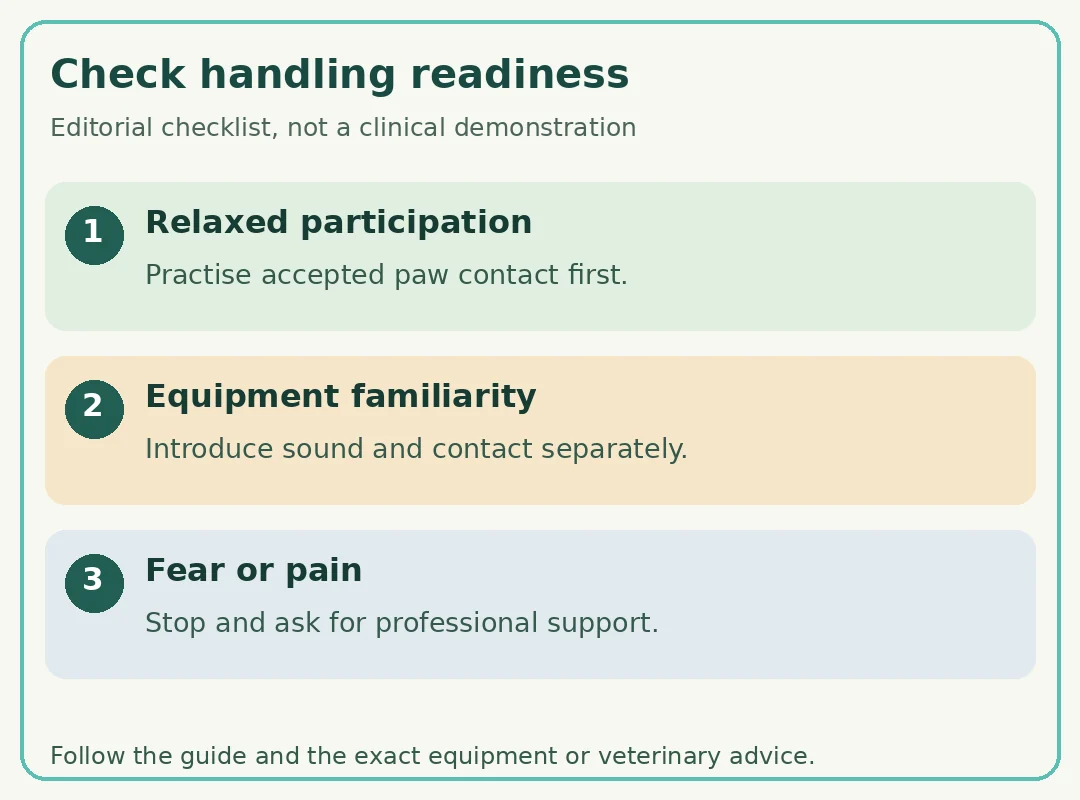
The right tool is only useful if your dog can participate comfortably. Practice relaxed paw contact separately from nail trimming. Introduce the inactive equipment with rewards before asking for anything harder. With a grinder, familiarity with its appearance doesn't mean acceptance of its sound or vibration.
VCA's handling guide recommends breaking practice into small, easily accepted steps and returning to an easier step when the dog becomes concerned. Use rewards to build a positive association, not to conceal an unexpected cut. Eating is not the only readiness check: VCA also lists becoming tense or frozen among signs that warrant a break.
A repeatable start-and-stop arrangement can help you keep the session predictable. Invite your dog onto a nonslip resting area, reward comfortable participation, and release them before attempting more. If they step away, let the handling stop. Agree on this rule with anyone helping, so a pause doesn't become accidental restraint.
Watch for paw withdrawal, moving away, freezing, trembling, growling, or snapping. Pause when cooperation changes. Don't scold a warning or recruit someone to hold the dog more tightly. Training sessions can end without trimming anything. Our puppy grooming starter guide places equipment introduction within a broader handling routine. Older dogs also need patient preparation, and sudden intolerance deserves a conversation with the veterinarian about possible pain.
Keep nail care separate from other grooming jobs
You do not have to finish bathing, brushing, teeth, and claws in one sitting. Nail work requires a clear view, comfortable paw handling, and your attention. If your dog is already tired of grooming, postponing a nonurgent nail session is more useful than buying a faster tool. Choose a stable, nonslip area and let the dog settle before deciding whether to continue.
Hair around the foot can hide what you are doing, and loose hair needs to stay away from a grinder's moving parts. A suitable dog brush matched to the coat can help organize routine coat care, but brushing is not a way to repair an injured claw. If you use a slicker brush for tangles, do not pull a mat beside a sensitive toe as preparation for nail trimming. Painful tangles or restricted access are reasons to ask a professional for help.
Likewise, dirty paws and overgrown nails are different problems. Our dog wipes guide discusses surface cleanup, not nail treatment. Do not wipe a split or bleeding nail with a grooming product and then resume clipping. If a bath is genuinely needed, choose an appropriate dog shampoo for the skin's needs, rinse and dry according to its directions, and reassess comfort separately. A clean coat does not make the quick easier to judge.
Use the dog bathing-frequency guide for that scheduling decision rather than tying every nail check to bath day. Nail growth and wear vary between dogs and between claws. Inspect regularly, including dewclaws, and ask your veterinary team what maintenance pattern suits your dog. The useful routine is a repeatable opportunity to look and handle gently, not an obligation to remove nail every time the kit comes out.
A trimmer needs care between sessions
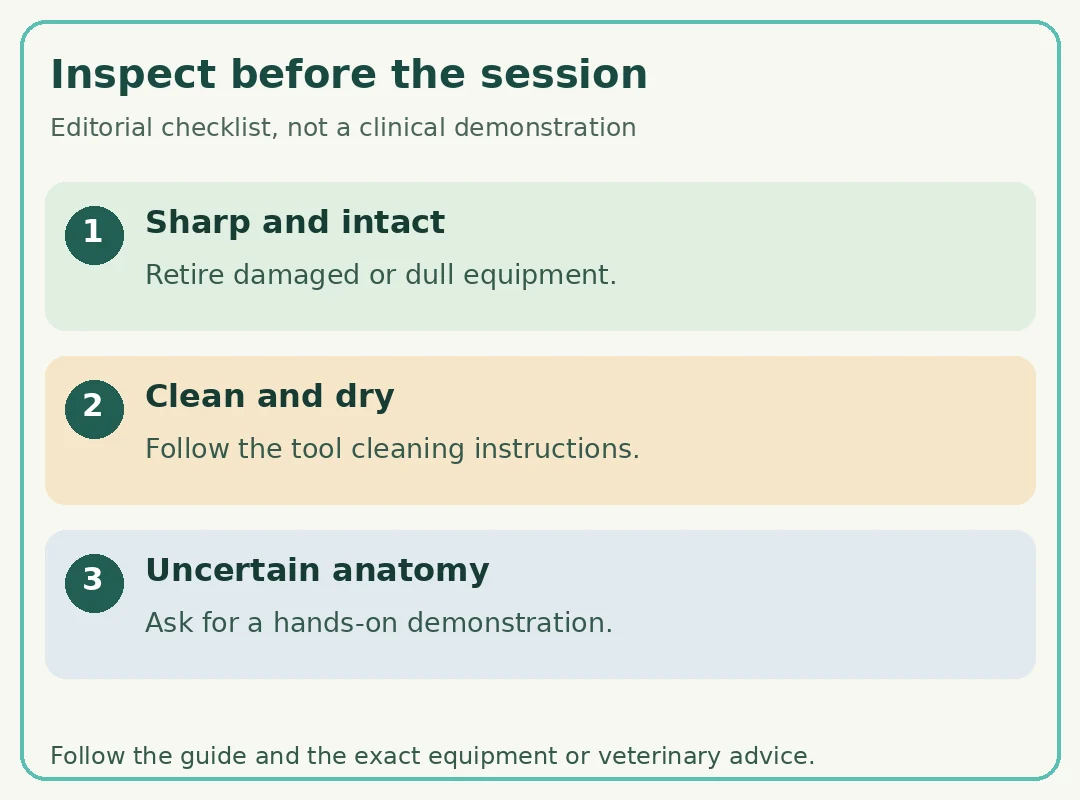
Inspect equipment before bringing your dog over. Look for damaged handles, corrosion, loose parts, misaligned blades, or an abrasive attachment that isn't seated correctly. Operate the empty manual tool to check its movement. Keep fingers clear of cutting edges, and inspect powered equipment with the power off.
After use, remove nail debris and follow the manufacturer's cleaning and drying directions. Don't assume a tool can be soaked or disinfected with any household product. Keep liquids away from electrical components. Replace worn abrasives or blades only as instructed; seek service or replace equipment that no longer works predictably.
Store sharp tools closed or protected, dry, and out of reach of pets and children. Keep the manual and compatible replacement details with the kit. Dental equipment belongs separately, as our gentle dog-toothbrushing guide also explains. Clean equipment is a maintenance habit, not a reason to groom sore tissue. There is no fixed replacement calendar that overrides visible damage or poor performance.
Know when buying another tool isn't the answer
Stop if your dog appears painful, the nail splits, bleeding starts, or you cannot maintain a clear view and safe position. A different handle shape won't resolve an injured claw. Nor should repeated attempts become a test of whether your dog will eventually stop resisting.
Contact your veterinarian for a broken or partly detached nail, limping, swelling, a nail curling into the pad, or bleeding that does not stop. Heavy bleeding warrants urgent help. A product-selection guide is not a treatment plan for a damaged claw. Do not pull off a hanging piece or trim through painful tissue; ask your veterinary team how to protect the paw while getting help.
For an otherwise healthy dog, a patient groomer or veterinary team can demonstrate positioning and evaluate tool fit. Severe fear or bite risk calls for veterinary guidance before another home attempt. Any medication or sedation decision belongs to the veterinarian. This guide supports equipment selection, not diagnosis or an individual trimming plan. A workable choice preserves comfort, visibility, and the ability to stop.
Frequently Asked Questions
Are dog claw trimmers and dog toenail trimmers different?
These names generally describe the same nail-care tools, not separate product categories. Check whether the tool uses scissor blades, a guillotine mechanism, or a rotating abrasive. Canine nail clippers also belong here. Hair clippers are different and should not be used to shorten claws.
Which nail trimmer should a beginner consider first?
Discuss a sharp, appropriately sized scissor or plier clipper with your veterinary team. VCA's handling guide favors this design, though other guidance includes guillotine tools. The best starting point is a tool you can control plus an in-person demonstration, not a promise that a particular mechanism prevents mistakes.
Does a safety guard prevent cutting the quick?
No. A guard or stop doesn't identify the blood vessels and nerves inside the nail. It cannot account for every nail's shape or the length of an overgrown quick. Keep visual checks and professional instruction central to your decision, and never use the guard as permission for a deep cut.
Is a grinder always gentler than nail clippers?
Not for every dog. Grinders remove material gradually and can smooth edges, but their sound and vibration may be unwelcome. Friction can create heat, and hair can catch in moving parts. Introduce the equipment gradually and choose according to your dog's comfort rather than assuming electric means painless.
How do I know when my trimmer needs replacing?
Replace or service it when blades are damaged or misaligned, handles crack, parts loosen, or cutting becomes unreliable. Follow the manufacturer's instructions for blade and abrasive replacement. Don't test a questionable tool repeatedly on your dog. Cleaning and dry storage help, but they cannot repair damaged cutting surfaces.
What if my dog won't let me hold a paw?
Pause rather than holding tighter. Work on gentle, rewarded handling away from a trimming session, and seek qualified help if fear persists. Sudden sensitivity, limping, swelling, or an injured nail needs veterinary assessment. Severe fear or a risk of biting also warrants veterinary guidance before another home attempt.