A dog seat belt is the cheapest piece of car safety equipment most owners will ever buy, and also the one most likely to be bought without reading anything first. This guide covers what the parts actually are, what the major animal welfare organisations each recommend (they do not fully agree, and the disagreement is worth knowing), how to fit one so it does its job, and the everyday mistakes that quietly turn a restraint back into decoration.
Header photo: ReggieandFriends, Wikimedia Commons, CC BY-SA 4.0.
What a Dog Seat Belt Actually Is, and the Three Parts That Matter
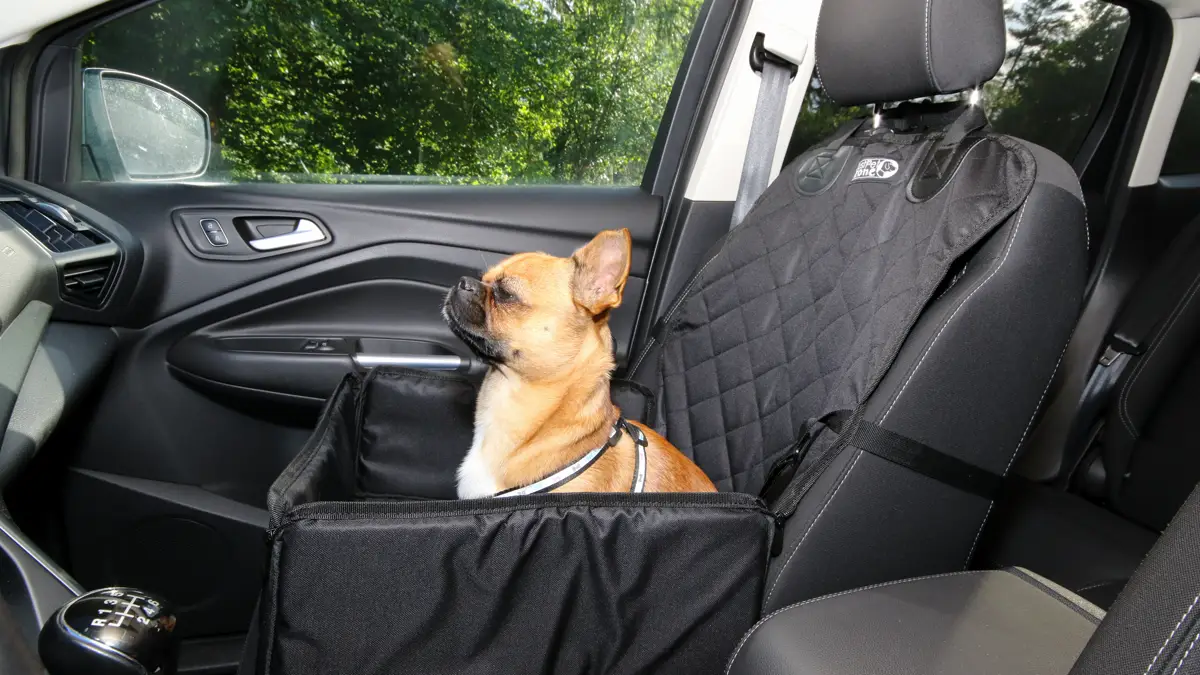
Almost nothing sold as a dog seat belt is a belt. The product is a system of three parts, and owners run into trouble when they buy one part and assume they have bought all three. The first part is a harness worn by the dog. The second is a short tether, a strap of webbing far shorter than a leash. The third is whatever locks the tether to the car: either a metal tongue that clicks into the buckle beside the seat, or a loop that the vehicle belt itself is threaded through.
Get that structure clear and most buying questions answer themselves. A tether sold on its own is not a restraint, because it has nothing to spread the load across the dog. A harness on its own is not a restraint either, because the dog is attached to nothing. A vehicle only holds what is anchored to it, and a dog is only held by the part of the system that touches the car.
The tether attaches to the harness, never to the collar. This is the single most common and most dangerous shortcut in the category. A flat dog collar concentrates every ounce of force onto the throat, and the forces in even a slow-speed stop are nothing like the forces in a walk. Our guides to the everyday dog harness and the no pull dog harness cover the walking side of that hardware, and the distinction between walking gear and car gear is the subject of a later section here.
Tether length is the setting most people never touch. A long tether lets a dog stand, turn, and lean across the seat, which feels generous and is exactly what you do not want: slack is distance to travel before anything stops the dog, and a dog that can reach the front is a driver distraction. Short enough to sit or lie comfortably, not long enough to stand and pivot, is the target.
What the Major Welfare Groups Actually Recommend, and Where They Differ
Three organisations publish plain guidance on this, and reading all three together is more useful than reading any one of them. They agree on the basics and part company on one important point, which is how much a seat belt style restraint is really doing for the dog in a crash as opposed to during ordinary driving.
For more expert recommendations, check out our no tug dog harness guide.
The American Kennel Club is the most direct about hardware. Its car safety guidance states that "For everyone's safety, dogs shouldn't be riding on the driver's lap, or unrestrained in the car," that dogs "should also never ride in the back of a pickup truck (which is illegal in many areas), whether if they are loose, tethered, or crated," and that "When dogs are riding in a vehicle, they should be in a dog crate or secured with a crash-tested dog seat belt." It also notes that a belt is the practical answer when the vehicle is not big enough for a properly sized crate. You can read the full guidance in the AKC dog car safety article.
The ASPCA ranks the options. Its travel guidance says a crate "is the safest option for your pet in case of an accident," that it "should be large enough for your pet to stand, sit, lie down and turn around in," and that you should "secure the crate so it will not slide or shift in the event of an abrupt stop." If you skip the crate, it adds, "don't allow your pet to ride with their head outside the window, and always keep them in the back seat in a harness attached to a secured seatbelt." That page is the ASPCA's travel safety tips.
Humane World for Animals, formerly the Humane Society of the United States, agrees on the ranking and then adds the caveat that changes how you should read every marketing claim in this category. Its guidance says "The safest way for your dog to travel in the car is in a crate that has been anchored to the vehicle using a seat belt or other secure means," and then, of belts specifically: "Dog restraints or seat belts are useful for preventing your dog from roaming around the car and being a distraction to the driver, but they haven't been reliably shown to protect dogs during a crash." The full page is Travel safely with your pet.
Put plainly: a dog seat belt has a proven everyday job, which is keeping the dog off the driver, off the front seat, and inside the vehicle when a door opens. Whether it also protects the dog in a serious collision is a claim the welfare bodies treat with more caution than most product pages do. That is a reason to buy one, fit it properly, and keep expectations honest, not a reason to skip it and drive with a loose dog.
Why the Walking Harness Already in Your Hallway Is Not a Car Harness
The AKC wording is specific. It does not say secured with a dog seat belt; it says secured with a crash-tested dog seat belt. That single adjective is the whole difference between the two categories of hardware, and it is invisible at a glance because a walking harness and a car harness look broadly alike hanging on a rail.
A walking harness is engineered for a steady pull in one direction, applied by the dog and sustained for as long as the walk lasts. Everything about it follows from that: light webbing, plastic side-release buckles, stitched D-rings, and a fit tuned for comfort over hours. A car harness is engineered for a very short, very large, forward load applied by the vehicle stopping while the dog keeps moving. That calls for wider chest panels to spread the load across the sternum and ribcage instead of the throat, heavier webbing, load-bearing stitching, and metal hardware where a walking harness is happy with plastic.
There is a second, less obvious difference: the direction the load arrives from. A walking harness is loaded backwards, from behind the dog, by a leash you are holding. A car harness is loaded forwards, and the panels and stitching that matter are the ones in front of the dog's chest. A harness that is superb on a walk can be built so the forward load path runs through a single stitched loop, which is not a design flaw for its intended job and is a serious one in a car.
None of this makes your walking gear useless on a trip. Keep it in the car for the far end of the journey, because a dog still needs a collar with dog tags, a dog leash for rest stops, and something to hold onto the moment a door opens. Our roundup of the best dog harness options and the broader pet accessories guide cover that everyday kit. The car restraint is a separate purchase that lives in the car.
Crate, Carrier, or Belt: Matching the Restraint to the Dog and the Car
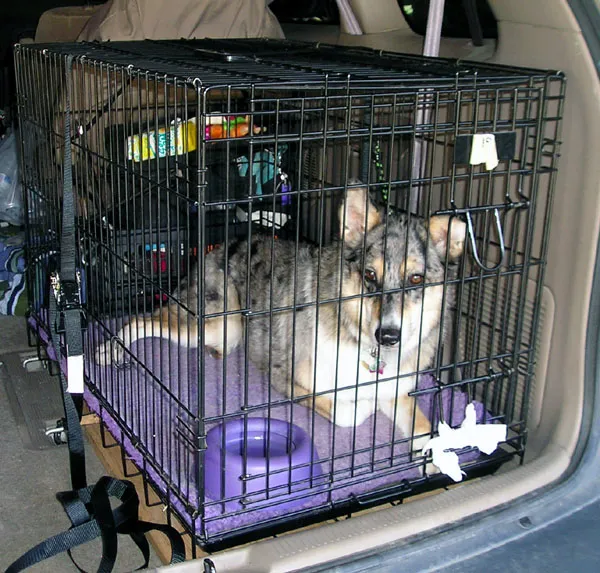
Both the ASPCA and Humane World for Animals put an anchored crate at the top of the list, and the AKC names a crate first as well. So the honest starting question is not which dog seat belt to buy; it is whether a crate fits the vehicle at all. In a hatchback or a sedan with a small boot, it usually does not, and that is precisely the situation the AKC describes when it says belts are a good option where a properly sized crate will not fit.
You might also find our fi collar article helpful when shopping.
Size the crate to the dog, not to the gap in the boot. The ASPCA's measure is that the pet can stand, sit, lie down and turn around inside it. Then secure it, because an unanchored crate is a heavy loose object with a dog in it. A strap through the frame to a cargo anchor or a seat belt through the crate handles is the difference between a restraint and a box that slides.
Cats belong in a carrier rather than on a belt, and the same anchoring logic applies. Humane World for Animals recommends securing a seat belt around the front of the carrier so it cannot bounce around. If you are working on leash walking with a cat as well, our guides to the cat harness cover the walking side of that.
For most dogs in most family cars, the realistic answer is a crash-tested harness plus a short tether, placed on the back seat. For a large dog in an estate car or SUV, an anchored crate in the cargo area is usually both safer and more comfortable, and it gives the dog somewhere to settle. Lining it with a washable dog bed makes the space one the dog actually chooses, which matters more than owners expect.
Back Seat Only: Airbags, Open Windows, and Pickup Beds
Where the dog sits is not a comfort preference, and it is the part of this topic where all three organisations agree without qualification. Humane World for Animals puts it simply: "Keep your pet in the back seat of the car. If an airbag deploys while your pet is in the passenger seat (even in a crate), it might injure your pet." The parenthesis matters, because it rules out the common workaround of belting a carrier into the front. The ASPCA's phrasing is the same instruction from the other direction: always keep them in the back seat in a harness attached to a secured seatbelt.
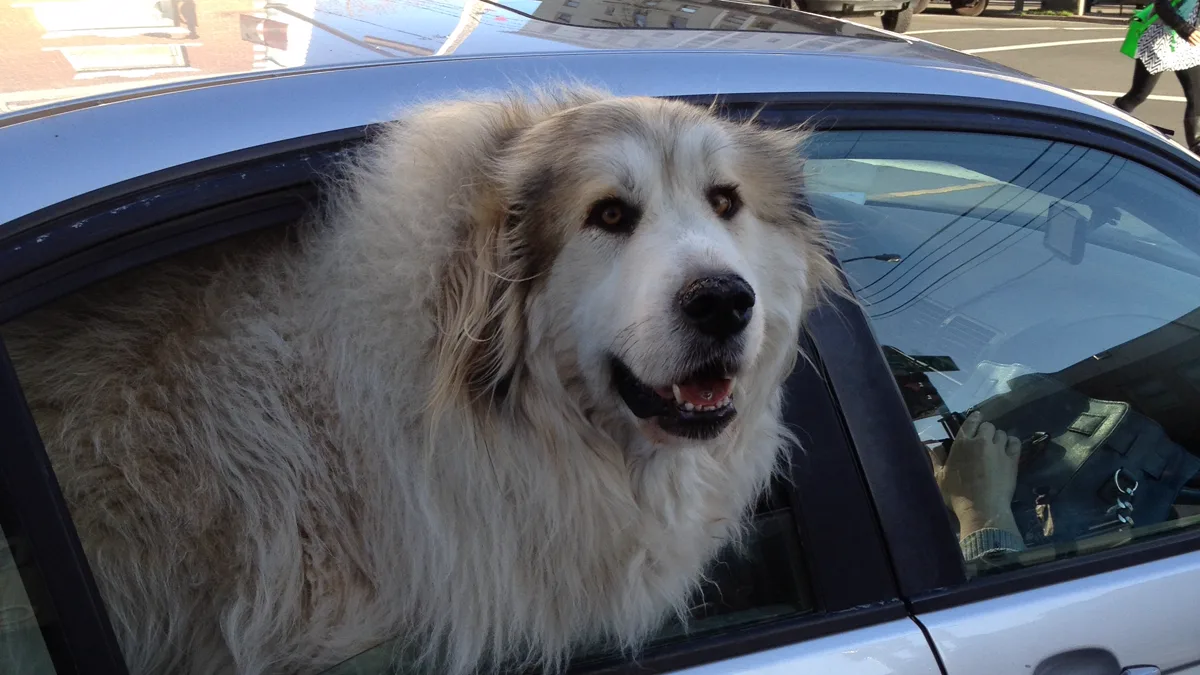
The open window is the habit hardest to give up, because a dog with its head in the wind looks like the happiest animal alive. Humane World for Animals is blunt about the cost: pets allowed to stick their heads out of the window of a moving vehicle "can be injured by particles of debris or made sick by having cold air forced into their lungs." An open window is also an exit, and the AKC article opens with a first-hand account of a Labrador Retriever going through the back window of a moving car and being partly dragged by its leash. Window vents or a locked window solve both problems at once.
The pickup bed is not a grey area. The AKC's guidance is that dogs should never ride in the back of a pickup truck, "whether if they are loose, tethered, or crated," and it notes that this is illegal in many areas. Humane World for Animals says the same: never transport a pet in the back of an open pickup truck. Tethering in a bed is worse than useless, because a short tether in an open bed changes what a fall becomes.
One more back-seat detail that is easy to miss: the dog needs to be able to get comfortable, and in warm weather a dark rear seat is the hottest place in the car. A dog cooling mat on the seat costs nothing in safety terms and takes one common source of restlessness out of the equation.
Seat Covers, Boosters, and Hammocks Are Not Restraints
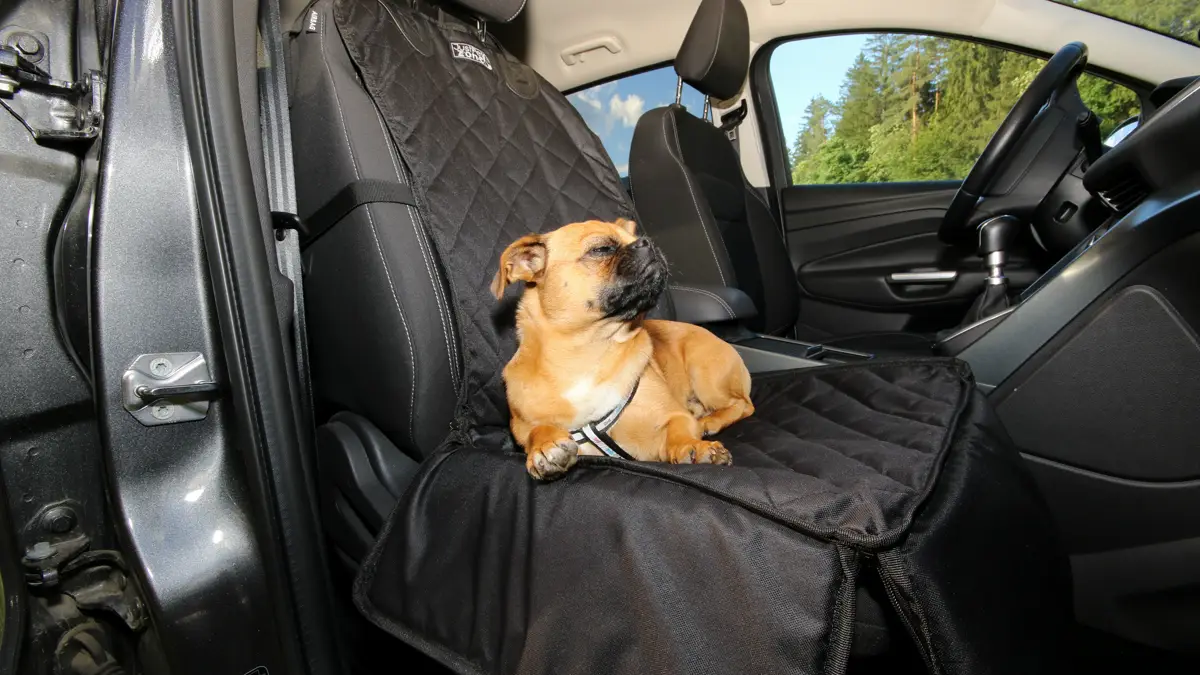
Search for a dog seat belt and the results fill up with quilted seat covers, bench hammocks, and raised booster baskets. These are useful products and they answer a real problem, which is hair, claws, and mud on upholstery. What they do not do is hold a dog, and the listings rarely say so plainly because the photographs carry the implication on their own.
Looking for more options? Our flea collar for dogs roundup covers additional top picks.
A hammock strung between the front and rear headrests does stop a dog from tumbling into the footwell, and that is genuinely worth something on a twisty road. It is a containment aid rather than a restraint: it holds a dog in a rough area of the car, not to a fixed point on it. A booster basket raises a small dog high enough to see out, which can settle a dog that gets anxious low down, and the good ones include an internal tether clip. That clip is the restraint. The basket is furniture.
The test to apply to anything in this category is short. Ask what the product is attached to, and what the dog is attached to. If the answer to the second question is nothing, you own an accessory, not a restraint, no matter how much webbing is involved. A cover with straps around the headrests is attached to the car; the dog lying on it is not.
There is a fair case for owning both. A cover plus a tethered harness keeps the seat clean and the dog anchored, which is the usual setup in a family car that also carries children. Just do not let the presence of the cover quietly stand in for the belt, which is the failure mode this section exists to name.
Fitting a Dog Seat Belt Without Guesswork
Fit is where a good restraint becomes a real one. Size by girth, measured around the deepest part of the chest just behind the front legs, and by weight, because car harnesses are usually rated by the weight they are built to hold rather than by breed. If the dog falls between two sizes, the one that can be tightened down is the safer choice, since a harness that can be pulled off over the head is not a restraint for the few seconds that matter.
Check the tightness the way you would for walking gear: two fingers should slide flat under every strap, and no more. Then do the extra check that only applies in a car, which is to pull the harness forward at the chest, in the direction the dog would travel in a stop, and watch what moves. The chest panel should stay put and the load should feel spread across the breastbone. If everything slides up towards the throat, the harness is the wrong shape for this job whatever the label says.
Anchor the tether to a fixed point. Clicking into the seat belt buckle is the usual method and the easiest to get right. Threading the vehicle belt through a loop on the harness works too, provided you then pull the belt all the way out and let it retract, which on most cars engages the locking mode that stops the belt paying out further. Never anchor to a headrest post, a door handle, a cargo net, or a grab handle: none of those are restraint anchors, and headrest posts in particular are designed to release.
Finally, sit in the back seat and look at the setup from the dog's height. Can the dog reach the driver? The tether is too long. Can the dog get a leg over the tether? Shorten it or reroute it. Can the dog lie down comfortably? If not, you will lose the argument on a long drive, and a dog that fights the restraint the whole way is the one whose owner stops using it.
Six Mistakes That Quietly Undo a Dog Seat Belt
Clipping the tether to the collar instead of the harness is first on the list and the hardest habit to break, because the collar is right there and it already has a ring on it. Everything the restraint is meant to spread across the chest is instead delivered to the neck. If the dog wears a martingale collar or any other collar that tightens, this goes from bad to worse.
Second, a tether left at full length. Most come long so they fit every car, and most owners never shorten them. Third, the front seat, usually justified by a short trip or a nervous dog. The airbag does not know the trip is short, and Humane World for Animals notes the risk applies even to a pet in a crate on the passenger seat.
Fourth, a crate or carrier that is in the car but not attached to it. Fifth, gear that is never inspected. Webbing frays, stitching pulls, and plastic hardware gets brittle after a few summers parked in the sun. Look at the stitching where the tether meets its fitting every few months, and retire anything with a lifted edge or a stiffened, chalky buckle.
Sixth, and the one owners feel worst about afterwards, is using the restraint only on long trips. Most journeys are short, local, and taken on roads where other drivers do unpredictable things. The habit is what protects the dog, not the intention. If you already track the dog's whereabouts with a dog GPS tracker, think of the restraint the same way: something that lives permanently on the dog for the journey, not something fetched out for special occasions.
Teaching a Dog to Settle in the Car, Not Just Strapping It In
A restraint controls where a dog is. It does not make a dog comfortable, and a dog that is frightened in a car will fight anything you attach it to. The AKC frames this as a training problem rather than an equipment problem, which is why its car safety article is built around teaching a dog how to behave in a vehicle at all.
Start with the car stationary and the engine off. Let the dog get in, wear the harness, be clipped in for a moment, and get out again with something good happening throughout. Then repeat with the engine running and the car not moving. Then a trip to the end of the street and home. The whole sequence is ordinary positive reinforcement training, and the mistake is skipping the boring middle steps because the dog seemed fine.
Make the destination unpredictable in a good way. A dog whose only car journeys end at the vet has learned exactly what a car means. Mix in trips that end at a park, at a friend's house, or simply back at your own front door. This is the same principle behind everything in our guide to anxiety in dogs, and it applies with particular force to dogs who already struggle with being left, which our guide to separation anxiety in dogs covers in depth.
Give the dog something to do once the car is moving. A chew or a stuffed toy that takes a while to work through converts a restless journey into an occupied one, and the same options that keep a dog busy at home work here; our list of toys to keep dogs busy is a reasonable starting point. Keep it to something the dog can manage lying down, and take it away before a rest stop so the excitement is not competing with a door opening.
Organizations like the VCA Animal Hospitals pet health library also offer trusted, science-backed advice that is well worth bookmarking.
Frequently Asked Questions
Does a dog seat belt actually protect my dog in a crash?
It depends who you ask, and the honest answer is that the evidence is thinner than the marketing. The AKC recommends a crash-tested dog seat belt as one of the two acceptable options alongside a crate. Humane World for Animals is more cautious, saying restraints and seat belts are useful for preventing a dog roaming around the car and distracting the driver, but that they have not been reliably shown to protect dogs during a crash. The everyday benefits are not in dispute, so use one; just do not treat it as a guarantee.
Can I clip the seat belt tether to my dog's collar?
No. A collar concentrates the entire load onto the throat, and the loads involved in a car are nothing like the loads in a walk. Every tether should attach to a harness that spreads the force across the chest and ribcage. If the only attachment point you have is a collar, the restraint is not ready to use.
Which seat should my dog travel in?
The back seat. Humane World for Animals advises keeping pets in the back because an airbag deploying while a pet is in the passenger seat, even in a crate, might injure it. The ASPCA gives the same instruction, saying to keep the pet in the back seat in a harness attached to a secured seatbelt.
Is a crate safer than a dog seat belt?
Both the ASPCA and Humane World for Animals name an anchored crate as the safest option, and the AKC lists a crate first as well. The practical catch is that a crate has to be sized so the dog can stand, sit, lie down and turn around, and then be secured so it cannot slide or shift. Many cars cannot take a crate that size, which is exactly when the AKC says a belt is a good option.
How long should the tether be?
Short enough that the dog can sit and lie down but cannot stand up and pivot, and nowhere near long enough to reach the front seats. Most tethers ship long so they suit any vehicle, and shortening it is the single highest-value adjustment most owners never make.
Can my dog ride in the back of a pickup truck if it is tethered?
No. The AKC states that dogs should never ride in the back of a pickup truck whether they are loose, tethered, or crated, and notes that it is illegal in many areas. Humane World for Animals gives the same advice.
What about letting my dog hang its head out of the window?
Humane World for Animals warns that pets allowed to stick their heads out of the window of a moving vehicle can be injured by particles of debris or made sick by having cold air forced into their lungs. An open rear window is also an escape route. Cracking the window for airflow without leaving a gap the dog can get its head through is the compromise.
Do seat covers and hammocks count as restraints?
No. They protect upholstery and can stop a dog sliding into the footwell, which is worth having, but the dog is not attached to the vehicle by any of them. Ask what the dog itself is clipped to. If the answer is nothing, you have an accessory rather than a restraint.
How often should I replace a dog seat belt harness?
There is no fixed interval, so inspect instead. Check the webbing for fraying, the stitching where the tether meets its fitting for lifted or broken threads, and the plastic hardware for the chalky, stiff feel that follows a few summers in a hot parked car. Retire anything showing those signs, and replace a harness after any collision rather than reusing it.
Browse Accessories
Free worldwide shipping on every order. No minimum purchase required.
Browse Accessories →