If you are looking for the best no tug dog harness, this comprehensive guide covers everything you need to know. Whether you are a first-time pet owner or an experienced one looking to upgrade, you will find practical advice, safety tips, and honest comparisons below.
What a No Tug Dog Harness Does and Who Needs One
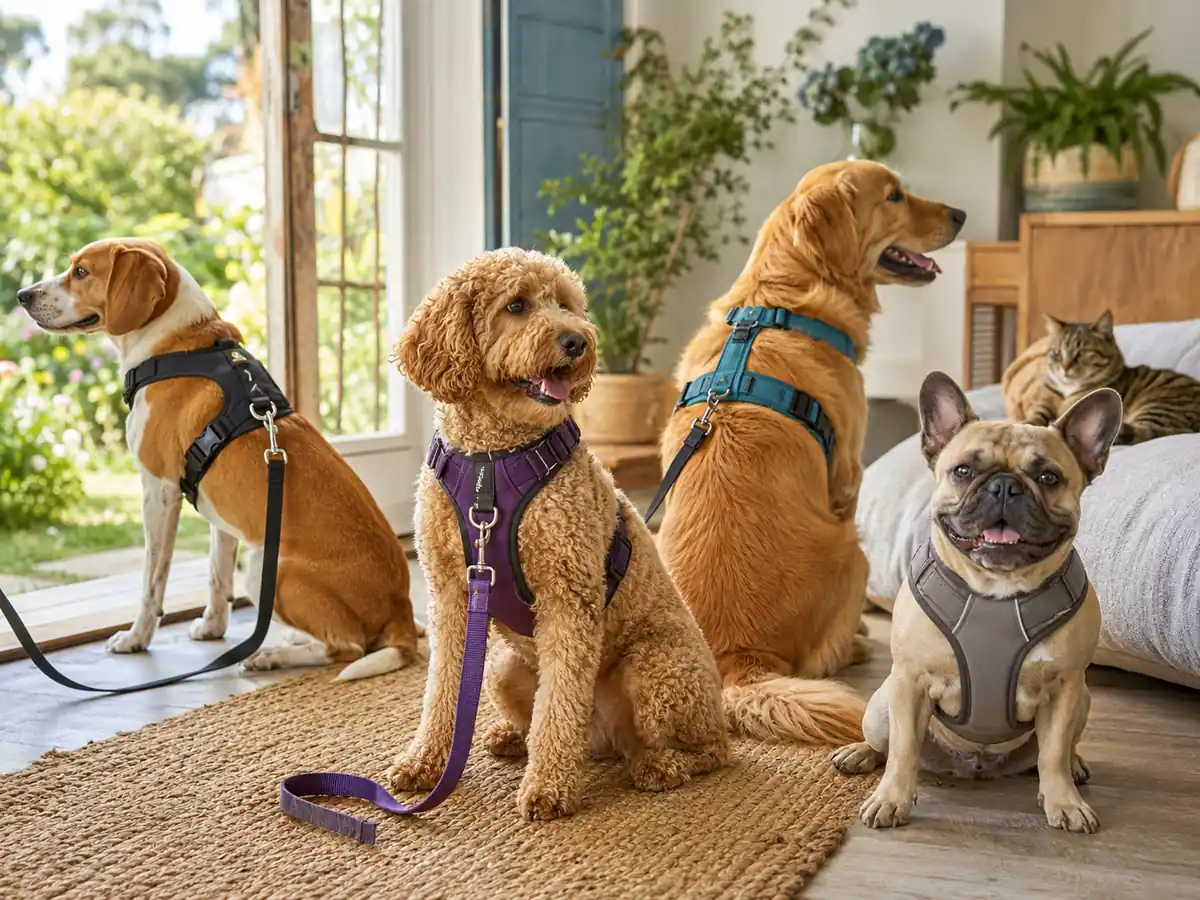
A no tug dog harness is a walking harness designed to take the power out of pulling. Instead of letting the dog throw its full chest weight into the leash the way a back-clip harness does, a no tug design places the leash attachment at the front of the chest, sometimes adding a second point on the back and a strap that tensions gently when the dog surges. When the dog tugs, the front attachment turns the dog's shoulders back toward the handler, so the tug costs the dog its forward line instead of rewarding it with progress.
The dogs that benefit most are steady leaners and sudden lungers: adolescent large breeds discovering their strength, sled-type breeds that lean into pressure by instinct, reactive dogs that hit the end of the leash when a squirrel appears, and any dog strong enough to tow its handler. Owners with shoulder injuries, small frames, or icy sidewalks also have a safety reason to stop the tugging rather than absorb it.
Be clear about what the harness is and is not. A no tug harness is management equipment: it makes walks controllable today. It does not, by itself, teach the dog that a loose leash is the goal. The combination that works is the harness plus a few minutes of reward-based loose-leash practice on every walk. The harness keeps your arm in its socket while the training changes the habit.
Why Dogs Tug on Leash in the First Place
Dogs tug for one overriding reason: pulling works. A dog wants to reach the lamppost, the park gate, or the interesting smell; it leans in; the human follows. Every step forward pays the behavior. Dogs also naturally move faster than humans walk, so the leash goes tight by default, and a phenomenon called the opposition reflex makes dogs push against steady pressure rather than yield to it. A back-clip harness amplifies all of this by giving the dog an efficient pulling geometry, which is exactly why sled dogs wear back-clip harnesses.
For more expert recommendations, check out our leash of dog guide.
Understanding this explains why simply strengthening your grip fails. Choking up on a collar gives the dog something firm to lean against and triggers the same reflex. Retractable leashes are worse: they teach the dog that constant tension is normal and that tugging harder unlocks more line. The mechanical answer is to change the geometry so that tugging stops producing forward motion, which is precisely the job of the front-clip attachment.
It also explains why the harness alone is not a cure. If the dog still reaches the park gate at full drag, the tug is still being paid. The harness buys you the leverage to stop, stand still, and only move when the leash is slack. Pair that rule with rewards delivered at your knee, and most dogs improve within weeks. The harness makes the training physically possible for an average-strength handler.
Front-Clip, Back-Clip, and Dual-Clip Harness Designs
Front-clip harnesses put the leash ring on a chest strap at the sternum. When the dog tugs, the pull rotates the dog toward the handler, which dissipates the force and interrupts the charge. This is the core no tug mechanism and it works immediately, with no learning curve for the dog. The tradeoff is that a low-set front ring can tangle under a leg on a dog that walks politely, and cheap versions let the whole harness twist sideways under load.
Back-clip harnesses put the ring between the shoulder blades. They are comfortable, easy to put on, and ideal for small dogs, calm walkers, and any dog with throat sensitivity, but they give a strong dog perfect towing leverage. A back clip on a determined tugger is a cart hitch. Dual-clip harnesses offer both rings, which is the most versatile buy: front ring for training walks, back ring for relaxed walks, or both rings at once with a double-ended leash for maximum steering on a powerful dog.
A subgroup of no tug designs adds a martingale-style loop at the chest that snugs slightly when the dog surges, then releases when the leash goes slack. These pressure-feedback harnesses give the dog clearer information without pain. Avoid designs that stop pulling through discomfort, such as thin cords that tighten under the front legs; they work by hurting, tend to chafe, and modern front-clip geometry makes them unnecessary.
Fitting a No Tug Harness So It Actually Works
Fit decides whether a no tug harness helps or chafes. Measure the chest girth at the widest point behind the front legs and the neck where the harness straps will sit, then buy by those numbers, never by breed or weight alone. On the dog, the harness should sit with the chest plate centered on the sternum, the girth strap two to three finger-widths behind the armpits, and every strap snug enough that you can slide two flat fingers underneath but no more.
You might also find our dog with collar article helpful when shopping.
The most common fitting mistakes all reduce the anti-tug effect. A girth strap riding in the armpit rubs bald patches on a dog that tugs. A front ring drooping toward the legs turns the steering geometry to mush and invites tangles. Straps left loose let the harness rotate when the dog lunges, so the dog ends up towing from its shoulder anyway. After adjusting, clip the leash to the front ring and apply gentle pressure sideways: the harness should turn the dog's chest without sliding around the body.
Watch range of motion too. A well-cut harness leaves the shoulder blades free; a Y-shaped front is generally kinder to gait than a horizontal strap that crosses the shoulder muscles, especially for dogs that hike or run. Check the coat under the straps weekly during the first month. Mild flattening of fur is normal; broken hair, pink skin, or reluctance to have the harness put on means the fit or the cut is wrong for that body shape.
Introducing the Harness and Building Loose-Leash Habits
Spend one session making the harness itself a good thing before the first walk. Let the dog sniff it, feed a treat through the head opening, fasten the buckles for a second, pay again, and take it off. Most dogs accept a harness within minutes when it predicts food; skipping this step is how some dogs learn to play keep-away at walk time. Practice a few steps indoors with the leash on the front ring so the new steering sensation is not a surprise on the sidewalk.
On walks, adopt one non-negotiable rule: a tight leash means the walk pauses. When the dog tugs, stop moving, keep your hand still and low, and wait. The front clip will have already turned the dog partway toward you; the moment the leash softens, mark with a cheerful word, reward beside your knee, and walk on. You are teaching a simple economy: slack leash makes the world move, tugging makes it stop. Consistency matters far more than session length.
Expect the harness to cut the force of tugging immediately and the frequency of tugging gradually. Weeks of short, consistent walks beat occasional marathon corrections. If the dog explodes at specific triggers such as other dogs or bikes, the harness gives you steering, but the underlying reactivity deserves distance management and possibly a professional trainer. Equipment manages force; training changes motivation.
Materials, Padding, and Build Quality Worth Paying For
The load path of a no tug harness runs through its stitching and hardware, so quality shows up exactly where a tugging dog stresses it. Look for box-stitched or bar-tacked joints at the front ring, metal D-rings rather than plastic on any ring that takes leash force, and buckles that click positively and cannot be popped by a sideways hit. Webbing should be thick enough not to fold into a cord under tension, because folded webbing is what causes most chafing on strong dogs.
Looking for more options? Our cat halters and leashes roundup covers additional top picks.
Padding is comfort, not decoration, on a harness that will see real force. Neoprene or fleece lining on the chest plate and girth strap spreads the load of a sudden lunge across soft tissue. Breathable mesh keeps a thick-coated dog cooler but check that the mesh is backed by webbing wherever the leash loads it. Reflective piping earns its place for dawn and dusk walkers, and a sturdy handle on the back panel is genuinely useful for steadying a dog over obstacles or during vet visits.
Buy for your actual dog, not the picture. Deep-chested breeds need harnesses with a long adjustment range in the girth; barrel-bodied breeds need straps that will not migrate; tiny dogs need lightweight hardware that does not knock their sternum. If your dog is between sizes, most manufacturers advise sizing to the chest girth and using the neck adjustment to fine-tune. A harness that fits the chest but gapes at the neck will still steer; one that pinches the chest will be resented.
Common Mistakes That Keep the Tugging Alive
The first mistake is clipping to the back ring and expecting the anti-tug effect. The back ring exists for relaxed walks after manners are solid, or for dogs that never tug in the first place. If your reason for buying the harness is pulling, the leash belongs on the chest ring until the habit changes. The second mistake is constant tension: handlers who keep the leash tight out of habit teach the dog that pressure is the normal state, which reactivates the opposition reflex the harness was meant to bypass.
The third mistake is inconsistency between family members. If one walker enforces the stop-when-tight rule and another lets the dog tow, the dog learns to test every walk. Agree on the rule, the reward word, and which ring gets the leash. The fourth is abandoning the harness because the dog walked worse for the first ten minutes; a novel steering sensation makes some dogs fussy at first, and a treat-paved introduction fixes it faster than switching gear again.
Finally, retire the idea that some dogs simply cannot be walked. Persistently extreme tugging despite a well-fitted front-clip harness and consistent training usually has a findable cause: too little exercise before walks, trigger-stacked routes, pain that makes pressure aversive, or rewards too weak to compete with the environment. Each of those has a fix, and a professional trainer can usually spot which one applies within a single session.
Choosing the Right No Tug Harness for Your Dog
Match the design to the severity of the problem. A mild leaner does well with any decent dual-clip harness used front-first. A powerful, committed tugger deserves a reinforced front-clip design with a martingale chest loop and a back handle, walked on a double-ended leash for two points of contact. A throat-sensitive dog that tugs only at triggers can live on the back clip and switch to the front ring in busy environments. There is no single best harness, only the best match for one dog's body and habits.
Whatever you choose, buy from a maker that publishes a real size chart with girth and neck measurements and accepts exchanges, because fit is half the product. Check reviews specifically from owners of your dog's body type; a harness that suits a Labrador may slide sideways on a slim pointer mix. Then commit to the system for a full month: front ring, stop-when-tight rule, rewards at the knee, short frequent walks.
A no tug dog harness will not train your dog by magic, but it changes the physics of the walk on day one, and that change is what makes everything else possible. The tugging stops paying, your shoulders stop aching, and the dog starts noticing the human on the other end of the leash. For most households that is the difference between walks that get skipped and walks that get enjoyed.
Organizations like the VCA Animal Hospitals pet health library also offer trusted, science-backed advice that is well worth bookmarking.
Frequently Asked Questions
Does a no tug dog harness really stop pulling?
It immediately reduces the force and effectiveness of pulling by redirecting the dog's momentum sideways instead of letting the dog lean into the leash. The tugging habit itself fades only when the harness is combined with consistent training, such as stopping whenever the leash goes tight and rewarding walking on a slack leash. Think of the harness as making the problem manageable today and trainable over the following weeks.
Is a front-clip harness safe for my dog's shoulders?
A well-fitted Y-front harness leaves the shoulder blades free and is considered gait-friendly for everyday walking. Problems come from poor fit rather than the front clip itself: straps that cross the shoulder muscles, girth straps in the armpit, or a harness so loose it rotates under load. If your dog runs long distances in a harness, choose one specifically cut for free shoulder movement and keep the leash work gentle.
Should I use the front ring or the back ring?
Use the front ring whenever tugging is the problem you are managing, including all training walks. The back ring is for dogs that already walk politely, for sniffy decompression walks, and for throat-sensitive dogs in calm settings. With a dual-clip harness and a double-ended leash you can use both at once, which gives the most control over a large or reactive dog.
Can a no tug harness hurt or choke my dog?
A properly designed no tug harness does not work through pain or choking; it works through geometry, turning the dog when the leash loads. Designs that tighten thin straps under the legs or squeeze hard enough to be uncomfortable should be avoided. Fit matters: keep two finger-widths of room under every strap and check the armpits and chest weekly for rubbing during the first month.
What size no tug harness should I buy?
Measure the chest girth at its widest point just behind the front legs and the lower neck where the straps will rest, then follow the manufacturer's chart using those numbers. Weight and breed labels are unreliable because body shapes vary so much. If your dog lands between sizes, size for the chest girth and fine-tune with the neck adjustment, and prefer sellers that allow exchanges.
How long until my dog stops tugging on the leash?
The mechanical improvement is immediate: most handlers feel the difference on the first walk. The behavioral change typically takes several weeks of consistent short walks with the stop-when-tight rule and rewards for slack-leash walking. Adolescent dogs and breeds bred to pull sit at the slower end. If there is no progress after a month of genuine consistency, a session with a reward-based trainer usually uncovers the missing piece.
Can my dog wear the harness all day?
Take the harness off between walks. All-day wear mats coat under the straps, traps moisture against the skin, and gives a chewing-inclined dog access to expensive webbing. Putting the harness on to signal walk time also builds a useful positive association. For identification, keep a lightweight flat collar with tags on the dog and treat the harness purely as walking equipment.
Browse Accessories
Free US shipping on every order. No minimum purchase required.
Browse Accessories →