Choose a dog harness by clip position first: a back clip for relaxed walkers and small dogs, a front clip for dogs that pull, and a dual-clip design if you want both options. Then check that it adjusts in every direction, leaves the shoulders free, and fits closely enough that your dog cannot back out. A harness does not replace ID, so keep a collar with a tag on as well.
This guide is the harness branch of our dog collars and walking gear series. It covers harness types, who each one suits, and what to look for in a listing. For the hands-on part, putting the harness on and adjusting the straps, read our harness fitting guide.
Why many owners choose a harness
A harness spreads leash pressure across the chest and ribcage instead of the neck. VCA Animal Hospitals describes a well-fitted body harness as putting minimal pressure on delicate tissue and calls it an excellent choice for dogs with tracheal disease or neck pain. That makes a harness the usual recommendation for small breeds, short-muzzled breeds and any dog with a neck or throat problem.
A harness also helps practically. The American Kennel Club notes that harnesses can discourage pulling and make it less likely that the leash gets caught under the dog's legs. The trade-off, according to the AKC, is that a harness can be harder to put on and take off, and walking a large dog in a back-clip harness may need more strength from you.
Harness types compared
Harness names vary between brands, so focus on where the leash attaches and how the harness closes. Those two details decide how it behaves on a walk.
| Harness type | Leash attaches | Suits | Consider |
|---|---|---|---|
| Back-clip (standard) | Ring between the shoulder blades | Small dogs, calm walkers | Gives little steering on strong pullers |
| Front-clip | Ring at the center of the chest | Dogs learning not to pull | Some designs press over the shoulders |
| Dual-clip | Front and back rings | Flexible use, training | More straps to adjust |
| Step-in | Usually back | Dogs that dislike things over the head | Must be sized carefully to stay secure |
| Vest harness | Usually back | Small and toy breeds | Can be warm in hot weather |
The AKC describes a standard back-attachment harness as a popular choice for small dogs, and explains that a front clip gives you leverage because the leash attaches at the front of the body. VCA adds a caution for front-clip styles: some designs rest directly over the shoulder joints, which restricts movement and can put pressure on delicate tissues. Look for a Y-shaped front, where the chest strap sits on the breastbone and leaves the shoulder points clear.
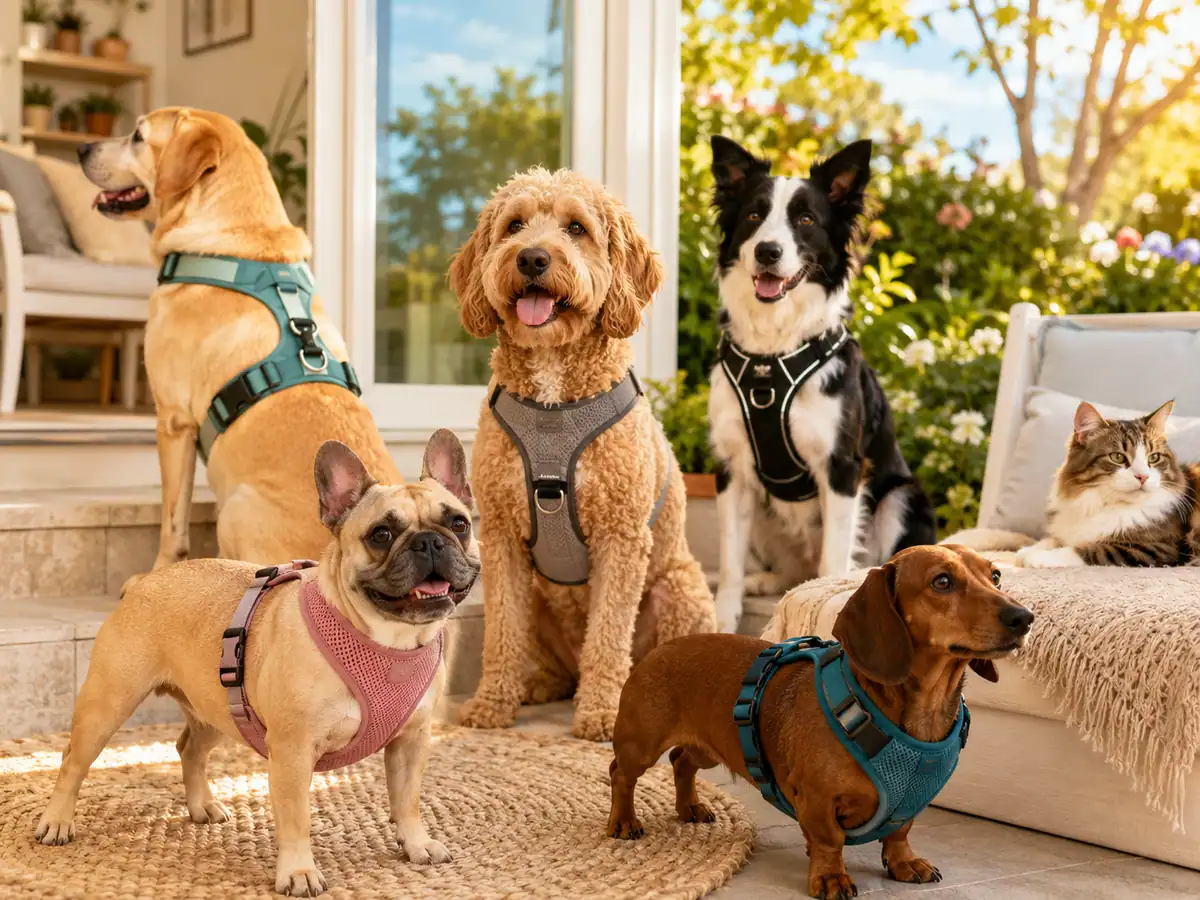
If your dog pulls
A front-clip harness gently turns the dog toward you when it surges forward, which reduces the payoff of pulling. It works best paired with reward-based loose-leash training rather than as a fix on its own. VCA describes the front clip as a way to use gentle leash pressure to turn a dog away from a distraction or back toward the handler.
Head halters are another option for large, strong dogs, but they need gradual introduction. VCA advises never using a head halter with a long line or retractable leash and never jerking the leash while one is fitted. We also avoid recommending prong or choke collars for pulling; VCA lists both among collars that can inflict considerable discomfort.
Measuring for a harness
Most harness size charts ask for chest girth, measured around the widest part of the ribcage just behind the front legs. Many also ask for neck size. Measure with a soft tape while your dog stands, and compare your figures with the adjustment range rather than the size name. If your dog sits between sizes, we suggest choosing the size that matches the chest and then adjusting the neck strap, because the chest loop has less room to compensate.
Weight-based charts are only a rough guide. Two dogs of the same weight can have very different chest shapes. Our collar sizing guide explains the same tape technique for the neck measurement.
Features worth paying for
Adjustment points at both the neck and the chest let you fit the harness to your dog's actual shape. VCA notes that a well-fitted harness should be adjustable in every dimension and should not rub behind the elbow. Padding helps on thin-coated dogs, but it should not be so thick that it traps heat.
A back handle helps with lifting a dog over obstacles or steadying it near traffic. Reflective stitching improves visibility in the dark. Metal rings are sturdier than plastic for strong dogs. Check that buckles lock firmly and that the leash ring is stitched with reinforced seams, since that point carries every pull.
Keep a collar for ID
A harness is not a substitute for identification. Many owners leave a lightweight collar with an ID tag on the dog and clip the leash to the harness. VCA also recommends removing a harness when you cannot supervise your dog, since it can become entangled. That means the collar is often the item that carries ID around the house. Our guide to when a dog should wear a collar covers those decisions.
Frequently asked questions
Is a harness better than a collar?
For dogs that pull, small breeds and dogs with neck or throat problems, a harness is usually the better leash attachment because it spreads pressure across the chest. Keep a collar on for ID.
Which harness is best for a dog that pulls?
A front-clip or dual-clip harness turns the dog toward you when it pulls. Use it together with reward-based loose-leash training.
How do I measure my dog for a harness?
Measure chest girth around the widest part of the ribcage just behind the front legs, and the neck if the chart asks for it. Compare your numbers with the adjustment range.
Can a harness hurt my dog's shoulders?
Some front-clip designs rest over the shoulder joints and restrict movement, according to VCA. Choose a Y-shaped front that leaves the shoulders free.
Should my dog wear a harness all day?
No. VCA advises removing a harness when your dog is not directly supervised because it can become entangled.
Choose with a short checklist
Decide the clip position based on your dog's walking behavior. Measure chest and neck. Choose a design with adjustment at both points and a shoulder-friendly front. After it arrives, fit it using the two-finger rule and try to pull it gently over the head to confirm it stays put.
Next, pair the harness with a suitable leash using our dog leash guide, or follow the step-by-step harness fitting guide once your harness arrives.