A small breed puppy fits in two cupped hands, yet it is building an entire adult body in well under a year. That speed is exactly why choosing a small breed puppy food deserves more thought than grabbing the cutest bag on the shelf. This guide explains what actually separates a good food for a tiny puppy from an ordinary one, how to read the label in under a minute, how often to feed, why skipped meals are riskier for toy breeds, and when to move on to adult food. Every number below comes from a named veterinary or regulatory source, and none of it replaces advice from the vet who knows your puppy.
In This Article
- Quick Answer: What Is the Best Small Breed Puppy Food?
- What Makes Small Breed Puppy Food Different?
- How Do You Read a Puppy Food Label?
- How Much and How Often Should a Small Breed Puppy Eat?
- Why Do Tiny Puppies Need Regular Meals?
- Is Wet or Dry Food Better for a Small Breed Puppy?
- When Should a Small Breed Puppy Switch to Adult Food?
- Which Foods and Treats Should You Avoid?
- What Do Owners Ask Most About Small Breed Puppy Food?
- Sources
Quick Answer: What Is the Best Small Breed Puppy Food?
The best small breed puppy food is a complete and balanced diet whose label says it meets AAFCO nutrient levels for growth or for all life stages, offered as small, frequent meals. Pick a kibble or wet food your puppy eats readily, feed by body condition rather than the bag alone, and confirm the plan with your vet.
Updated October 27, 2026- Must have: a nutritional adequacy statement for growth or all life stages, not maintenance only.
- Meal rhythm: several small meals a day while young, tapering as the puppy grows.
- Watch for: drowsiness, trembling or weakness between meals in toy breeds, which can signal low blood sugar.
- Switch timing: small breeds usually move to adult food months earlier than large breeds.
What Makes Small Breed Puppy Food Different?
Answer: Small breed puppies grow fast, reach adult size early and have little fat and muscle to fall back on between meals. A suitable food is complete and balanced for growth, comes in a form the puppy can eat comfortably, and is offered often enough that a tiny body never runs on empty for long.
The American Kennel Club treats dogs that weigh less than 20 pounds as adults as small breed dogs, and notes that these puppies grow quickly and may reach adulthood by 9 months. Large breed puppies, by contrast, can take 15 to 24 months to reach full size. Source: American Kennel Club, Puppy Feeding Fundamentals.
That compressed timeline changes what you need from the bowl. A small breed puppy is doing most of its growing in the first few months at home, so the food has to support growth from the first day, not just keep an adult body ticking over. It also means the window for getting habits right, such as a calm feeding spot and a predictable routine, is short. By the time many large breed puppies are still in their gangly phase, a Chihuahua or Toy Poodle may already be eating like an adult.
The other difference is reserve. A tiny puppy carries very little stored energy. Veterinary sources describe how very young or very small puppies, especially toy breeds, have limited fat and muscle mass and an immature liver, so they cannot store much glycogen and can use up their available glucose between meals. That is the practical reason meal frequency matters so much for this group, and we cover it in detail in the section on low blood sugar below.
Notice what is not on this list. There is no legal definition in the labeling rules that makes a bag "small breed" just because it says so on the front. The words that actually carry regulatory meaning sit in the nutritional adequacy statement on the back or side of the package. Marketing terms such as "small bites" or "tiny paws" can still be useful, because a smaller kibble may simply be easier for a small mouth, but treat them as convenience features and judge the food on its adequacy statement first. If you are still deciding on a breed, our guide to the AKC Toy Group breeds explains which dogs fall into the smallest size class, and the teacup Chihuahua guide covers the extra care very tiny dogs need.
How Do You Read a Puppy Food Label?
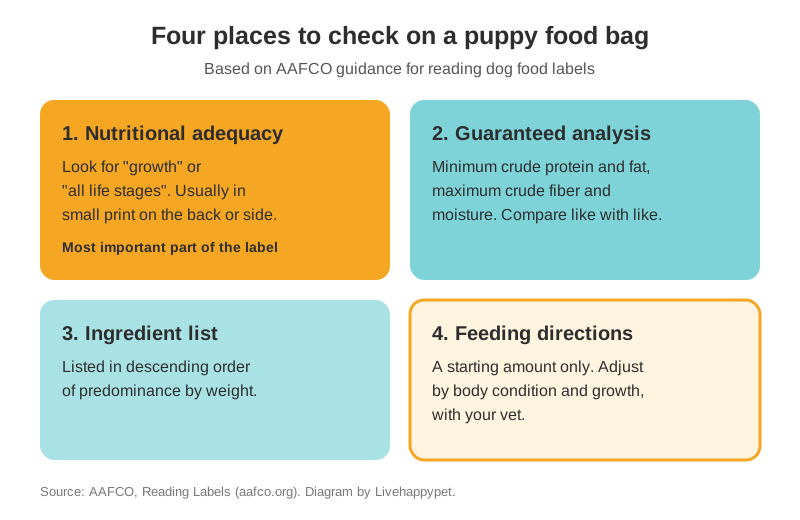
Answer: Start with the nutritional adequacy statement, which AAFCO calls perhaps the most important part of the label. It should name growth or all life stages. Then glance at the guaranteed analysis, the ingredient list in order of weight, and the feeding directions, which give you a starting amount to adjust.
The Association of American Feed Control Officials publishes model rules that most US states have adopted into their own laws, and federal FDA labeling requirements also apply to pet food sold across state lines. Under those models, a pet food label must show the product name, the species it is for, the net quantity, a guaranteed analysis, an ingredient statement, a nutritional adequacy statement for most complete foods, feeding directions and the name and address of the manufacturer or distributor. Source: AAFCO, Reading Labels.
The adequacy statement uses a standard format, which makes it easy to compare bags. The two common versions read either that the food "is formulated to meet the nutritional levels established by the AAFCO Dog Food Nutrient Profiles" for a named life stage, or that "animal feeding tests using AAFCO procedures substantiate" that the food provides complete and balanced nutrition for a named life stage. AAFCO recognizes four life stages: gestation and lactation, growth, maintenance and all life stages. "Complete" means every required nutrient is present, and "balanced" means the nutrients are in the correct ratios.
The guaranteed analysis lists four basic figures: minimum crude protein, minimum crude fat, maximum crude fiber and maximum moisture. "Crude" describes the lab method, not the quality of the ingredient. Because wet food is mostly water, you cannot compare a can and a bag of kibble on these raw percentages; compare dry with dry and wet with wet. The ingredient list runs in descending order of predominance by weight, and the feeding directions, required on most complete foods, are your starting point rather than a fixed rule.
How Much and How Often Should a Small Breed Puppy Eat?
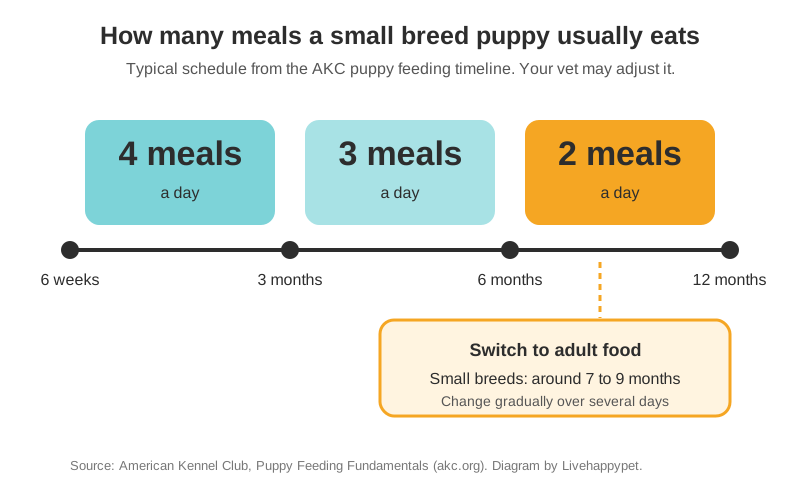
Answer: Most puppies eat four meals a day from about 6 to 12 weeks, three meals a day from 3 to 6 months and two meals a day after 6 months, according to the AKC. Portion size comes from the feeding directions, then gets adjusted by body condition, growth and energy, with help from your vet.Source: American Kennel Club, Puppy Feeding Fundamentals.
The AKC also notes that a puppy should be losing its potbelly and pudginess by about 12 weeks, and that if it is still roly-poly at that age you should keep feeding puppy-size portions until its body type matures. Rather than judging by whether the bowl is licked clean, watch body condition, growth and energy, and ask your vet to check whether adjustments are needed. Source: American Kennel Club, Puppy Feeding Fundamentals.
In practice, a simple routine helps a small puppy and the rest of the household. Here is a way to set it up:
- Pick fixed meal times that you can keep on weekdays and weekends alike.
- Weigh or measure the daily amount from the feeding directions once each morning, then split it into the day's meals.
- Count any training treats as part of the day and keep them small.
- Offer each meal in a quiet spot and lift the bowl after a set time so you can see how much was eaten.
- Note your puppy's weight and shape regularly and bring the notes to vet visits.
Food can also be enrichment. A shallow slow feeder dog bowl or one of the puzzle feeders for dogs sized for small mouths turns part of a meal into a short game, which pairs well with the toys for small breed puppies you already use for play.
Why Do Tiny Puppies Need Regular Meals?
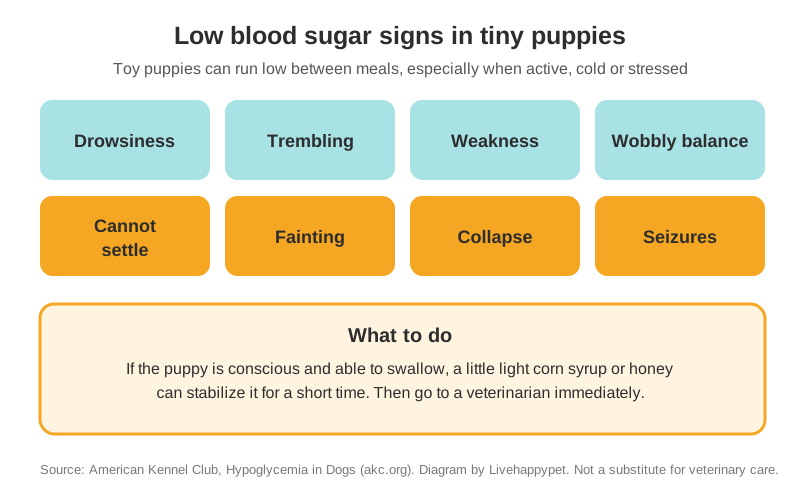
Answer: Very young and very small puppies, especially toy breeds, store little glycogen and can use up their available glucose between meals, particularly when they are active, cold or stressed. Regular small meals help prevent low blood sugar, a condition that can cause trembling, weakness, collapse or seizures and needs urgent veterinary care.
Low blood sugar, or hypoglycemia, is defined in dogs as a blood glucose level below 60 mg/dL, and signs tend to show once levels fall below roughly 40 to 50 mg/dL. The AKC lists drowsiness or lethargy, fainting, seizures, collapse, trembling and an inability to settle, along with weakness, muscle tremors, lack of balance and rapid breathing. Source: American Kennel Club, Hypoglycemia in Dogs.
The same source is clear about prevention: make sure tiny puppies do not go too long between meals, especially if they are active, stressed or cold, and keep xylitol out of reach, because that sweetener can trigger low blood sugar. The AKC's chief veterinarian adds that there is no special diet for dogs prone to hypoglycemia; in young puppies the recommendation is small, frequent meals as directed by a veterinarian, using a complete and balanced food appropriate for the puppy's age and growth.
Low blood sugar is one reason breeders and vets often suggest keeping a toy breed puppy's routine steady during the first weeks in a new home, when excitement, travel and new people can all add stress. Our guides on the Toy Poodle and toys for Chihuahuas include more on settling very small dogs into a household.
Is Wet or Dry Food Better for a Small Breed Puppy?
Answer: Neither is automatically better. The AKC says both wet and dry foods can provide complete nutrition when they are formulated for puppies. The right choice depends on your puppy's needs and preferences and on your vet's advice, and many owners use one as the base with a little of the other.
Dry kibble is easy to measure, store and use in puzzle toys, and the AKC notes that small dogs can usually manage unmoistened dry puppy food by 12 or 13 weeks of age. Wet food is soft, aromatic and often appealing to a picky eater. What matters most is that whichever you choose is complete and balanced for growth, and that you account for both in the daily amount if you mix them, so the puppy does not end up overfed. Source: American Kennel Club, Puppy Feeding Fundamentals.
Toppers and premium formats are optional extras, not requirements. If you are curious about them, our articles on dog food toppers, human-grade dog food and freeze-dried raw dog food explain what those labels mean, and the dog food subscription guide covers delivery options. Whatever format you use, the same rule applies: read the adequacy statement first.
When Should a Small Breed Puppy Switch to Adult Food?
Answer: The AKC says small breed puppies can usually move to adult food at around 7 to 9 months, while larger breeds stay on puppy food until 12 months or later. Spaying or neutering lowers energy needs slightly, so ask your vet about timing, and make the change gradually over several days.Source: American Kennel Club, Puppy Feeding Fundamentals.
The AKC's advice is to err on the side of caution: it is better to stay on puppy food a little too long than not long enough. When you do switch, a sudden change can upset the stomach and cause diarrhea, so mix the new food in gradually over a period of a few days. Your vet and your breeder can help judge the best moment based on your puppy's growth and breed.
A simple step-by-step switch looks like this:
- Confirm with your vet that your puppy has reached adult size and body shape.
- Choose an adult food whose adequacy statement says maintenance or all life stages.
- Start by replacing a small part of each meal with the new food.
- Increase the share of the new food over several days while watching the stool.
- Recalculate the daily amount from the new bag's feeding directions and keep checking body condition.
Which Foods and Treats Should You Avoid?
Answer: Keep table scraps limited, because the AKC warns that many human foods can upset digestion or be toxic to dogs. Keep xylitol, a sweetener found in some sugar-free gum and baked goods, completely out of reach. Treats are not complete diets, so count them in the daily amount and keep them small.
Treats, snacks and supplements are exempt from the nutritional adequacy statement under AAFCO's model rules, which is a quiet reminder that they are not designed to feed a puppy on their own. For a small breed puppy, a few treats can add up to a meaningful share of the day, so break training rewards into tiny pieces or use part of the regular kibble as rewards. Source: AAFCO, Reading Labels.
Chewing is also part of growing up. Instead of edible chews that may be too hard or too big for a tiny jaw, many owners rely on toys made for the purpose; our guides to puppy teething toys and small dog toys cover sizes and materials. As your puppy's adult teeth arrive, the dog dental powder guide explains where food-based dental products fit alongside brushing.
What Do Owners Ask Most About Small Breed Puppy Food?
Answer: Owners most often ask whether a small breed formula is required, how to tell if a food suits puppies, how often to feed, what to do about picky eating, and when to change foods. The short answers below are based on AKC and AAFCO guidance and should be confirmed with your own vet.
Do small breed puppies need a special small breed formula?
Not necessarily. What matters most is that the food is complete and balanced for growth or for all life stages, as shown in the nutritional adequacy statement. A smaller kibble size can make eating easier for a tiny mouth, but the words small breed on the front of a bag are not the part of the label that carries regulatory meaning.
How do I know if a food is suitable for puppies?
Find the nutritional adequacy statement, usually in small print on the back or side of the bag. AAFCO says it is perhaps the most important part of the label. For a puppy it should name growth or all life stages. A food labeled for maintenance only is meant for adult dogs.
How often should I feed my Chihuahua puppy?
The AKC says most puppies eat four meals a day between six and twelve weeks, three meals a day between three and six months, and two meals a day after six months. Very small toy breed puppies should not go too long between meals, so ask your vet whether your puppy needs extra small meals.
Can I give my small breed puppy adult dog food?
Not as the main diet while it is still growing. The AKC warns that feeding a growing puppy adult food robs it of important nutrients. Use a puppy food, or one labeled for all life stages, until your vet agrees your puppy has reached adult size.
What should I do if my small breed puppy will not eat?
Do not wait long with a toy breed puppy. Tiny puppies can use up their available glucose between meals, and the AKC lists drowsiness, trembling, weakness and collapse as signs of low blood sugar. If your puppy refuses food or shows any of these signs, call your veterinarian promptly.
When should a small breed puppy switch to adult food?
According to the AKC, small breed puppies can usually switch at around seven to nine months, while larger breeds stay on puppy food until twelve months or later. Spaying or neutering lowers energy needs slightly. Change foods gradually over a few days to avoid an upset stomach.
Is wet or dry food better for small breed puppies?
Both can provide complete nutrition when they are formulated for puppies, according to the AKC. Choose based on your puppy's needs and preferences and your vet's advice. If you mix wet and dry food, count both in the daily amount so the total does not creep up.
How do I know if I am feeding the right amount?
Use the feeding directions on the bag as a starting point, then watch body condition, growth and energy rather than whether the bowl is empty. The AKC notes that a puppy should be losing its potbelly by about twelve weeks. Your vet can tell you whether to adjust portions.