Brushing a dog's teeth every day is the gold standard, and most owners know it. Many also find it hard to keep up. That is why a dog dental powder, a fine powder you sprinkle on food once a day, has become a popular shortcut. This guide explains what these powders contain, what the published research and the Veterinary Oral Health Council (VOHC) list actually show, how a powder compares with brushing, chews and water additives, how to use one safely, and what no powder can do.
In This Article
- Quick Answer: What Is a Dog Dental Powder?
- What Is in a Dog Dental Powder?
- Does Dog Dental Powder Actually Work?
- Is Any Dental Powder VOHC Accepted?
- How Does Dental Powder Compare With Brushing, Chews and Water Additives?
- How Do You Use a Dog Dental Powder Safely?
- Is the Iodine in Kelp Powder a Concern?
- What Can a Dental Powder Not Do?
- What Are the Signs of Periodontal Disease in Dogs?
- How Do You Build a Home Dental Routine Around a Powder?
- What Do People Ask Most About Dog Dental Powder?
- Sources
Quick Answer: What Is a Dog Dental Powder?
A dog dental powder is a supplement you sprinkle on your dog's food each day to slow new plaque and tartar. Most popular powders are dried brown seaweed, Ascophyllum nodosum. Some have good evidence and a VOHC seal, but they work alongside brushing and vet cleanings, never instead of them.
Updated October 25, 2026- What it is: a daily food topper, usually kelp based, that works through the mouth and saliva rather than by scrubbing the teeth.
- Best evidence: placebo controlled dog trials on Ascophyllum nodosum products, plus a VOHC seal for specific powders. Check the current VOHC list for the exact product.
- Safety point: seaweed is rich in iodine. Talk to your vet first if your dog has thyroid disease, kidney disease, is pregnant or takes regular medication.
- Limits: a powder cannot remove tartar that has already formed or treat gum disease. That takes a professional cleaning under anesthesia.
What Is in a Dog Dental Powder?
Answer: Most dental powders for dogs are built on dried, ground brown seaweed called Ascophyllum nodosum, sometimes sold as kelp or knotted wrack. Some blends add other seaweeds, probiotics, enzymes or breath freshening herbs. You sprinkle a small scoop on food once a day, and the powder works after it is eaten, not by brushing the teeth.
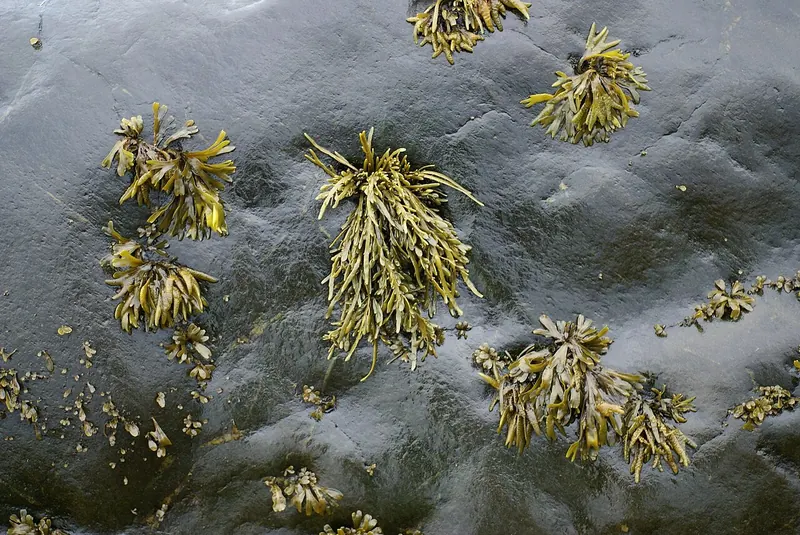
Ascophyllum nodosum is a brown seaweed that grows on rocky North Atlantic shores. A review by veterinary dentist Jerzy Gawor and pharmacologist Michał Jank describes it as a passive home dental care option that has been shown to reduce both plaque and calculus in dogs and cats after it is eaten. The same review is frank that the exact way it works is still unclear. Source: Gawor and Jank, Polish Journal of Veterinary Sciences review (PubMed).
One leading theory is that compounds from the seaweed reach the mouth through saliva and change the conditions in which plaque bacteria grow and plaque hardens. A placebo controlled study of a powdered product found that the saliva of dogs taking the seaweed changed in a clearly different direction from dogs given a placebo powder. That is a clue to how it might work, not proof of a mechanism. Source: Gawor et al., Frontiers in Veterinary Science (2021).
Because a dental powder is eaten, the label matters as much as the idea. Read the ingredient list, check whether it contains only seaweed or a blend, and note the scoop size and how it changes with your dog's weight. If a product does not list its seaweed species, or makes claims about curing gum disease, treat that as a warning sign. If you already add a dog food topper to meals, remember that a powder is one more thing in the bowl.
Does Dog Dental Powder Actually Work?
Answer: There is real, if limited, evidence. Placebo controlled trials in dogs found less plaque and tartar build up after a professional cleaning when dogs ate Ascophyllum nodosum products daily. The strongest published plaque and tartar trial used seaweed treats, not powder, and the maker funded it. Results apply to tested products, not every powder.
The best known trial followed sixty small breed dogs for ninety days after a full cleaning under anesthesia. Half got daily treats containing Ascophyllum nodosum and half got identical treats without seaweed. By day ninety, the seaweed group had a lower combined plaque index (1.67 versus 2.71 in the placebo group) and less calculus, plus fresher breath on a sulfur compound test. Source: Gawor et al., Frontiers in Veterinary Science (2018).
The authors reported that the calculus index fell by 35% by day 30 and that the reduction held for the rest of the study. They also disclosed that Sweden Care, the maker of the tested product, financed the study design and budget. That does not cancel the results, but it is a reason to want independent trials as well. Source: Gawor et al., Frontiers in Veterinary Science (2018).
For powder specifically, a 2021 double blind study gave sixty dogs either ProDen PlaqueOff powder or a cellulose placebo powder for 30 days after a professional cleaning. Its main goal was to measure changes in saliva chemistry, so it is better evidence for how the seaweed acts than for how much plaque it prevents. Source: Gawor et al., Frontiers in Veterinary Science (2021).
The 2023 review pulls these findings together. It concludes that, across the clinical trials in dogs and cats, the seaweed showed its strongest preventive effect as a powder, followed by dental bites and then dry food. It also notes that the only study of a curative effect, in cats, found no benefit, and it recommends starting the seaweed after a professional cleaning. Source: Gawor and Jank, review (2023), PubMed abstract.
Put simply, the research supports a dental powder as a way to slow the return of plaque and tartar on clean teeth. It does not support using one to clear tartar that is already there, or as a treatment for sore, red or receding gums.
Is Any Dental Powder VOHC Accepted?
Answer: Yes. The current VOHC list for dogs includes two food powders, both ProDen PlaqueOff products, accepted for both plaque and tartar. A third listed powder is mixed into drinking water rather than food. The seal belongs to the exact product listed, so a different seaweed powder does not inherit it.
The VOHC dog list groups powders with water additives, gels, sprays and toothpastes. When we checked it, ProDen PlaqueOff Powder from SwedenCare was listed for plaque and tartar, with the seal awarded in 2019. CEVA Clenz-A-Dent ProDen PlaqueOff powder for Dogs was listed for plaque and tartar, awarded in 2020. Vetradent Powder from Dechra was listed for tartar only, awarded in 2023, and the website names it a water additive. Source: VOHC, Accepted Products (dogs).
The seal is not a casual badge. VOHC grants it in two claim categories, helps control plaque and helps control tartar, and it requires two separate trials so the results can be repeated. For products with a chemical agent, the trials must show no increase in gingivitis and a reduction of plaque or tartar at or above the VOHC minimum standard. Source: VOHC, Protocols and Submissions.
Lists change, and many seaweed powders on store shelves are not on it. Before you buy, open the VOHC accepted products page and search for the exact product name on the pack. A seal on a sister product, such as a chew from the same brand, does not mean the powder itself has been accepted. VCA Animal Hospitals gives the same advice: look for the VOHC seal, which only appears on products shown to reduce plaque or tartar. Source: VCA Animal Hospitals, Dental Disease in Dogs.
How Does Dental Powder Compare With Brushing, Chews and Water Additives?
Answer: Brushing is still the most effective home care because it physically removes plaque. Dental chews and diets add chewing action, water additives and powders work passively through the mouth. A dental powder is the easiest option to give, suits dogs that refuse brushing, and adds no calories, but it is a helper, not a replacement.
VCA Animal Hospitals calls daily tooth brushing with a dog toothpaste the best way to prevent tartar, while noting that most owners do not manage it every day. It lists dental chews, treats, special diets and water additives as options that may help reduce or delay plaque and tartar. A food powder fits into that second group. Source: VCA Animal Hospitals, Dental Disease in Dogs.
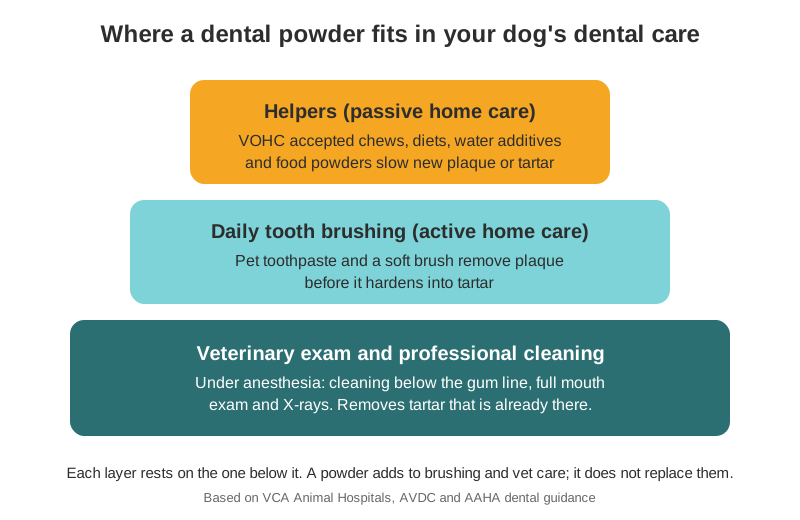
Many owners combine methods. A dog that tolerates brushing a few times a week might get a dental powder on the other days. A dog that will not accept a brush at all might get a powder daily plus a VOHC accepted chew. Our dog dental chews guide explains how to read chew labels and pick a safe size, and our dog toothbrush guide walks you through training a nervous dog to accept brushing step by step.
Chewing itself also matters for many dogs. Safe dog chew toys and rubber dog toys give a dog something appropriate to work on, and a lick mat can make a slow, calm routine out of a meal with a powder mixed into wet food.
How Do You Use a Dog Dental Powder Safely?
Answer: Start with a vet check and, ideally, a professional cleaning, so the powder works on clean teeth. Then give the exact scoop the label sets for your dog's weight, once a day, mixed into a meal. Introduce it slowly, never double the dose, and stop and call your vet if anything seems wrong.
- See your vet first. Ask whether your dog has existing tartar or gum disease that needs a cleaning, and whether a seaweed product suits your dog's health and medications.
- Pick the product carefully. Prefer a powder listed on the VOHC site, and confirm the seaweed species and the full ingredient list.
- Weigh your dog. Scoop size on these products is set by body weight, so use a current weight rather than a guess.
- Follow the label dose exactly. Use the scoop that came with the pack and do not add extra in the hope of faster results.
- Mix it into food. Sprinkle it on wet food or on lightly moistened kibble so it sticks and your dog eats it all.
- Start gradually if your dog is fussy. Begin with a small pinch and build up to the full scoop over several days.
- Be consistent and patient. Give it daily and judge results over weeks, with your vet looking at the teeth at the next check up.
Timing matters more than many owners expect. In the published dog trials, every dog had a full cleaning under anesthesia before starting the seaweed, and the review recommends starting after a professional cleaning. A dental powder started on teeth that already carry heavy tartar has nothing in the evidence to say it will clean them up. Source: Gawor and Jank, review (2023), PubMed abstract.
Keep the powder dry and sealed, and keep the scoop with the pack so the dose stays consistent. Watch for soft stools, vomiting or a sudden refusal to eat after you start. Those are reasons to stop and phone your vet. If you feed from a slow feeder dog bowl, mixing the powder into wet food first helps it reach your dog instead of settling in the grooves.
Is the Iodine in Kelp Powder a Concern?
Answer: It can be for some dogs. Ascophyllum nodosum is naturally high in iodine, which the thyroid gland uses. At label doses, healthy dogs in the trials stayed well under the safe limit the researchers cited, but dogs with thyroid problems or on thyroid treatment need a vet's approval before starting any seaweed product.
The 2018 trial measured this directly. The authors put the iodine content of the seaweed at 450 to 1,000 ppm and calculated that the daily treats supplied 16 to 32 micrograms of iodine per kilogram of body weight, an average of 18.7. They cited a safe upper daily limit for dogs of 170 micrograms per kilogram. Source: Gawor et al., Frontiers in Veterinary Science (2018).
The same paper only enrolled dogs with normal thyroxine levels and says that caution is needed in dogs with abnormal thyroid hormone regulation, or those on diet or drug therapy for an overactive or underactive thyroid, because the product contains significant amounts of iodine. Source: Gawor et al., Frontiers in Veterinary Science (2018).
Iodine also adds up. A dental powder sits on top of the iodine already in complete dog food, and some owners give other kelp or seaweed supplements without thinking of them as the same thing. Tell your vet about everything you add to the bowl. We did not find published studies on seaweed powders in pregnant or nursing dogs or in dogs with kidney disease, so for those dogs the safe move is to ask your vet before starting rather than assume it is fine.
What Can a Dental Powder Not Do?
Answer: A dental powder cannot remove hardened tartar, clean below the gum line, find broken or infected teeth, or treat periodontal disease. Those jobs need a veterinarian and a professional cleaning under general anesthesia. Veterinary dental specialists also warn against anesthesia free scaling, which only cleans what you can see.
VCA Animal Hospitals explains that once tartar has formed, professional scaling and polishing under general anesthesia are needed, because tartar cannot easily be removed by diets or brushing. A routine cleaning includes a full dental exam, scaling and polishing of every tooth surface, and blood tests beforehand to check the dog is fit for anesthesia. Source: VCA Animal Hospitals, Dental Disease in Dogs.
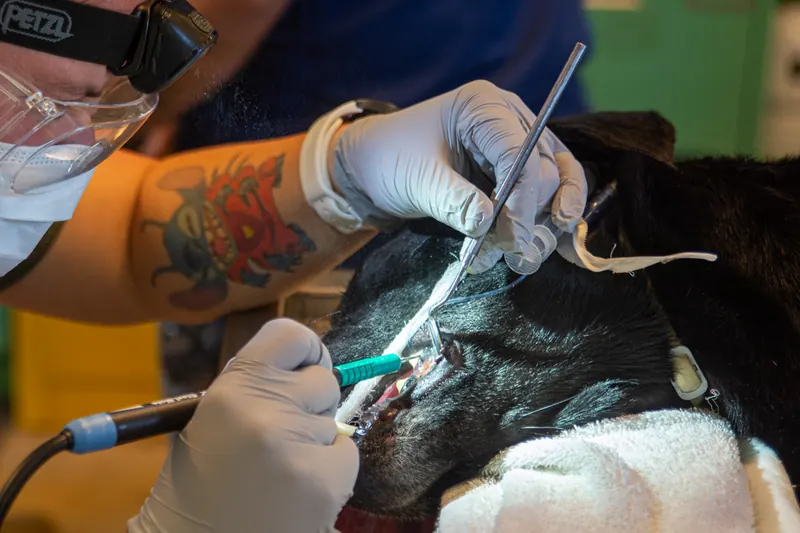
The American Veterinary Dental College is clear on cleanings done on awake pets, which it calls non-professional dental scaling. It says that cleaning the visible tooth surfaces has little effect on a pet's health and gives a false sense of accomplishment, because the disease is active below the gum line, an area that cannot be reached in an awake dog. It also notes that a complete oral exam is impossible without anesthesia. Source: AVDC, Dental Scaling Without Anesthesia position statement.
The AAHA dental care guidelines for dogs and cats, written for veterinary teams, take the same line. They cover the steps of an anesthetized cleaning, the science behind VOHC accepted home care products, and how to explain the risks of nonanesthetic dentistry to owners, stressing that periodontal disease can be prevented with regular dental exams and proper home care. Source: AAHA, 2019 Dental Care Guidelines for Dogs and Cats.
So the honest role of a dental powder is to help keep clean teeth cleaner for longer between professional cleanings. If a product promises to dissolve tartar, cure bad breath for good or make vet cleanings unnecessary, it is promising more than the evidence shows.
What Are the Signs of Periodontal Disease in Dogs?
Answer: Watch for bad breath, yellow or brown tartar, red or bleeding gums, drooling, dropping food, chewing on one side, pawing at the mouth or reluctance to eat hard food. Many dogs hide dental pain, so regular vet exams matter even when your dog seems fine. Any of these signs means a vet visit, not a supplement.
Dental disease is very common. VCA Animal Hospitals says that over 80% of dogs over the age of three have active dental disease, and that few dogs show obvious signs. When signs do appear, they can include pawing at the mouth, head shaking, jaw chattering, chewing with discomfort, dropping food, trouble swallowing, drooling, blood in the saliva and bad breath. Source: VCA Animal Hospitals, Dental Disease in Dogs.
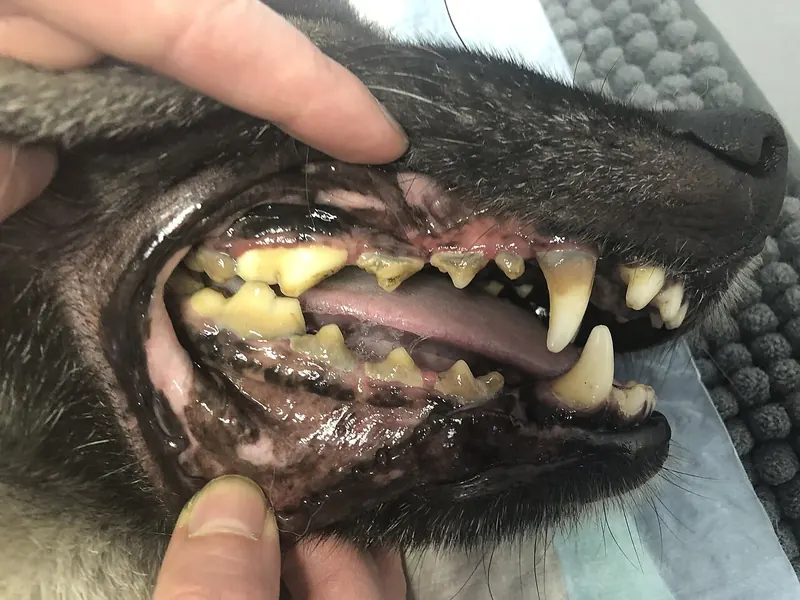
Gingivitis is the first stage of periodontal disease and the only stage that can be fully reversed. Small breeds and short nosed dogs are more prone to it because their teeth are crowded into small jaws. That makes early home care and regular checks especially useful for toy breeds. Source: VCA Animal Hospitals, Dental Disease in Dogs.
A quick home check takes a minute. Lift your dog's lip on each side and look at the back teeth, where tartar usually starts. Healthy gums are pink (or naturally pigmented) and sit snugly against the teeth. Red edges, swelling, bleeding, loose or broken teeth, or a strong smell are all reasons to book a vet visit before you start any dental powder.
Older dogs deserve extra attention, since dental disease tends to build with age. If your senior dog has become picky with hard food or toys, mention it to your vet, and consider softer options from our senior dog toys guide while you wait for the appointment.
How Do You Build a Home Dental Routine Around a Powder?
Answer: Start from a clean mouth after a vet check or professional cleaning. Brush as often as your dog allows, add a dental powder or another VOHC accepted helper daily, and book regular dental exams. Track breath, gum color and tartar once a week so you notice changes early and can tell your vet.
A realistic weekly plan for a busy household might look like this:
- Every day: the label dose of dental powder mixed into one meal, and a quick look at the gums while you praise your dog.
- Several times a week: short, positive brushing sessions, even if you only reach the outer surfaces of the back teeth.
- As treats: a correctly sized dental chew, counted as part of the daily calories.
- At every vet visit: a mouth check, and a professional cleaning under anesthesia when your vet recommends it.
Puppies are the easiest to train. Handling the mouth gently from an early age makes brushing and vet exams far less stressful later; our new puppy essentials list and puppy teething toys guide help with that stage. Always check the age limit on a dental powder label before giving one to a young dog.
Diet plays a supporting role too. Some complete foods are formulated as dental diets, and a few carry the VOHC seal. If you are reviewing what goes in the bowl, our guides to human grade dog food and premium pet food explain how to read labels, and fresh water from a clean dog water fountain or bowl supports overall health.
What Do People Ask Most About Dog Dental Powder?
Answer: Owners usually ask how long a powder takes to work, whether it removes tartar, whether it is safe every day, whether it can replace brushing, and what to do about thyroid concerns. The short answers below draw on the studies, the VOHC list and the veterinary sources listed at the end.
How long does a dog dental powder take to work?
It is a slow, preventive product. In the published dog trials, results were measured over weeks to a few months after a professional cleaning. Give it daily as the label directs and ask your vet to judge the teeth at the next check up rather than expecting a quick visible change.
Does dog dental powder remove existing tartar?
No. The research supports seaweed powders for slowing new plaque and tartar on clean teeth. Hardened tartar, especially below the gum line, has to be removed by a veterinarian during a professional cleaning under anesthesia.
Is it safe to give my dog dental powder every day?
Dental powders are designed for daily use at the label dose, and healthy dogs in the trials tolerated seaweed products well. Do not exceed the scoop for your dog's weight, and check with your vet first if your dog has thyroid or kidney disease, is pregnant or takes regular medication.
Can a dental powder replace brushing my dog's teeth?
No. Brushing removes plaque physically and is still the most effective home care. A powder is a passive helper that works alongside brushing, dental chews and regular vet cleanings, and it is most useful on days or for dogs where brushing is not possible.
Can dogs with hypothyroidism take kelp dental powder?
Only with your vet's approval. Seaweed such as Ascophyllum nodosum is rich in iodine, and the study authors advise caution in dogs with abnormal thyroid regulation or on thyroid treatment. Your vet may prefer brushing or a non seaweed product instead.
Is a VOHC seal on the brand enough?
No. The VOHC seal belongs to the specific product that passed its trials. Search the VOHC accepted products page for the exact name on the pack, because a chew or treat from the same brand being listed does not mean the powder is.
What if my dog will not eat food with dental powder on it?
Start with a small pinch mixed into wet food and increase slowly to the full dose over several days. If your dog still refuses, try a VOHC accepted water additive or chew instead, and keep working on brushing with lots of praise.
Can I use a dental powder for my cat too?
Only a product made and dosed for cats. Some seaweed powder brands sell separate cat versions, and the VOHC keeps a separate list for cats. Never share a dog product with a cat without checking the label and asking your vet.
Sources
- Gawor J, Jank M, Jodkowska K, Klim E, Svensson UK. Effects of edible treats containing Ascophyllum nodosum on the oral health of dogs. Frontiers in Veterinary Science, 2018
- Gawor JP, Wilczak J, Svensson UK, Jank M. Influence of dietary supplementation with a powder containing A.N. ProDen (Ascophyllum nodosum) algae on dog saliva metabolome. Frontiers in Veterinary Science, 2021
- Gawor J, Jank M. Ascophyllum nodosum as a nutrient supporting oral health in dogs and cats: a review. Polish Journal of Veterinary Sciences, 2023 (PubMed)
- Veterinary Oral Health Council: Accepted products
- Veterinary Oral Health Council: Protocols and submissions
- VCA Animal Hospitals: Dental disease in dogs
- American Veterinary Dental College: Companion animal dental scaling without anesthesia (PDF)
- American Veterinary Dental College: Anesthesia free dentistry information for pet owners
- AAHA: 2019 Dental care guidelines for dogs and cats
Healthy chewing, happy dogs
Browse our durable chew toys and dog essentials to support a daily care routine.
Shop dog essentials