Rubber earns its place in the toy box because it can pass VCA's fingernail test and still stand up to steady gnawing, but "rubber dog toy" covers everything from a squishy teething ring to a carbon-reinforced ring made for tough chewers. This page sorts six widely sold rubber toys by the kind of chewer they suit, lists what each maker actually states about its product, and pulls the safety rules from VCA Animal Hospitals, the AKC, the ASPCA, and the U.S. Consumer Product Safety Commission into one checklist you can use in the store aisle.
How this guide was built: we did not lab-test these toys. Every material, size, and guarantee detail in the table comes from the manufacturer's own product page, linked in the table, and every safety rule links to the veterinary or government source it came from. Where a claim is ours (for example, which chew style a toy fits), we say so.
Quick Answer: Which Rubber Dog Toy Fits Your Dog?
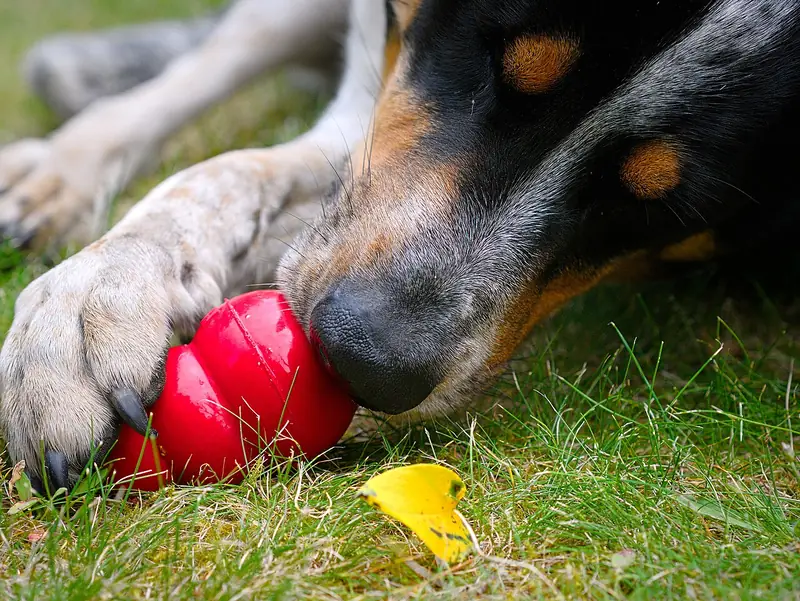
- Average chewer who likes food puzzles: a stuffable natural rubber toy such as the KONG Classic, sized so it cannot fit entirely in the mouth.
- Power chewer: a denser formula (KONG Extreme) or a solid natural rubber ring with a replacement guarantee (Goughnuts), used under supervision.
- Fetch-driven dog: a thick-walled rubber ball like the Chuckit! Ultra Ball instead of a tennis ball, because the AKC notes tennis-ball fuzz wears teeth down.
- Puppy: a rubber toy sold specifically as a puppy or teething toy, since the AKC points out a power chewer can tear chunks off softer rubber.
If your dog swallows a piece of any rubber toy, call your veterinarian. Rubber does not digest, and the ASPCA case described in the safety section below ended in intestinal surgery.
Rubber Dog Toy Brands Compared
The six toys below are widely sold rubber products; KONG, Benebone, and Ruffwear each rank their own rubber collections in US search results for this keyword. The "best for" column is our reading of each maker's own description; the remaining columns quote or paraphrase the linked manufacturer page as of September 2026.
| Toy | Material (maker's words) | Best for | Notable detail from the maker |
|---|---|---|---|
| KONG Classic | Natural red rubber formula | Average chewers, stuffing and freezing | Made in the USA from globally sourced materials; power chewers are told to go up one or two sizes or switch to KONG Extreme |
| KONG Extreme | Black natural rubber formula | Power chewers who still need a food puzzle | Described as KONG's most durable rubber, designed for "the toughest of chewers" |
| Goughnuts Ring | 100% natural rubber, molded in Modesto, California | Supervised power chewing | Colored solid rings hide a red safety layer; once red shows, the toy comes away, and the guarantee replaces a chewed-through toy |
| Ruffwear Gnawt-a-Cone | Natural latex rubber | Small to medium dogs that fetch and lick | One size, 3 x 4 inches; internal treat chamber; top-rack dishwasher safe |
| Chuckit! Ultra Ball | Extra-thick rubber core | Fetch on land and in water | Built for high bounce and buoyancy; it floats |
| Benebone Bounce | Natural rubber | Interactive play such as tug and toss | Sold as its own natural rubber collection on the Benebone site, so check the product name before you buy |
Two patterns stand out. First, the makers of the toughest options (KONG Extreme, Goughnuts) still say "supervised" on their own pages; no rubber toy is sold as unsupervised-safe for a determined chewer. Second, a one-size toy like the Gnawt-a-Cone is a sizing risk for big dogs, because VCA's first rule is that a toy should never fit entirely in the mouth. For a KONG versus nylon head-to-head, see our KONG vs Nylabone comparison.
Match the Rubber Toy to How Your Dog Chews
Durability ratings on packaging are not standardized, so the more reliable approach is to watch your own dog for a week and put it in one of four groups. VCA puts it plainly: some dogs tear even rubber toys apart in minutes, so choose toys you know can withstand your dog's bite force.
Gentle mouthers
These dogs carry toys around, lick them, and rarely leave tooth marks. A softer rubber toy with a treat opening is plenty. The main risk is size rather than breakage, so buy for the dog's mouth, not for its weight class.
Average chewers
Many adult dogs fall here: they gnaw steadily, leave marks, but do not take pieces off. This is the group the KONG Classic is built around. Filling it with food turns ten minutes of chewing into a longer job, which is where rubber beats plush and rope. Our rubber vs plush vs rope comparison covers when the other two materials make more sense.
Power chewers
If your dog has ever removed a chunk from a rubber toy, treat it as a power chewer from now on. Size up, move to a denser formula, and pick a toy with a visible wear signal such as the Goughnuts red layer. Our tough chew toys for large dogs guide covers non-rubber options for this group too.
Fetch specialists
Retrievers and herding breeds often care more about the chase than the chew. A thick rubber ball survives repeated catches and does not carry the abrasive felt that the AKC warns about in its tennis ball safety article, where a board-certified veterinary dentist describes the fuzz acting like sandpaper on teeth.
What Makes a Rubber Toy Last
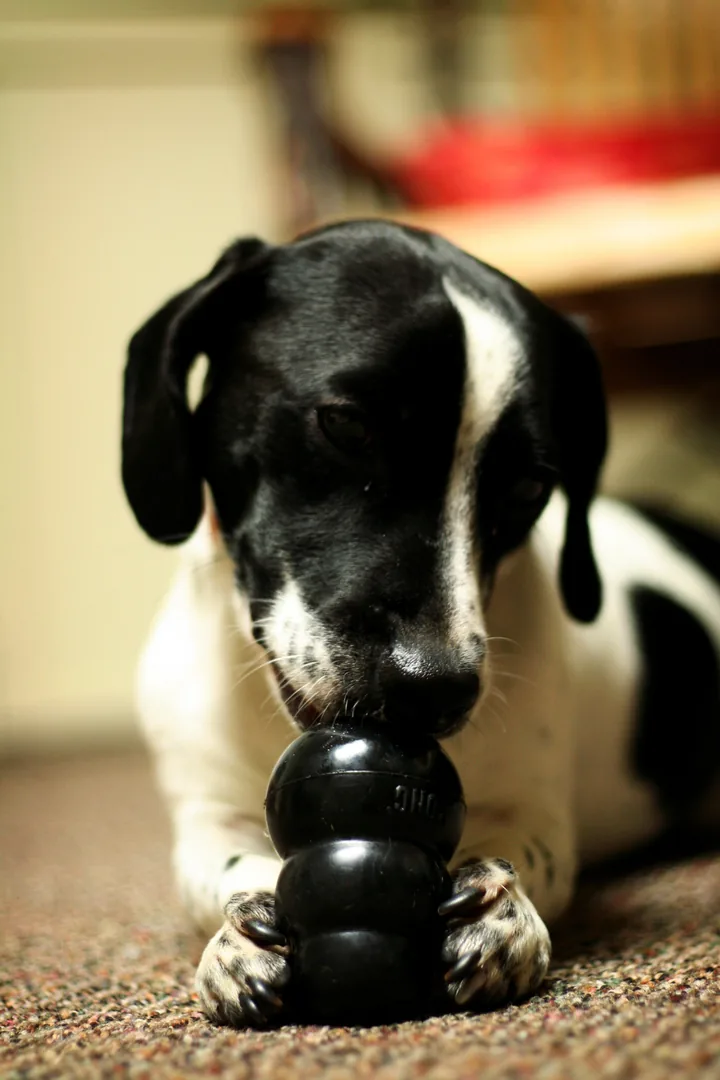
Three physical features predict how long a rubber toy survives, and you can check all three in the shop without a spec sheet.
- Wall thickness. Squeeze the toy. Thin walls that fold flat under your thumb will split along the fold line under a strong jaw. A thick-walled toy flexes but springs back.
- Solid versus hollow. Hollow toys are what make stuffing possible, but the hollow is also where cracks start. Solid rings and sticks trade the food puzzle for longevity.
- Size relative to the jaw. A toy that fits between the back molars takes the dog's full crushing force. That is why KONG tells power chewers to go up one or two sizes rather than simply buying a "tougher" toy in the same size.
When to retire a rubber toy: remove it as soon as pieces are coming off, when a crack runs through the wall, when a wear indicator becomes visible, or when the toy has worn small enough to disappear into your dog's mouth. VCA adds a simple habit that catches most problems early: always supervise, and take the toy away if your dog is chewing off chunks.
Rubber Material Safety: What the Experts Say
No single agency certifies dog toys, which is why the checklist below is drawn from several named sources rather than a label.
- Pet toys have no chemical rules of their own. VCA Animal Hospitals notes that there are no specific rules about which chemicals can be used in pet toys, and that some cheap toys are colored with paint or ink that may contain toxic levels of lead. Unpainted rubber from a maker that names its material is the safer bet.
- The fingernail test. VCA's chew toy guide says a toy should be soft enough to indent with a fingernail; toys that are too hard can chip and even fracture teeth. Good rubber passes this test easily, which is one of its main advantages over bone, antler, and hard nylon.
- No add-ons. The same VCA guide warns against ribbons, eyes, and other removable parts that can be swallowed or inhaled. Plain molded rubber has none.
- Swallowed rubber is a surgical problem. The ASPCA reported the case of Apo, a six-year-old American bully mix who stopped eating and began vomiting; an X-ray found a whole rubber duck lodged in his small intestine, and it was removed surgically. A rubber toy that is small enough to swallow is not a chew toy for that dog, however soft it is.
- Skip batteries in chew toys. The U.S. Consumer Product Safety Commission recalled about 15,400 Pet Zone Laser Pointer and LED Ball pet toys in August 2025 because the light-up ball could break on impact and expose button cell batteries. A plain rubber toy has nothing inside to break open, which is one more reason to keep light-up gadgets out of the chew rotation.
- Choose chews made for the job. The ASPCA's position statement on dog chews says larger, durable products are appropriate for large breeds and aggressive chewers who might otherwise quickly consume a toy.
For a wider look at labels such as "BPA-free" and what they do and do not promise, read our non-toxic dog toys guide. If the natural versus synthetic rubber question matters to you, our natural rubber dog toys page goes deeper on that one material.
Rubber Toys for Puppies and Senior Dogs
The AKC's advice on what puppies can safely chew is to give options designed specifically for puppies, and it notes that a power chewer might tear chunks off a softer rubber toy while a gentle dog might prefer a squishier texture. In practice that means buying a puppy-labeled rubber toy for a teething puppy, then reassessing the moment adult teeth are in, because a growing strong chewer will outgrow soft puppy rubber quickly. Our best chew toys for puppies list covers the teething window in more detail.
Older dogs are the reverse case. Worn or missing teeth make the fingernail test more important, not less, and a lighter hollow rubber toy filled with soft food is often easier on an aging mouth than a dense ring.
How to Stuff and Freeze a Rubber Toy
Stuffing is what separates a rubber toy from every other material, and KONG's own product pages recommend stuffing its toys and freezing them for a longer-lasting challenge. A simple routine:
- Plug the small hole with a piece of a dog biscuit or a dab of something sticky so the filling cannot leak out.
- Fill with part of your dog's normal meal mixed with a little of a wet food they like. Using the regular ration avoids adding calories, a point the ASPCA stresses for treats in general.
- Seal the large opening with a firmer layer, then freeze standing upright in a cup or on a plate.
- Wash the toy after each use. Food residue left in the hollow is the main hygiene issue with stuffable rubber.
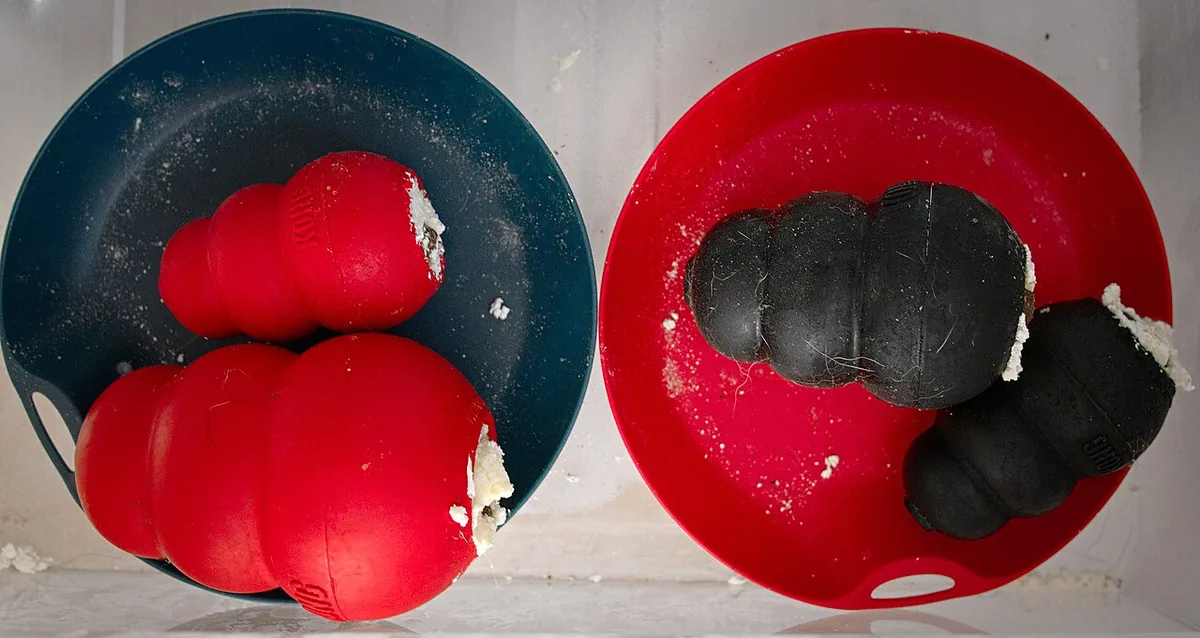
Rotating two or three stuffed toys keeps one always ready in the freezer. Our toy rotation guide explains how to fit rubber toys into a wider weekly rotation.
Rubber Dog Toys: Frequently Asked Questions
Are rubber toys safe for dogs?
Yes, when the toy is large enough that it cannot fit entirely in your dog's mouth, has no removable parts, and is soft enough to dent with a fingernail, which are the three checks in VCA Animal Hospitals' chew toy guide. Supervise use and remove the toy once pieces start coming off.
Is natural rubber better than synthetic rubber for dogs?
Natural rubber is the material KONG, Goughnuts, Ruffwear and Benebone name for the toys in our table, and it tends to flex rather than splinter. Because VCA notes there are no specific chemical rules for pet toys, the practical advantage is transparency: pick a maker that names its material and avoid painted or unlabeled budget toys.
What happens if my dog swallows a piece of a rubber toy?
Call your veterinarian right away, especially if your dog stops eating or starts vomiting. Rubber does not break down in the gut. In a case reported by the ASPCA, a dog that swallowed a rubber duck needed surgery to remove it from the small intestine.
What size rubber toy should I buy?
Choose a size your dog cannot fit completely in its mouth, then go bigger if your dog is a strong chewer. KONG's own guidance tells power chewers to go up one or two sizes or move to its Extreme formula.
Which rubber toy is best for a power chewer?
Look for a dense formula or a solid design with a wear signal, such as the KONG Extreme or a Goughnuts ring with its red safety layer, and use it under supervision. Both makers still describe their toughest toys as supervised-use products.
Can I put a rubber dog toy in the dishwasher?
Many can go on the top rack, for example Ruffwear lists its Gnawt-a-Cone as top-rack dishwasher safe, but check the maker's care instructions for your specific toy. Clean stuffable toys after every use so food does not sit inside the hollow.
Build a Balanced Toy Box
Pair one rubber chew with a softer comfort toy and a rope for tug. Our dog toy range ships free within the US.
Browse Dog Toys →