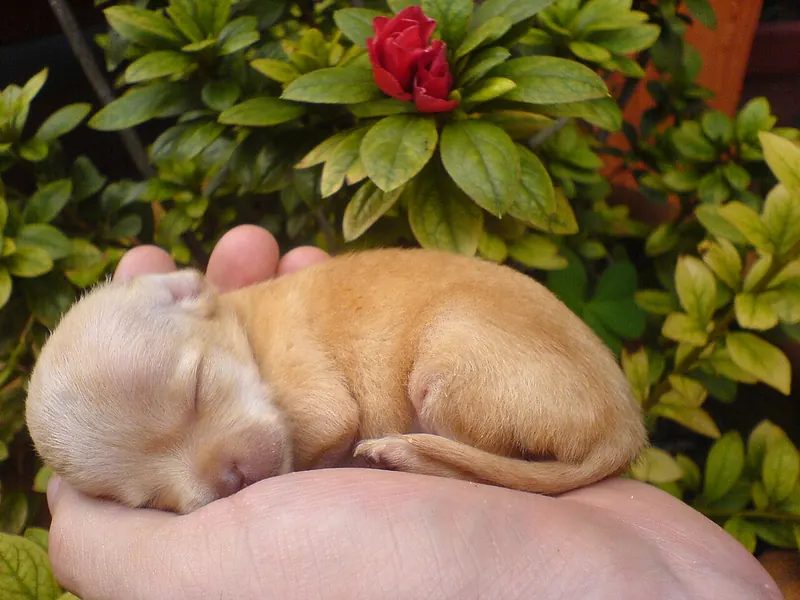
Top photo: a two-month-old female Chihuahua puppy in Coacalco, Mexico. Photo: Cvmontuy / Wikimedia Commons, CC BY 4.0 (resized and converted to WebP).
Quick Answer: Should You Buy a Teacup Chihuahua?
There is no such thing as an official "teacup" Chihuahua. The AKC standard describes one breed, in Smooth and Long coats, that should not exceed 6 pounds, and the Chihuahua Club of America calls teacup and similar size labels incorrect and misleading. If you want a small Chihuahua, look for a healthy puppy from a breeder you can visit in person, do not pay extra for a size label, and be ready for the extra care very small puppies need, especially regular meals to prevent low blood sugar.
What "Teacup" Really Means
"Teacup" is a sales word, not a breed or a size class. The official AKC breed standard describes the Chihuahua as "a well balanced little dog not to exceed 6 pounds" and lists "any dog over 6 pounds in weight" as a disqualification. It sets a maximum, not a minimum, and it names only two varieties: Smooth Coat and Long Coat. The AKC breed page gives the same weight ("not exceeding 6 pounds") and a life expectancy of 14 to 16 years.
The Chihuahua Club of America's official Teacup Statement is blunt about it. The club says its standard "does not categorize the Chihuahua by size," that labels such as Teacup, Pocket Size, Tiny Toy, Miniature, or Standard "have been misused for so long they now seem legitimate," and that it "does not endorse nor condone the use of any of these terms."
Why the Label Should Not Raise the Price
The same Teacup Statement explains why the labels exist: the club is "concerned that these terms may be used to entice prospective buyers into thinking that puppies described in this way are of greater monetary value. They are not." It adds that an unusually small puppy in a litter "is a small Chihuahua and any other breakdown in description is not correct."
We do not quote puppy prices, because they vary by region and seller and cannot be verified from here. The practical rule is simple: compare puppies on health, temperament, and how they were raised, never on a size word. If one puppy costs more only because it is called "teacup," that premium is buying a label, not a better dog.
The club also says, fairly, that very small puppies "are adorable and can be perfectly healthy," but that buyers "should be cautioned as to the extra care that may be required." The next section covers what that care looks like.
Health Risks of Very Small Puppies
Smaller is not automatically less healthy, but a few problems are well documented in toy breeds and in very young toy puppies. Knowing the signs is the most useful thing a new owner can do.
Low blood sugar (hypoglycemia)
The AKC's guide to hypoglycemia explains that it "can occur in very young or very small puppies, especially young toy puppies," because limited fat and muscle and an immature liver mean they cannot store enough glycogen. Puppies "can deplete their available glucose between meals, especially if they're active, cold, or stressed."
Signs listed by the AKC include drowsiness or lethargy, trembling, weakness, lack of balance, fainting, collapse, and seizures. AKC Chief Veterinarian Dr. Jerry Klein notes that the puppies he sees with it are often very young (under 12 weeks), newly acquired, and toy-breed types, and that owners usually do not recognize the problem. His advice for small puppies is that corn syrup or honey given by mouth can temporarily stabilize them, "but they should then be taken to veterinarian immediately." For prevention, the AKC recommends that tiny puppies not go too long between meals, with small, frequent meals as directed by your veterinarian.
Hydrocephalus
VCA Animal Hospitals describes hydrocephalus as excess cerebrospinal fluid inside the skull that can lead to brain swelling, and lists the Chihuahua among the small and toy breeds that "seem to be more affected." Signs in puppies include a dome-shaped skull, a large soft spot, eyes that appear to gaze downward, abnormal walking, circling, head pressing, vision loss, and trouble with house-training or basic commands. A puppy showing these signs needs a veterinary exam.
Slipping kneecaps (patellar luxation)
According to VCA, many toy and small-breed dogs, including the Chihuahua, have a genetic predisposition for a medial luxating patella. Owners may notice a skip in the dog's step, or the dog running on three legs and then suddenly back on four. Ask the breeder whether the parents' knees have been checked, and ask your vet to check your puppy's.
Dental disease
VCA calls periodontal disease the most common disease in pet dogs and says small breeds are more prone to it "due to the small size of their jaw and crowding of the teeth." Plan for regular dental checks and home tooth care from puppyhood.
The Soft Spot (Molera): Normal or Not?
Many Chihuahuas have a soft spot on top of the head called a molera. The AKC standard describes the skull as an "apple dome," "with or without molera," so it is not a fault. The Chihuahua Club of America's Molera Statement says that "the presence of a molera does not mean the Chihuahua has a medical problem." VCA likewise notes that "not all puppies with large fontanelles will develop hydrocephalus."
The takeaway: a molera alone is not a reason to walk away from a puppy, but neurological signs like those listed above are a reason to see a vet, and you should handle the top of a tiny puppy's head gently.
Where to Buy, and Where Not To
We do not sell puppies, and we do not recommend or rank individual breeders. These steps come from Humane World for Animals' guide to finding a responsible dog breeder and hold up wherever you look:
- Consider a shelter or rescue first. Humane World for Animals suggests starting there, and with an adult dog you already know its size.
- Avoid pet stores and online-only sellers. The same guide says, "You don't want to buy a puppy from a pet store or a website," because most of those puppies come from mass breeding facilities.
- Get referrals. Ask your veterinarian or trusted friends, contact local breed clubs, or visit dog shows. The Chihuahua Club of America is the national breed club in the United States.
- Always visit in person. See where the puppy was born and raised before you pay anything. A responsible breeder will want to meet and interview you too.
- Walk away from size marketing. A seller who leads with "teacup," "micro," or a guaranteed tiny adult weight is using exactly the labels the breed club calls misleading.
Online Puppy Scam Red Flags
If you search to buy a teacup Chihuahua online, scams are a real risk. In its Puppy Scams 2025 Study Update, the Better Business Bureau lists the word "teacup" in an advertisement as one of its red flags for puppy scams. These are the warning signs the BBB and the Federal Trade Commission describe:
- A price that looks too good. The BBB flags popular breeds "available for incredibly low prices," and the FTC warns about purebred puppies advertised "for a few hundred dollars when they often cost thousands."
- No visit and no video call. The BBB lists a seller who "refuses to meet in person or take a video call" as a red flag.
- Surprise fees after you pay. Watch for "extra charges for cages, vaccinations and other shipping costs," another BBB red flag.
- Payment you cannot get back. The FTC says, "Only scammers say you must pay with gift cards, a payment app, cryptocurrency, or a wire transfer service."
- Pressure to decide fast. The FTC notes scammers push you "to act fast before they've gone to other homes," and the BBB flags high-pressure tactics.
Before you pay anything, the BBB suggests you see the puppy in person, set up a video call, run a reverse image search on the ad photos, and research the breed's usual market price. Search the seller's name with words like "review," "scam," or "complaint," as the FTC suggests. If you spot a scam, you can report it to the FTC at ReportFraud.ftc.gov.
Questions to Ask Before You Pay
- How old is the puppy, and how much does it weigh now? Very young toy puppies are the group most at risk of low blood sugar.
- What and how often is the puppy eating? Ask for the current feeding schedule so you can keep it steady after the move.
- Can I meet the mother, and the father if possible? Parents give a better hint of adult size and temperament than any label.
- What health checks have the parents and puppy had? Ask about knees, teeth, and a veterinary exam record for the puppy.
- What happens if I cannot keep the dog? Get any agreement in writing.
Preparing Your Home for a Tiny Dog
- Book a vet visit in the first days. Your veterinarian will set vaccines and parasite control and can check for the issues above.
- Keep meals regular and the puppy warm. The AKC links low blood sugar in tiny puppies to long gaps between meals, especially when the puppy is active, cold, or stressed. A soft, enclosed sleeping spot such as a small round plush bed helps a little dog curl up and stay cozy.
- Prevent falls and squashes. Block off stairs, and teach children to sit on the floor to hold the puppy rather than carrying it around.
- Plan house-training. Small puppies have small bladders. An indoor potty tray can help on cold or rainy days.
- Choose toys sized for a tiny mouth. Soft, light toys that are still too big to swallow are the safest bet. Our guide to the best toys for Chihuahuas covers sizes and materials, and chew toys for teething puppies helps when the baby teeth start coming out.
Frequently Asked Questions
Is a teacup Chihuahua a separate breed?
No. The AKC standard recognizes one Chihuahua breed in two coat varieties, Smooth and Long, and does not divide it by size. The Chihuahua Club of America calls labels such as teacup, pocket size, and tiny toy incorrect and misleading.
How big is a teacup Chihuahua supposed to be?
There is no official teacup size. The AKC breed standard says a Chihuahua should not exceed 6 pounds and sets no minimum weight. A seller's teacup label tells you nothing that the standard does not already cover.
Is a teacup Chihuahua worth a higher price?
The Chihuahua Club of America says these size terms are used to make buyers think a puppy has greater monetary value, and that it does not. An unusually small puppy is simply a small Chihuahua, and it may need extra care.
What health problems should I watch for in a very small Chihuahua puppy?
The AKC notes that very young toy-breed puppies are prone to low blood sugar (hypoglycemia). VCA lists the Chihuahua among breeds more affected by hydrocephalus and among small breeds predisposed to luxating kneecaps, and says small breeds are more prone to dental disease. Ask your veterinarian to check your puppy soon after you bring it home.
Does a soft spot on my Chihuahua's head mean something is wrong?
Not by itself. The soft spot is called a molera and the AKC standard allows it. The Chihuahua Club of America says its presence does not mean the dog has a medical problem, and VCA notes that not all puppies with large fontanelles develop hydrocephalus. Signs such as circling, head pressing, or trouble learning are reasons to see a vet.
How can I avoid a teacup Chihuahua scam online?
See the puppy in person or on a live video call before paying, run a reverse image search on the ad photos, and never pay by gift card, payment app, cryptocurrency, or wire transfer. The BBB counts the word teacup in an ad, very low prices, and surprise shipping or crate fees among its puppy scam red flags.
Sources
- American Kennel Club, Official Standard of the Chihuahua (PDF) and Chihuahua breed page
- Chihuahua Club of America, Official Teacup Statement and Official Molera Statement
- American Kennel Club, Hypoglycemia in Dogs: Signs, Symptoms, and Treatments
- VCA Animal Hospitals, Hydrocephalus in Toy Breed Puppies, Luxating Patella in Dogs, Dental Disease in Dogs
- Humane World for Animals, How to find a responsible dog breeder
- Better Business Bureau, Puppy Scams 2025 Study Update (archived copy)
- Federal Trade Commission, Getting a pet? Avoid scams (December 16, 2024; archived copy)
This article is general information, not veterinary advice. Talk to your veterinarian about your own dog's health, feeding, vaccines, and medications. Livehappypet sells toys and accessories; we do not sell or broker puppies.
Getting Ready for a Little Dog?
Soft beds, potty trays, and toys for small dogs. Free US shipping on every order.
Browse Dog Toys & Accessories →