A PetSafe wireless fence is an electronic containment kit that keeps a dog inside an invisible circle around your home without digging or burying wire. A transmitter plugged in indoors sends out a radio signal, and a receiver collar on your dog beeps, then gives a static correction, if your dog walks past the edge. This guide explains how the system works, compares the current PetSafe models, walks through setup and training, and covers who should not use one.
In This Article
- Quick Answer: Is a PetSafe Wireless Fence Right for Your Dog?
- How Does a PetSafe Wireless Fence Work?
- Which PetSafe Wireless Fence Models Can You Buy?
- How Do You Choose Between the PetSafe Wireless Kits?
- What Are the Limits of a Circular Wireless Boundary?
- How Do You Set Up a PetSafe Wireless Fence?
- How Do You Train a Dog to a Wireless Fence?
- How Does a Wireless Fence Compare With Wired, GPS and Physical Fences?
- Which Dogs Should Not Use a Wireless Fence?
- How Do You Maintain a PetSafe Wireless Fence?
- What Do People Ask Most About PetSafe Wireless Fences?
- Sources
Quick Answer: Is a PetSafe Wireless Fence Right for Your Dog?
A PetSafe wireless fence suits a calm, trainable dog in a fairly flat, open yard of up to about three quarters of an acre, where a circular boundary fits the space. It sets up in an afternoon and travels with you. Choose a wired or GPS fence for odd shaped or larger land, and skip electronic containment for anxious dogs.
Updated October 11, 2026- The boundary is always a circle. You can make it bigger or smaller, but not square.
- It is a training tool, not a barrier. It only works after about two weeks of daily boundary lessons.
- Start on tone only. Every PetSafe receiver has a beep only mode; use the lowest setting your dog responds to.
- It does not keep other animals out. Stray dogs and wildlife can still walk into your yard.
How Does a PetSafe Wireless Fence Work?
Answer: An indoor transmitter broadcasts a radio signal in a circle around itself, and the area inside that circle is your dog's safe zone. As your dog nears the edge, the receiver collar sounds a warning tone; if your dog keeps going, it delivers a static correction. There is no digging, and the transmitter only needs a power outlet.
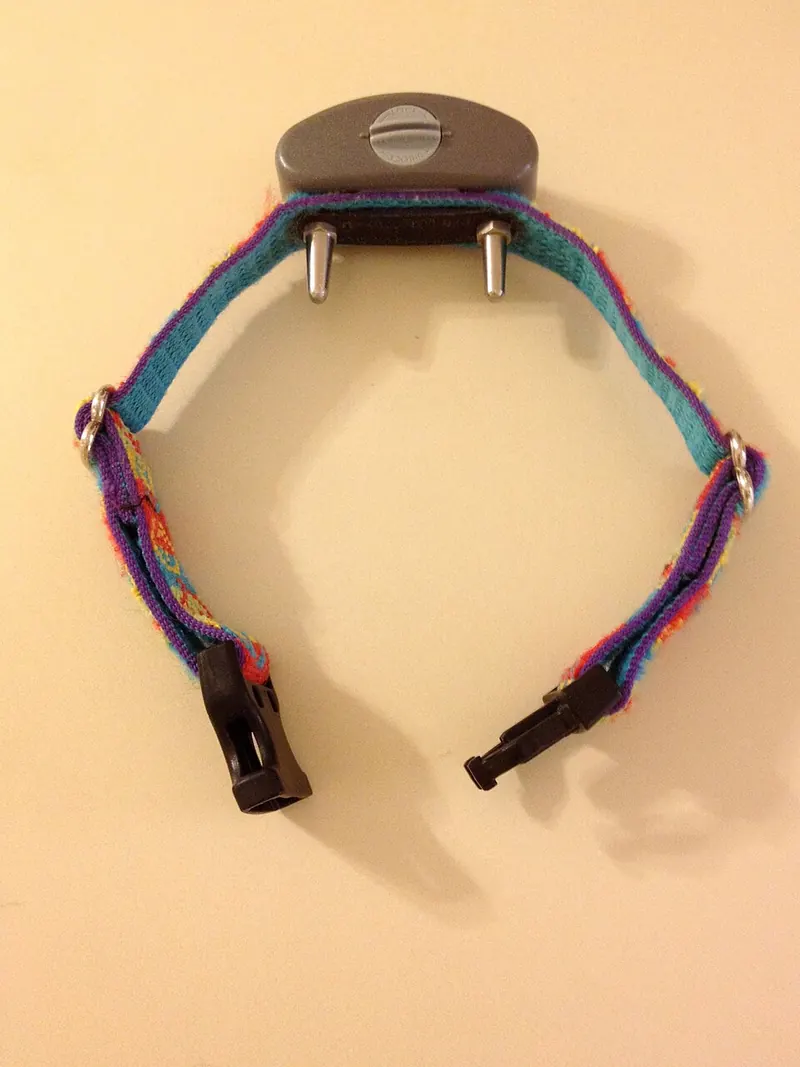
Every PetSafe wireless kit has the same three parts: a transmitter with a power adaptor, a receiver collar and a bag of white training flags. You plug the transmitter in somewhere central inside the house, turn a dial or press buttons to set how far the signal reaches, and the system draws an invisible ring around that point. Because the signal spreads out evenly, the safe zone is always round, centered on the transmitter.
The receiver collar constantly listens for the signal. While your dog is well inside the circle, nothing happens. Near the edge, the collar beeps as a warning. If your dog ignores the beep and keeps walking, the collar gives a short static correction through two metal contact points that touch the skin. PetSafe says most of its wireless systems let a dog that has slipped out walk back in without another correction, so coming home is never punished. Source: PetSafe, Wired vs. Wireless vs. GPS Dog Fence.
The key point to understand before buying is that nothing physical stops your dog. The fence works only because your dog has learned that the beep means turn back. PetSafe's own guide describes every one of its containment systems as a training tool, not a physical barrier, and that is the most honest way to think about it.
Which PetSafe Wireless Fence Models Can You Buy?
Answer: PetSafe currently sells four transmitter based wireless kits: the Stay and Play Compact Wireless Fence, the Stay and Play Wireless Fence with Replaceable Battery Collar, the Stay and Play Wireless Fence for Stubborn Dogs, and the older Wireless Pet Containment System. The Stay and Play kits cover larger yards; the older system costs more but covers less ground.
The table below summarizes the four kits as PetSafe lists them. The biggest practical differences are coverage, the collar's power source and the smallest dog each kit is meant for. Sources: PetSafe product pages for the Stay and Play Compact, Replaceable Battery, Stubborn Dogs and Wireless Pet Containment System kits.
All four kits share the core features: a tone only mode plus five adjustable levels of static correction, a waterproof receiver, setup in one to two hours, and support for as many dogs as you buy extra collars for. Every kit is for dogs at least six months old. Source: PetSafe wireless pet fences.
Prices are PetSafe's own list prices on the day we checked and change often, so compare them with authorized retailers before you buy. If your dog is small, check the minimum weight carefully: the older Wireless Pet Containment System is listed for dogs of 8 lb and up, while the Stay and Play kits start at 5 lb. Sources: PetSafe Wireless Pet Containment System, PetSafe Stay and Play Compact.
How Do You Choose Between the PetSafe Wireless Kits?
Answer: Start with your yard size, then decide how you feel about charging. The Compact kit is the default pick for most homes because it covers the most ground with the smallest transmitter and a rechargeable collar. Choose the replaceable battery kit if you dislike charging, and the stubborn dog kit only if a trainer agrees your dog needs it.
Most buyers can narrow the choice with three questions. First, how big is the space? Measure from where the transmitter will sit to the farthest point you want your dog to reach. The Stay and Play kits reach further than the older system. Source: PetSafe Stay and Play Compact.
Second, do you want to charge a collar or swap batteries? A rechargeable collar saves on batteries but has to be charged regularly, and a dog wearing a flat collar is not contained. A battery collar runs for weeks between changes, but you need to keep spare batteries in the house.
Third, how does your dog respond to training? The stubborn dog kit exists for dogs that ignore lower correction levels, but a stronger correction is rarely the right first answer. If your dog regularly blows through boundaries, a session with a qualified trainer is a better investment than a stronger collar. Our guides to dog training collars and e collars for dogs explain how correction levels work in more detail.
- Small or medium yard, most dogs: Stay and Play Compact Wireless Fence.
- You hate charging gadgets: Stay and Play with Replaceable Battery Collar.
- Very small dog: one of the Stay and Play kits, which PetSafe lists for lighter dogs.
- Strong willed dog: talk to a trainer first, then consider the stubborn dog kit.
What Are the Limits of a Circular Wireless Boundary?
Answer: The safe zone is always a circle centered on the transmitter, so it will not follow a rectangular lot or a driveway. Metal, such as a metal roof, siding or a camper, can also weaken the signal. Narrow, long or sloping yards and homes close to a road are usually better served by a wired or GPS fence.
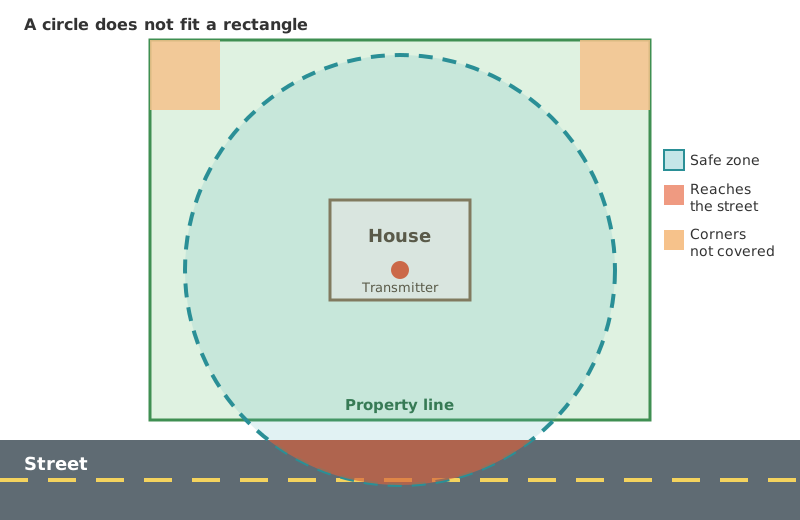
PetSafe states plainly that its wireless boundaries are circular and cannot be changed into a square or rectangle; you can only make the circle larger or smaller. That matters more than most buyers expect. On a typical rectangular suburban lot, a circle big enough to reach the back of the yard may also spill across the front lawn toward the street, while a circle small enough to stay off the street may leave the back corners unused. Source: PetSafe Wireless Pet Containment System FAQ.
Metal is the second limit. PetSafe advises keeping the transmitter at least 3 feet from metal objects and warns that a metal RV or a building with a metal roof can shrink the maximum boundary. Large appliances, foil backed insulation and metal siding can have a similar effect, so test the edge with the collar before training. Source: PetSafe travel FAQ.
Terrain is the third. Radio boundaries are most predictable on fairly flat, open ground. Steep slopes and dense obstacles can make the edge less consistent, which confuses a dog that is still learning. If you need more room than one transmitter gives, PetSafe says you can add a second transmitter and overlap the two circles by at least 30 feet. Source: PetSafe.
How Do You Set Up a PetSafe Wireless Fence?
Answer: Place the transmitter indoors near the center of the area, away from metal, and plug it in. Set the boundary size, then walk outward with the collar until it beeps and plant a training flag there. Repeat all the way around, fit the collar so the contact points touch skin, and test the edge before you begin training.
PetSafe says setup takes one to two hours. The steps are the same for every kit; the exact buttons differ, so keep the quick start guide nearby. Source: PetSafe guide.
- Pick the transmitter spot. It must sit indoors in a climate controlled room. Choose a central point on the ground floor, on a table rather than the floor, clear of appliances and metal shelving.
- Set the size small first. Start with a boundary comfortably smaller than the yard and increase it later. A circle that is too large is the most common setup mistake.
- Charge or fit the battery. Charge a rechargeable collar fully, or insert the battery in a battery collar, and choose tone only mode.
- Find the edge. Hold the collar at your dog's neck height and walk slowly outward. When it beeps, step back until it stops and plant a flag.
- Flag the whole circle. Repeat every few steps all the way around. The flags show your dog, and you, exactly where the boundary is.
- Check for gaps. Walk the line again with the collar to make sure the edge is consistent, especially near the house and any metal structures.
- Fit the collar. The contact points must touch the skin. You should be able to slide one finger under the strap, no more.
Choose the right contact points for your dog's coat. Kits include short and long contact points, and long haired dogs usually need the longer ones to reach the skin. Remove the receiver collar when your dog comes indoors, and check the skin under the contact points every day for redness or sores.
How Do You Train a Dog to a Wireless Fence?
Answer: Train in short, daily, leashed sessions over at least two weeks. Walk your dog along the flags in tone only mode, and every time the collar beeps, guide your dog back into the yard and reward with a treat and praise. Add distractions slowly, move to supervised off leash time, and remove the flags gradually over the following weeks.
PetSafe says that with consistent training most dogs learn the new boundary in about two weeks, and its containment guide suggests a three stage plan. Keep sessions short, ten to fifteen minutes, so your dog stays relaxed and focused. Sources: PetSafe Stay and Play Compact, PetSafe containment guide.
Pair the fence with reward based training. The American Veterinary Society of Animal Behavior recommends that only reward based methods be used for dog training and warns that aversive methods can harm welfare and the bond between dog and owner. Using tone only mode, and keeping any correction at the lowest level that gets your dog's attention, keeps the fence as close to that standard as possible. Source: AVSAB Position Statement on Humane Dog Training.
Never leave a dog alone outside with only a wireless fence until training is complete, and ideally not for long periods even then. Teach a solid recall as a backup, and keep a regular dog leash and collar by the door so you can bring your dog back quickly if it ever crosses the line.
How Does a Wireless Fence Compare With Wired, GPS and Physical Fences?
Answer: A wireless fence is the quickest to set up and most portable, but only makes circles and suits smaller open yards. A wired in ground fence follows any shape and covers far more land but must be buried. A GPS fence handles large, irregular properties with open sky. Only a physical fence also keeps other animals out.
PetSafe sells all three electronic types, and its own comparison is a useful starting point. Wired systems cover up to 25 acres in any shape but take a weekend or more to install, while GPS systems start at about half an acre. Source: PetSafe, Wired vs. Wireless vs. GPS.
If GPS appeals, PetSafe's Customizable GPS Dog Fence needs no subscription and fits dogs of 20 lb and up, while the Guardian GPS 2.0 adds live tracking but requires a paid plan and cellular coverage. GPS boundaries can drift under dense trees, so they are not a cure for every yard. Our GPS dog collar and dog GPS tracker guides explain the technology. Sources: PetSafe Customizable GPS Dog Fence, PetSafe Guardian GPS 2.0.
A physical fence remains the safest choice whenever escape would be dangerous. It is the only option that keeps loose dogs, coyotes and people out as well as keeping your dog in, and it does not depend on a charged collar.
Which Dogs Should Not Use a Wireless Fence?
Answer: Skip electronic containment for puppies under six months, anxious or noise sensitive dogs, dogs with aggression toward people or other dogs, dogs with a very strong chase drive near a road, and dogs with heart or skin conditions unless your vet approves. For these dogs, a physical fence, a secure run or supervised leash time is safer.
PetSafe sets a minimum age of six months for all its wireless kits and explains that a puppy should reliably respond to basic commands such as come and sit before training with any static correction collar. Source: PetSafe FAQ.
Temperament matters as much as age. A nervous dog may link the beep or correction with whatever it was looking at, such as a child, a neighbor's dog or a delivery driver, which can make fear or reactivity worse. A dog with a strong prey drive may run through the line while chasing a squirrel and then refuse to come back across it. If your dog has a history of anxiety, our anxiety in dogs guide is a better place to start than any containment gadget.
Cats are a separate case. PetSafe sells cat collars for some systems, but its own guide says wireless is not the best fit for most cats and recommends a vet conversation first. A breakaway cat collar and supervised time in a cat harness are usually simpler options.
How Do You Maintain a PetSafe Wireless Fence?
Answer: Keep the collar charged or the battery fresh, check the contact points and skin every day, and test the boundary edge with the test light tool monthly or after moving the transmitter. Keep the transmitter indoors. Replace worn straps, and recheck the circle whenever you add metal furniture, a shed or a vehicle near the house.
A dead collar means no fence, so make power part of your routine. PetSafe says its rechargeable Stay and Play collar charges in two to three hours and lasts about three weeks per charge, while battery collars use an RFA-67 battery that lasts roughly one to two months depending on use. Set a calendar reminder rather than relying on memory. Sources: PetSafe Stay and Play Compact, PetSafe Replaceable Battery kit.
The transmitter must stay in a fully indoor, climate controlled spot. PetSafe gives an operating range of minus 10 to 104 degrees Fahrenheit, so a cold garage or a hot attic is not suitable. Source: PetSafe FAQ.
Check your dog's neck daily. Pressure from the contact points can cause irritation if the collar is left on too long or fitted too tightly, so take it off indoors and at night, and wash the neck area and contact points regularly. A waterproof everyday collar for tags, like those in our waterproof dog collar guide, should be a separate collar, not the receiver strap. For walks outside the boundary, switch to a regular lead and dog harness.
Finally, remember travel. Because the transmitter is portable, you can set up a temporary safe zone at a cabin or campsite with an outlet, but re-flag the new circle and repeat a few days of training, since your dog will not know where the new edge is.
What Do People Ask Most About PetSafe Wireless Fences?
Answer: Owners most often ask how far the fence reaches, whether the boundary shape can change, whether it works for cats, how long training takes, whether it is safe, what happens if the dog runs through it and whether it can be used while traveling. The short answers below cover each question, based on PetSafe's published product information.
How far does a PetSafe wireless fence reach?
The Stay and Play kits cover up to three quarters of an acre, a circle reaching about a hundred feet out from the transmitter. The older Wireless Pet Containment System covers up to half an acre.
Can I change the shape of the wireless boundary?
No. PetSafe wireless boundaries are always circular. You can make the circle larger or smaller, but for a square, narrow or irregular yard a wired or GPS fence fits better.
How long does it take to train a dog to a wireless fence?
PetSafe says most dogs learn the boundary in about two weeks of short daily sessions. Keep the training flags in place for longer and remove them gradually.
Is a wireless dog fence safe for my dog?
Used carefully it can be, but it relies on an aversive correction. Start in tone only mode, use the lowest level your dog responds to, pair it with rewards, and do not use it on anxious or reactive dogs.
What happens if my dog runs through the boundary?
The collar warns and corrects as your dog crosses the edge. PetSafe says most of its wireless systems let your dog walk back in without another correction, but you still need to go and bring your dog home.
Can I use a PetSafe wireless fence for a cat?
PetSafe sells cat collars for some systems, but its own guide says wireless is not the best fit for most cats. Talk to your vet first, and consider a breakaway collar and supervised harness time instead.
Can I take a PetSafe wireless fence on vacation?
Yes. The transmitter is portable and works anywhere with an indoor outlet. Keep it a few feet away from metal, re-flag the new boundary and repeat a few days of training at the new place.
Does a wireless fence keep other animals out of my yard?
No. It only affects a dog wearing a receiver collar. Stray dogs, wildlife and people can still enter, so use a physical fence if keeping other animals out matters.
Sources
- PetSafe: Stay and Play Compact Wireless Fence
- PetSafe: Stay and Play Wireless Fence with Replaceable Battery Collar
- PetSafe: Stay and Play Wireless Fence for Stubborn Dogs
- PetSafe: Wireless Pet Containment System
- PetSafe: Wired vs. Wireless vs. GPS Dog Fence
- PetSafe: Customizable GPS Dog Fence
- PetSafe: Guardian GPS 2.0 Dog Fence
- American Veterinary Society of Animal Behavior: Humane Dog Training Position Statement
Gear for a safe, happy yard
Browse collars, harnesses and toys that keep outdoor time fun.
Shop dog accessories