An e-collar, or remote training collar, is one of the most argued-about pieces of equipment in dog ownership. It is also frequently confused with two other things: the plastic cone worn after surgery, which shares the name, and a GPS containment collar, which does something different. This guide separates those, explains what the modes actually do, sets out where the law restricts them, and covers what most trainers would have you try first.
Three Different Products Share This Name

The Elizabethan collar is the plastic or fabric cone a vet sends home after surgery to stop a dog reaching stitches. It is a medical recovery device, it involves no electronics, and it is what a large share of people searching for an e-collar actually need. If you are here after a vet visit, that is the product, and it is sized by neck circumference and snout length.
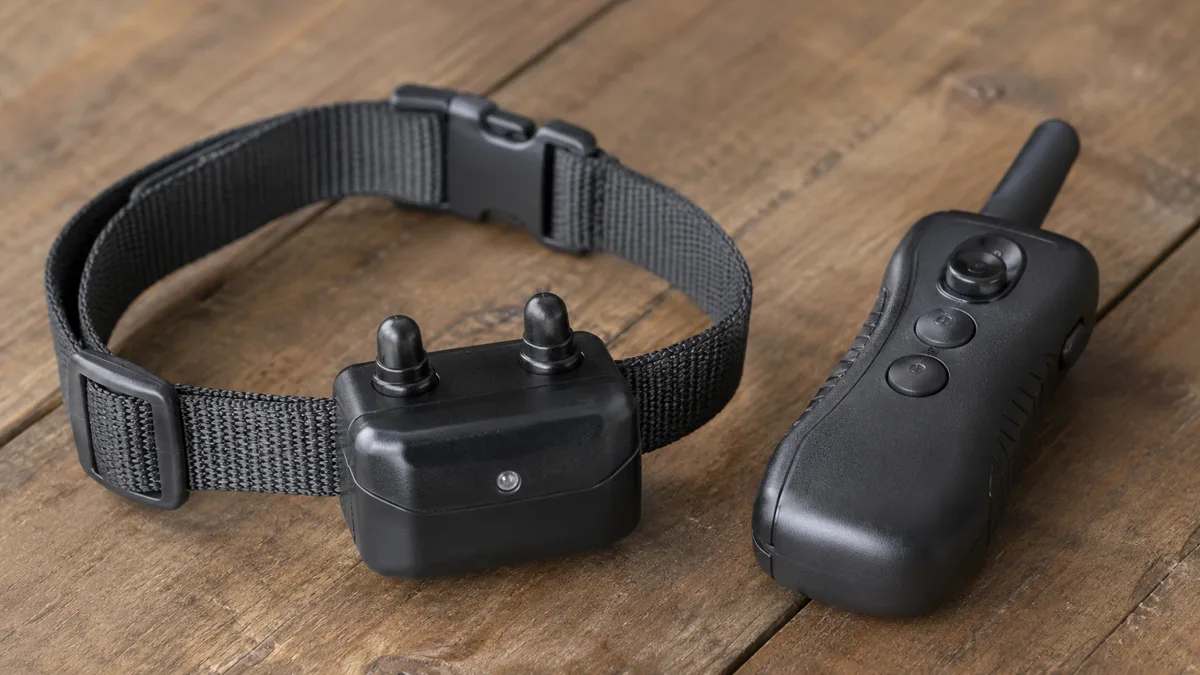
The remote training collar is the electronic device this guide is mostly about. It has a receiver on the dog’s neck and a handheld transmitter, and it delivers a tone, a vibration, or a static stimulation when the handler presses a button. It is a training tool used at a distance, and its use is genuinely contested among professionals.
The GPS containment collar is the third product. It uses satellite positioning and a virtual boundary to warn a dog approaching the edge of a property, and while some models include a static option, its purpose is containment rather than distance training. Confusing it with a remote trainer leads to buying a tool that does not do the job you had in mind.
What the Modes Do and How They Differ
Tone is a sound marker. It carries no aversive component by itself and works only because the dog has been taught what it predicts, which makes it functionally similar to a whistle or a clicker used at a distance. Many handlers who own e-collars use tone alone for the majority of their work.
For more expert recommendations, check out our dog with harness guide.
Vibration is a physical buzz on the neck, and reactions to it vary far more than owners expect. Some dogs treat it as a neutral tap and respond calmly; others find it more startling than a brief static pulse. It is the primary mode used for deaf dogs, where a sound marker is not available.
Static stimulation is an electrical sensation delivered through two contact points, adjustable across a wide range of levels. At the low end it is described as a tingle at the threshold of perception; at the high end it is unambiguously aversive. This is the mode that drives both the regulation and the controversy, and it is the one that requires competent instruction rather than a manual.
Fit, Skin, and the Injury Owners Cause by Accident
Pressure necrosis is the well-documented injury from these collars, and it comes from wear time and strap tension rather than from the electronics. Contact points pressed into one spot for hours restrict blood flow to the skin, and the resulting sores can be severe. The standard guidance is to limit continuous wear to a few hours, reposition the receiver regularly, and never leave one on overnight.
Fit has to be snug enough for reliable contact and no snugger. A collar loose enough to rotate produces inconsistent stimulation, which is worse for the dog than none at all because the signal becomes unpredictable. Check the skin under the contacts every time the collar comes off and stop entirely at the first sign of redness that does not fade.
Test on yourself before you test on your dog. Every reputable manufacturer expects handlers to feel the levels on their own forearm, and doing so tends to permanently change how casually people use the high end of the dial. Never leave a transmitter where a child can reach it.
Age, Temperament, and When Not to Use One at All
Puppies are not candidates. A dog that has not yet learned what a cue means cannot be corrected for ignoring it, and applying aversive stimulation during the fear periods of early development risks lasting associations with whatever the puppy happened to be looking at. Foundation training comes first, by a wide margin.
You might also find our elizabethan collar article helpful when shopping.
Fearful, anxious, and reactive dogs are the group where these tools most often make things worse. If the underlying behaviour is driven by fear, adding an unpleasant sensation to the situation the dog already fears tends to deepen the association rather than interrupt it. Behaviour rooted in anxiety belongs with a qualified behaviourist, not with equipment.
Senior dogs bring thinner skin, reduced hearing, and often some cognitive decline, all of which change how the tool lands. A senior that has stopped responding to a recall may be losing hearing rather than choosing to ignore you, and the correct response to that is a vet check and a visual or vibration cue, not more stimulation.
How Responsible Handlers Actually Use One
Every competent protocol starts with conditioning rather than correction. The dog is taught the cue thoroughly on a long line first, so that the recall is already reliable in a low-distraction setting before any collar is introduced. The collar is then used to reinforce a known cue at distance, not to teach an unknown one.
Levels are found individually and quietly. Handlers start at the lowest setting and increase in single steps until the dog shows the smallest observable acknowledgement, an ear flick or a head turn, and then work at or just below that level. Working at a level that produces a yelp, a tuck, or freezing is a sign the process has gone wrong.
Timing decides whether the tool teaches anything. Feedback delivered more than a second or two after the behaviour is not connected to it by the dog, and a badly timed correction teaches confusion. This is the specific skill that makes hands-on instruction from an experienced trainer worth more than any product feature.
Where This Goes Wrong Most Often
Buying one to stop barking, then leaving it on all day. Continuous wear is the direct route to pressure sores, and automatic bark collars fire on the wrong triggers routinely, including on other dogs barking nearby. Barking driven by isolation or anxiety is not solved by suppressing the sound.
Looking for more options? Our e collar roundup covers additional top picks.
Using a high level from the start because a low one produced no visible reaction. The absence of a reaction is the goal at the working level, not evidence of failure. Escalating quickly is how dogs learn to be afraid of the equipment, the handler, or the location.
Skipping the instruction. This is the mistake that underlies the other two. These are the only common training tools where the major professional bodies specifically warn against unsupervised use, and the difference between a handler who has been taught and one who has read a manual is visible in the dog within a week.
What You Should Be Spending Money On

A professional trainer is a better first purchase than a collar. Several sessions with an experienced instructor costs a comparable amount to a mid-range unit and addresses the actual problem, which is usually a recall that was never proofed against distraction.
If you do buy hardware, buy range and reliability rather than features. A unit with a stable connection, clearly separated levels, and controls you can operate without looking is worth more than one with a screen full of modes. Cheap units with coarse level steps are the ones that jump from imperceptible to painful in a single press.
Budget for the long line and the harness too, because that is where the training actually happens. A fifteen-metre line and a well-fitted harness let you practise recall safely for months, and many households find they never need the collar they were about to buy.
Law, Guidance, and Alternatives Worth Trying First
Check your local law before you buy, because this varies sharply by country and region. Wales banned the use of electronic shock collars on dogs and cats in 2010, and several other jurisdictions have introduced or debated restrictions since. Regulation in this area changes, so confirm the current position with your own government or veterinary authority rather than with a retailer.
Understand where the major welfare and veterinary organisations stand. Groups including the RSPCA and a number of veterinary behaviour associations recommend against aversive electronic training tools and point to reward-based methods as both effective and lower risk. That does not settle the argument, but it is context worth having before you decide.
Try the alternatives properly first. A long line with a well-fitted harness gives you physical safety while a recall is being built, a vibration-only collar covers deaf dogs and dogs that cannot hear a whistle at distance, and structured reward-based recall training resolves the majority of the problems that send people looking at e-collars in the first place.
E Collar for Dogs: Feature Comparison
The table below separates the three products that share the e-collar name, because buying the wrong one is the most common error in this category.
Frequently Asked Questions
Is an e-collar the same as a cone?
No, though they share the name. An Elizabethan collar is the plastic cone a vet sends home to stop a dog reaching stitches. A remote training e-collar is an electronic device with a handheld transmitter used as a training cue at distance.
Are e-collars legal?
It depends where you live. Wales banned the use of electronic shock collars on dogs and cats in 2010, and other jurisdictions have introduced or debated similar restrictions. Rules change, so check the current position with your national or regional authority before buying.
Does the static setting hurt?
It depends entirely on the level. At the lowest settings most people describe a tingle at the edge of perception, and at high settings it is clearly aversive. Manufacturers expect handlers to test the levels on their own forearm first, and working level should produce no more than a small acknowledgement from the dog.
Can I use one on a puppy?
No. A puppy that has not yet learned a cue cannot be corrected for ignoring it, and aversive stimulation during early development risks lasting fear associations. Build foundation training and a reliable recall on a long line first.
How long can a dog wear one?
Only a few hours at a time, with the receiver repositioned regularly and never left on overnight. Contact points pressed into one spot restrict blood flow and can cause serious pressure sores, which is the best-documented physical risk of these collars.
Will it stop my dog barking?
Automatic bark collars suppress the sound without addressing the cause, and they misfire on other dogs and on household noise. Barking driven by isolation, boredom, or anxiety needs the underlying cause resolved, usually with help from a behaviourist.
What should I try first?
A long line with a well-fitted harness plus structured reward-based recall training resolves most of the problems that lead owners to consider an e-collar. Several sessions with an experienced trainer costs about the same as a mid-range collar and works on the cause rather than the symptom.