A leather dog collar is a flat or rolled strap of tanned hide with a metal buckle and a ring for the leash and tags. Good leather is strong, comfortable once it softens, and it can last for years with a little care. It is not the right pick for every dog, though. This guide explains the leather grades worth paying for, the styles that suit different coats, how a leather collar should fit, and how to keep one supple.
In This Article
- Quick Answer: Is a Leather Dog Collar a Good Choice?
- What Makes a Leather Dog Collar Different?
- Which Leather Grade Should You Look For?
- Flat, Rolled or Padded: Which Leather Collar Style Fits Your Dog?
- How Does Leather Compare With Nylon and Biothane?
- How Should a Leather Collar Fit?
- When Should Your Dog Not Wear Its Collar?
- How Do You Clean and Condition a Leather Collar?
- Why Has Leather Lasted So Long as a Collar Material?
- What Do Owners Ask Most About Leather Dog Collars?
- Sources
Quick Answer: Is a Leather Dog Collar a Good Choice?
Yes, for most dogs. A well made leather collar is strong, softens with wear and lasts for years. Choose full grain or top grain leather, stitched or riveted hardware, and a buckle closure. Fit it so two fingers slide underneath. Pick nylon or biothane instead for dogs that swim often.
Updated October 4, 2026- Grade matters most. Full grain leather keeps the whole surface layer and ages into a patina; bonded leather is shredded scraps glued together and is not worth buying for a collar.
- Hardware is the weak point. Look for a solid buckle and a welded D ring that is stitched or riveted in, not glued.
- Fit with the two finger rule. The Humane World for Animals guide says you should be able to slide two fingers comfortably under a flat collar.
- Keep it dry and conditioned. Wipe off mud, dry it away from heaters, and condition it now and then so it does not crack.
What Makes a Leather Dog Collar Different?
Answer: Leather is tanned animal hide, so a leather collar behaves differently from woven nylon. It starts firm, then softens and shapes itself to your dog's neck. It does not fray at the edges, it holds a buckle well, and full grain leather develops a patina rather than simply wearing out over time.
Most dog collars fall into the flat collar family. The Humane World for Animals collar guide calls the flat collar the standard collar for dogs: a strap with a buckle or a plastic quick release snap and a ring for identification tags and the leash. A leather collar is simply that design made from tanned hide instead of woven nylon or coated webbing.
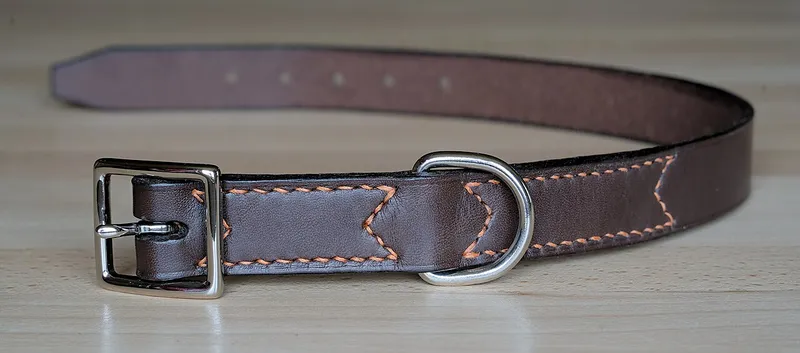
The material changes how the collar feels and ages. Nylon is soft from day one and stays the same until the edges fray. Leather starts out firmer, then softens as the oils in it warm up against your dog's neck. A well cut leather strap has smooth, burnished edges that do not catch on fur, and a buckle with a tongue through punched holes keeps the size exactly where you set it. Many owners also like the look, and leather takes stamping or a riveted name plate well, which makes it a popular base for a personalized dog collar.
Construction tells you most of what you need to know about quality. On a good collar the buckle and D ring are held by a fold of leather that is stitched or riveted, not glued, and the stitching sits in a groove so it does not wear through. If you are still deciding on a basic collar for a new dog, our broader dog collar guide and our roundup of the best dog collars cover every material side by side.
Which Leather Grade Should You Look For?
Answer: Look for full grain or top grain leather. Wikipedia's leather article describes full grain as keeping the entire grain layer, which develops a patina instead of wearing out, and usually counts as the highest quality. Avoid bonded leather, which is shredded leather scraps bonded with polyurethane or latex onto a fiber backing.
Leather labels can be confusing, because the word leather covers everything from a thick strap of full grain hide to a thin layer of shredded scraps. The Wikipedia article on leather sets out the grades clearly, and the table below summarizes what each one means for a collar that will be pulled, chewed at, rained on and worn every day.
Tanning is the other half of the story. Tanning permanently changes the protein structure of hide so it does not rot. The Wikipedia article on tanning explains that traditional vegetable tanning uses tannins taken from tree bark, while chrome tanning, developed in the nineteenth century, uses chromium salts instead. Vegetable tanned leather tends to be firmer and is the classic choice for burnished, hand stitched collars. Chrome tanned leather is usually softer and more flexible from the start. Both can make a good collar if the grade underneath is sound. Source: Wikipedia, Tanning (leather).
A quick shop floor test helps too. Look at the cut edge: full grain shows dense fibers right up to the surface, while bonded leather looks layered and papery. Bend the strap; good leather creases gently and springs back, bonded material shows white stress lines.
Flat, Rolled or Padded: Which Leather Collar Style Fits Your Dog?
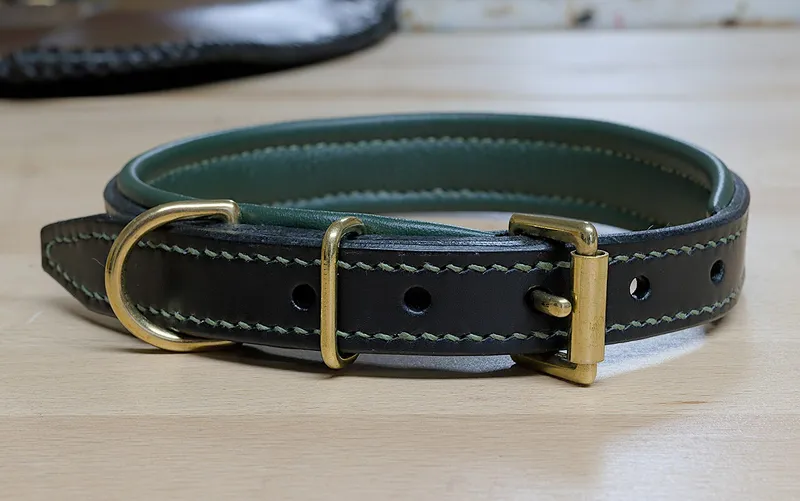
Answer: A flat leather collar suits most short coated dogs and holds tags well. A rolled collar is stitched into a tube, so it spreads less across the neck and many owners of long coated dogs use one to reduce flattened fur. A padded collar adds a softer lining layer for comfort on thin skinned breeds.
Once you know the grade, pick the shape. Each style has a job, and the right one depends mostly on your dog's coat and how the collar will be used.
Width matters as much as shape. A wider collar spreads any pressure over a larger area of the neck, which is kinder to a dog that leans into the leash, while a narrow strap looks neater on a small dog. Very small breeds often do better with a light, narrow collar for ID and a harness for walks.
How Does Leather Compare With Nylon and Biothane?
Answer: Leather wins on comfort over time, looks and longevity when it stays dry. Nylon is lighter, cheaper and comes in endless colors, but frays and holds smells. Biothane, a coated webbing, shrugs off water and mud and wipes clean. Many owners keep a leather collar for daily wear and a waterproof one for swimming.
There is no single best material. Each one is a trade off between comfort, care and how your dog actually spends its day.
If your dog lives in the water, read our guide to the waterproof dog collar before buying leather. If you walk in the dark, a reflective dog collar or a clip on light is the safer choice for those walks. Plenty of owners use both: a leather collar that carries the ID tags around the house and town, and a waterproof or reflective one for beach days and night walks.
How Should a Leather Collar Fit?
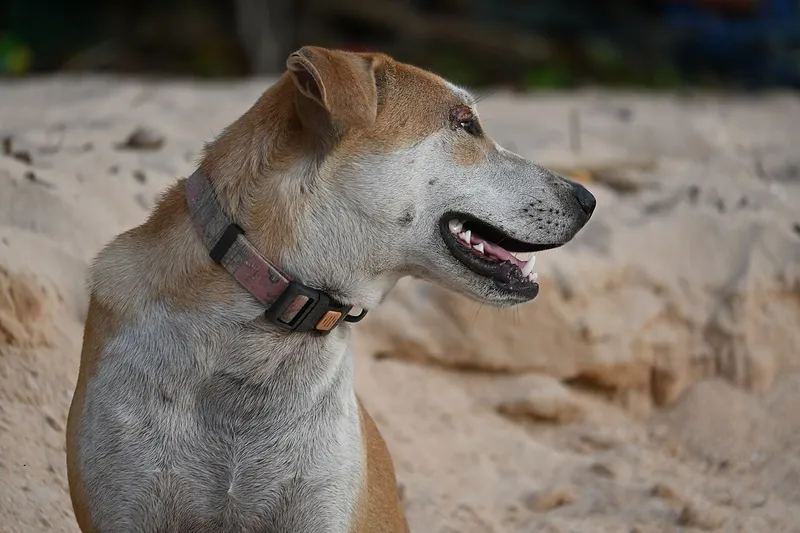
Answer: A flat collar should sit comfortably without choking your dog or being loose enough to slip over the head. The Humane World for Animals rule of thumb is that you can slide two fingers comfortably underneath. Measure the neck with a soft tape, then pick a collar whose middle hole matches that size.
The Humane World for Animals guide puts it simply: a flat collar should not be so tight that it chokes your dog, nor so loose that your dog can slip out of it, and you should be able to slide two fingers comfortably underneath. VCA Animal Hospitals adds that a collar that fits too loosely lets a dog escape. Source: Humane World for Animals, Dog collars.
Leather adds one twist. A new collar is stiff and may feel snug for the first week, then it relaxes slightly as the leather warms and softens. Measure around the middle of your dog's neck with a soft tape, choose a collar where that measurement falls on a middle hole, and recheck the fit after the first week of wear. Our adjustable dog collar guide explains why a range of holes matters.
- Measure the neck where the collar will sit, not the base near the shoulders.
- Buckle on a middle hole so you have room to loosen or tighten later.
- Test with two fingers flat under the strap, then check the collar will not slide over the ears when you pull it gently forward.
- Recheck after the leather softens, and every few weeks for growing puppies.
Puppies are the exception to buying leather early. They grow fast, so an inexpensive adjustable collar makes more sense until they reach adult size. For dogs that pull hard, a collar is not the right tool at all; see our no pull dog harness guide and our dog harness overview.
When Should Your Dog Not Wear Its Collar?
Answer: Take the collar off in the crate and during rough play with other dogs. The AKC notes that a dog's risk of a collar accident rises with time spent crated wearing a collar, wrestling with other dogs, and yard hazards such as branches, fencing or decks that a collar or tag could catch on.
Any buckle collar, leather included, can snag. The American Kennel Club article on collar dangers lists the situations that raise the risk: how often a dog is crated with its collar on, whether it wrestles with other dogs, and whether there is anything in the yard a collar could get caught on, such as branches, fencing or decks. VCA Animal Hospitals adds that serious injury can occur if a collar becomes entangled and twisted tightly, and that hard pulling against a collar can put too much pressure on delicate structures in the neck.
In practice that means a few simple habits:
- Crate time: take the collar off, or use a breakaway style collar while the dog is unsupervised.
- Dog play: remove collars during wrestling sessions so a jaw or leg cannot get trapped under a playmate's collar.
- Walks with a puller: clip the leash to a harness and let the leather collar simply carry the tags.
- Old collars: retire any collar with cracked leather around the buckle holes or a loose D ring.
Correction collars are a separate topic and a separate debate; our article on dog training collars covers them. For sight hounds with narrow heads, a martingale collar is often safer than any flat collar, leather or not.
How Do You Clean and Condition a Leather Collar?
Answer: Brush off dry dirt, wipe the collar with a damp cloth and a little saddle soap, then let it dry slowly at room temperature, never on a heater. Once dry, rub in a thin coat of leather conditioner and buff off the excess. Condition more often if your dog gets wet regularly or the leather starts to look dull.
Leather does not need much, but it does need some. Dirt and skin oils build up on the inside of the strap, and leather that is soaked and then dried quickly can stiffen and crack around the buckle holes. A short routine every few weeks keeps a good collar going for years.
- Brush off dried mud and hair with a soft brush.
- Clean with a barely damp cloth and a small amount of saddle soap, working the lather in gently and wiping it away.
- Dry slowly at room temperature, away from radiators, heaters and direct sun.
- Condition with a thin layer of leather balm or conditioner, let it soak in, and buff off what remains.
- Inspect the stitching, the buckle tongue and the leather around the holes for cracks.
Never put a leather collar in the washing machine. If your dog has a skin condition or you are applying a topical treatment, ask your vet whether the collar should come off for a while, since some products can stain or soften leather. The same goes for flea collars worn alongside a leather collar; our collars overview explains how different collar types can be combined safely.
Why Has Leather Lasted So Long as a Collar Material?
Answer: Leather was the obvious material for collars long before synthetic webbing existed: it is strong, it can be cut, stitched and riveted by hand, and it holds metal fittings well. Museum collections still keep old leather collars with brass name plates, which shows how well the material lasts when it is looked after.
Before nylon and plastics, dog collars were made from the materials a harness maker or saddler already used, and leather was the main one. It could be cut to length, stitched by hand and fitted with brass buckles, studs and engraved plates. That tradition is why many modern leather collars still use the same saddle stitch and roller buckle designs.
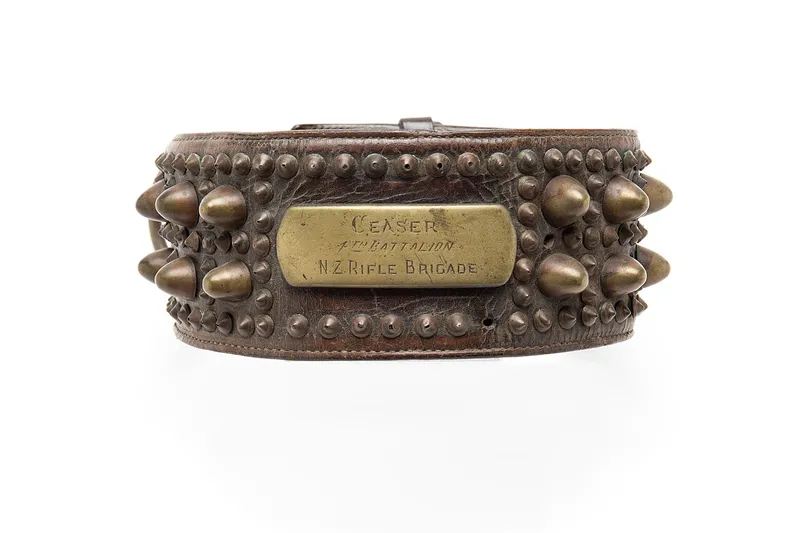
Some of those older collars survive in museums. The Auckland War Memorial Museum holds a studded leather collar made for Caesar, a bulldog mascot of the New Zealand Rifle Brigade, complete with a brass buckle and a brass name plate. It is a reminder that a leather collar with sound hardware can outlast the dog that wore it, and a modern ID tag or riveted plate follows the same idea. Our guide to the dog leash and collar pairing covers how to match a leash to a leather collar, and the GPS dog collar guide covers modern tracking add ons.
What Do Owners Ask Most About Leather Dog Collars?
Answer: Owners most often ask whether leather collars are safe, which leather grade to buy, how tight the collar should be, whether leather can get wet, how to clean it, whether puppies should wear leather, and whether a rolled collar helps long coats. The short answers below cover each of these, with the detail in the sections above.
Are leather collars good for dogs?
Yes. A well made leather collar is strong, comfortable once it softens, and long lasting. Choose full grain or top grain leather with stitched or riveted hardware, and fit it with the two finger rule.
What is the best leather for a dog collar?
Full grain leather is the best choice because it keeps the whole grain layer and develops a patina rather than wearing out. Top grain is a good second choice. Avoid bonded leather.
How tight should a leather dog collar be?
You should be able to slide two fingers comfortably under the collar. It should not choke your dog, and it should not be loose enough to slip over the head.
Can a leather dog collar get wet?
An occasional soaking is fine if the collar dries slowly at room temperature and is conditioned afterwards. For dogs that swim often, a biothane or other waterproof collar is the better choice.
How do I clean a leather dog collar?
Brush off dirt, wipe it with a damp cloth and a little saddle soap, dry it slowly away from heat, then apply a thin coat of leather conditioner. Never machine wash leather.
Should a puppy wear a leather collar?
It is usually better to wait. Puppies outgrow collars quickly, so an inexpensive adjustable collar makes more sense until your dog reaches adult size.
Is a rolled leather collar better for long haired dogs?
Many owners of long coated dogs prefer a rolled collar because its round profile sits on a narrower band of fur than a flat strap, which can leave less of a flattened ring in the coat.
Should my dog wear its collar in the crate?
The AKC lists crate time with a collar on as one of the situations that increases the risk of collar accidents, so take the collar off or use a breakaway collar in the crate.
Sources
- Humane World for Animals: Dog collars
- VCA Animal Hospitals: Collar and harness options for dogs
- American Kennel Club: Could your dog's collar endanger his life?
- Wikipedia: Leather
- Wikipedia: Tanning (leather)
Find a collar your dog will wear every day
Browse our dog accessories, from everyday collars to leashes and harnesses.
Shop dog accessories