A dog blanket is the least glamorous thing in the dog aisle and the one most households end up owning several of. It costs a fraction of a bed, it goes in the machine, and it travels. It is also the item people give least thought to before buying, which is how a household ends up with a drawer of shedding fleece, a sofa that still has hair on it, and in the worst cases a dog in surgery because it ate the thing.
This guide covers what a blanket is genuinely doing, how the common fabrics differ where it matters, which dogs actually need the warmth rather than merely enjoying it, the swallowed fabric risk that veterinary surgeons see regularly, and why washing a blanket is a parasite control measure rather than a housekeeping nicety. The clinical material is drawn from the American College of Veterinary Surgeons and the Companion Animal Parasite Council.
The Four Jobs a Dog Blanket Actually Does

The first job is insulation, and it works in both directions. A blanket under a dog stops body heat draining into a cold floor, which matters more than the layer on top for a dog lying on tile or on a concrete floor in an outbuilding. A blanket over a dog traps a layer of still air against the coat. Most owners think about the second and buy for it, while the first is usually the bigger effect in an ordinary house.
The second job is protecting your furniture and your car, and it is the reason most blankets are actually bought. A throw over the end of the sofa takes the hair, the mud and the damp instead of the upholstery, and it can be stripped off and washed in a way the sofa cannot. The same logic applies to a back seat, a crate tray and the bottom of a carrier, and it is entirely respectable to buy a blanket for this reason alone.
The third job is territorial and it is the one that surprises people. A blanket carries the dog's own scent, which makes it a portable version of its own bed. That is why the same slightly disreputable fleece is worth taking to a holiday cottage, into a crate in a new house, or to the practice for an overnight stay: the familiar smell does more for a nervous dog than anything new and clean.
The fourth job is containment of mess at source. Dogs that are wet, muddy, elderly, incontinent, or recovering from surgery all benefit from something absorbent and replaceable between them and everything else. A stack of cheap blankets in rotation is the practical answer to that, and it is why veterinary practices run laundry rather than buying luxury bedding. If the dog also needs the surface itself replaced regularly, a washable dog bed and a blanket work better together than either alone.
Fabrics Compared, Where It Matters
Polyester fleece is the default and it deserves its popularity. It is warm for its weight, it dries fast, it washes at temperature without shrinking, and it costs very little. Its weaknesses are equally consistent: it pills into loose fibres with age, it holds static and therefore hair, and the cheap grades shed visible fluff from the day they arrive. A shedding blanket is a blanket a dog can eat, which is the subject of the next section.
For more expert recommendations, check out our dog bed guide.
Sherpa and the double sided fleece and sherpa combinations trade weight for warmth. The looped pile traps far more air than flat fleece, which makes them the right choice for a genuinely cold room or a thin coated dog, and the wrong choice for a dog that runs warm or sleeps by a radiator. They also take longer to dry, which matters if the same blanket is going out to a wet car twice a day.
Cotton and cotton blends are cooler, more absorbent and far more pleasant in a warm climate or a heated flat. A cotton throw is the sensible summer layer and the right thing under a dog that is damp rather than cold. It wrinkles, it takes longer to dry than fleece, and it does very little for warmth, so it is a complement to a fleece rather than a replacement for one.
Waterproof backed blankets have a thin membrane bonded to the underside so that liquid stops at the blanket rather than reaching the sofa or the car seat. They are the correct product for an incontinent or post operative dog and for a muddy back seat, and they are hotter to lie on than anything else here because the membrane stops airflow as well as moisture. Check that the backing survives your washing machine before you rely on it; many do not.
Which Dogs Actually Get Cold
Coat, size, age and body condition decide this, not breed prestige. Small dogs, toy breeds, short coated dogs, puppies, elderly dogs and thin dogs all lose heat faster than a large, well covered, middle aged animal, because a small body has more surface area relative to its mass and a short coat traps less air. Short legged dogs sit closer to a cold floor or cold ground, which adds a conductive loss on top of everything else.
Illness and medication change the picture too. A dog that is underweight, recovering from surgery, hypothyroid, or simply too arthritic to move to a warmer spot will feel a cold room that a healthy dog shrugs off. The same is true of a dog on sedatives, and of any dog that has recently been clipped short for a procedure. In each of those cases the blanket is not a comfort item, it is part of the nursing, and for a frail dog in a cold house a heated dog bed underneath it does more than another layer on top.
Learn the early signs rather than waiting for something dramatic. Shivering and curling up tightly for warmth are the first indications of mild hypothermia in a dog; if it progresses, breathing and heart rate slow, the animal becomes sluggish with delayed reflexes, and in severe cases the pupils dilate and consciousness is lost. A dog that whines, seems anxious, slows down or stops moving, or starts hunting for somewhere warm to burrow is telling you it is cold, and the response is warmth and a phone call to the practice rather than another layer and a wait.
Conversely, do not bury a dog that does not need it. Thick coated northern breeds, active young dogs and any dog in a warm room will move off a blanket they find too hot, which is exactly what they should do, and that is the argument for laying a blanket on a bed rather than fastening it around an animal. A dog that keeps pushing the blanket into a heap and lying beside it has answered the question.
The Risk Nobody Mentions: Eaten Fabric
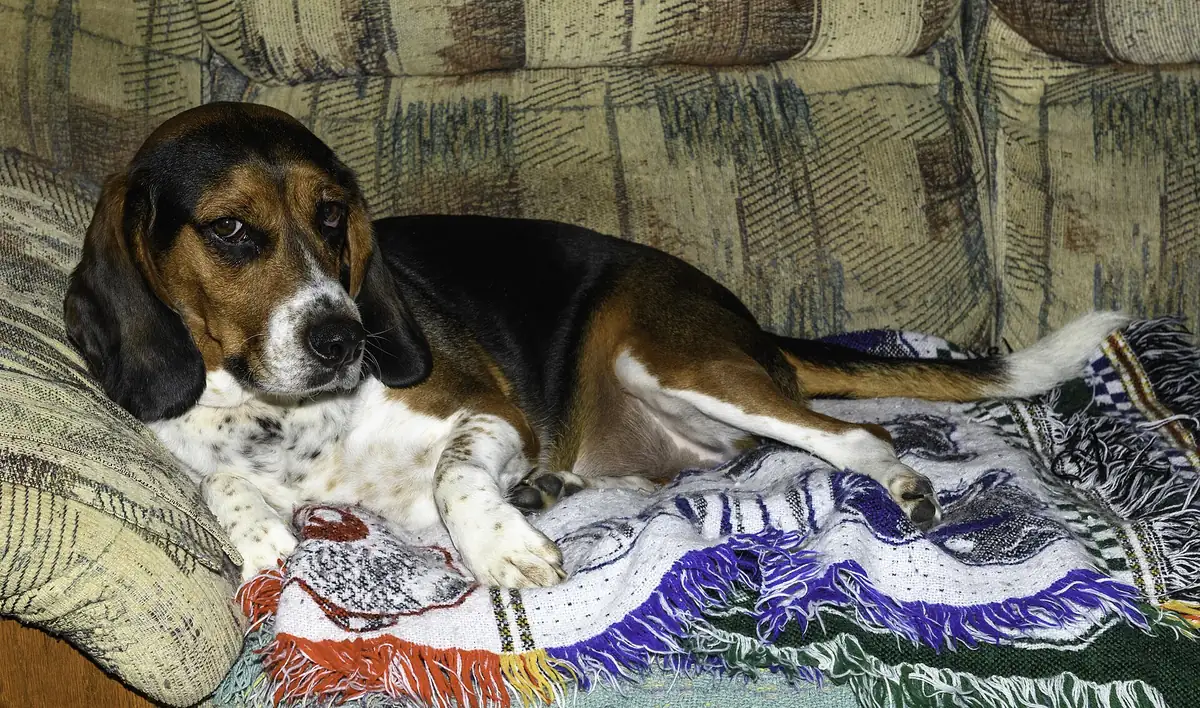
This is the part of the subject that belongs in a veterinary surgery rather than a homeware catalogue. The American College of Veterinary Surgeons lists clothing among the objects dogs swallow that fail to pass, alongside toys, leashes and sticks, and the consequence is a gastrointestinal obstruction that usually requires surgery to relieve, either by opening the stomach or by opening the intestine.
You might also find our washable dog bed article helpful when shopping.
Long strips of fabric are a category of their own. A linear foreign body, in the ACVS description, can anchor at one end while the rest passes on, and the tension that results can cut holes in the tissue. Perforation spills intestinal contents into the abdomen, which leads quickly to peritonitis and to bacterial contamination of the abdominal cavity. This is the reason fringes, tassels, binding tape and unravelling seams matter on a dog blanket in a way they do not on a human one.
The signs ACVS lists for a gastrointestinal foreign body are vomiting, loss of appetite, abdominal pain, dehydration, diarrhoea with or without blood, and fluid in the abdomen. None of those are specific to fabric, which is precisely the problem: a dog that has quietly eaten half a fleece over a weekend presents as a vomiting dog, and the history you give the vet is often the fastest route to the diagnosis. Say what the blanket is made of and how much is missing.
The practical answer is selection rather than vigilance. If your dog strips and swallows fabric, do not buy a fringed throw and supervise harder; buy something with bound edges and no loose pile, or skip the blanket and use a chew proof dog bed instead. Check blankets weekly for holes and retire them at the first sign of unravelling, because a blanket that has started to come apart supplies exactly the long strip the surgical literature is describing.
Crates, Cars and the Blanket as a Portable Home
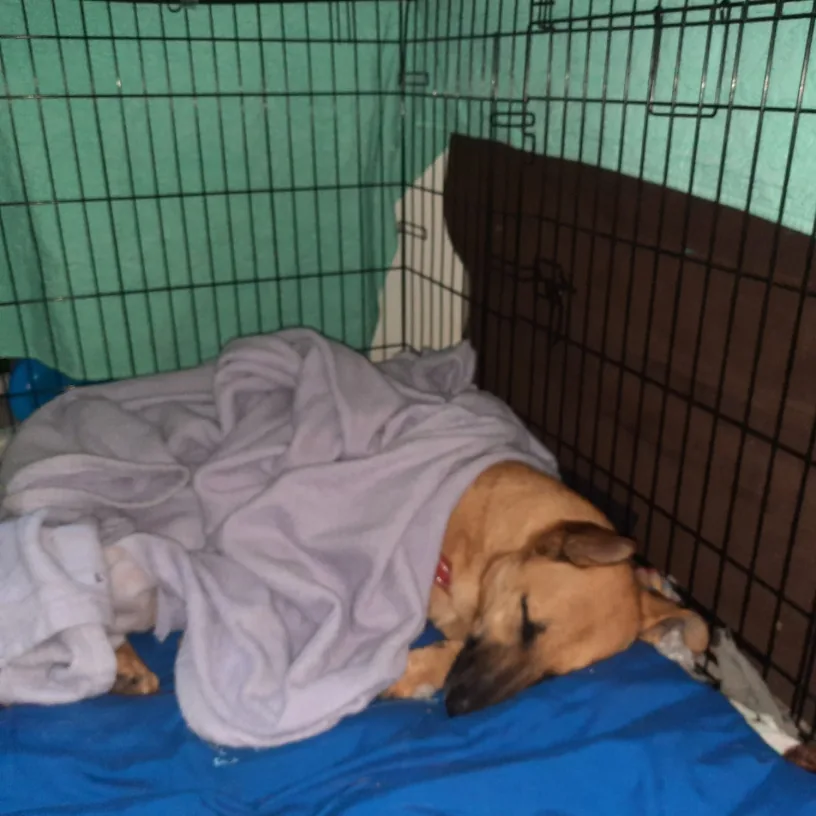
In a crate the blanket does three things at once: it softens a hard tray, it absorbs the inevitable, and it carries the dog's scent so the crate smells like somewhere the dog already lives. That last point is why a blanket the dog has slept on for a fortnight is worth more in a new crate than anything fresh out of a packet. Introduce the crate with the familiar blanket already in it rather than the other way round, which is worth building into the new puppy setup from the first day.
Use two and rotate them. One in the crate, one in the wash, and the crate is never bare while the other dries. This is also the honest answer to the household that finds the crate blanket permanently damp or hairy: the problem is that there is only one of them, not that the fabric is wrong.
In the car, the blanket protects the seat and nothing else, and it is worth being explicit about that because the two functions are regularly confused. A blanket or a quilted cover is not a restraint. A dog travelling loose on a covered seat is travelling loose, and if you want the dog secured you need a harness and tether or a crate anchored to the car, which is a separate subject covered in the dog seat belt guide.
For dogs that travel badly, the scent point does real work. A dog that associates a particular blanket with sleeping at home will settle faster in a hotel room, a caravan, or a crate at a friend's house, and the effect is larger for anxious dogs than for confident ones. It is not a treatment for travel anxiety and it will not fix a dog that panics in a car, but it is free and it is on the right side of the ledger.
Weighted and Calming Blankets: What Is Actually Known
Weighted blankets for dogs are sold on an analogy with the human product and with pressure wraps, the idea being that even, distributed pressure has a calming effect. The honest position is that the evidence base for weighted blankets specifically in dogs is thin, and it is not comparable to the evidence behind the medical and behavioural treatments a veterinarian would offer for a genuinely anxious dog. Anyone telling you a blanket is a proven anxiety treatment is going beyond what is known.
Looking for more options? Our chew proof dog bed roundup covers additional top picks.
There are also mechanical reasons for caution. A weighted blanket rests on a dog that may not be able to get out from under it easily, and that is a different proposition from a person who can push a blanket off. A dog should always be able to leave, which in practice means a weighted blanket laid loosely over part of the body on an open bed, never wrapped, never in a closed crate, and never on a puppy, a senior with mobility problems, or a dog recovering from surgery.
If the dog is genuinely anxious, spend the money on the parts of the problem that respond. Predictable routine, a defined safe place, environmental management during fireworks and storms, and a veterinary conversation about behavioural support all have better returns than any textile. The site's guide to anxiety in dogs covers the triggers and the management in detail, and a calming dog bed with high sides does much of what a weighted blanket claims to do without the weight.
None of which means a heavier blanket is useless. Plenty of dogs sleep better under something with substance to it, the same way plenty of dogs sleep better in a bed with a raised rim, and there is no harm in buying one for a dog that clearly likes it. The distinction worth keeping is between a preference you have observed in your own dog and a clinical claim printed on a label.
Washing: Parasite Control, Not Housekeeping
The reason to wash dog blankets on a schedule is not that they look grubby. The Companion Animal Parasite Council describes flea eggs as pearly white ovals about half a millimetre long that are laid on the host and fall off into the environment within a few hours. They land wherever the dog spends time, and dog bedding is the single most reliable collection point in the house.
What happens next is the part that explains the schedule. CAPC notes that flea larvae develop in undisturbed, protected indoor sites such as carpets, under furniture and along baseboards, and that the whitish pupal cocoons are found in soil, on vegetation, in carpets, under furniture and on animal bedding. Adults can begin emerging about eight days into the pupal stage, with all of them usually emerged by day thirteen at 24 degrees Celsius and 78 percent humidity, and pupae can stay dormant for up to thirty weeks at 11 degrees. Washing the blanket removes eggs and larvae before that timetable runs.
Two further details from the same source are worth knowing. Mechanical pressure, carbon dioxide and increased temperature all stimulate adult fleas to emerge from their cocoons, which is why a dormant problem in an empty house erupts the day the dog comes back. And CAPC is clear that a comprehensive flea control programme has to eliminate the environmental infestation as well as the fleas on the animal, which is precisely the job that washing the bedding does. Any flea treatment for the dog itself, whether a spot on, a tablet or a flea collar, should be the product your veterinarian recommends.
In practice: wash the blanket weekly in an ordinary household, more often for a dog that is shedding heavily, damp, unwell or under treatment for fleas, and always at the hottest temperature the fabric tolerates. Dry it completely, because a damp blanket in a crate breeds smell and bacteria faster than a dirty dry one. Wash it separately from human laundry, skip the fabric softener, which coats fibres and reduces absorbency, and use a non biological detergent if your dog has sensitive skin.
Sizing, Layering and When to Throw One Out
Size the blanket to the surface rather than the dog. For a bed, you want enough overhang to tuck under so that the dog's digging and circling does not roll it into a rope within a night. For a sofa, measure the seat and the arm you actually want covered. For a crate, cut to the tray footprint or fold to fit, because a blanket that mounds up in a small crate reduces the usable floor the dog has.
Layer rather than buying one very thick blanket. Two thin layers trap more still air than one thick one of the same total weight, they dry faster, and they let you take a layer away when the weather turns. On a cold hard floor, put the cheapest layer down first as insulation from the floor, the warm layer next, and the washable layer on top where the dog actually lies.
Match the blanket to the rest of the sleeping setup rather than treating it in isolation. An orthopaedic bed for an older dog wants a thin blanket that does not defeat the point of the foam, while a raised elevated dog bed in a cool room wants a proper insulating layer because air is circulating underneath it. For a dog that is already too warm, a blanket is the wrong answer entirely and a cooling mat is the right one.
Retire blankets earlier than feels necessary. A blanket goes in the bin when it has holes, when the pile has started to shed in strips, when the binding has come away, when a waterproof membrane has delaminated, or when it cannot be got properly clean any more. The replacement cost is trivial, and the alternative cost, as the surgical literature above makes clear, is not.
For more independent, vet-reviewed guidance on this topic, the American Kennel Club expert advice center is an excellent place to start.
Frequently Asked Questions
What is the best fabric for a dog blanket?
Polyester fleece for most households, because it is warm for its weight, dries fast and washes at temperature for very little money. Sherpa and double sided pile are warmer and suit thin coated, elderly or small dogs in cold rooms. Cotton is the summer and damp dog answer. Waterproof backed blankets are for incontinence, recovery and car seats. The choice that matters more than any of these is a bound edge and no loose fringes if your dog chews fabric.
Is it safe for a dog to sleep under a blanket?
For a healthy adult dog that can get out from under it, yes, and many dogs choose to. The conditions are that the dog can leave whenever it wants, that the blanket is not fastened around the animal, and that it is not in a closed crate where the dog cannot move away from the heat. Puppies, very small dogs, elderly dogs with mobility problems and dogs recovering from anaesthesia should not be covered unsupervised.
How often should I wash my dog's blanket?
Weekly in an ordinary household, and every few days during active flea treatment. The reason is parasitological rather than cosmetic: CAPC describes flea eggs as falling off the host into the environment within hours of being laid, and lists animal bedding among the sites where pupal cocoons collect. Adults can start emerging about eight days into the pupal stage, so a weekly wash interrupts the cycle before it completes.
My dog eats his blanket. What should I do?
Change the product rather than the supervision. Choose a blanket with bound edges, no fringe or tassels and a tight pile that does not shed, or move to a chew proof bed instead. The American College of Veterinary Surgeons lists clothing among the swallowed objects that fail to pass and require surgical removal, and describes how a long strip of material can anchor at one end and cut through tissue, which causes perforation and then peritonitis.
What are the signs my dog has swallowed fabric?
ACVS lists vomiting, loss of appetite, abdominal pain, dehydration, diarrhoea with or without blood, and fluid in the abdomen as the signs of a gastrointestinal foreign body. None of them are specific to fabric, so your description matters: tell the practice what the blanket was made of and roughly how much is missing. A dog that is vomiting and off its food with a chewed blanket in the house is an urgent appointment rather than a wait and see.
Do weighted blankets calm dogs down?
The claim is borrowed from the human product and the evidence base in dogs is thin, so it should not be presented as a proven anxiety treatment. Some dogs clearly prefer something with weight to it, which is reason enough to buy one for that dog. Use it laid loosely over part of the body on an open bed, never wrapped, never in a closed crate, and never on a puppy, a senior with mobility problems or a dog recovering from surgery.
Which dogs get cold and need a blanket most?
Small and toy breeds, short coated dogs, puppies, elderly dogs, thin dogs and short legged dogs whose bodies sit close to a cold floor. Illness adds to the list: underweight dogs, dogs recovering from surgery, arthritic dogs that cannot move to a warmer spot and dogs recently clipped for a procedure all feel a room that a healthy dog ignores. Shivering and curling up tightly are the first signs of mild hypothermia.
Can a blanket keep my dog safe in the car?
No. A blanket or a quilted cover protects the upholstery and does nothing else, and the two functions are regularly confused. A dog travelling loose on a covered seat is travelling loose. If you want the dog restrained you need a harness and tether rated for the job, or a crate anchored to the vehicle. The blanket still earns its place in the car for hair, mud and the familiar scent that helps an anxious traveller settle.
Browse Dog Beds
Free worldwide shipping on every order. No minimum purchase required.
Browse Dog Beds →