Few things win a cat over faster than the crinkle of a treat bag. Used well, cat treats are a training tool, a way to sneak in a pill, a reason to play and a small daily pleasure. Used carelessly, they quietly unbalance a carefully chosen diet and add weight that is hard to take off a cat later. This guide covers the main types of treats, how much is too much, what the label must tell you, which human foods are off limits, and how to choose treats for kittens, seniors and cats on a diet. The guidance comes from veterinary and regulatory sources, and your own vet always has the final word for your cat.
In This Article
- Quick Answer: What Are the Best Cat Treats?
- What Are Cat Treats and How Are They Different From Cat Food?
- What Types of Cat Treats Are There?
- How Many Treats Can a Cat Have per Day?
- How Do You Read a Cat Treat Label?
- Which Human Foods Are Unsafe as Cat Treats?
- How Can You Use Treats for Training, Play and Pills?
- Which Cat Treats Suit Kittens, Seniors and Cats on a Diet?
- What Do Cat Owners Ask Most About Cat Treats?
- Sources
Quick Answer: What Are the Best Cat Treats?
The best cat treats are small, clearly labeled products with a calorie count per piece, fed as an occasional extra rather than a meal. Cornell's Feline Health Center suggests treats stay within about ten to fifteen percent of daily calories. Skip milk, onions, garlic and raw meat, and match treat type to the job.
Updated October 28, 2026- Portion rule: treats are extras, so keep them to a small slice of daily calories and trim meals if you give more.
- Label check: look for the word "treat" or "snack" and a calorie statement per piece.
- Never as treats: onions, garlic, chives, chocolate, alcohol, raw meat and milk for most cats.
- Best uses: training, pill time, puzzle toys and short play sessions that keep an indoor cat moving.
What Are Cat Treats and How Are They Different From Cat Food?
Answer: Cat treats are rewards, not meals. AAFCO model rules do not require treats to be complete and balanced, so most of them lack the full range of nutrients a cat needs. That is fine in small amounts, but a cat that fills up on treats can end up eating less of the food that actually keeps it healthy.
A complete cat food is formulated to supply every nutrient a cat needs at a given life stage. Treats sit in a different category. The Association of American Feed Control Officials explains that treat products are primarily for rewarding pets, and that the regulations do not require them to meet the nutritional adequacy standards of a complete and balanced dog or cat food. The front of the package must still say "snack" or "treat" so you know which kind of product you are holding. Source: AAFCO, Treats and Chews.
Cornell University's Feline Health Center makes the same point from the vet's side. Treats are not generally harmful, but they are usually not a nutritionally complete source of food and should be given only occasionally. That is why the amount matters more than the brand. A premium treat fed by the handful can do more harm than a plain one used sparingly.
There is a second reason to keep treats in their place. Cats are often particular eaters, and a cat that learns that refusing dinner brings out the treat bag will happily repeat the lesson. If you notice your cat skipping meals but begging between them, cut treats back for a week and let regular meals do their job. Pairing food with movement helps too: an automatic cat feeder keeps meal times predictable, and our guide on how to entertain a cat covers ways to reward a cat without opening a bag at all.
What Types of Cat Treats Are There?
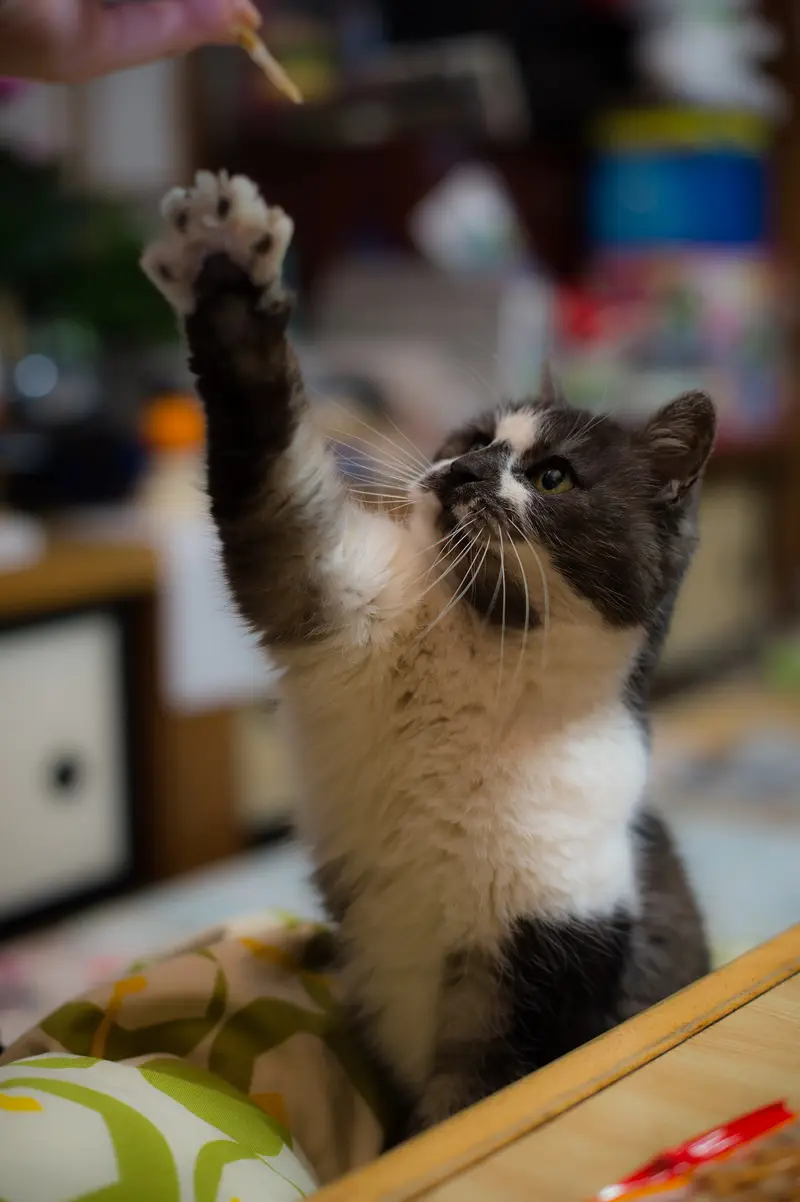
Answer: The main types are crunchy biscuits, soft and chewy bites, freeze-dried meat or fish pieces, lickable purees in tubes, and dental treats. Each suits a different purpose. Small crunchy or soft pieces work for training, purees help with pills and bonding, and dental treats only make a dental claim worth trusting when they carry a VOHC seal.
Most cats have a clear favorite texture, so it is worth trying a few before you buy in bulk. The table below compares the common types by what they are good for and what to watch.
Freeze-dried treats deserve a short note. They are popular because many cats find a single piece irresistible, which makes them excellent for teaching new behaviors. Some are made from raw meat that has only been dried, and the ASPCA warns that raw meat can contain bacteria such as Salmonella and E. coli that are harmful to pets and people alike. Wash your hands after handling them and keep them away from young children.
Catnip is not a food treat at all, but many owners use it the same way. If your cat is one of the responders, a sprinkle on a toy can replace several edible rewards a day. Our guides on catnip toys and why cats like catnip explain how it works and how often to offer it.
How Many Treats Can a Cat Have per Day?
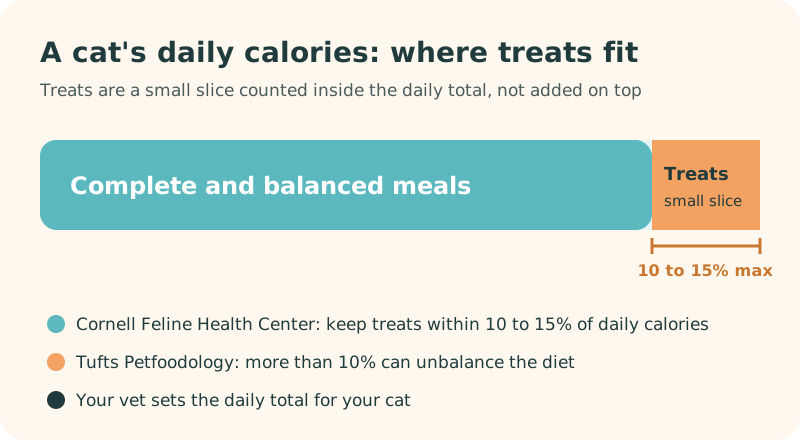
Answer: Keep treats to a small slice of the day's calories. Cornell's Feline Health Center gives ten to fifteen percent as a rule of thumb, and Tufts veterinary nutritionists warn against going past about ten percent. In practice that often means only a few small pieces a day, so check the calories per treat and adjust meals.Source: Cornell Feline Health Center, Feeding Your Cat.
The Cornell Feline Health Center puts it simply: a good rule of thumb is not to let treats exceed 10 to 15 percent of a cat's daily caloric intake. Source: Cornell Feline Health Center, Feeding Your Cat.
The clinical nutrition team at Tufts University's Cummings School is slightly stricter. They say that more than 10% of a pet's daily calories from treats adds unnecessary calories, can unbalance the diet and could be harmful if the pet has a medical condition. They also point out that even tiny cat treats can end up being a large portion of the calories for a small cat. Source: Tufts Petfoodology, What are safe and healthy treats for my pet?.
Turning that rule into pieces takes two numbers. First, ask your vet how many calories your cat should eat in a day, because the right figure depends on weight, age, activity and whether the cat is spayed or neutered. Second, read the calorie content on the treat bag, which is given per piece or per familiar unit. Divide the treat allowance by the calories per piece and you have a daily count you can stick to.
- Get your cat's daily calorie target from your veterinarian.
- Work out the treat allowance as a small fraction of that target, using the Cornell or Tufts guidance above.
- Find the calories per treat on the package, or ask the maker if it is missing.
- Count out the day's treats each morning into a small dish, so every family member draws from the same allowance.
- If you go over the allowance, trim the next meal slightly rather than skipping it.
How Do You Read a Cat Treat Label?
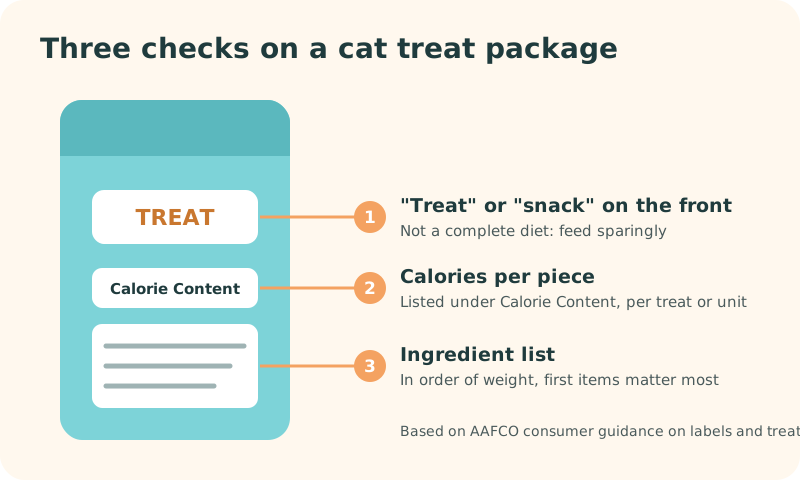
Answer: Look for three things. The front must say treat or snack, which tells you it is not a complete diet. The calorie content statement tells you the calories per piece. The ingredient list, in order of weight, shows what the treat is mostly made of. If the maker cannot tell you the calories, Tufts nutritionists suggest choosing another brand.
AAFCO requires the calorie statement on a pet food label to appear under the heading "Calorie Content" and to be expressed both per kilogram and per familiar unit, such as per can, per cup or per biscuit. For a treat, the per-piece figure is the one you need. Source: AAFCO, Reading Labels.
Some products are not labeled as treats but are meant to be used like one, for example a can of plain tuna sold for cats. AAFCO explains that these carry the statement "This product is intended for intermittent or supplementary feeding only," which means they do not meet the standards for complete and balanced nutrition. Treat that wording as a signal to feed sparingly.
Tufts nutritionists add a practical rule. If a commercial treat does not show calories on the label, call the company or check its website, and they do not recommend feeding treats from companies that cannot or will not tell you the nutrition information for their products. It is a quick test of how seriously a brand takes its own recipe.
Which Human Foods Are Unsafe as Cat Treats?
Answer: Never use onions, garlic or chives, chocolate, coffee, alcohol, raw dough, raw meat or raw eggs as cat treats. Milk is a poor choice because many cats are lactose intolerant, and canned fish meant for people has been linked to neurological problems in some cats. When in doubt, choose a treat made for cats.
The ASPCA Animal Poison Control Center lists onion, garlic and chives as members of the Allium family that can cause stomach irritation and red blood cell damage leading to anemia, and notes that cats are more susceptible than dogs. Chocolate, coffee and caffeine contain methylxanthines, which can cause vomiting, tremors, abnormal heart rhythm and seizures. Alcohol and raw yeast dough are also on the list. Source: ASPCA, People Foods to Avoid Feeding Your Pets.
Two classic "cat treats" from cartoons are also poor choices. Cornell notes that milk is not generally recommended because many cats are lactose intolerant and can develop digestive problems from dairy, and that some cats fed canned fish products meant for humans have developed potentially serious neurological disorders. Raw meat is not recommended as a food or treat either, because it can carry toxoplasmosis and other infections.
If your cat eats something on this list, call your veterinarian or an animal poison control line right away rather than waiting for symptoms. Keep the packaging so you can say exactly what and how much was eaten.
How Can You Use Treats for Training, Play and Pills?
Answer: Break treats into tiny pieces and give them the moment your cat does what you want, such as coming when called or stepping into a carrier. Hide a few in a puzzle feeder so your cat works for them, and use a soft treat or puree to make pill time calmer. Count every piece toward the daily allowance.
Cats can be trained, and treats are the easiest currency. Keep sessions short, reward within a second or two, and stop while your cat is still interested. Good first lessons are coming to a sound such as a bag shake or a clicker, sitting on a mat, and walking into a carrier on their own, which makes vet visits far less stressful.
- Pick one small, strong-smelling treat and break it into pieces about the size of a pea or smaller.
- Choose one behavior and one cue word, and practice for a minute or two at a time.
- Reward the instant the behavior happens, then pause before asking again.
- Gradually ask for a little more before each reward, and mix in praise and play as rewards too.
Food puzzles turn a few treats into real exercise for an indoor cat. Tufts nutritionists suggest putting kibble into dispensing toys so pets earn their meals and treats, which also provides enrichment. You can do the same with part of your cat's regular dry food, which keeps the calorie count down. Our guides to treat dispensing cat toys, cat puzzle toys and interactive puzzle toys for cats compare the main designs, and cat enrichment toys covers wider ideas for keeping a house cat busy.
For play, a treat at the end of a wand toy session gives your cat the satisfying "catch and eat" finish that hunting instinct expects. See our cat wand toy guide for how to run a good session. For pills, ask your vet first whether the medicine can be given with food, then wrap it in a small soft treat or offer it right after a lick of puree.
Which Cat Treats Suit Kittens, Seniors and Cats on a Diet?
Answer: Kittens need their growth food first, so keep treats tiny and rare. Senior cats often prefer soft treats that are easy to chew. Cats on a weight plan can still enjoy rewards if you use pieces of their regular kibble or very low-calorie treats. Cats with health conditions should get treats your vet has approved.
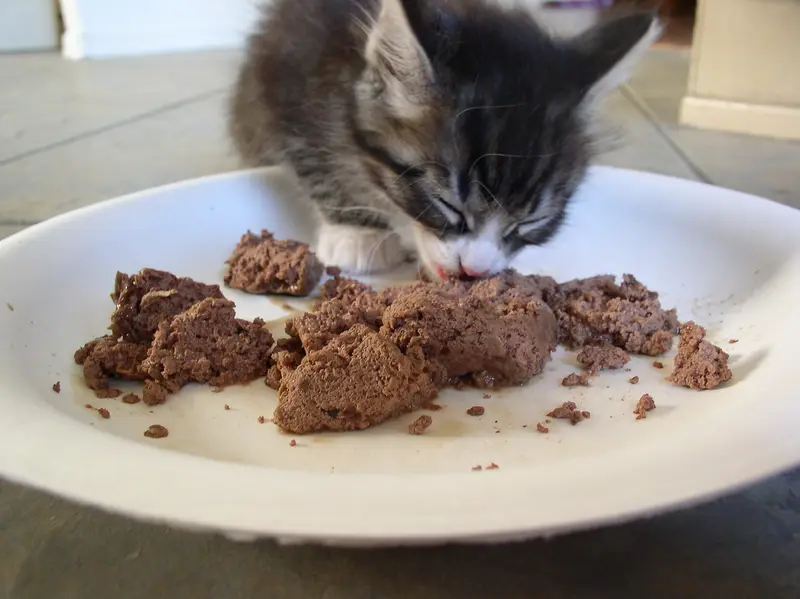
Kittens grow quickly, and their main food is formulated for that growth. Treats that are not complete and balanced dilute it, so use them mostly for training and handling practice, in crumbs rather than whole pieces. A soft treat also helps when you start brushing teeth or trimming nails. Our new kitten essentials checklist and kitten toys guide cover the rest of a young cat's setup.
Older cats may have sore teeth or a weaker appetite. Soft treats or purees are easier to eat, and a treat can encourage a reluctant eater, but a sudden change in appetite is worth a vet visit rather than a new treat. For dental support, the Veterinary Oral Health Council reviews data on products that help control plaque or tartar and awards a seal to those that meet its standard. Tufts notes that brushing is still the best way to keep teeth and gums healthy, with sealed products as extra help. Our cat toothpaste guide explains how to start brushing.
For a cat that needs to lose weight, the simplest trick is to measure out the day's dry food in the morning and set a few pieces aside to use as treats. The cat still gets rewards, and the calorie count does not change. Pair that with more play, for example with calming toys for anxious cats or a cat exercise wheel for energetic ones, and talk to your vet about a safe pace of weight loss.
Finally, if your cat has kidney disease, diabetes, urinary crystals or a food allergy, treats need the same care as meals. Many prescription diets have matching treats, and your vet can tell you which, if any, fit the plan. You can shop toys that make rewards more fun in our cat shop.
What Do Cat Owners Ask Most About Cat Treats?
Answer: Owners most often ask how many treats are safe, whether treats can replace meals, if milk or tuna is a good reward, which treats help teeth, and what to give kittens or older cats. The short answers below draw on Cornell, Tufts, AAFCO and ASPCA guidance and should be confirmed with your own veterinarian.
How many treats can I give my cat a day?
Only a few small pieces for most cats. Cornell's Feline Health Center suggests treats should not exceed ten to fifteen percent of a cat's daily calories, and Tufts nutritionists warn against going past about ten percent. Ask your vet for your cat's daily calorie target, then divide the treat allowance by the calories per piece on the bag.
Can cat treats replace a meal?
No. AAFCO rules do not require treats to be complete and balanced, so most of them lack nutrients a cat needs every day. If your cat fills up on treats and skips meals, cut treats back and let regular, complete meals do their job. Products labeled for intermittent or supplementary feeding only are not a full diet either.
Is milk a good treat for cats?
Usually not. Cornell notes that many cats are lactose intolerant and can develop digestive problems if fed dairy products, and the ASPCA explains that pets lack significant amounts of the enzyme that breaks down lactose, so milk can cause diarrhea. Fresh water and a treat made for cats are safer choices.
Can I give my cat canned tuna as a treat?
Not as a habit. Cornell reports that some cats that ate canned fish products meant for humans developed potentially serious neurological disorders. A plain tuna product made for cats is labeled for intermittent or supplementary feeding only, so if you use it, keep it to a small occasional portion.
Are freeze-dried cat treats safe?
Many cats love them, and they work well as high-value training rewards. Some freeze-dried treats are made from raw meat, and the ASPCA warns that raw meat can carry bacteria such as Salmonella and E. coli that can make pets and people sick. Wash your hands after handling them and store them away from children.
Do dental treats really clean a cat's teeth?
Some help. The Veterinary Oral Health Council reviews company data and awards its seal to products that meet its standards for plaque or tartar control. Tufts nutritionists note that brushing is still the best way to keep teeth and gums healthy, so treat a sealed dental product as extra help rather than a replacement for brushing.
What treats are best for kittens?
Tiny pieces of a soft or crunchy treat used for training and handling practice, or crumbs of the kitten's own food. A kitten's growth formula supplies the nutrients it needs, and treats that are not complete and balanced dilute it. Keep treats rare, and ask your vet before adding anything new.
What can I use as a low-calorie treat for an overweight cat?
The easiest option is a few pieces of your cat's measured daily kibble set aside in the morning and handed out as rewards. The cat still gets treats, and the daily calories stay the same. Combine that with more play and ask your vet for a safe weight loss plan and target.
Sources
- Cornell Feline Health Center: Feeding Your Cat
- Tufts Petfoodology: What are safe and healthy treats for my pet?
- Tufts Petfoodology: Foods and treats for dental health
- AAFCO: Treats and Chews
- AAFCO: Reading Labels
- ASPCA: People Foods to Avoid Feeding Your Pets
- Veterinary Oral Health Council: Accepted Products