A cat exercise wheel is the single largest and most expensive object most indoor cat households will ever consider buying, and it is also the one with the highest chance of being ignored. Both of those things are true at once, and any honest guide has to hold them together. A wheel suits a particular kind of cat extremely well. For every other cat it is a very large piece of furniture that gathers dust beside the sofa.
What follows is the practical version: what the machine actually is, which cats take to one, the geometry that decides whether it is safe, how to teach a cat to use it without ever lifting the animal onto a moving surface, and the health claims that belong to a veterinarian rather than to a wheel. Specifications quoted for the best known commercial model come from the manufacturer's own published product page, and the veterinary material on feline weight comes from the Cornell Feline Health Center.
What a Cat Exercise Wheel Actually Is
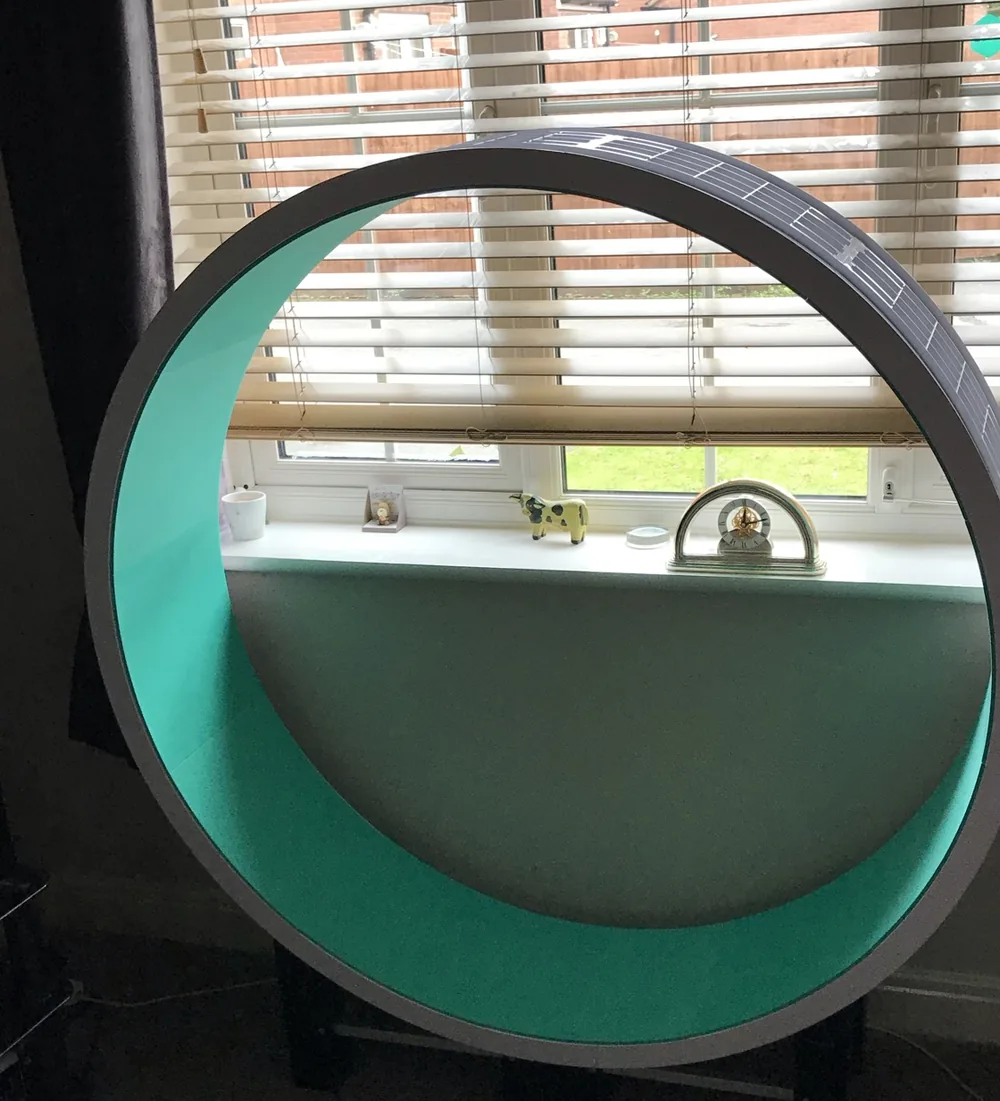
Strip away the marketing photography and a cat wheel is a large vertical hoop with a lined interior, balanced on rollers so that it turns under the animal's own weight. The cat steps inside, walks or runs, and the hoop rotates beneath it. There is no motor, no resistance setting and nothing electronic. The whole device is a wheel, a set of bearings and a base, and almost every difference in quality comes down to those three things rather than to features.
The category has one dominant commercial reference point, and its published numbers are a useful yardstick even if you buy something else. The most widely sold model in the United States states a 48 inch outer diameter and a 43 inch inner diameter, an overall footprint of 48 inches long by 13 inches deep by 50 inches high, a running surface 11 inches wide, a maximum cat weight of 25 pounds, an injection moulded ABS hoop on a steel base, and 74 millimetre polyurethane inline wheels running on ABEC-7 bearings. Those figures come from the manufacturer's own specification list.
Home built wheels are common and some of them are excellent. The photographs in this article are of owner assembled units, and the construction logic is visible in them: a rigid rim, a continuous lining glued to the inside, and a base carrying several skate style rollers that the rim sits on. What separates a good home build from a dangerous one is not craftsmanship so much as dimensions, which is the subject of the geometry section below.
It helps to be clear about the category the wheel belongs to. It is enrichment equipment, in the same family as a tall cat tree or a wall of shelves, rather than a training device or a medical intervention. Cats decide for themselves whether to use enrichment, on their own schedule, and a wheel is no more obligatory than a scratching post that a particular cat happens to dislike.
Which Cats Actually Use One, and Which Never Will
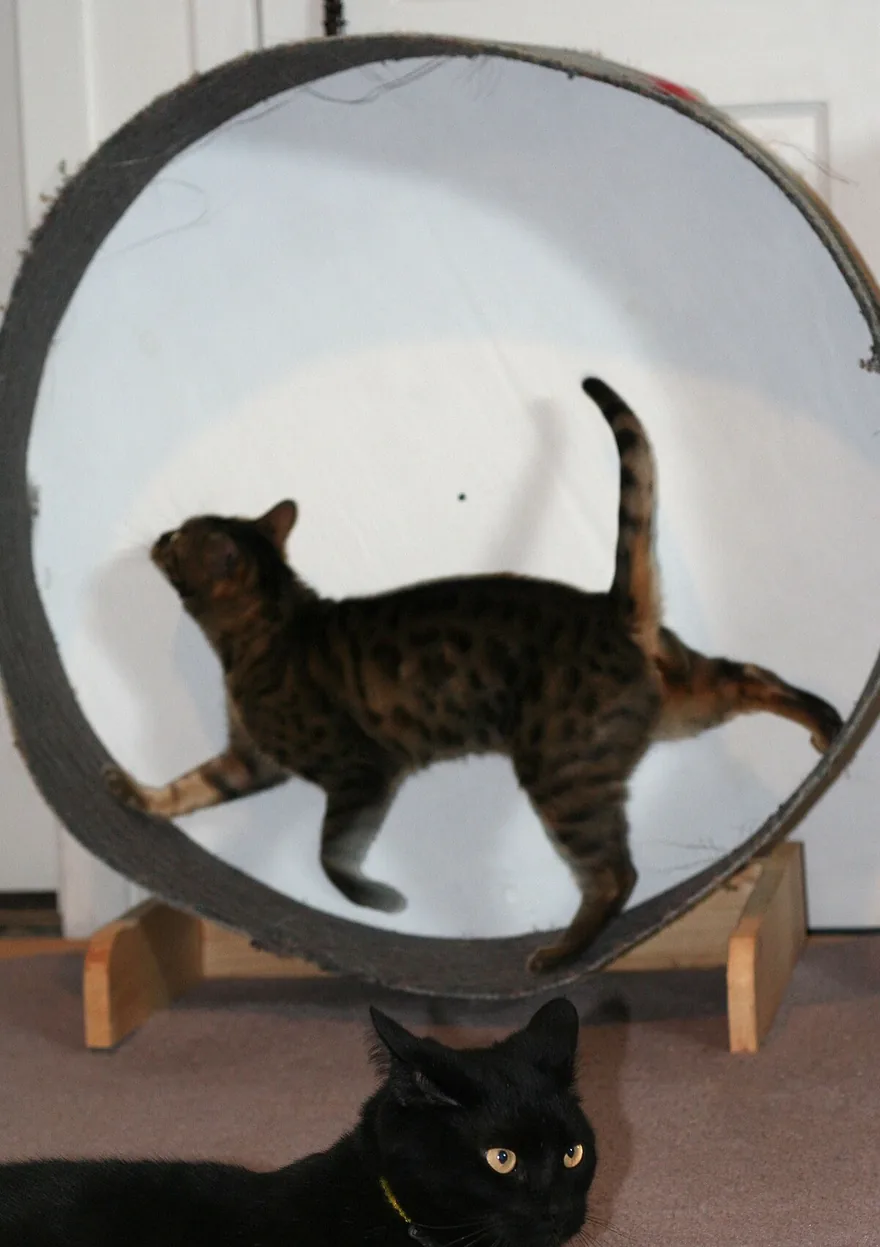
The cats that take to a wheel share a temperament rather than a pedigree. They are young to middle aged, lean, confident on unstable surfaces, and already inclined to run laps of the house at speed rather than to stalk a toy and pounce on it. If your cat sprints corridor lengths at midnight, a wheel is a plausible outlet, and probably a better one than another round of boredom busting toys. If your cat's favourite activity is a five minute ambush from behind a door, the wheel is unlikely to interest it however much it costs.
Cat parents might also find our indoor cat toys guide helpful.
Breed is a weak predictor that nonetheless correlates with that temperament. Bengals, Savannahs, Abyssinians, Siamese, Orientals and other high activity types turn up disproportionately in wheel running videos, and the reason is stamina rather than any special aptitude. The spotted cat in the photograph here is exactly that profile. A placid domestic shorthair from the same household may look at the wheel once and never return, and that is a completely normal outcome.
Some cats should not be encouraged onto one at all. Kittens whose growth plates are still open, cats with diagnosed arthritis, cats with heart or respiratory disease, heavily overweight cats, and cats recovering from any orthopaedic problem all belong in a conversation with a veterinarian before a wheel enters the house. The same applies to a cat that is blind or has significant vestibular disease, for whom a moving floor is a genuinely unpleasant surprise.
Be realistic about the odds before you spend the money. A wheel is a large, heavy, awkward object to return, and refusal is the most common outcome rather than an unlucky one. If you are unsure, spend a fortnight first on cheaper tests of the same drive: does the cat chase a wand relentlessly, does it run when a motion activated toy starts up, does it use the highest shelf in the house every day? A cat that says yes to all three is a reasonable candidate.
Diameter and Geometry: The Numbers That Decide Safety
Diameter is the specification that matters most, and the reason is simple mechanics. A running animal on a curved surface has its spine bent to match the curve, and the tighter the circle the greater the bend. On a wheel that is large enough, the cat can extend fully at each stride and the curvature is negligible. On a wheel that is too small, the animal runs permanently arched. The manufacturer of the best known commercial model makes exactly this argument for its 48 inch outer and 43 inch inner diameter, describing it as letting a cat stretch out mid stride without forced curving of the spine.
There is no feline equivalent of the published welfare standards that exist for rodents, so the honest position is that the cat industry has borrowed a principle rather than proved a number. The rodent literature is unusually clear on that principle. As summarised in the reference material on running wheels, the German veterinary animal welfare association TVT recommends minimum wheel diameters for dwarf and Syrian hamsters specifically because smaller diameters lead to permanent spinal curvature, especially in young animals. Scale the same logic up to an animal the length of a cat and you arrive at something in the 40 to 50 inch range.
Width of the running surface is the second number and it is quietly important. The commercial reference model publishes an 11 inch track. Narrower than that and a cat has to place its feet in a single line, which is unnatural at speed and encourages the animal to clip the rim. Wider than necessary adds weight and rotational inertia for no benefit. If a listing does not state a track width at all, treat the omission as information about the seller.
Finally, look at the ratio between the hoop and the cat rather than at the hoop alone. A large Maine Coon on a 40 inch wheel is in a tighter circle, proportionally, than a small Siamese on the same hoop. The same arithmetic is why furniture sold for big cats is built to different dimensions. Measure your cat from shoulder to tail base while it stands relaxed, then check that the wheel's inner diameter is comfortably more than three times that length. If it is not, the wheel is too small for that particular animal regardless of what the box says.
The Running Surface, the Gap and the Tail
The interior lining has two jobs: grip and continuity. Grip is obvious, because a cat that slips once at speed has learned something about the wheel that you will not easily unteach. Continuity is the one people miss. The running surface has to be a single uninterrupted band with no rungs, no mesh and no gaps at the segment joins, because anything a paw can drop into is something a paw can be trapped in while the hoop is still turning.
For more feline-friendly picks, browse our cat tree roundup.
This is the one place where the rodent welfare literature translates directly, and where it is unambiguous. The same TVT guidance that sets minimum diameters also recommends a solid running surface, on the grounds that rungs and mesh cause injury, and that advice has been repeated in small animal care texts for a quarter of a century. Any cat wheel with an open lattice interior fails this test outright, and a segmented wheel whose tiles have shrunk apart fails it in slow motion.
Tails are the specific feline hazard and they deserve their own paragraph. A cat's tail hangs below the body while it runs, near the point where the rim meets the rollers, and that is a pinch point. Good designs shroud the rollers or set them far enough outboard that a tail cannot reach them. Before you buy, look at photographs of the base from the side and ask where a tail would go. Before you assemble a home build, answer the same question with your hands.
Check the lining on a schedule once the wheel is in use. Self adhesive tiles lift at the edges, glue softens in a warm room, and a raised tile corner is both a trip hazard and the beginning of a gap. Ten seconds of running a palm around the inside of the hoop once a week is the whole maintenance routine, and it catches every failure mode that matters before a cat finds it at speed.
Stability, Noise and Where the Wheel Can Stand
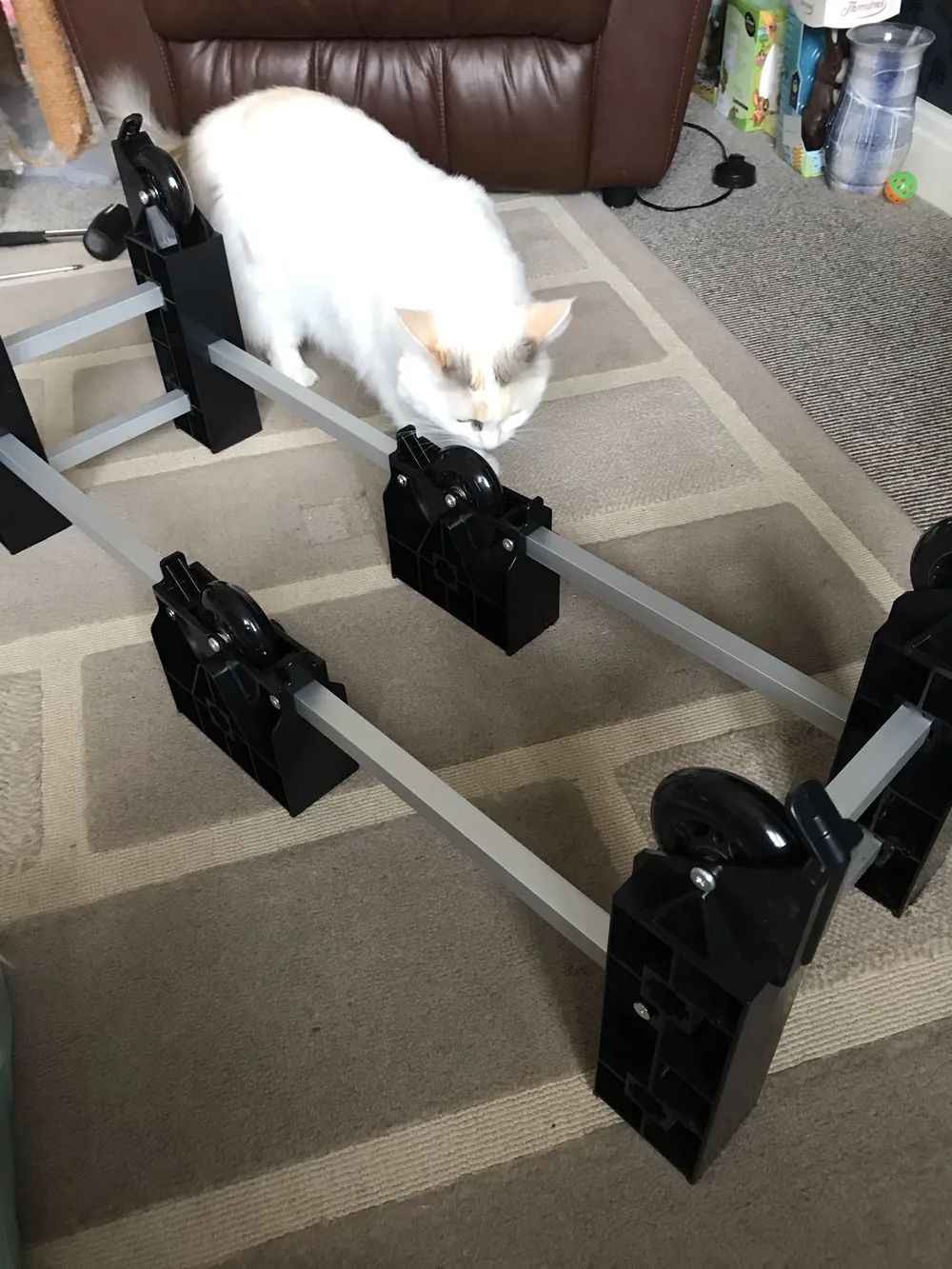
The base is doing more work than it looks. It has to hold a tall hoop upright while an animal accelerates inside it, absorb the sideways load when the cat leans into a turn, and keep several rollers in contact with the rim at once. Commercial bases use a steel spine with rubber feet for exactly that reason; the home built example photographed here uses a moulded frame carrying rollers that the owner describes as being like skateboard wheels. Either approach works. A light plastic base with two contact points does not.
Flooring changes the outcome more than most buyers expect. On thick carpet a base sinks unevenly, the hoop goes slightly out of true and the wheel develops a wobble that cats abandon quickly. On hard floors the wheel runs true but transmits every rotation into the room as a low rumble, which is fine at four in the afternoon and considerably less fine at four in the morning. A thin, dense mat under the base is the usual compromise.
Give the wheel clearance on all sides. A cat leaving a moving hoop does so at speed and not always in the direction you would predict, so the exit path should not end in a radiator, a glass door or a coffee table corner. Half a metre of clear floor in front of the opening, and enough space behind that the wheel cannot be pushed into a wall and jammed, is the working minimum in a normal living room.
Position it where the cat already spends time rather than where it looks best. A wheel parked in a spare room that the household enters twice a week will be used twice a week at most. Cats exercise where they feel safe and observed, which in most homes means the room with the sofa in it. That is inconvenient for interior design and it is the single biggest predictor of whether the thing gets used. The same rule explains why the bed the cat actually sleeps in is rarely the one in the quiet spare room.
Teaching a Cat to Use It, Without Ever Lifting It On
The first rule is the one most often broken: never place a cat inside a wheel, and never hold it there while the hoop turns. A cat that experiences a moving floor it did not choose has learned that the wheel is a trap, and undoing that lesson takes far longer than teaching the behaviour properly would have taken in the first place. Every step below is voluntary, and the cat is free to leave at any point.
If your cat needs variety, our motion activated cat toys guide has great suggestions.
Start with the wheel stationary and blocked so it cannot turn at all, with a folded towel wedged under the rim. Feed the cat near it, then on the base, then just inside the stationary hoop. This stage is about the wheel becoming furniture rather than an event, and for a cautious cat it can take a fortnight. Rushing it is the most common reason the whole project fails.
Once the cat walks into the stationary hoop by choice, unblock it and let the surface move a few centimetres under the cat's own weight. Most cats step off, look at it, and step back on. Reward that. Then use a wand or a laser spot held just ahead of the cat's nose to draw a few steps of forward motion, and stop while the cat still wants more. Short sessions, ending early, build the habit; long sessions end it.
Treats do the heavy lifting here and they have to be worth working for, which usually means something meatier than the daily kibble. Keep the portions tiny and subtract them from the day's food, because a training programme that adds calories while teaching exercise is working against itself. If you already use treat dispensing toys, count those portions in the same daily total. Some cats never progress past walking, and walking is a perfectly good outcome. Others are running laps within a week and then the problem becomes the rumble at three in the morning.
Weight, Health and What a Wheel Cannot Do
A wheel is not a weight loss device and it is important to say so plainly. Cornell describes feline obesity, generally defined as a body weight twenty percent or more above normal, as the most frequently observed nutritional disorder in domestic cats, and lists osteoarthritis, hip dysplasia and diabetes mellitus among the conditions that excess weight can aggravate, with additional strain on the heart and vasculature. None of that is solved by adding minutes of voluntary running to a diet that is still oversupplying calories.
Cornell is equally specific about how weight loss should be handled, and it is not by exercise alone. Any feline weight reduction programme should be carried out under veterinary direction, because a cat put on a sudden starvation diet risks hepatic lipidosis, a serious liver condition. The target Cornell quotes is gradual: a loss of roughly one to two percent of body weight per week, monitored at home, ideally on a baby scale. A wheel can support that plan. It cannot replace it.
There is a second trap worth naming. An overweight cat is exactly the animal least suited to starting on a wheel, because the extra load falls on joints that may already be arthritic and because the curvature of the running surface is proportionally tighter for a larger body. The order of operations matters: veterinary assessment first, diet plan second, gentle floor level play third, and a wheel only once the cat is moving comfortably and the vet has no objection.
Used within those limits, a wheel earns its place. It gives a high energy indoor cat a way to spend stamina that no toy can absorb, it is available at three in the morning when nobody else in the house is, and it shifts some of the enrichment burden off the owner in a way that no single one of the usual cat enrichment toys manages. Those are real benefits. They are just enrichment benefits rather than clinical ones, and the packaging is not always careful about the difference.
Cheaper Things That Deliver a Lot of the Same Value
Before committing the floor space and the money, it is worth knowing that most of the enrichment value a wheel delivers can be had for a fraction of the outlay. Vertical territory is the strongest substitute: shelves, a tall tree and a window perch let a cat climb, jump and survey, which uses the same muscles and a great deal more of the brain than running in a circle does. For many households that is the better first purchase by some margin.
Hunting play remains the highest value activity per pound spent. A wand toy in a person's hand for ten minutes twice a day produces sprinting, leaping and a catch, and the sequence ends in something a wheel never provides, which is a successful kill. A cat that gets that daily is measurably less likely to be pacing the hall at midnight, and the whole apparatus costs about the same as a takeaway.
Food based enrichment covers the rest of the day when nobody is home. Puzzle feeders, treat balls and scattered portions turn eating into work and spread activity across hours rather than concentrating it. Pair that with a couple of interactive cat toys the cat can operate alone and a solid scratching post, and the flat starts to look like an environment rather than a room.
If you have done all of that and the cat is still running the corridor at speed every night, the wheel is a sensible next step rather than a first one. Buy it having already established the temperament, measured the cat, measured the room, and accepted that a fortnight of patient, voluntary training stands between the delivery and the first lap. Households that follow that order are the ones whose wheels get used.
Organizations like the International Cat Care advice hub also offer trusted, science-backed advice that is well worth bookmarking.
Frequently Asked Questions
Do cats actually use exercise wheels?
Some do, enthusiastically, and many never touch one. The cats that take to a wheel are typically young to middle aged, lean, confident on moving surfaces and already inclined to sprint laps of the house. High activity breeds such as Bengals, Savannahs, Abyssinians and Orientals appear disproportionately in wheel running footage because of stamina rather than any special aptitude. A placid cat that prefers ambush play to running is unlikely to be converted by a purchase.
What size cat exercise wheel do I need?
Bigger than instinct suggests. The leading commercial model publishes a 48 inch outer diameter and a 43 inch inner diameter with an 11 inch wide running track, and argues that this size lets a cat stretch out mid stride rather than run with a curved spine. As a check against your own animal, measure from shoulder to tail base while the cat stands relaxed and look for an inner diameter comfortably more than three times that length.
Are cat exercise wheels safe?
A well made one is, and the failure modes are predictable. The running surface must be a single continuous band with no rungs, mesh or gaps at the segment joins, because anything a paw can drop into can trap it while the hoop is turning. The rollers must be shrouded or set outboard so a tail cannot reach them. The base must be heavy and wide enough that the hoop cannot tip when a cat accelerates inside it.
How do I train my cat to use a wheel?
Voluntarily, in stages, and never by lifting the cat on. Block the wheel so it cannot turn, then feed the cat near it, on the base, and finally inside the stationary hoop until it is simply furniture. Unblock it and let the surface shift slightly under the cat's own weight, rewarding any calm reaction. Use a wand or laser spot ahead of the nose to draw a few forward steps, and stop while the cat still wants more.
Will an exercise wheel help my cat lose weight?
Not on its own. Cornell defines feline obesity as a body weight twenty percent or more above normal and calls it the most frequently observed nutritional disorder in cats, with osteoarthritis, hip dysplasia and diabetes among the conditions it can aggravate. Cornell advises that any weight reduction programme be run under veterinary direction, aiming at a gradual loss of about one to two percent of body weight per week, because sudden starvation diets risk hepatic lipidosis.
Are cat wheels noisy?
On a hard floor, yes, in the sense that a turning hoop transmits a low rumble into the structure of the room, and cats often choose the small hours to run. Quality bearings reduce the high pitched element but not the rumble. A thin dense mat under the base is the usual fix, and positioning the wheel away from a bedroom wall matters more than any specification on the box.
Can kittens or senior cats use an exercise wheel?
Both groups need a veterinary opinion first. Kittens are still growing and a repetitive activity on a curved surface is not obviously appropriate for open growth plates. Senior cats frequently have arthritis that is not yet diagnosed, and a moving floor is exactly the surface that makes a stiff joint uncomfortable. Cats with heart or respiratory disease, vestibular problems or impaired vision should not be encouraged onto one at all.
What can I buy instead if my cat will not use a wheel?
Vertical space is the strongest substitute, because climbing and jumping use the same muscles and much more of the brain: shelving, a tall tree and a window perch. Ten minutes of wand play twice a day delivers the sprint, the leap and the catch that a wheel cannot. Puzzle feeders and treat balls then spread activity through the hours when nobody is home, which is the part of the day a wheel was meant to cover.
Browse Cat Toys
Free worldwide shipping on every order. No minimum purchase required.
Browse Cat Toys →