Putting up a Christmas tree in a house with a cat is a design problem, not a battle of wills. The tree is tall, it smells interesting, and it is covered in swinging objects, which is close to a perfect invitation for a climbing animal. This guide covers what is genuinely dangerous, what is only inconvenient, how to anchor and decorate a tree so a cat can live alongside it, and the signs that mean a call to the veterinarian rather than a dustpan.
Why a Christmas Tree Is Irresistible to a Cat
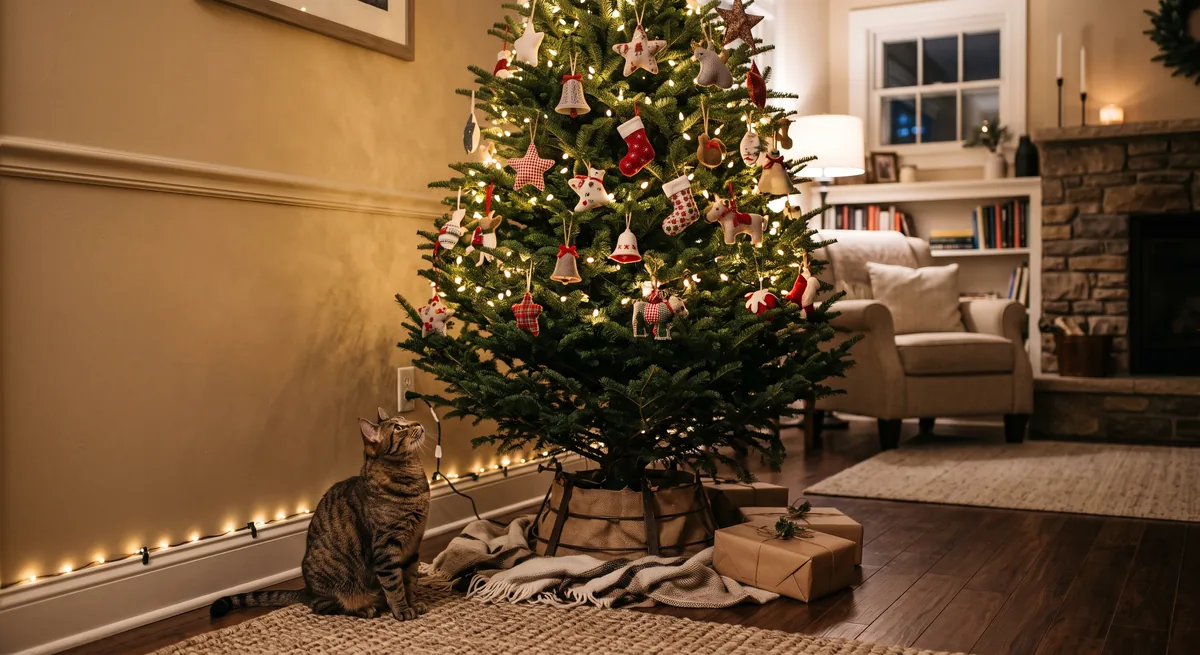
From a cat's point of view, a Christmas tree is not a decoration. It is a tall climbing structure that has appeared indoors, it smells of the outside, it moves when touched, and it is hung with small swinging objects at exactly the height a paw likes to bat. Every instinct a cat has for climbing, hunting, and investigating vertical space points straight at it.
Height is the strongest pull. Cats look for elevated resting places because height feels safe and offers a view of the room, so a new structure two metres tall is genuinely appealing rather than simply naughty. Understanding that changes how you respond. A cat that keeps returning to the tree is usually telling you that the room does not offer enough legitimate vertical space, which is a problem you can solve.
Movement is the second pull. Dangling ornaments behave like prey: they swing, they catch the light, and they respond when a paw touches them. That is the same appeal as a wand toy, and a cat has no way of knowing that one is a game and the other is a family heirloom.
The practical conclusion is that scolding rarely works and redirection usually does. Most of the advice in this guide is about making the tree boring and safe while making somewhere else more interesting, which is a far more reliable strategy than trying to convince a cat that a climbing frame is not for climbing.
The Real Hazards Worth Taking Seriously
Not every worry about a cat and a Christmas tree is equally serious. A broken bauble is annoying; an ingested strand of tinsel can be a surgical emergency. It helps to separate the two so your effort goes where it matters.
The ASPCA's holiday safety guidance is direct about the main ones: secure the tree so there is no chance it can tip over and injure an animal, keep wires, batteries, and glass or plastic ornaments out of reach, and avoid tinsel entirely because swallowed tinsel can cause severe vomiting, an obstructed digestive tract, dehydration, and may even require surgery.
Two of those deserve extra emphasis. String-like items, which veterinarians call linear foreign bodies, are dangerous out of proportion to their size, because one end can lodge while the rest keeps travelling through the gut. Tinsel, ribbon, and the string on a gift tag all fall into that group. Second, a falling tree is not a small accident when it lands on a cat, and it is entirely preventable with a stable base.
Pine needles are a smaller but real nuisance. They are sharp, they are swallowed while grooming, and a cat that chews on them may end up with mouth irritation or an upset stomach. Sweeping fallen needles regularly is a small habit that removes a whole category of problem.
Choosing and Placing the Tree
The choice between a real and an artificial tree is partly about hazard profile. A cut tree drops needles and stands in a water reservoir that can grow bacteria and may contain preservative additives, so that water needs to be covered rather than left accessible. An artificial tree drops no needles and needs no water, though a cheap one can shed plastic bristles that a cat may swallow.
Placement is where you win most of the battle. Put the tree in a corner rather than the middle of a room, so two sides are already protected. Keep it away from anything a cat can use as a launch pad: a bookcase, a sideboard, a windowsill, or the back of a sofa. A cat that has to jump from the floor is far less likely to end up in the branches than one that can step across from a shelf at the same height.
Consider whether a smaller tree on a stable, heavy surface makes more sense than a full-height tree in your particular home. A shorter tree gives a cat less to climb and falls a shorter distance if the worst happens. If your cat is young, confident, and an enthusiastic climber, that trade is often worth making for a season or two.
Leave the tree bare for the first day or two. Cats investigate new things intensely and then lose interest, so letting the novelty wear off before you decorate means the ornaments arrive when the tree is already old news. It is a small piece of timing that saves a lot of trouble.
Anchor It So It Cannot Tip
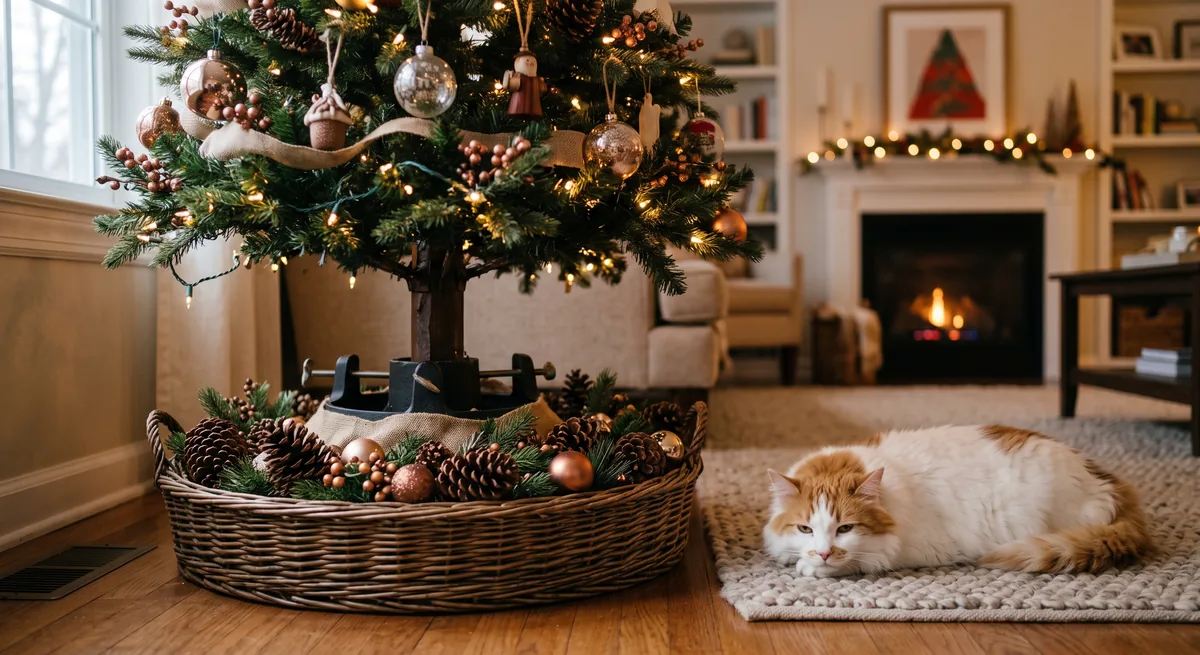
Securing the tree is the single highest-value job on this list, because it removes the one hazard that can injure a cat badly and instantly. A wide, heavy stand is the starting point, not the finish. Weight low down helps too: a few heavy items placed inside or around the base of the stand lower the centre of gravity and make the whole thing far harder to topple.
For a determined climber, add a tether. A length of fishing line or thin cord run from the trunk near the top of the tree to a wall hook, a curtain rail bracket, or a window fitting is nearly invisible and stops the tree from going over even if a cat lands in it. Two tethers at right angles are better than one.
Cover the water reservoir on a real tree. A tree skirt alone does not do it. A purpose-made cover, or a piece of board cut to fit around the trunk, stops a cat drinking water that may hold sap, bacteria, or additives from the packaging that came with the tree.
Finally, check the whole assembly by hand before you decorate. Push the trunk gently in each direction at about the height a cat would reach. If it rocks, fix that now rather than after it has fallen once.
Decorations: What to Skip and What to Use
Decorating with a cat in the house is mostly about substitution rather than sacrifice. Almost every festive look can be achieved with materials that are not worth swallowing.
Two placement rules do most of the work. Keep the lowest branches bare or hung only with soft, unbreakable items, because that is the zone a cat reaches without climbing. And attach everything with a closed hook or a loop of ribbon tied firmly rather than a simple open hook, so a curious paw dislodges an ornament far less easily.
Skip tinsel completely, and treat ribbon, string, garlands of small beads, and the fine cord on gift tags the same way. If you love the shimmer, an artificial garland attached firmly along the branches gives a similar effect without loose strands.
Edible decorations are a category to avoid entirely. Chocolate, candy canes, and salt-dough shapes all invite a cat to chew on the tree, and chocolate in particular is not safe for pets. Gift-wrapped food under the tree is the same problem in a different package, so keep it out of reach until it is time to open it.
Lights, Cords, and Batteries
Electrical cord is the hazard most people underestimate, because a chewed cord looks harmless right up until it is not. Run the cable down the back of the tree, secure it along the skirting with clips or cord covers, and avoid leaving loops hanging where a paw can hook them. The ASPCA guidance is blunt on this point: a wire can deliver a potentially lethal electrical shock, and a punctured battery can cause burns to the mouth and oesophagus.
Battery-operated lights remove the mains risk but introduce a battery pack, so make sure the compartment screws shut and sit the pack where a cat cannot carry it off. Loose button batteries are a serious emergency if swallowed, so treat them the way you would treat a small child in the house.
Switch the lights off whenever the room is empty. A timer or a smart plug makes that automatic, which matters because the risky moments are usually the unsupervised ones. Warm bulbs against dry branches are also a fire question, not only a pet question.
If your cat has already shown interest in cords elsewhere in the house, deal with that habit separately rather than hoping the tree will be an exception. Enrichment helps here: a cat with something better to chew and chase tends to leave cables alone, and our guides to cat enrichment toys and interactive cat toys cover the options.
Holiday Plants That Are Not Safe
The tree is rarely the most toxic thing in a festive room. The ASPCA notes that mistletoe and holly can cause gastrointestinal upset and cardiovascular problems if eaten by pets, that many lilies commonly found in holiday bouquets are highly toxic to cats and can cause kidney failure, and that poinsettias can cause mild to moderate gastrointestinal irritation.
Lilies deserve their own line. For cats specifically, the risk is severe rather than mild, and it applies to pollen and vase water as well as the plant itself. The safest approach in a household with cats is simply not to bring lilies indoors, and to check any gifted bouquet before you put it in a vase.
Artificial alternatives solve this neatly. A good artificial wreath or a silk arrangement gives the same look and removes the question entirely. If you do keep live plants, put them somewhere a cat genuinely cannot reach rather than somewhere that merely looks high.
Keep your veterinary practice's out-of-hours number and a pet poison helpline number saved before the holidays start. If you think your cat has eaten something toxic, phone straight away rather than waiting for symptoms, and take the packaging or a photo of the plant with you.
Give the Cat Somewhere Better to Climb
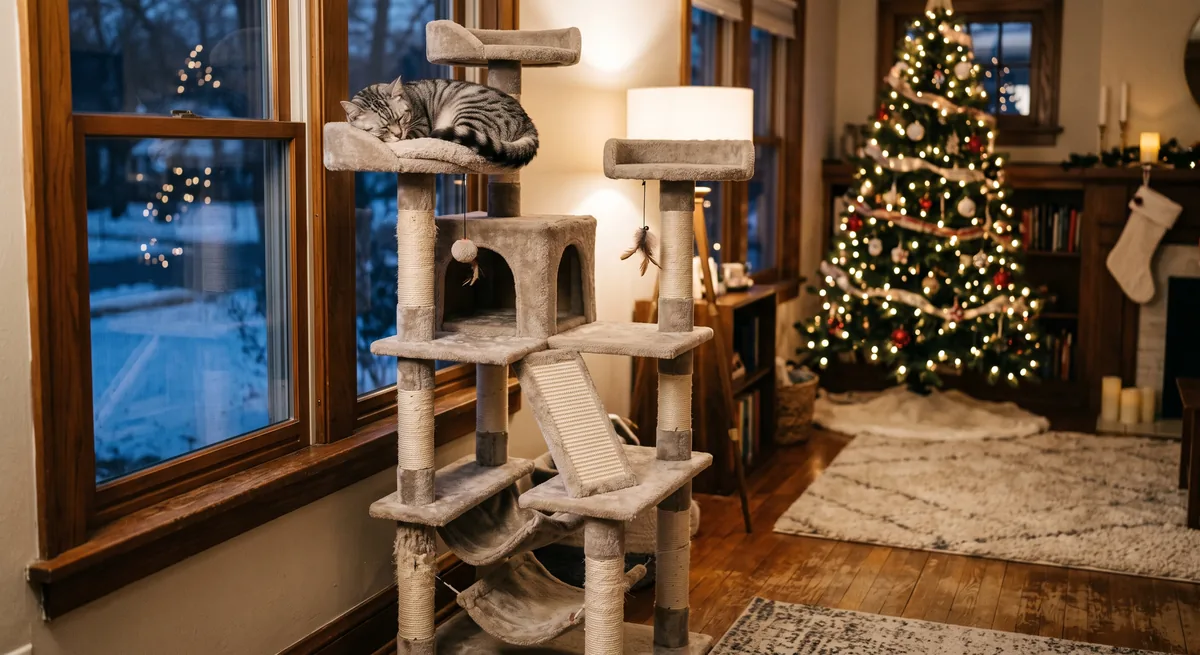
Deterrence works far better when it comes with an alternative. A cat wants height, a lookout, and something to bat at. Provide all three away from the tree and the tree becomes much less interesting on its own.
A tall cat tree placed near a window is the most direct substitute, because it offers the same elevation with better views and a more comfortable resting surface. Our guides to cat trees, cat trees and towers, and the cat climbing tree cover sizing and stability, and a cat window perch is a lighter option where floor space is tight.
Add scratching in the same area. A cat that has been given a proper cat scratching post near its favourite resting spot has a legitimate outlet, which reduces the appeal of a tree trunk wrapped in bark. Position matters more than most owners expect: a post in the corner of a spare room gets ignored, while the same post beside the sofa gets used daily.
Then make the alternative more rewarding than the tree. Rotate a few favourite cat toys onto the cat tree, use catnip on the new furniture rather than near the tree, and schedule a play session in the evening when a cat is most likely to go looking for something to do. Our guides on how to entertain a cat and toys for cats home alone go into more detail, and Christmas cat toys are an easy way to give a cat its own festive thing to attack.
Signs Your Cat Needs a Veterinarian
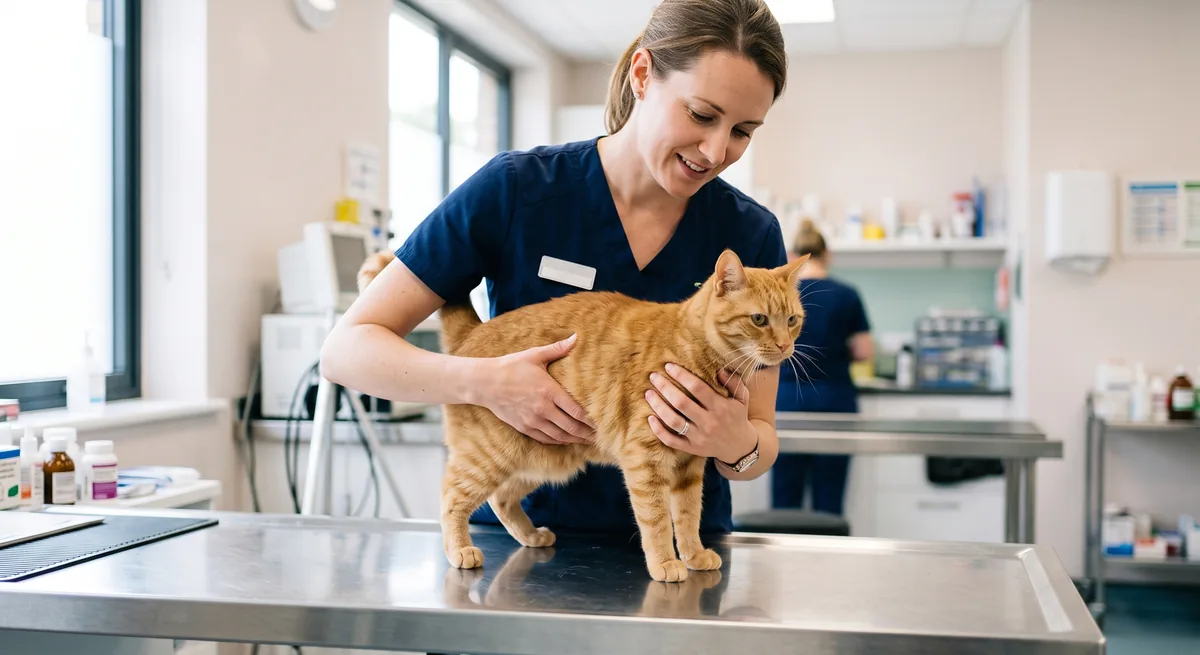
Even a carefully managed room can go wrong, and the useful skill is recognising when a problem has moved beyond a mess to clear up. Contact a veterinarian promptly if your cat is repeatedly vomiting or retching, has stopped eating, seems lethargic or hides away, strains without producing stool, has a swollen or painful abdomen, drools, paws at the mouth, or has diarrhoea that does not settle.
One warning deserves to stand alone. If you can see string, tinsel, or ribbon hanging from your cat's mouth or from under the tail, do not pull it. The other end may be anchored inside the gut, and pulling can cause serious internal damage. Phone your veterinary practice immediately and describe exactly what you can see.
Suspected electrical injury is also urgent, even when the cat seems fine. Burns inside the mouth may not be obvious, and fluid can build up in the lungs some hours after a shock. If you find a chewed cable and a cat that has been near it, that is a call to make now rather than in the morning.
Finally, tell the practice what your cat may have reached, not just what you saw it eat. Knowing that a decorated tree, a bouquet, and a box of chocolates were all in the same room helps a veterinarian narrow things down quickly, and a photograph of the plant or packaging is genuinely useful. For the rest of the season, a room set up along the lines above, plus a little cat furniture in the right place and a bag of Christmas pet gifts aimed at the cat rather than the tree, usually keeps everybody out of the waiting room.
Frequently Asked Questions
How do I stop my cat climbing the Christmas tree?
Make the tree less rewarding and something else more rewarding. Place the tree in a corner away from furniture a cat can jump from, leave the lowest branches bare, and set up a tall cat tree or window perch nearby with toys and catnip so the cat has a better place to climb.
Is tinsel dangerous for cats?
Yes. The ASPCA advises skipping tinsel entirely, because swallowed tinsel can cause severe vomiting, an obstructed digestive tract and dehydration, and may require surgery. Ribbon, string and fine gift-tag cord carry the same risk and are best kept away from the tree.
Is a real or artificial Christmas tree safer with a cat?
Both can be managed. A real tree drops sharp needles and stands in water that should be covered so a cat cannot drink it. An artificial tree avoids needles and water, though a low-quality one may shed plastic bristles. Stability and decoration choices matter more than the material.
How do I stop the Christmas tree falling on my cat?
Use a wide, heavy stand, add weight low around the base, and tether the upper trunk to a wall hook or curtain fitting with thin cord or fishing line. Push the trunk gently at cat height before decorating; if it rocks, secure it further.
Which Christmas ornaments are safest with cats?
Choose shatterproof, unbreakable ornaments in fabric, felt, wood or sturdy plastic, attach them with closed hooks or firmly tied loops, and keep breakable or sentimental pieces on the upper branches. Avoid tinsel, loose ribbon, small beads and anything edible.
Are poinsettias, holly and lilies safe around cats?
No. The ASPCA notes that mistletoe and holly can cause gastrointestinal upset and cardiovascular problems, that many lilies found in holiday bouquets are highly toxic to cats and can cause kidney failure, and that poinsettias can cause mild to moderate gastrointestinal irritation. Artificial versions avoid the problem.
What should I do if my cat swallowed tinsel or ribbon?
Contact a veterinarian immediately. If you can see string or tinsel hanging from the mouth or under the tail, do not pull it, because the other end may be anchored inside the gut and pulling can cause serious internal injury. Describe exactly what you can see when you call.
Shop Pet Supplies
Free worldwide shipping on every order. No minimum purchase required.
Shop Pet Supplies →