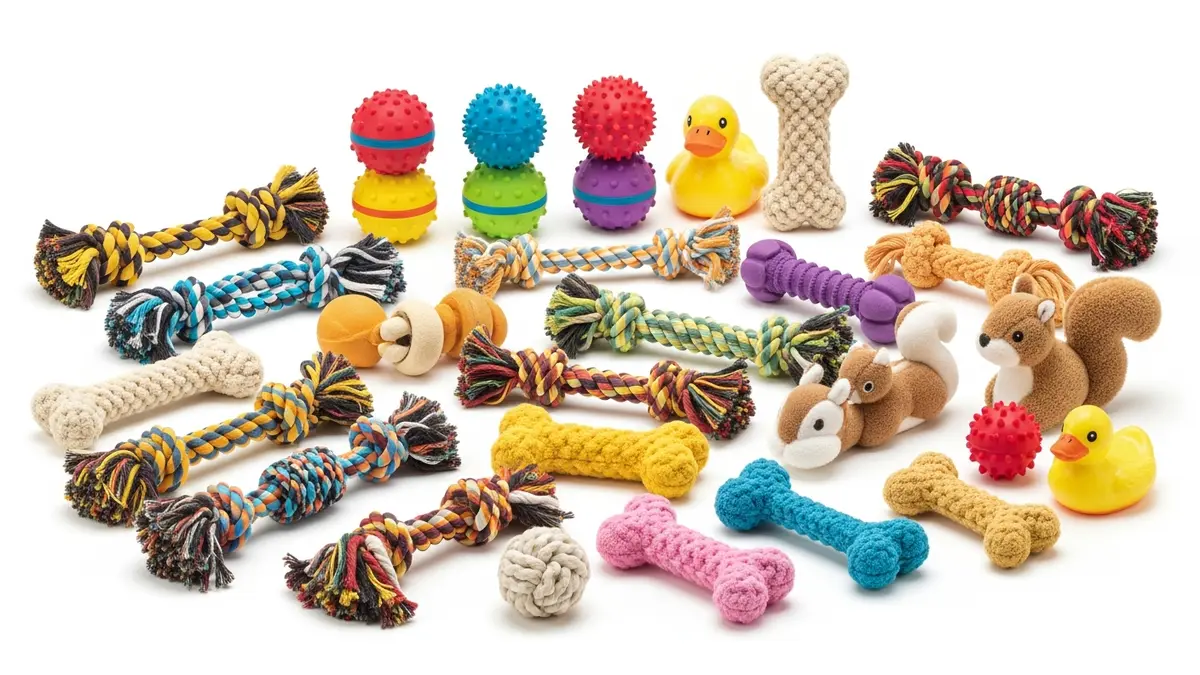
Top photo: a young tabby cat resting on a cat tree beside a grey plush mouse and a fabric mouse toy. Photo: TudorTulok / Wikimedia Commons, CC BY-SA 4.0 (cropped, resized and converted to WebP).
Quick answer: the best cat toys are the ones that let your cat run through a hunt: watch, stalk, chase, pounce and catch. Most homes need three kinds. A wand or teaser toy for daily play with you, a few small solo toys such as plush mice and kicker toys, and a food puzzle for mealtimes.
Plush cat toys are worth having for the "catch" and for solo play. Pick ones too big to swallow, with no string tails, glued-on eyes or bells, and throw them out once a seam opens.
This article is for general informational purposes only and is not a substitute for professional veterinary advice, diagnosis, or treatment. Always consult your veterinarian about any health concerns, dietary changes, medication, or product safety questions specific to your pet. If your pet shows signs of distress, illness, or injury, contact a licensed veterinarian or emergency animal hospital immediately.
Why Cats Need Toys at All
A full food bowl does not switch off the urge to hunt. VCA Animal Hospitals puts it plainly: a cat's desire to hunt "is not connected to the sensation of hunger," and even well-fed cats will stalk anything that moves fast or squeaks. The same VCA page notes that an outdoor cat might catch as many as 10 small animals a day (VCA, Cat Behavior and Training).
An indoor cat has none of that. Toys are the stand-in. The feline environmental needs guidelines from the American Association of Feline Practitioners (AAFP) and the International Society of Feline Medicine (ISFM) list "opportunity for play and predatory behavior" as one of five basic needs, met through toys, play with people, and feeders that make a cat work for its food (VCA summary of the AAFP/ISFM guidelines).
That is the test to apply to any toy on a shelf: does it let your cat do part of a hunt? If it does nothing but sit there, it will be ignored within days.
The Best Cat Toys by Type
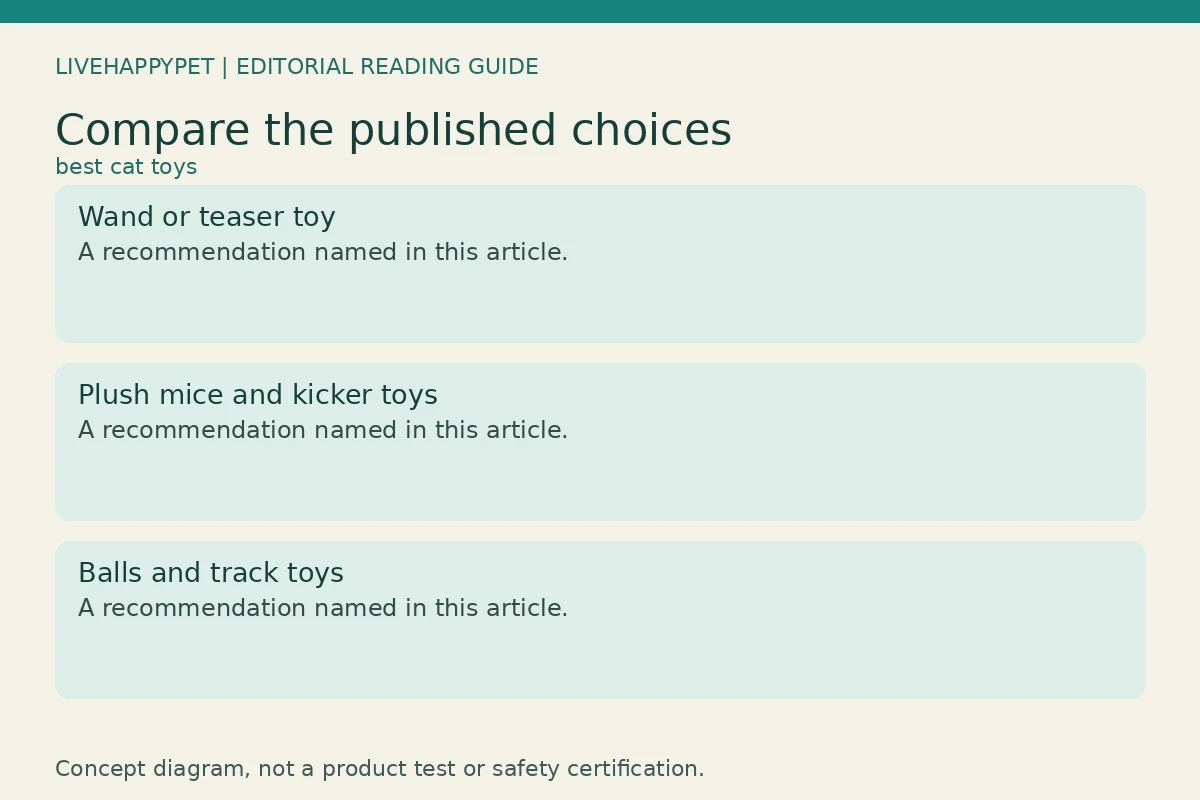
VCA's advice is to choose toys that "mimic real prey in terms of size, texture, and color," and to play "chase the bird," "chase the mouse," or "chase the bug." The table below groups toys by which part of the hunt they cover.
| Toy type | Part of the hunt | Best for | Safety note |
|---|---|---|---|
| Wand or teaser toy | Watch, stalk, chase, pounce | Daily play with you, cats that bat at your hands | Supervised only. Put it away after every session. |
| Plush mice and kicker toys | Catch, bite, carry, kick | Solo play, ending a wand session with a real catch | No string tails, glued eyes or bells. Retire torn ones. |
| Balls and track toys | Chase, bat | Solo play while you are busy | Larger than your cat's mouth can close around. |
| Food puzzles | Search, catch, eat | Fast eaters, bored indoor cats | Check the food is actually being eaten. |
| Tunnels | Hide, ambush | Shy cats, multi-cat homes | Remove dangling pom-poms on cords. |
| Catnip or silver vine toys | Rub, roll, kick | Reviving interest in old toys | Not every cat responds. See below. |
Wand and teaser toys
A wand puts you in charge of the "prey," which is why it gives the most complete hunt. Move the lure the way a small animal would: away from your cat, behind furniture, pausing, then darting off. VCA recommends a wand toy for this kind of social play and is just as direct about the risk: "Do not leave any wand toys unattended," because swallowing ropes or strings is very dangerous for cats. After play, the wand goes in a closed cupboard, not on the floor. Our guide to interactive cat toys covers wand technique in more detail.
Solo toys: balls, tracks and small plush toys
Solo toys keep a cat busy between your play sessions. Light balls, track toys and small plush mice that slide on a hard floor work well. They do not replace play with you, but they give a cat something to bat at when it wakes up at 3 a.m. Plush toys get their own section below because they are the type people ask about most.
Food puzzles
VCA suggests hiding toys or part of your cat's daily food around the house and using puzzle toys to deliver part of a meal. It adds one caution that is easy to miss: make sure all the food is actually eaten, because cats can become seriously ill if they do not take in enough calories each day. We look at the research in do cats need puzzle toys.
Tunnels
A tunnel is half hiding place, half ambush spot. It suits cats that like to lie in wait more than chase. See our cat tunnel guide for how to pick one and get a reluctant cat to use it.
Laser toys
Lasers trigger chasing well, but the cat can never catch the dot. If you use one, finish by landing the beam on a plush toy or a treat your cat can actually grab. Our guide to using a laser cat toy without frustration explains why.
Plush Cat Toys: What They Are Good For and How to Pick Safe Ones
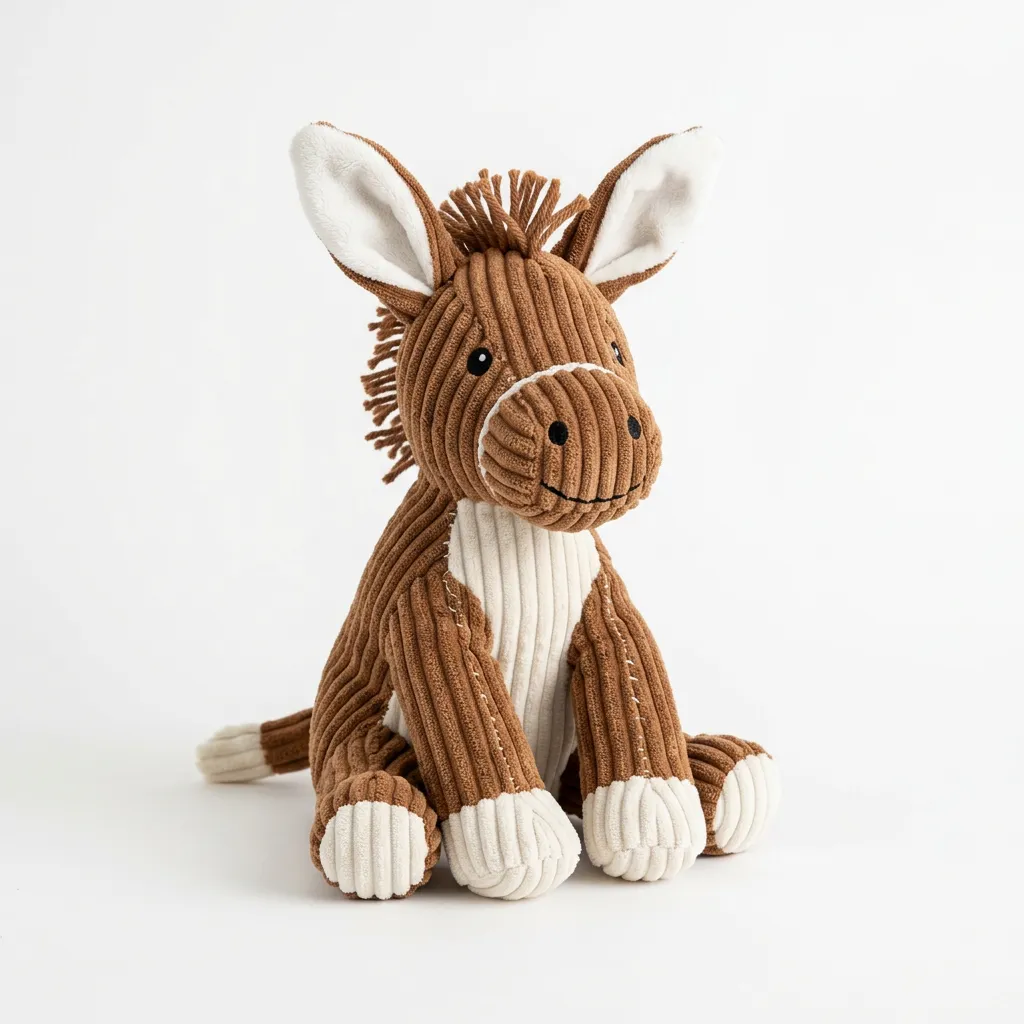
Plush cat toys are soft, fabric-covered toys, usually shaped like mice, fish or birds, and often filled with fibre, crinkle material, catnip or silver vine. Their job is the end of the hunt. A wand covers the stalk and chase; a plush toy is the part your cat can grab, bite, carry off and kick. That fits VCA's advice to pick toys that resemble prey in size and texture.
The main kinds of plush cat toys
- Small plush mice. Light enough to bat across a floor and carry. Good for solo play and for ending a wand session with a real catch.
- Kicker toys. Long, pillow-like plush toys, roughly the length of a cat's body, that a cat can hug with its front legs while kicking with its back legs. Many cats play this way with any toy that is the right size; kickers are simply built for it.
- Catnip or silver vine plush toys. A plush shell filled or treated with dried plant material. These rely on scent as much as movement.
- Crinkle plush toys. A plush cover around a crinkly inner layer that makes noise when batted. VCA notes that anything that moves rapidly or squeaks in a high pitch can trigger a cat's hunting response.
How to choose a safe plush cat toy
The safety rules for plush cat toys come down to one question: what could your cat swallow? VCA's page on foreign bodies lists thread, wool, rubber bands and small toys among the things cats are known to eat, and explains why string is worse than most objects: the backward-facing spines on a cat's tongue make it hard for a cat to spit thread out once it is in the mouth (VCA, Foreign Bodies in Cats).
- Size first. VCA says to make sure toys are not so small they could be swallowed and cause an intestinal blockage. A plush toy should be clearly larger than your cat's mouth can close around.
- No string or yarn tails. A long tail on a plush mouse is exactly the "linear" shape VCA warns about. If a toy you love has one, cut it off at the body.
- Embroidered faces, not glued parts. Plastic eyes, noses, bells and sewn-on ribbons are the first parts to come loose.
- Tight seams and closed ends. Check the seams with your fingers before you hand the toy over, and look again every few days.
- Supervise new toys. Watch the first few sessions. A cat that shreds fabric is better off with sturdier toys.
When to throw a plush toy away
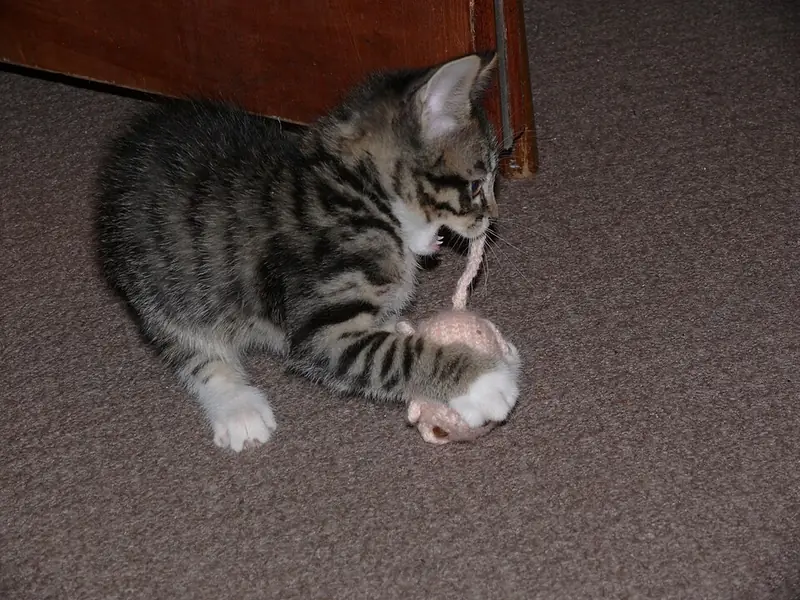
Retire a plush toy as soon as the stuffing shows, a seam opens, or any part hangs loose. Filling and loose thread are small, easy to swallow pieces. Keep a few spares so you never feel tempted to leave a damaged favourite out.
Catnip and silver vine plush toys
Scent-filled plush toys are popular, but they do not work on every cat. In a 2017 study of 100 domestic cats published in BMC Veterinary Research, 68% responded to catnip and 79% responded to silver vine. Of the cats that ignored catnip, almost 75% did respond to silver vine (Bol et al., 2017). The same paper describes the typical response: sniffing, licking, rubbing the head and cheeks on the material, rolling over, and sometimes kicking it with the hind feet, which is why scented plush toys and kicker shapes so often go together.
If your cat shrugs at a catnip toy, that is normal for about one cat in three. A silver vine toy is the next thing to try. The authors also note that catnip and silver vine are generally considered safe and not toxic or addictive for cats. For more on why cats react, read why do cats like catnip, and for refillable options see our catnip toys guide.
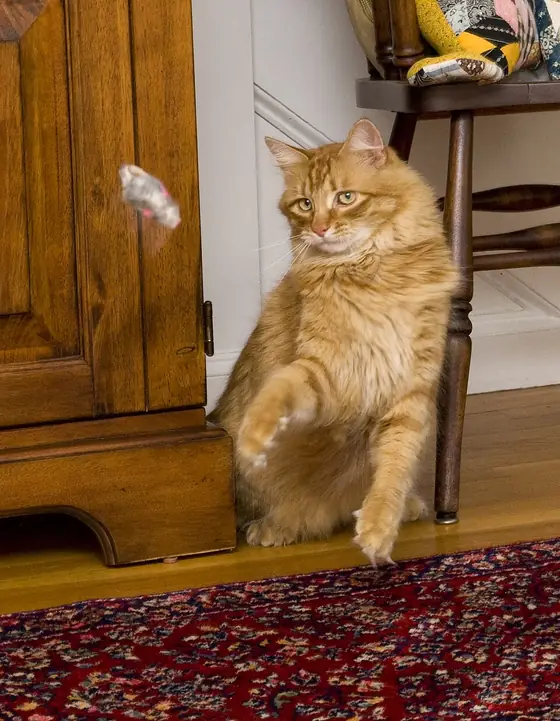
Plush toys for kittens
Kittens chew and shred more than adult cats, so the swallowing rules matter even more. Choose plush toys with no tail at all, check them after every session, and keep them in a drawer when you are not around. Our kitten toys guide covers the rest of a kitten's toy box.
Signs Your Cat May Have Swallowed Part of a Toy
Most small pieces pass, but not all of them. VCA lists these signs of a swallowed foreign body: vomiting or diarrhoea, belly pain or tenderness, poor appetite, straining to pass stool or passing only small amounts, lethargy, biting or growling when picked up around the belly, and pawing at the mouth if string is wrapped around the base of the tongue (VCA).
String-type objects are the most serious. VCA explains that if one end of a "linear foreign body" catches at the base of the tongue or in the stomach, the intestines can bunch up along it like fabric on a drawstring, and the most significant complication is a tear in the intestine. Treatment is usually surgery (VCA, Linear Foreign Body in Cats). If you see string in your cat's mouth or think a toy part is missing, call your veterinarian rather than waiting to see what happens.
How to Keep Your Cat Interested in Its Toys
- Rotate. VCA recommends providing a variety of toys and rotating them often to keep them novel. Leave two or three out and put the rest away for a week.
- Play before your cat's active times. VCA suggests starting play just before your cat would normally be active or ask for attention, for example before dinner or before bed.
- Several short sessions. VCA advises at least three short play sessions a day rather than one long one.
- Always let your cat win. End wand or laser play by letting your cat catch something real, such as a plush mouse, then offer a meal or treat.
- Never use your hands as the toy. VCA warns against letting a cat chase or pounce on any part of you; even a small bite or scratch can become infected.
A Note on What We Sell
Livehappypet does not stock plush cat toys right now, so we have not recommended any by brand on this page. Use the checklist above with any toy you buy. Our cat range focuses on scratching and climbing instead; the AAFP/ISFM guidelines list scratching areas and resting areas among the key resources every cat needs, alongside play areas. If your cat needs a place to climb and scratch between play sessions, see the mushroom cat scratching post or the window-mount cat tree with sisal post, or browse all cat products.
Frequently Asked Questions
Are plush toys safe for cats?
Yes, if they are larger than your cat could swallow, have no string tails, glued-on eyes or bells, and are thrown away once a seam opens. VCA warns that small toys and thread are among the objects cats commonly swallow, and that string is especially dangerous.
Do cats like plush toys?
Many do, especially small plush mice they can carry and kicker toys they can wrap their legs around. VCA recommends toys that resemble prey in size and texture, and a soft plush mouse fits that description. Preferences vary, so try more than one shape.
What is a cat kicker toy?
A kicker is a long plush toy, roughly the length of a cat's body, designed for a cat to hold with its front paws while kicking with its back legs. Many are filled with catnip or silver vine.
Why does my cat ignore catnip toys?
Not every cat responds to catnip. In a 2017 study of 100 cats, 68% responded to catnip and 79% to silver vine, and almost 75% of catnip non-responders reacted to silver vine. Try a silver vine toy instead.
How often should I play with my cat?
VCA recommends at least three short play sessions a day, ideally just before the times your cat is normally active. Rotate toys often so they stay new.
Can I leave toys out when I am not home?
Leave out only sturdy solo toys with nothing that can be chewed off. Wand toys and anything with string should be put away after play; VCA says never to leave wand toys unattended.
Sources
- VCA Animal Hospitals. Cat Behavior and Training (hunting, choosing toys, wand toy safety, rotation, play sessions).
- VCA Animal Hospitals. Feline Environmental Needs Guidelines (summary of the AAFP/ISFM five pillars).
- VCA Animal Hospitals. Foreign Bodies in Cats (objects cats swallow, warning signs).
- VCA Animal Hospitals. Linear Foreign Body in Cats (string, yarn and tinsel risks, treatment).
- Bol S, Caspers J, Buckingham L, Anderson-Shelton GD, Ridgway C, et al. Responsiveness of cats (Felidae) to silver vine, Tatarian honeysuckle, valerian and catnip. BMC Veterinary Research, 2017.