Most bunny toys sold in pet shops are designed to catch a human eye on a shelf. Rabbits do not shop. They chew, dig, forage, hide and shred, and a toy is only useful to a bunny if it gives one of those behaviours somewhere to happen. This guide works backwards from what welfare organisations say rabbits actually need, then matches cheap and widely available objects to each need. Almost everything worth buying for a bunny costs very little, and several of the best options are already in your recycling bin.
One warning before the shopping list. Livehappypet is a dog and cat supply store, so nothing here is a product pitch. The advice below is drawn from the RSPCA, PDSA veterinary guidance and the Rabbit Welfare Association and Fund. Where an organisation gives a number, the number is theirs, not ours.
Header photo: Bcwarner, Wikimedia Commons, CC BY-SA 4.0.
What Bunny Toys Have to Do for a Rabbit
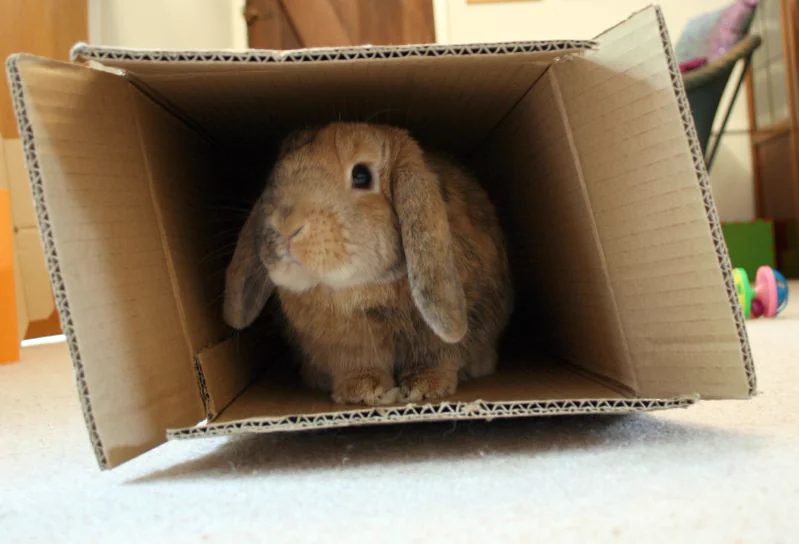
A rabbit is a prey animal that spends most of its waking hours grazing, moving and keeping an escape route in mind. The RSPCA lists what a pet rabbit needs in its living space in plain terms: a platform to climb on, a sand pit to dig in, a cardboard box to hide in, and other safe objects to chew and manipulate. Read that list again and notice how little of it looks like a toy in the retail sense. That gap is the whole reason so many bunny toys sit untouched in a corner of the run.
The same guidance suggests hanging food so the rabbit has to reach up on its hind legs, putting hay in a rack or inside cardboard tubes and empty egg boxes, and hiding food in and under things to encourage foraging. None of that requires a purchase. It requires a change in how food and objects are presented, which is the part most owners skip when they buy bunny toys for bunnies and expect the toy to do the work on its own.
It also helps to be honest about timing. The RSPCA notes that rabbits are most active in the early morning, late afternoon and overnight, so an enrichment setup that only exists while you are watching in the evening misses most of the animal's active day. Toys that hold up unsupervised, such as a stuffed cardboard tube or a loaded forage tray, earn their place far more than anything that needs you holding one end.
If you also keep a dog or a cat, the underlying principle will be familiar from our guide to dog enrichment activities. The species differ, but the logic does not: work out the behaviour first, then choose the object that lets the animal perform it safely. A bunny with nothing to chew will chew the wrong thing, exactly as a bored dog will.
Hay Is the First Toy, Not an Afterthought
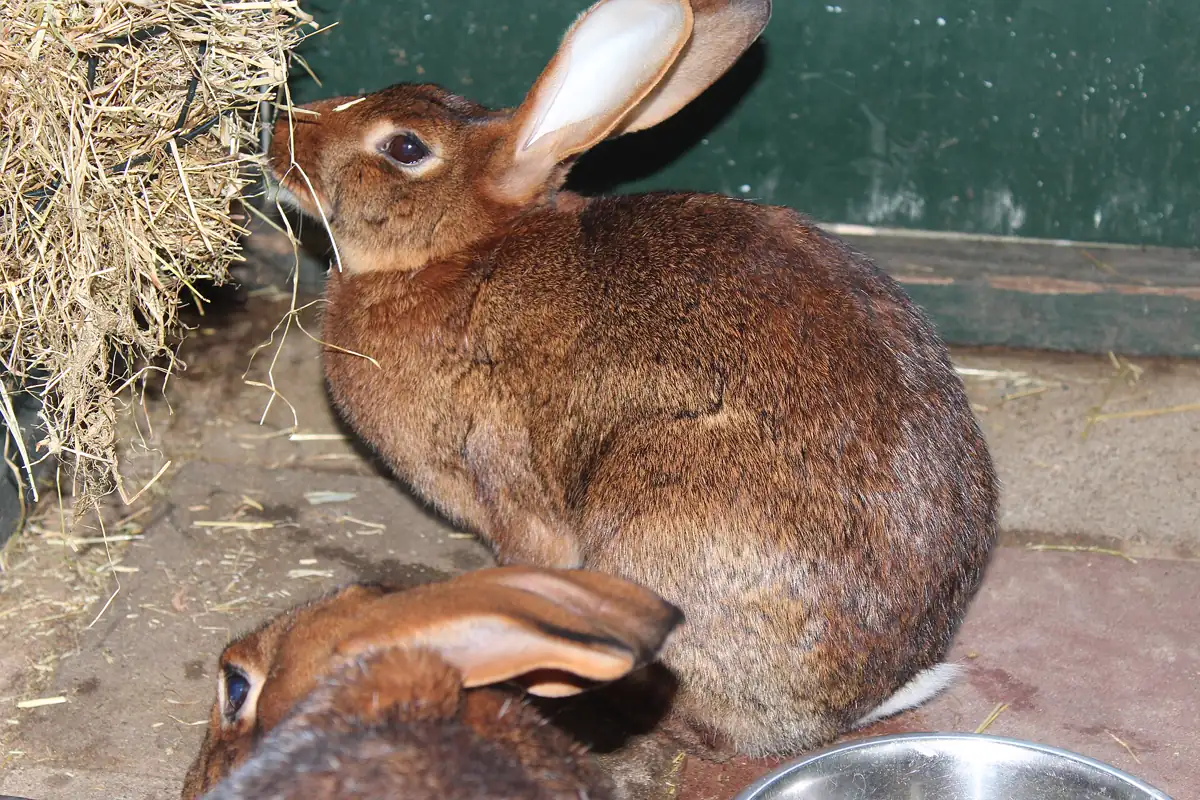
Every other bunny toy is optional. Hay is not. The RSPCA explains that a rabbit's digestive system needs hay or grass to function properly, and that rabbit teeth grow continuously, so the right food is what wears them down and keeps them the correct size and shape. PDSA puts the consequence bluntly: without enough fibre, the teeth overgrow and develop sharp spikes, called spurs, that dig into the tongue and cheeks.
Safety-conscious pet owners will also appreciate our eco friendly pet products guide.
That is why the most effective bunny toys are usually hay delivery systems rather than toys. A cardboard tube packed tightly with hay takes a rabbit several minutes of pulling and chewing to empty. A tissue box stuffed with hay and scrunched cardboard does the same job. PDSA suggests exactly this, alongside hiding a favourite vegetable inside a pile of hay so the bunny has to dig it out.
Presentation matters more than most owners expect. A pile of hay on the floor of a hutch is eaten and ignored. The same hay spread between a rack, a tube, a box and a tray creates four separate feeding events across the day. Nothing has been bought, and the rabbit has spent far longer chewing, which is the entire point.
A practical note on quantity. Hay should be constantly available, not rationed, because it is both the diet and the dental maintenance. If your rabbit is picking at hay and preferring pellets, reduce the pellets rather than adding more toys. No bunny toy fixes a diet problem, in the same way no puzzle feeder fixes a dog fed the wrong food, a point we make in our puzzle feeders for dogs guide.
Safe Chews: Wood, Cardboard and What to Skip
PDSA vets note that rabbits need to chew almost constantly to keep their teeth a healthy length, and recommend small branches to gnaw at. The wood list they give is specific: untreated apple, aspen, birch, maple and willow. They also add two conditions that are easy to miss. Rinse branches before giving them to wash off insects and pesticide residue, and never take branches from the side of a road.
Cardboard sits alongside wood as the other everyday chew. Plain, unwaxed, unprinted cardboard is destructible, cheap and endlessly replaceable, and a bunny shredding a box is doing something entirely normal. Remove packing tape, staples and glossy printed panels first. If you have ever watched a cat demolish a scratching pad, you already know the appeal of a material that comes apart, which is why our cardboard cat scratcher guide makes the same argument for cats.
Seagrass, water hyacinth and untreated willow woven into mats, balls and tunnels give the same shredding outlet in a tidier shape. They are consumable by design, so expect to replace them, and check them for fraying loops that a rabbit could catch a foot in. Anything sold with a dye, varnish, glitter or a scented coating is not worth the risk, whatever the packaging claims.
The habit worth building is inspection rather than brand loyalty. Look at what the object is made of, whether a mouthful of it would be safe to swallow, and whether it has hardware in it. That is the same test we apply to dog products in our non-toxic dog toys and safe dog toys guides, and rabbits deserve a stricter version of it because they eat what they chew.
Boxes, Tunnels and Hiding Places
Hiding is not optional for a rabbit. The RSPCA is explicit that rabbits are a prey species and need constant access to safe hiding places, away from the sight and smell of predators including dogs, cats, ferrets and birds of prey. It recommends cardboard boxes and tunnels, and adds a detail worth following exactly: they should have more than one opening, so the rabbit is never cornered in a dead end.
For more on pet-safe products, read our organic pet toys recommendations.
The same guidance gives a counting rule. There should be as many hiding places as there are rabbits, plus one extra where possible, and they should vary in size so the bunnies can hide together or separately depending on how they feel. It also adds the limit most owners forget, which is that hiding places should not fill so much of the space that the rabbit can no longer move around freely.
PDSA suggests the simplest version of this: cut two holes in either side of a cardboard box so the bunny can run through it. A second box at a different size, and a tunnel connecting them, turns a flat run into something with routes and corners. Rabbits use tunnels the way cats do, which is why the reasoning in our cat tunnel toy guide carries over directly.
Keep boxes disposable on purpose. A rabbit hideaway is meant to be chewed, soiled and thrown out, and a cardboard box replaced every fortnight is more hygienic than a plastic hide that never gets properly cleaned. If you do use washable hides, the routine in our how to clean dog toys guide applies: plain hot water, thorough drying, no scented cleaners left behind.
Digging Boxes Give the Instinct Somewhere to Go
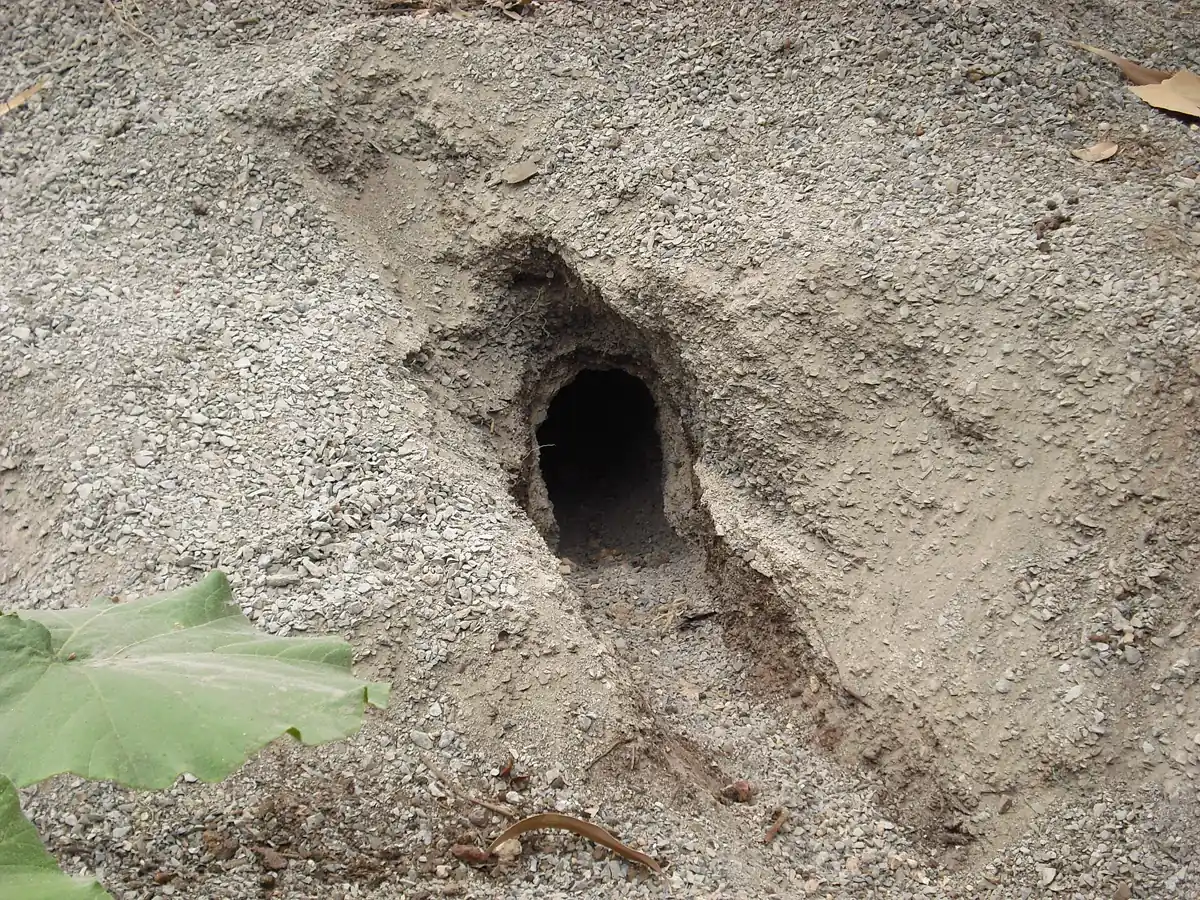
Digging is one of the behaviours the RSPCA names when it describes what a rabbit must be able to do in its living space, alongside hopping, running, jumping and stretching out fully. It specifically suggests a sand pit to dig in. Rabbits that are not given a legal place to dig will find an illegal one, usually a carpet corner, a lawn or the base of a fence.
A digging box is the least glamorous and most reliably used of all bunny toys. A deep, sturdy container filled with a safe substrate, placed where the rabbit already tries to dig, is often occupied within minutes. Suitable fillings include shredded plain paper, torn cardboard, hay, or clean children's play sand. Whatever you use, the rabbit will throw a good deal of it on the floor, so site the box accordingly.
Avoid anything dusty or chemically treated. Skip cat litters, especially clumping ones, and skip potting compost with added fertiliser or wetting agents. PDSA also warns that wood pellet bedding should be dust free and free of silicone, which is a reasonable bar for digging substrate too. A bunny inhales and eats what it digs through.
Outdoor diggers need a different kind of planning. If your rabbits have garden access, the run needs a buried skirt or a solid base, because a determined rabbit will tunnel out rather than stop. The photograph at the top of this section shows how far that instinct goes when there is nothing to stop it.
Forage Trays and Scatter Feeding Beat a Food Bowl
Asked whether rabbits need a food bowl, PDSA answers no, and says it is better to scatter their food so they can forage for it as they would in the wild. If you do use bowls, the same guidance says to have at least two, in separate areas, so one rabbit cannot block another from eating. That single change turns a thirty second meal into a long, slow search.
For related picks, take a look at our dog enrichment toys roundup.
The forage tray is the version of this that PDSA vets recommend outright. Take a shallow tray or planter, fill it with a little hay or shredded paper, then hide healthy rabbit treats in it such as mint, sage, parsley, small slices of apple or carrot, plus a little freshly pulled grass. Refresh the treats daily. There is one hard rule attached: avoid cut grass, such as lawn mower clippings, which PDSA warns can cause serious stomach problems.
Mixing pellets into the hay achieves much the same thing with no equipment at all. PDSA notes this also encourages rabbits to spend more time outside in the sunshine, which matters because rabbits need sunlight to make vitamin D, which in turn helps them absorb calcium. Feeding becomes exercise, daylight and enrichment in one move.
Dog owners will recognise the pattern from scent work. The principle behind our snuffle mat for dogs guide is identical: make the animal search rather than swallow. For rabbits, keep the treat portion small. PDSA warns that shop bought rabbit treats are often high in sugar, which is bad for teeth, gut and waistline, and recommends fresh vegetables, herbs or a very small amount of fruit instead.
Bunny Toys That Are Not Safe
The fastest way to sort a shelf of bunny toys is to ask what happens when a mouthful comes off. Rabbits do not chew and spit. Soft plastic that dents under a fingernail, painted or varnished wood, glued fabric, ribbon, glitter and foam all fail that test, because the pieces go down rather than out. A rabbit that stops eating or passing droppings after chewing something unsuitable needs a vet the same day, not the next morning.
Hardware is the second category to remove. Bells, wire frames, plastic eyes, split rings and wire hanging hooks are all common on small pet toys and all worth cutting off before the toy goes in the run. Loose fabric, stuffing and long loops carry an entanglement risk for feet and ears, particularly in a run the rabbits use unsupervised overnight.
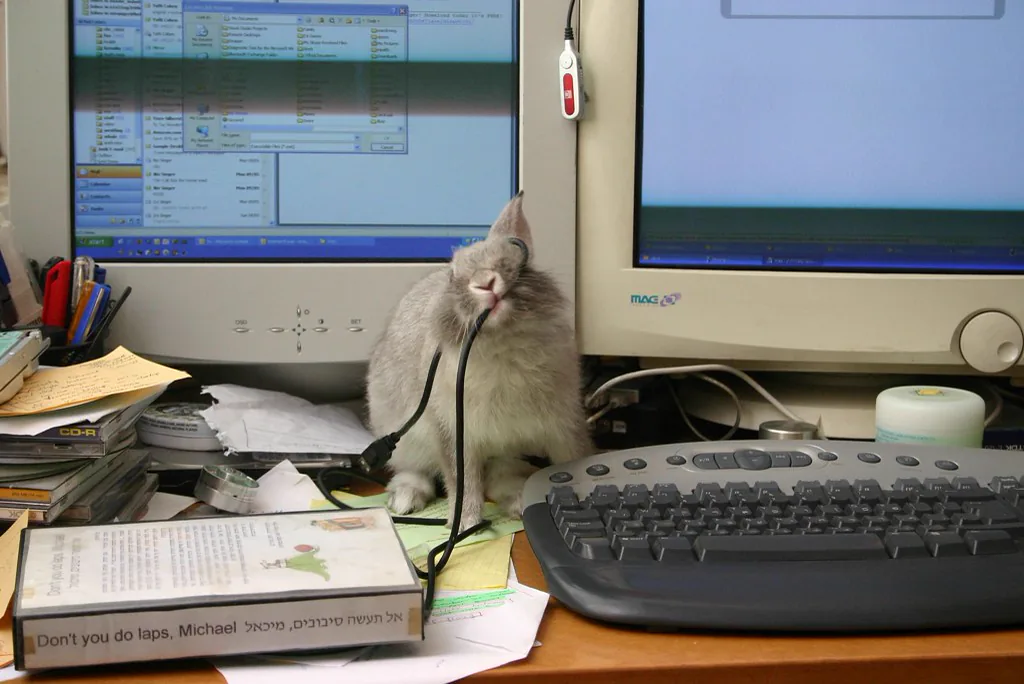
Then there is the category that is not sold as a toy at all but gets chewed anyway. Electrical cable is the classic, and the photograph earlier on this page shows exactly how casually a house rabbit will take one on. Cable is a genuine hazard, so route it out of reach or sleeve it, and give the rabbit a legal chewing target in the same room so the instinct has somewhere else to land.
Finally, treat any toy marketed for a different species with suspicion. Hard rubber built for a powerful dog jaw, like the products in our natural rubber dog toys guide, is not designed around an animal that eats its toys. Some hollow rubber toys made specifically for small pets can be stuffed with food and used safely, but the word that matters on the label is the species, not the shape.
Rotation, Boredom Signals and the One Thing Toys Cannot Replace
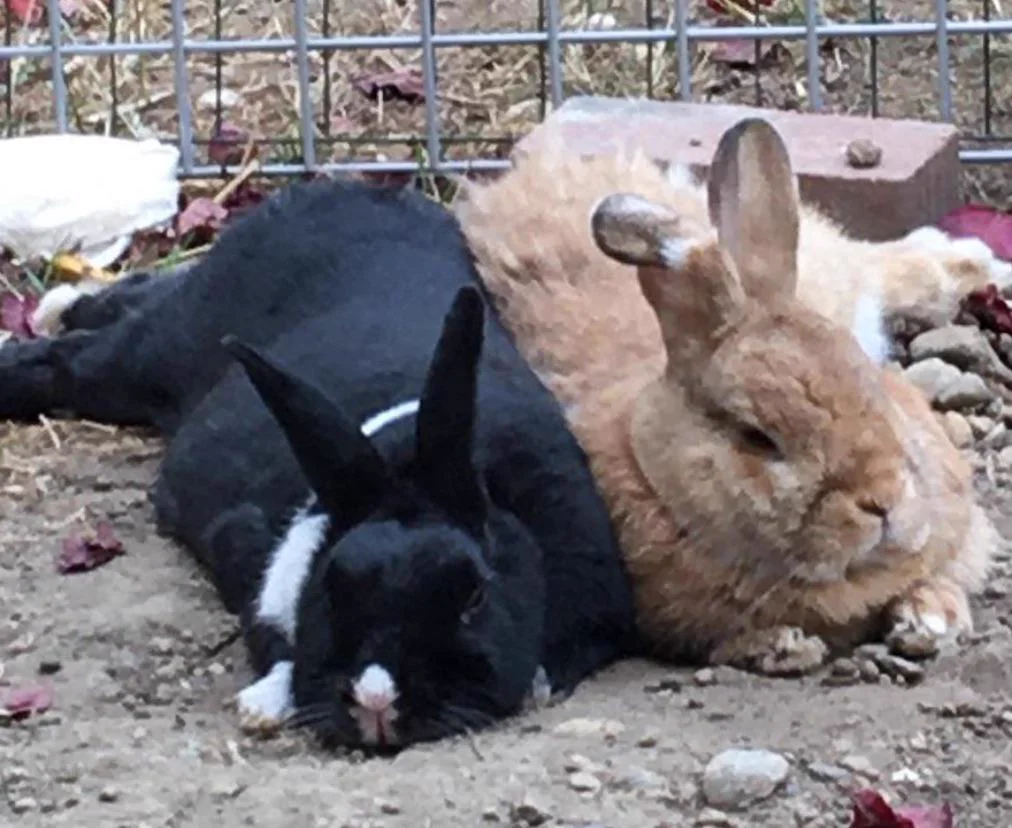
Rotation costs nothing and works. Keep a small set of bunny toys out at a time and swap them every few days, so that a familiar box or tray reappears as something new. The habit is the same one we describe in our how to rotate dog toys guide, and the reason is identical: novelty is the active ingredient, and permanent access destroys it.
Learn the signals that say enrichment is failing. The RSPCA lists chewing cage bars, over-grooming, a change in feeding or toileting habits, and repeatedly circling the enclosure among the signs that a rabbit is stressed or frightened. Those behaviours are a request for more space, more company or more to do, and they rarely resolve by adding another toy on top of an inadequate setup.
Space is usually the real answer. PDSA calls 3m by 2m by 1m, roughly 10ft by 6ft by 3ft, the absolute minimum for a pair of rabbits and recommends providing much more, and the RSPCA gives the same 3m by 2m by 1m figure for two medium sized rabbits including shelter and exercise area. Both bodies want the exercise area available at all times, because rabbits choose their own active hours.
The last point is the one no bunny toy can cover. Rabbits are highly social, and both the RSPCA and PDSA say a rabbit should not be kept alone unless a vet advises otherwise. A neutered, bonded companion does more for a bunny's daily life than every object in this article combined. Buy the boxes, build the digging tray, and get the company right first.
A Quick Checklist Before You Buy Bunny Toys
Before anything goes in the basket, run the object past four questions. What behaviour does it serve? What is it made of? What happens if a piece is swallowed? And will it still be interesting at five in the morning when nobody is watching? A toy that fails any of the four is decoration.
Budget honestly, too. The spending that changes a rabbit's life goes on space, a companion, unlimited good hay and veterinary care. Bunny toys are the cheap layer on top, and the best of them are free. If a product costs more than a week of hay, it should be doing something a cardboard box genuinely cannot.
For owners who also keep dogs or cats and want the same thinking applied to those species, our how to choose dog toys guide, the material notes in eco-friendly pet products, and the homemade ideas in DIY dog toys and boredom busters for dogs cover the same ground. You can also browse our full pet accessories and organic pet toys guides, and our notes on sustainable pet products, for materials thinking that carries across species.
For more independent, vet-reviewed guidance on this topic, the American Kennel Club expert advice center is an excellent place to start.
Frequently Asked Questions
What are the best bunny toys for bunnies on a small budget?
The cheapest options are also the ones welfare organisations recommend first. A plain cardboard box with two holes cut in it, a cardboard tube stuffed tightly with hay, a shallow forage tray holding hay and a few herbs, and a digging box filled with shredded paper will occupy most rabbits better than anything on a pet shop shelf. The RSPCA also suggests a platform to climb on and hanging food so the bunny has to reach up on its hind legs.
Which types of wood are safe for rabbits to chew?
PDSA vets name untreated apple, aspen, birch, maple and willow as safe woods to give as gnawing branches. They add two conditions: rinse the branches before giving them so that insects and pesticide residue are washed off, and never collect branches from the side of a road. Avoid anything painted, varnished, pressure treated or scented, since a rabbit swallows what it chews.
Do rabbits really need toys, or is hay enough?
Hay is the foundation and is not optional, because rabbit teeth grow continuously and fibre is what wears them down. Toys sit on top of that. The RSPCA states that rabbits need safe toys to play with or chew on to stay physically and mentally active, and lists chewing, digging, hiding and foraging as behaviours the living space has to support. In practice most good bunny toys are simply ways of making the hay and daily food harder to reach.
How do I stop my rabbit chewing cables and furniture?
Treat it as redirection rather than correction. Route electrical cable out of reach or sleeve it, block access to skirting boards and furniture legs, and then place a legal chewing target in the same room, such as an untreated willow branch, a cardboard box or a hay stuffed tube. A rabbit chewing the wrong thing is almost always a rabbit with nothing better to chew, too little space, or no company.
What should I put in a rabbit digging box?
Use a deep, sturdy container and fill it with something safe to inhale and swallow in small amounts: shredded plain paper, torn cardboard, hay, or clean children's play sand. The RSPCA specifically suggests a sand pit to dig in. Avoid cat litter, especially clumping litter, and avoid potting compost with fertiliser or wetting agents. Expect a good deal of the filling to end up on the floor, so place the box where that does not matter.
Can I give my rabbit grass clippings from the lawn?
No. PDSA warns specifically against cut grass, such as lawn mower clippings, because it can cause serious stomach problems. Freshly pulled grass is fine and is one of the ingredients PDSA suggests for a homemade forage tray, alongside hay or shredded paper and small amounts of herbs, apple or carrot. The difference is that cut grass begins to ferment quickly, while freshly pulled grass does not sit in a heap first.
Are shop bought rabbit treats safe to use in toys?
Use them sparingly if at all. PDSA notes that rabbit treats sold in pet shops are often high in sugar, which is bad for the teeth, the gut and the waistline, and recommends fresh vegetables, plants, herbs or a very small amount of fruit instead. Safe fruits it lists, in very small amounts and avoided in overweight rabbits, include apple without the pips, banana, kiwi, melon, pear, plum and strawberry. Adjust the meal size to match anything given as a treat.
My bunny ignores every toy I buy. What am I missing?
Usually one of three things: space, company or timing. The RSPCA and PDSA both give 3m by 2m by 1m as a minimum living space for two medium sized rabbits and recommend more, with the exercise area available at all times. Both also advise against keeping a rabbit alone unless a vet says otherwise. And rabbits are most active in the early morning, late afternoon and overnight, so enrichment that only exists during your evening is missing most of their active day.
How often should I swap my rabbit's toys around?
Every few days is enough. Keep a small selection available and rotate the rest out of sight, so that a familiar box, tunnel or forage tray reappears as something novel. Replace cardboard as soon as it is heavily chewed or soiled, check woven seagrass and willow items for fraying loops, and throw out any toy that has developed sharp edges or exposed hardware.
Browse Dog Toys
Free worldwide shipping on every order. No minimum purchase required.
Browse Dog Toys →