A cat tunnel is a collapsible fabric tube that gives a cat two things at once: a covered spot to hide and a runway to sprint, ambush and play through. Those two uses line up with two of the five environmental needs in the AAFP and ISFM feline guidelines, a safe place and the chance to play and act out predatory behavior (VCA summary of the guidelines). This guide covers which type of cat tunnel toy to pick, how to set it up so your cat actually uses it, games that work, and when a tunnel needs to go in the bin.
Why Cats Like Tunnels
A tunnel works because it covers both halves of how cats deal with the world: hiding when unsure, and hunting when curious.
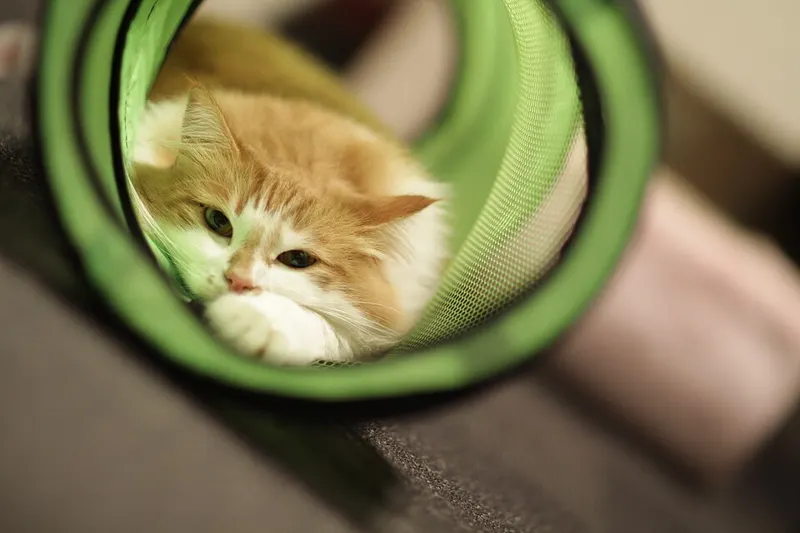
It is a hiding place
The first pillar of the AAFP and ISFM Environmental Needs Guidelines is a safe place, a private spot a cat can retreat to. VCA's summary of the guidelines lists cardboard boxes, carriers, perches and "hideaway holes" as examples, and recommends at least as many safe spaces as there are cats in the home (VCA). Veterinary behaviorists at Ohio State make the same point: cats use resting, perching and hiding spots at different times of day, so it pays to offer several comfortable options to avoid competition (Herron and Buffington, 2010).
There is some direct evidence that a hide helps a cat cope with a stressful situation. In a small 2017 study of 30 cats newly admitted to a veterinary clinic, the cats given a hide used it mostly to hide inside, and after 20 minutes they had lower stress scores than cats without one, along with a small drop in heart and breathing rate (Buckley and Arrandale, Veterinary Nursing Journal). The authors described the effect as real but small. That study used a hide box in a clinic, not a tunnel at home, so treat it as support for offering covered spaces in general rather than proof that a tunnel calms every cat.
It is a hunting ground
Play in cats closely follows the predatory sequence of stalking, chasing, pouncing and biting (Herron and Buffington, 2010). A tunnel gives a cat somewhere to lie in wait and burst out from, which is exactly the stalk-then-pounce part of that sequence. That is why a tunnel tends to get the most use when a person brings a wand toy to it, not when it sits alone in a corner.
Types of Cat Tunnels
Most tunnels share the same build: fabric stretched over a coiled spring-steel frame that collapses flat for storage. They differ in shape and material.
- Straight tunnels. One tube, two ends. The simplest option and the easiest to fit along a wall or under a sofa.
- Curved or S-shaped tunnels. The bend hides the far end, so a cat cannot see what is coming. Good for ambush games.
- Three-way and four-way tunnels. Several arms meeting at a hub. More exits mean a cat inside cannot be cornered, which matters in a home with more than one pet.
- Tunnels with a bed or "donut" ring. A tube that curls around a cushioned center, or a tunnel that ends in an enclosed bed. These lean toward resting rather than racing.
- Crinkle fabric vs soft felt. Crinkle nylon rustles when a cat moves, which many cats find exciting and some nervous cats avoid. Felt and plush tunnels are quiet and warmer to lie in.
- Peek holes and mesh panels. Openings in the side let a cat watch out and let you slide a wand toy past. They also let light in, so the tunnel feels less like a dark tube.
How to Choose a Cat Tunnel
Product listings rarely tell you what matters. Check these points against the listing photos and dimensions before you buy.
| Check | Good sign | Why it matters |
|---|---|---|
| Diameter | Your cat can walk through without squeezing or crouching flat | A cat that has to wriggle through is less likely to rest inside. Measure across your cat's shoulders and compare with the listed diameter. |
| Exits | Two or more openings, plus side holes for multi-pet homes | VCA recommends safe spaces with multiple entryways so one cat cannot trap another (VCA). |
| Dangling toys | Removable, or none at all | Toys with strings or parts that can be swallowed should be put away after play (VCA). A string-and-pompom sewn into the tunnel cannot be put away. |
| Frame ends | Wire fully enclosed in a stitched fabric sleeve | The spring wire is what can poke through a worn seam. Thin, single-stitched ends wear first. |
| Fabric | Crinkle for confident players, felt for shy cats and nappers | Noise that excites one cat can put another off. If you do not know yet, a quiet fabric is the safer first buy. |
| Cleaning | Washable cover or wipe-clean fabric | Tunnels collect hair and the odd hairball. Check the care label before you buy. |
| Space | Fits a quiet wall or corner without blocking a walkway | A tunnel in the middle of foot traffic gets stepped on and collapsed, which can scare a cat off using it. |
Setting Up the Tunnel
Where you put a cat tunnel decides whether it becomes a favorite spot or a dust collector.
- Pick a calm edge of a room your cat already uses. Along a wall, beside a sofa or near a window perch. Keep it out of the main walkway.
- Keep it separate from food, water and the litter box. The AAFP and ISFM guidelines call for key resources in separate locations, and a tunnel is part of the play and resting area (VCA).
- Let your cat investigate on its own terms. Leave the tunnel out, drop a treat or a toy at the entrance, and walk away. The guidelines advise letting cats initiate interaction instead of forcing it, and that applies here too: never push a cat into a tunnel or block the far end while it is inside.
- Add a familiar scent. A blanket or towel your cat already sleeps on, laid inside one end, makes a new object smell like home.
- Give it a week before judging. Some cats dive straight in. Others watch the new object for days before using it.
Cat Tunnel Games
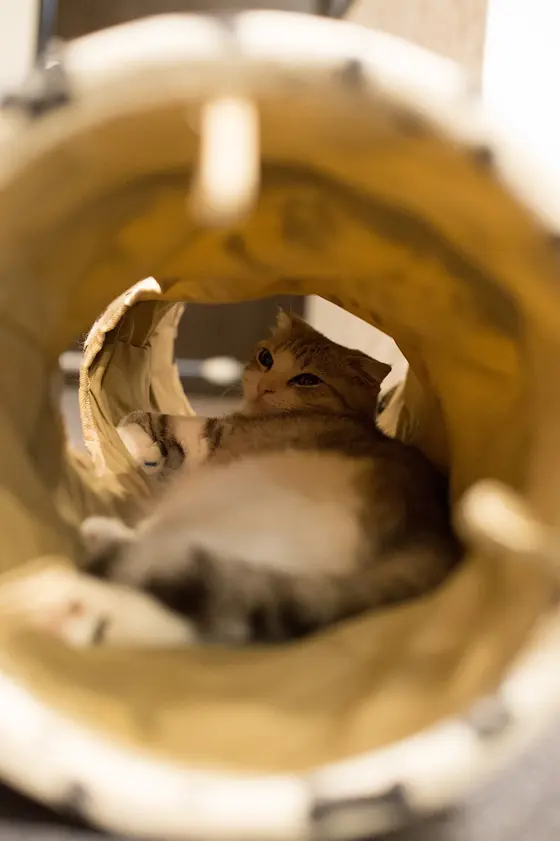
VCA suggests building at least three short play sessions into a cat's day and rotating toys often so they stay new and interesting (VCA). A tunnel makes those sessions easier because it gives the "prey" somewhere to disappear.
- Wand past the opening. Drag a wand toy slowly across one end, then flick it out of sight. Let your cat ambush it from inside. Move the toy away from the cat, the way prey would.
- Through and out. Pull the toy through the tunnel from one end to the other so your cat chases it inside and bursts out the far end.
- Side-hole whack-a-mole. On tunnels with peek holes, poke the end of the wand through a hole and pull it back. Cats that prefer to stay hidden can play without leaving cover.
- Treat trail. VCA suggests hiding toys or part of the daily food ration around the home to satisfy hunting and exploring instincts (VCA). A few kibbles inside the tunnel turn it into a short search. Count those kibbles as part of the day's food, and check they actually get eaten.
- Finish with a catch. End each session by letting your cat grab the toy, then put any string toys away.
To keep the tunnel interesting, try collapsing it and putting it away for a few days, the same way you rotate other toys. For more ideas, see our guides to interactive cat toys and toys for bored cats.
Kittens, Seniors and Multi-Cat Homes
Kittens
Kittens tend to treat a tunnel as a racetrack. Watch for chewing on the fabric or on any attached toy, and supervise until you know how your kitten treats it. Our kitten toys guide covers what else suits young cats.
Senior cats
An older cat may still enjoy a tunnel as a hiding spot even if the sprinting days are over. A short, straight tunnel with a soft lining on the floor is easier to get in and out of than a long crinkle tube, and gentle wand play at the entrance keeps hunting games low effort.
More than one cat (or a dog)
This is where tunnel choice matters most. VCA's summary of the guidelines recommends safe spaces with several entryways so one cat cannot trap another inside, and at least as many safe spaces as you have cats (VCA). A three-way or four-way tunnel, or two separate tunnels in different rooms, does that better than one straight tube. If you have a dog, place the tunnel where the dog cannot stand guard at the exit.
Safety and When to Replace It
Tunnels are low-risk compared with many cat toys, but they do wear out. Check yours every few weeks.
- Strings and attached toys: remove or cut off any string, pompom or bell your cat chews. Toys with strings or swallowable parts should be put away after play (VCA). If you ever see string hanging from your cat's mouth or rear end, do not pull it, call your vet.
- Exposed wire: if the spring frame pokes through a seam, retire the tunnel. A bent wire end can scratch.
- Torn fabric: small holes are fine. Large tears where a cat can chew off strips are not.
- Chewing: a cat that eats fabric, plastic or other non-food items needs a vet check, not just a new tunnel.
Cat Tunnel vs Cardboard Box vs Cat Cave
All three can work as a safe place. The difference is how much play each one invites.
| Feature | Cat tunnel | Cardboard box | Cat cave or covered bed |
|---|---|---|---|
| Hiding | Yes | Yes | Yes |
| Active play | High: run-through and ambush games | Some: pouncing in and out | Low: built for resting |
| Exits | Two or more | Usually one unless you cut more | Usually one |
| Storage | Folds flat | Recycle and replace | Stays out |
| Best for | Playful cats and multi-cat homes | Trying out the idea for free | Cats that mostly want a warm den |
A cardboard box with a second hole cut in it is a reasonable free test. If your cat loves it, a tunnel is a sturdier, foldable upgrade. For the wider picture of keeping an indoor cat busy, see our indoor cat toys guide and the pet enrichment glossary.
Frequently Asked Questions
Do cats like tunnels?
Many do, because a tunnel offers a covered hiding spot and a place to ambush toys. Both match needs listed in the AAFP and ISFM Environmental Needs Guidelines: a safe place, and the chance to play and act out predatory behavior. Individual cats vary, so give a new tunnel a week or so before deciding.
Are cat tunnels safe?
Generally yes, with two checks. Remove or put away any dangling string toys after play, since VCA advises putting away toys with strings or swallowable parts. And retire the tunnel if the wire frame pokes through the fabric.
What size cat tunnel should I get?
Choose a diameter your cat can walk through without squeezing. Measure across your cat's shoulders and compare it with the listed diameter. Large breeds and multi-cat homes usually do better with a wider tunnel and more than two openings.
How do I get my cat to use a tunnel?
Put it along a quiet wall, place a treat or a familiar blanket at the entrance, and leave your cat to explore. Then play with a wand toy around the openings. Never push a cat inside or block the exit.
Can a tunnel help a shy or stressed cat?
It can give a shy cat somewhere to retreat. A small 2017 study found that newly hospitalized cats given a hide had lower stress scores after 20 minutes than cats without one, though the effect was small and the study used hide boxes, not tunnels. A cat that hides constantly or stops eating should see a vet.
Do I need one cat tunnel per cat?
Not necessarily one tunnel each, but VCA's summary of the feline environmental guidelines recommends at least as many safe spaces as cats in the home, ideally with more than one entrance. A tunnel can count as one of those spaces alongside boxes, beds and perches.
Sources
- VCA Animal Hospitals, Feline Environmental Needs Guidelines (summary of the five pillars from the AAFP and ISFM guidelines).
- American Association of Feline Practitioners, 2013 AAFP/ISFM Environmental Needs Guidelines.
- Herron ME, Buffington CAT. Environmental Enrichment for Indoor Cats. Compendium: Continuing Education for Veterinarians, December 2010 (The Ohio State University Indoor Pet Initiative).
- Buckley L, Arrandale L. The use of hides to reduce acute stress in the newly hospitalised domestic cat. Veterinary Nursing Journal, 2017.
- VCA Animal Hospitals, Cat Behavior and Training: Enrichment for Indoor Cats.
Pair Your Tunnel With a Wand Toy
We do not sell tunnels, but a wand toy is what turns one into a hunting game. Free US shipping on every order.
Browse Wand Toys →