Most "best dog toys" lists rank products. This one ranks toy types, because the toy that suits a gentle Cavalier is a choking hazard for a Labrador and a five minute snack for a power chewer. For this year's update we rebuilt the guide around the safety checks veterinary and welfare organizations actually publish, then matched each toy type to the dogs it suits. Use it to build a small, safe set of the best dog toys for this year that covers chewing, thinking, fetching, tugging and comfort.
Quick Answer: What Are the Best Dog Toys in 2026?
This year's best dog toys are a small rotating set: a hollow natural rubber chew you can stuff with food, a treat-dispensing puzzle, a rope tug toy, a fetch ball sized so it cannot be swallowed, and a sturdy plush for comfort. Match each toy to your dog's size and chewing strength, and supervise new toys.
Updated October 4, 2026- Size beats brand. No toy should fit entirely inside your dog's mouth.
- Softer than you think. VCA's fingernail rule: a chew toy should dent when you press it with a fingernail.
- Skip the frills. Ribbons, eyes and loose parts are what dogs swallow.
- Rotate, do not hoard. A few toys swapped regularly stay more interesting than a full basket.
How Should You Choose a Dog Toy in 2026?
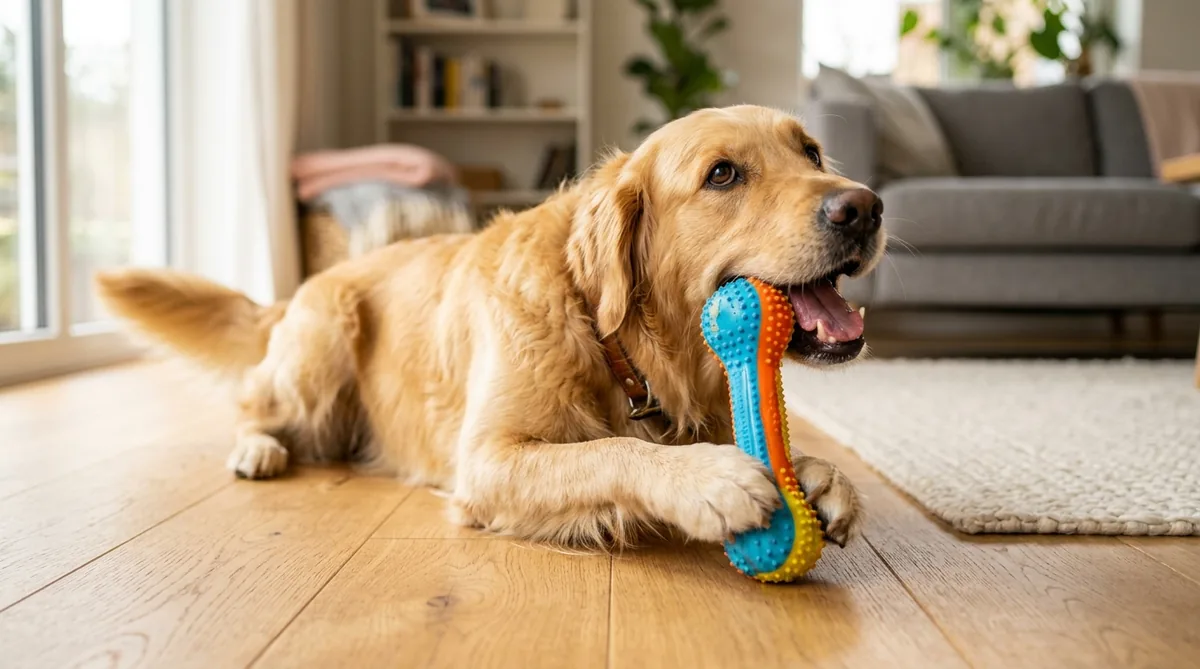
Answer: Start with your dog, not the toy. Note their size, age and how hard they chew, then choose toys too big to fit fully in the mouth, soft enough to dent with a fingernail, and free of ribbons, eyes or loose parts. Supervise the first sessions to see how your dog actually uses it.
VCA Animal Hospitals sums up toy safety in a few rules that are worth checking in the shop aisle. Go big, so the toy can never fit entirely in your dog's mouth. Choose no frills, meaning no ribbons, eyes or removable parts. Follow the fingernail rule, so the toy is soft enough to indent and long toys bend a little between your hands. Know your dog, because some dogs can tear even rubber toys apart within minutes, and swallowed chunks can need surgery to remove.
The other half of choosing well is purpose. A dog left alone for a few hours needs a different toy from a dog who wants a game with you in the evening. Humane World for Animals groups toys into active toys, distraction toys and comfort toys, and a balanced set includes at least one of each. That is the structure the shortlist below follows.
Which Toy Types Make the 2026 Shortlist?
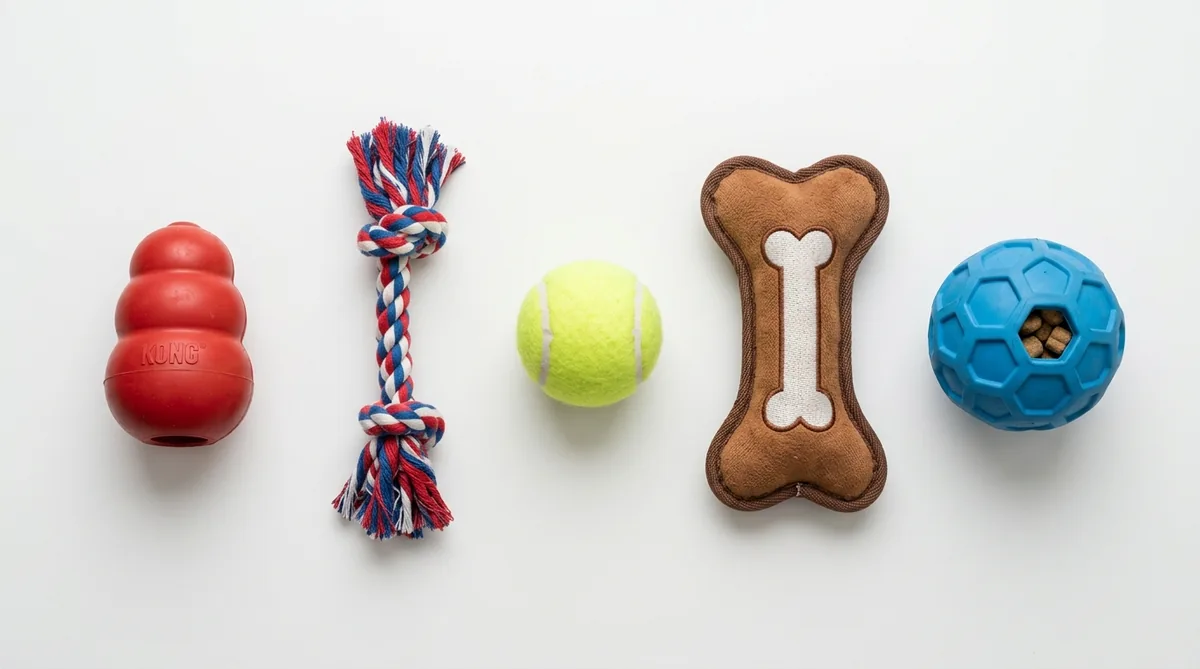
Answer: Six toy types cover almost every dog: a hollow natural rubber chew you can stuff, a treat-dispensing puzzle or feeder, a knotted rope tug toy, a durable rubber fetch ball, a sturdy plush comfort toy, and a soft teething toy for puppies. Most dogs need four or five of these, chosen to match how they play.
Hollow natural rubber chew
This is the workhorse. Hard rubber toys come in many shapes and sizes, and Humane World for Animals notes that hollow ones filled with broken-up treats can keep a dog busy for a long time. Stuff it with part of a meal, freeze it on hot days, and you have a chew and a puzzle in one toy. Pick a size up if your dog is between sizes. Our KONG dog toys guide compares the best known range.
Treat-dispensing puzzle or feeder
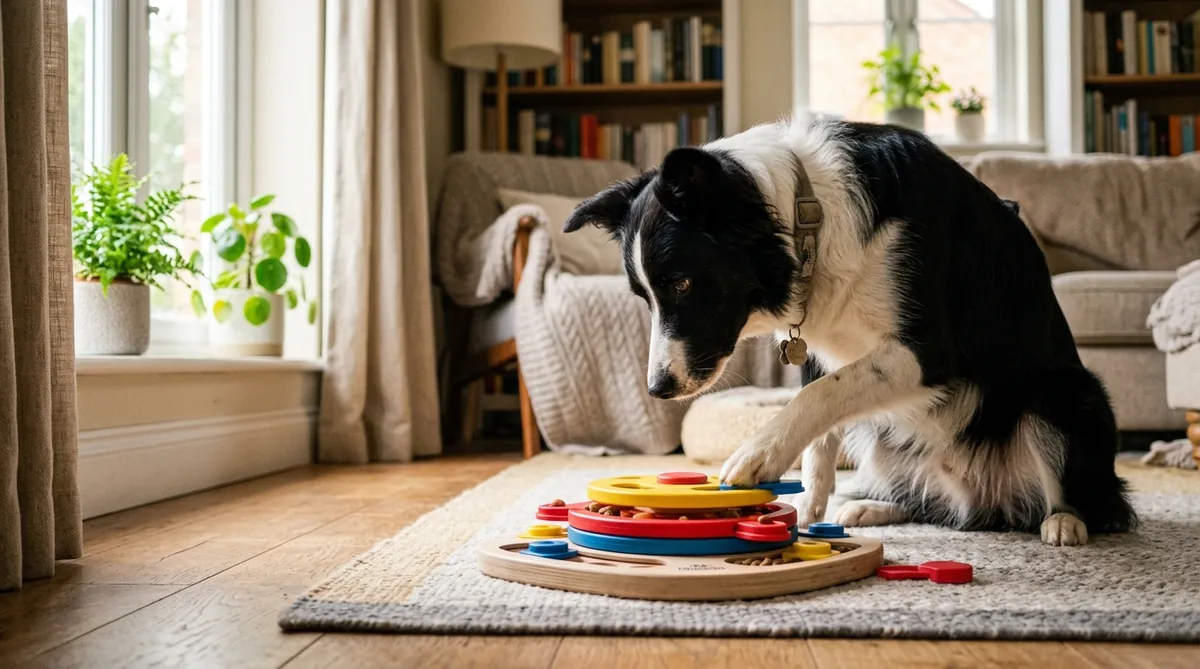
Busy-box and feeder toys release food as your dog pushes them around with nose, mouth and paws. Humane World for Animals points out that dogs who eat too quickly often benefit from being fed this way. Start with an easy puzzle so your dog wins early, then step up the difficulty. Browse more in our mental stimulation toys guide.
Knotted rope tug toy
Rope and woven toys with knotted ends suit dogs who love tug of war and chewing on interesting textures. Tug is a game to play together, with a clear start and a "drop it" at the end, rather than a toy to leave out for unsupervised shredding. Swallowed rope strands are a real hazard, so retire a rope toy once it frays.
Durable rubber fetch ball
Tennis balls are fine for fetch, but VCA warns that obsessive chewing on their scratchy surface can wear teeth down, and Humane World for Animals advises throwing them away once they are chewed through. A solid rubber ball, sized so it cannot slip into the throat, is a better choice for dogs who chew while they carry.
Sturdy plush comfort toy
Some dogs carry a soft toy around like a companion, and others want to shake and "kill" it. Humane World for Animals suggests a small, carryable plush for the first kind of dog and a larger, tougher one for the second, and recommends machine washable soft toys without nutshell or polystyrene bead fillings. See our plush dog toys guide for durable options.
Soft teething toy for puppies
Puppies chew hardest while adult teeth come through, which Humane World for Animals places from about twelve weeks to six months of age. A softer, flexible rubber toy, chilled in the fridge, soothes gums and protects the furniture. Our teething toy guide covers this stage in detail.
Which Dog Toys Should You Skip?
Answer: Skip anything too hard to dent with a fingernail, such as bones, cow hooves, pig ears, hard rawhides and large ice cubes, which VCA says can chip or fracture teeth. Also skip toys small enough to swallow, toys with ribbons, eyes or strings, and stuffed toys filled with nutshells or polystyrene beads.
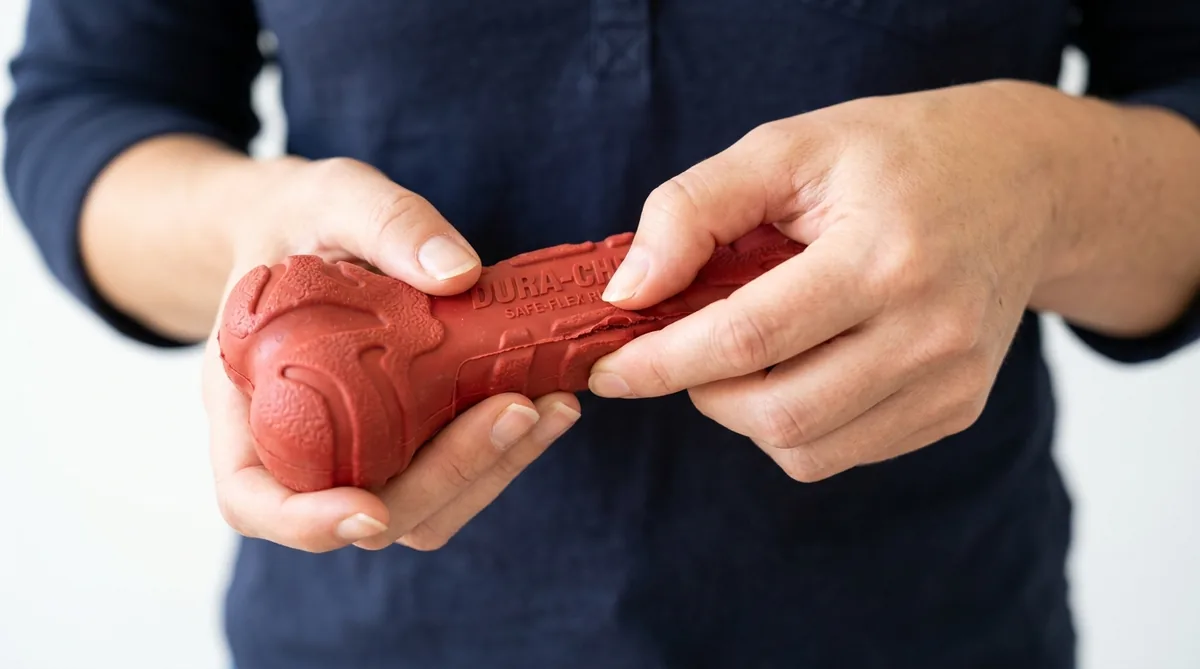
Hard chews are popular because they last, but lasting is the problem: a toy that will not give will break a tooth before it breaks itself. Humane World for Animals also suggests asking your vet before offering rawhide and only giving it under supervision, since it can be a choking hazard. Squeaky toys are not banned, but supervise them, because some dogs feel they must find and destroy the source of the squeak. Around the house, put away string, rubber bands, children's toys and anything else inedible that could be swallowed. Our guide to non toxic dog toys covers materials in more depth.
How Do the Main Dog Toy Types Compare?
Answer: Rubber chews and puzzle feeders are the safest toys to leave with a dog for short periods once you know how they use them. Rope tug toys, fetch balls and squeaky plush toys are interactive toys that need supervision. The table below compares each type by job, best fit, main risk and supervision level.
Which Toys Suit Puppies, Power Chewers and Seniors?
Answer: Puppies need soft, flexible teething toys and easy puzzles. Power chewers need solid or thick-walled natural rubber in a size up, and should not be left alone with plush or rope. Seniors do best with lighter toys, gentle lick or sniff games and soft plush, because sore teeth and stiff joints change how they play.
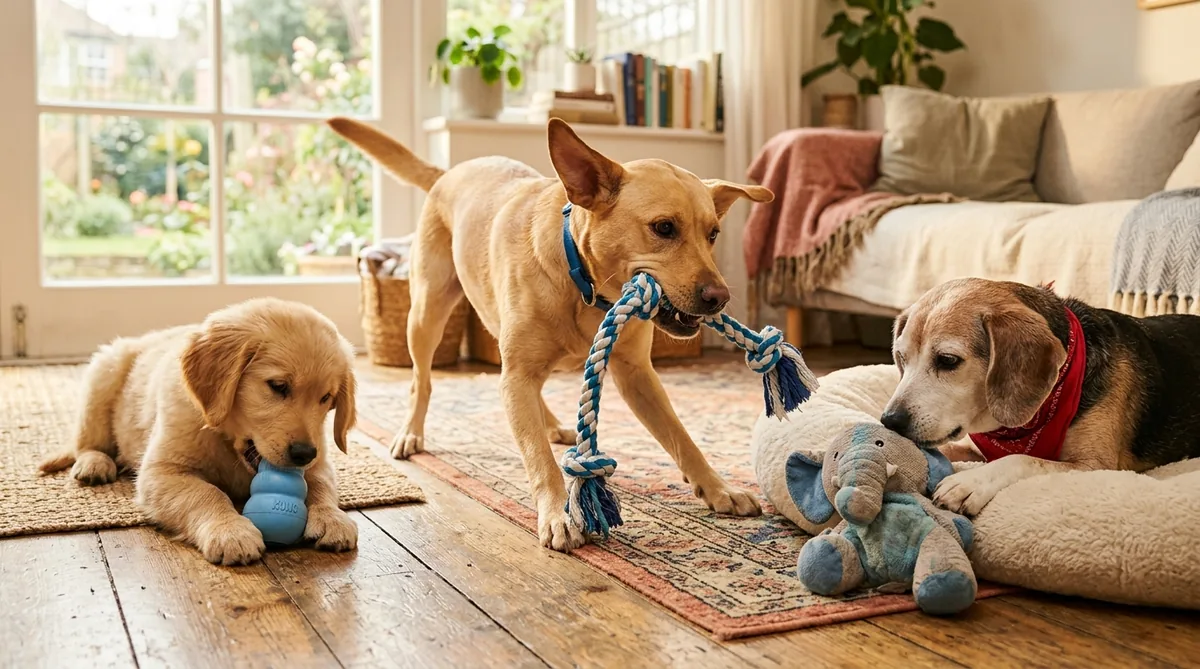
Power chewers are where most toy money is wasted. If your dog has destroyed several toys already, read our guide to tough chew toys for large dogs before buying again, and pick the thickest-walled rubber in a size larger than the label suggests. For dogs who are home alone for part of the day, a frozen stuffed rubber toy or a feeder puzzle is the safest choice, as covered in toys for dogs home alone. In hot weather, switch to the floating and frozen toys in our summer dog toys guide.
How Many Toys Does a Dog Need, and When Should You Replace Them?
Answer: Most dogs are happy with a small set put out a few at a time and swapped every few days, so each toy feels new again. Inspect toys often and retire any toy with exposed stuffing, frayed rope or broken rubber, because VCA warns that swallowed pieces can lodge in the stomach.
A rotation keeps a modest collection interesting without constant buying. Keep the rest out of sight, bring one back when another goes away, and notice which toys your dog actually chooses. Those are the ones to replace when they wear out. Our guide on how many toys a dog should have walks through a simple rotation plan. When you shop, start with the gaps in your set rather than more of what your dog already ignores, and browse our dog shop for accessories.
What Questions Do Owners Ask About the Best Dog Toys?
Answer: Owners usually want to know which toys are safest, whether tennis balls and squeaky toys are a problem, what to give a dog who destroys everything, and whether rawhide is a good idea. The short answers below follow the same veterinary and welfare guidance from VCA and Humane World for Animals used throughout this guide.
What is the safest type of dog toy?
A flexible natural rubber toy that is too large to fit entirely in your dog's mouth, soft enough to dent with a fingernail, and free of ribbons, eyes or loose parts is the safest starting point. Supervise the first few sessions and retire it once it starts to break.
Are tennis balls bad for dogs?
Tennis balls are fine for supervised fetch. VCA warns that obsessive chewing on the scratchy surface can wear teeth down over time, and Humane World for Animals advises throwing away any ball that has been chewed through. Use a solid rubber ball for dogs who chew while they carry.
Are squeaky toys safe?
They can be, with supervision. Some dogs feel driven to find and destroy the squeaker, and could swallow it if left alone. Offer squeaky toys during play time with you and put them away afterwards.
What toy should I buy for a dog who destroys everything?
Choose solid or thick-walled natural rubber in a size larger than the label suggests, and skip plush and rope for unsupervised time. Stuffing the toy with food gives your dog a job to do instead of a toy to dismantle.
Is rawhide a good chew toy?
Humane World for Animals recommends checking with your veterinarian before offering rawhide and only giving it under supervision, because it can be a choking hazard. VCA also lists hard rawhides among chews that can be hard enough to damage teeth. A hard rubber toy is a longer lasting alternative.
How often should I replace my dog's toys?
Replace a toy as soon as stuffing shows, rope frays or rubber cracks or breaks off. How long that takes depends entirely on your dog, so a quick look at each toy when you rotate it is the best routine.
Written by Ahmad Thariq Syauqi. General information, not veterinary advice. Sources: VCA Animal Hospitals, How to choose the best chew toy for your dog and Humane World for Animals, Safe toys for your dog.