A slip lead is the simplest piece of dog gear there is: one length of rope or webbing with a ring at one end, so the lead itself becomes the collar. Vets, shelters, groomers and gundog trainers reach for one every day because it goes on and off in a second. That same simplicity is why it needs care. This guide explains how a slip lead works, how to put it on the right way, when it is the wrong tool and what to use instead.
In This Article
- Quick Answer: What Is a Slip Lead?
- What Is a Slip Lead and How Does It Work?
- Who Uses Slip Leads, and Why?
- How Do You Put On a Slip Lead Correctly?
- Where Should a Slip Lead Sit on the Neck?
- When Is a Slip Lead a Poor Choice?
- How Does a Slip Lead Compare With a Martingale, Flat Collar or Harness?
- Which Material Is Best: Rope, Nylon or Leather?
- How Do You Train Kindly With a Slip Lead?
- What Safety Rules Apply Every Time You Use One?
- What Do People Ask Most About Slip Leads?
- Sources
Quick Answer: What Is a Slip Lead?
A slip lead is a leash and collar in one: the rope passes through a ring to form a loop that slides over the dog's head and tightens when pulled. Put it on in a P shape, high behind the ears, with the stopper set. Skip it for pullers, puppies, flat faced breeds and dogs with airway problems.
Updated October 18, 2026- What it is: a single rope or strap with a ring that forms an adjustable neck loop, often with a leather or rubber stopper.
- Who uses it: veterinary teams, shelters, groomers, gundog handlers and show handlers, mostly for short, supervised moves.
- How to fit it: P shape for a dog on your left, loop high behind the ears, two fingers of room when slack.
- When to skip it: dogs that pull, small or young dogs, brachycephalic breeds and dogs with tracheal, eye or neck conditions.
What Is a Slip Lead and How Does It Work?
Answer: A slip lead is one continuous rope or strap with a ring at one end. Feeding the rope back through the ring creates a loop that goes over the dog's head. When the lead is pulled, the loop closes; when it goes slack, it opens again. A sliding stopper can limit how wide the loop opens.
The American Kennel Club describes it plainly as a loop collar combined with a leash, and adds that it should only be used with well trained dogs that are unlikely to duck out of it. That second point matters, because a slip lead has no buckle and no fixed size. Its security depends on the loop staying snug enough and on the person holding the other end. Source: American Kennel Club, Choosing the right dog leash.
Most slip leads have the same handful of parts: a handle loop at one end, the long standing part of the lead, a metal ring at the other end, the sliding section that becomes the neck loop, and an adjustable stopper or toggle. A clinical skills guide from the University of Bristol veterinary school names these as the handle, the loop that goes around the neck, the adjustable toggle and the sliding section that tightens. Source: University of Bristol Veterinary School, Using a Slip Lead (CSL_D06).
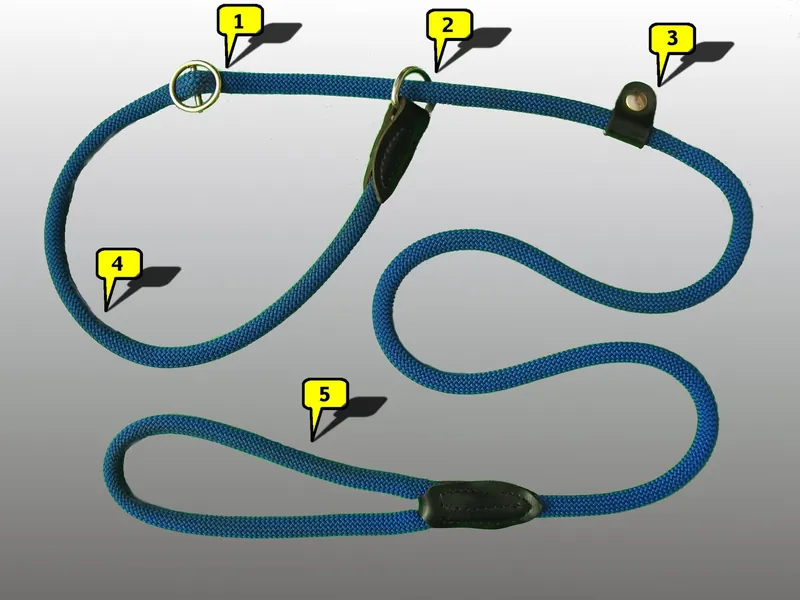
The stopper is what separates a modern slip lead from an old fashioned noose. Slide it down toward the ring and the loop can no longer open wide enough for the dog to back out. It is not meant to lock the rope tight against the throat, only to keep the loop from growing. Without a stopper, or with the stopper pushed up to the handle, a slip lead behaves much like a choke chain made of rope.
It helps to compare it with the gear you already know. A standard dog leash clips onto a collar or harness that stays the same size. A slip lead replaces both pieces at once, so it changes size with every pull. That is its main advantage for quick handling and its main risk for everyday walking.
Who Uses Slip Leads, and Why?
Answer: Slip leads are standard kit wherever dogs are moved often and quickly: vet clinics, research and teaching hospitals, shelters, boarding kennels, grooming salons, gundog training and the show ring. They fit any size of dog, slip on without fiddling with buckles, and come off in one movement when the job is done or the dog is released.
In veterinary settings the appeal is speed and hygiene. A standard operating procedure on canine restraint from the Office of the University Veterinarian at Virginia Tech notes that slip leads are used frequently so that collars do not need to remain on the dog. The same document allows a slip lead or leash to be tethered to an exam table with a quick release knot or snap, but says animals should never be left unattended. Source: Virginia Tech, SOP: Canine Restraint.
Many clinics also use two leads at once when moving an unfamiliar dog. The Bristol guide explains that some hospitals require both a collar with a clip on lead and a slip lead, because a dog in a strange place is more likely to try to escape. If you see a clinic do this with your dog, that is good practice, not a sign that your dog is difficult.
- Vet clinics and hospitals: moving patients between the waiting room, exam room and kennels without leaving a collar on.
- Shelters and boarding kennels: one lead fits dogs of every size, and staff can take it off a nervous dog without reaching for a buckle.
- Groomers: a similar loop attached to a grooming arm helps keep a dog steady on the table, always under constant supervision. Our guide to dog grooming tools covers the rest of the table setup.
- Gundog handlers: the lead comes off in one smooth movement when the dog is sent to retrieve. The German name for a slip lead, Retrieverleine, literally means retriever lead.
- Show handlers: thin show leads work on the same principle and keep the dog's outline clean for the judge.
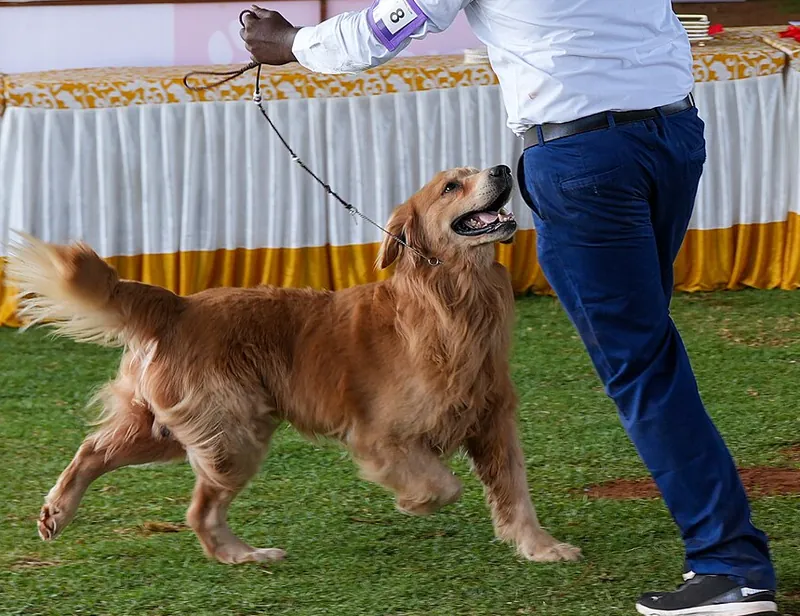
The American Kennel Club's conformation rules list a slip collar with a lead, a slide lead, a swivel lead and martingales among the acceptable collar and lead setups in the show ring. Source: American Kennel Club, Dog Show Policies: Training Collars.
How Do You Put On a Slip Lead Correctly?
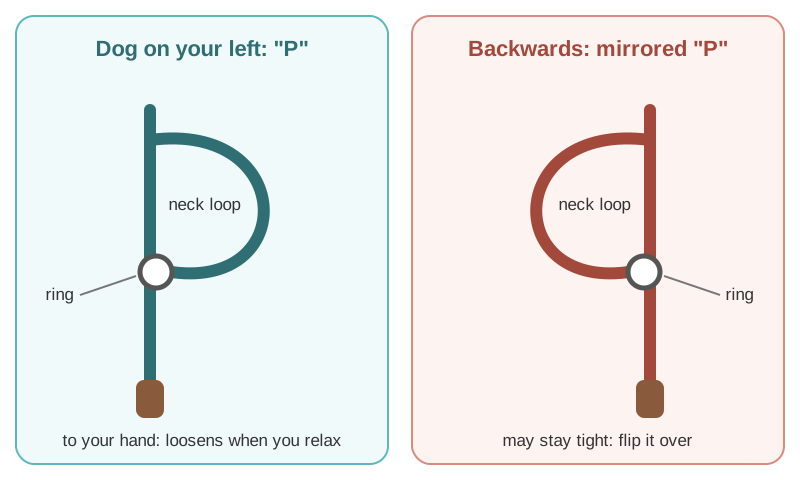
Answer: Open the loop wide, hold it so the rope forms a letter P for a dog on your left, and slide it smoothly over the head. Move the loop high, just behind the ears and under the jaw, then set the stopper so two fingers fit underneath. Check that the loop loosens as soon as you relax.
The orientation is the step most people get wrong. Virginia Tech's restraint procedure tells handlers to make a shape like the letter P out of the lead and to stand on the dog's left side, so the lead tightens when the dog or handler pulls and loosens when the pulling stops. Put on the other way round, the loop can stay closed after the pull ends. Source: Virginia Tech, SOP: Canine Restraint.
- Check the lead first. Make sure the stopper slides freely and the ring and stitching are sound. The Bristol guide warns that a dog may escape while you are still fiddling with a stiff toggle.
- Open the loop. Make it large enough to pass easily over the dog's head without catching the ears or eyes.
- Form the P. For a dog on your left, hold the lead in front of you so it looks like a letter P. For a dog on your right, use the mirror image.
- Let the dog know you are there. Approach calmly from the side, and hold the loop at the ring so it does not change size in your hand.
- Slide it on in one smooth movement. Avoid flicking the rope at the face, which can startle the dog into jumping back.
- Move it up. Settle the loop high on the neck, just behind the ears and beneath the jaw, not low on the throat.
- Set the stopper. Slide it toward the ring until the dog cannot back out, while two fingers still fit easily between the loop and the neck.
- Test the release. Take up a little tension, then relax your hand. The loop should open again by itself. If it stays tight, take it off and flip it.
Taking it off is the reverse. Slide the stopper back toward the handle to enlarge the loop, then guide it smoothly over the head. Practice on a stuffed toy or a cushion before you try it on a wriggly dog; veterinary students do exactly that on a model before handling live patients.
Where Should a Slip Lead Sit on the Neck?
Answer: High on the neck, right behind the ears and under the jaw. In that position the loop rests on firmer muscle and gives clear, light guidance. Low on the neck it presses on the softer front of the throat, where the windpipe and major blood vessels run, and the dog gains leverage to pull harder.
Retail guides and veterinary handling notes agree on this point. Rydale's fitting guide tells owners to move the loop toward the top of the neck, just behind the ears and beneath the jaw, and warns against letting it slide down to the base of the neck. Virginia Tech's procedure likewise describes adjusting the lead snugly around the neck behind the ears. Source: Rydale, How to put a slip lead on a dog.
Loops drift. As a dog sniffs, shakes or turns, the rope tends to slide down toward the chest. Make a habit of checking the position every few minutes and resetting it gently. If you hear coughing, gagging or wheezing, the loop is either too low, too tight or both. Stop, loosen it and let the dog settle before you continue.
When Is a Slip Lead a Poor Choice?
Answer: Avoid a slip lead for dogs that pull or lunge, for puppies and very small dogs, for flat faced breeds, and for any dog with tracheal collapse, glaucoma, eye disease or a neck injury. Neck pressure can harm these dogs. A well fitted harness is the safer everyday choice.
Neck pressure is not a theoretical worry. In a laboratory study published in the Veterinary Record in 2020, researchers tested seven collars and a slip lead on a model neck fitted with a pressure sensor. They concluded that no single collar tested produced pressure low enough to remove the risk of injury when the lead was pulled. Source: Carter, McNally and Roshier, Veterinary Record, Canine collars: an investigation of collar type and the forces applied to a simulated neck model.
The eyes are affected too. A study led by veterinary ophthalmologists at the University of Wisconsin measured eye pressure in sled dogs pulling on a collar and then on a harness. Pressure rose significantly with the collar but not with the harness, and the authors advised that dogs with thin corneas or glaucoma should wear a harness. Source: dvm360, Study shows collar stress can heighten glaucoma risk.
- Dogs that pull or lunge: the loop stays tight for most of the walk. Rydale's own guide advises against a slip lead for a dog that persistently pulls.
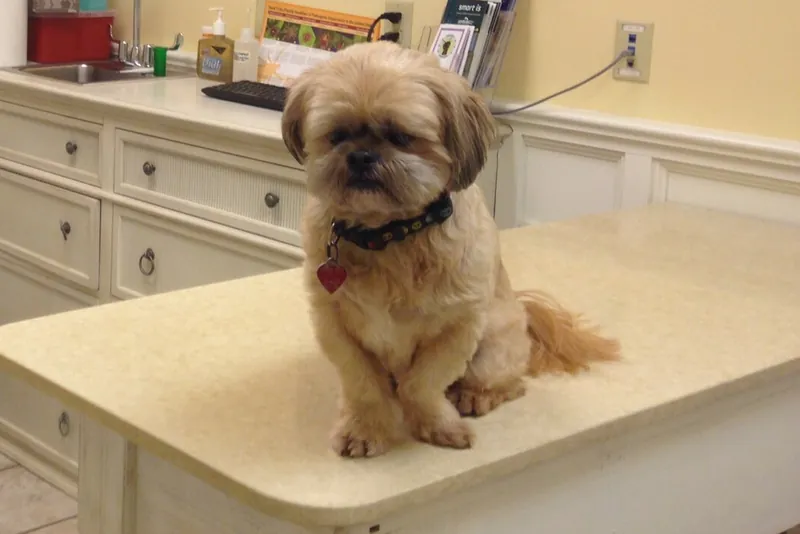
- Tracheal collapse: VCA Animal Hospitals says coughing can worsen with pressure on the trachea, such as from a collar, and advises a harness rather than a collar. Toy breeds such as Chihuahuas, Pomeranians, Shih Tzus, Yorkshire Terriers and toy Poodles are most often affected.
- Brachycephalic breeds: Purdue University's canine welfare team advises walking brachycephalic, or flat faced, dogs in a harness, because a collar adds strain to the windpipe.
- Eye conditions: glaucoma, thin corneas or recent eye surgery, as the eye pressure study above explains.
- Puppies and tiny dogs: they bounce, twist and pull while they learn, and a small neck has little margin for error.
- Any dog left alone: never tie a dog out on a slip lead or leave one on a dog in a crate or car.
How Does a Slip Lead Compare With a Martingale, Flat Collar or Harness?
Answer: A slip lead is the quickest to put on but has the least limit. A martingale tightens only to a set size, a flat collar never tightens, and a harness moves the load off the neck entirely. Most dogs walk best in a harness or flat collar, keeping a slip lead for short, supervised moves.
Each tool solves a different problem, so the best choice depends on the dog in front of you. A research review of collars, harnesses and head collars published in the journal Animals found that no single device suits every dog, favored non tightening front clip harnesses for dogs that pull, and advised caution with tightening devices such as martingales. Source: Cavalli and Protopopova, Animals, Review of Collars, Harnesses, and Head Collars for Walking Dogs.
A martingale is the closest relative of a slip lead. AKC notes that martingale, or limited slip, collars suit dogs whose necks are about as wide as their heads, and the Calgary Humane Society recommends them for escape prone sighthounds while warning against leaving one on an unsupervised dog. Our full guide to the martingale collar covers sizing. Source: Calgary Humane Society, Dog Walking Equipment.
If your dog pulls, look at a no pull dog harness or a front clip dog harness before any tool that closes around the neck. Our roundup of the best dog harness styles and our guide to the Gentle Leader head collar cover the other options. Tools built on discomfort, such as the prong collar, are a different category altogether, and veterinary behaviorists advise against them.
Which Material Is Best: Rope, Nylon or Leather?
Answer: Braided rope is the classic choice: grippy, easy to clean and quick to release. Flat nylon is light and cheap, and it is common in clinics. Leather is soft on the hands and lasts for years with care but dislikes water. Whatever you choose, pick a width that suits your dog's size and a stopper that holds firmly.
Material changes how a slip lead feels for both of you. Thin cord concentrates pressure on a narrow band of skin, while a wider rope spreads it. A slick nylon cord slides easily through the ring, which is good for release but can make the loop close faster. Leather and waxed cotton grip a little more and feel warmer in cold hands.
For a gundog or a dog that swims, rope or coated webbing dries faster and does not rot. If you prefer the look of leather, our guide to leather dog collars explains how to care for it. And if you mainly need a dependable everyday line, the different styles in our leash guide and our look at the hands free dog leash are worth a read before you buy.
How Do You Train Kindly With a Slip Lead?
Answer: Treat the slip lead as a way to hold your dog, not as a way to correct it. Keep the lead loose, reward your dog for walking beside you, and stop or change direction instead of jerking. If your dog keeps pulling, switch to a harness while you teach loose leash walking with treats.
The American Veterinary Society of Animal Behavior states that evidence supports reward based methods for all dog training, and lists choke chains and physical corrections such as leash jerking among the techniques an appropriate trainer should avoid. A slip lead used for repeated pops on the neck works the same way as a choke chain, which is exactly what this guidance warns against. Source: AVSAB, Position Statement on Humane Dog Training.
- Introduce it calmly. Let your dog sniff the lead, then reward. Slip it on and off a few times at home with treats before you go anywhere.
- Reward the loose lead. Each time the rope hangs in a gentle J between you, mark it with a word and reward at your side.
- Be a tree. When the lead tightens, stop and wait. Move on the moment the lead goes slack again.
- Change direction. If your dog surges ahead, turn and walk the other way, rewarding when it catches up.
- Keep sessions short. A few minutes of focused practice beats a long walk full of pulling.
Our step by step guide to positive reinforcement dog training explains how to time rewards and build longer stretches of loose leash walking. If you are comparing other tools sold for training, our overview of dog training collars sets out what each one does.
What Safety Rules Apply Every Time You Use One?
Answer: Always supervise, never tie out, and keep the loop high and loose with the stopper set. Watch for coughing or gagging, check the rope and stitching for wear, and keep a flat collar with an ID tag on your dog for the times the slip lead comes off. When in doubt, use a harness.
- Supervise every second. A slip lead only works with a person holding it. Never leave it on a dog that is crated, tied, in a car or playing with other dogs.
- Never tie out. If the dog jumps or falls, the loop can tighten and will not release by itself.
- Keep ID on separately. A slip lead carries no tags. Keep a flat collar with ID on your dog, sized with our adjustable dog collar tips, or fitted from our best dog collar picks.
- Use two leads for nervous dogs. A collar and clip on lead plus a slip lead, as many clinics do, gives a backup if one fails.
- Check the gear. Replace frayed rope, cracked leather stoppers and bent rings straight away.
- Avoid retractable leads with it. A sudden stop at the end of a retractable dog leash would land on the neck.
What Do People Ask Most About Slip Leads?
Answer: Owners most often ask what a slip lead is for, whether it is cruel, which way it goes on, whether puppies and pullers can use one, how it compares with a martingale and how tight it should be. The short answers below draw on veterinary handling guides, AKC advice and published research on neck pressure.
What is a slip lead used for?
A slip lead is a leash and collar in one piece. Vets, shelters, groomers and gundog handlers use it to move a dog quickly without fitting a separate collar. At home it works best as a short term or backup lead for a calm dog that walks on a loose leash.
Is a slip lead cruel?
Not in itself, but it can hurt if it is misused. Because the loop tightens when the lead is pulled, steady pulling or leash jerks put pressure on the throat. Used loosely, high on the neck and with reward based training, it is a simple handling tool rather than a correction device.
Which way should a slip lead go on?
For a dog walking on your left, hold the lead so the loop and the rope form the letter P as you hold it in front of you, then slip it over the head. For a dog on your right, use the mirror image. Done correctly, the loop loosens as soon as the lead goes slack.
Can a puppy wear a slip lead?
Briefly, for moving a puppy from the car to the clinic door, yes. For everyday walks and leash training, a well fitted harness or flat collar is kinder, because puppies pull, bounce and twist while they learn, and every pull on a slip lead lands on the neck.
Is a slip lead good for a dog that pulls?
Usually not. A dog that pulls keeps the loop tight against the throat for most of the walk. A recent research review favors a non tightening front clip harness for pullers, together with reward based loose leash training, rather than any tightening device around the neck.
Should a dog with tracheal collapse use a slip lead?
No. VCA advises using a harness rather than a collar for dogs with tracheal collapse, because pressure on the windpipe can trigger coughing. The same logic applies even more strongly to a lead that tightens around the neck. Ask your vet which harness suits your dog.
What is the difference between a slip lead and a martingale?
A slip lead has no limit unless you set its stopper, and it is a collar and leash in one piece. A martingale is a separate collar with a small control loop that tightens only to a set size, so it cannot close further. Martingales suit narrow headed dogs like greyhounds.
How tight should a slip lead be?
When the lead is slack you should be able to slide two fingers between the loop and the neck. Set the stopper so the dog cannot back out, but never use it to clamp the rope tight. If the dog coughs, gags or wheezes, stop and loosen the loop.
Sources
- American Kennel Club: Dog Leashes 101, choosing the right dog leash
- American Kennel Club: Dog harnesses and dog collars
- American Kennel Club: Dog Show Policies, training collars
- University of Bristol Veterinary School: Using a Slip Lead
- Virginia Tech, Office of the University Veterinarian: SOP Canine Restraint
- VCA Animal Hospitals: Tracheal collapse in dogs
- Purdue University Canine Welfare Science: Respiratory function in brachycephalic dogs
- Carter, McNally and Roshier (2020), Veterinary Record: Canine collars and forces on a simulated neck model
- dvm360: Study shows collar stress can heighten glaucoma risk
- Cavalli and Protopopova (2025), Animals: Review of collars, harnesses and head collars for walking dogs
- Calgary Humane Society: Dog walking equipment
- American Veterinary Society of Animal Behavior: Position statement on humane dog training
- Rydale: How to put a slip lead on a dog
Gear for calm, happy walks
Browse our collar and leash set, toys and accessories for dogs of every size.
Shop dog accessories