A Gentle Leader is a head halter: a two strap device that sits around a dog's muzzle and behind the ears, with the leash clipping under the chin rather than at the back of the neck. It belongs to a product category of its own. It is not a collar, it is not a harness, and it is not a muzzle. Owners who treat it like any of those three are the ones who end up with a dog that rubs its face along the pavement and a halter that goes in a drawer after a week.
This guide covers what the device is, how it differs from the collar and harness guides you may already have read, why it changes pulling, how to fit it properly, how to introduce it so your dog accepts it, the mistakes that turn it from helpful into risky, the dogs it is simply wrong for, and why it should always sit alongside training rather than replace it. Fit and introduction are welfare matters, so where this guide makes a behavioral or anatomical claim it points to a veterinary source you can read yourself.
What a Gentle Leader actually is
The Gentle Leader is a brand of head halter, sometimes called a head collar, made by PetSafe. Several similar designs exist from other manufacturers, and the fitting principles in this guide apply across the category, so treat the brand name as shorthand for the design rather than an endorsement of one product. The construction is deliberately simple: a soft loop that rests over the bridge of the muzzle, a strap that fastens high on the neck just behind the ears, and a single attachment ring that sits beneath the chin where the two meet.
The most important thing to understand about the design is what it is not. It is not a muzzle. A dog wearing a correctly fitted head halter can open its mouth fully, and can pant, drink, take treats, and bark exactly as normal. That confusion matters in practice, because owners are sometimes reluctant to use one in public for fear of looking like their dog is dangerous, and because owners occasionally reach for one expecting it to prevent biting. It will not. If bite risk is your concern, the Merck Veterinary Manual discusses the use of a properly conditioned basket muzzle in its guidance on behavior problems of dogs, and that is a different tool for a different job.
How it differs from a collar or a harness
The site already has detailed guides to the other walking gear categories, and it is worth being precise about where a head halter sits among them, because the four categories solve genuinely different problems.
| Category | Where the leash attaches | What it is mainly for |
|---|---|---|
| Head halter (Gentle Leader) | Under the chin, on the muzzle loop | Guiding the head so pulling loses its leverage |
| Flat or adjustable collar | Back of the neck | Carrying identification, everyday wear |
| Martingale collar | Back of the neck, with limited tightening | Stopping narrow headed dogs backing out |
| No pull harness | Chest or back, or both | Spreading pressure across the body, off the neck |
If you are still deciding between categories rather than shopping within one, our broader guides to the dog harness and the dog collar are the better starting point, and the dog leash guide covers the line itself. A head halter is worth considering specifically when a dog is strong enough that steering the body is not working, and when you want that leverage without the neck pressure that a flat collar puts on a pulling dog.
Why a head halter changes pulling
The mechanism is leverage, not discomfort. When the leash attaches at the back of the neck, a determined dog can put its whole body weight into the harness or collar and drag you forward. When the attachment point is under the chin, gentle pressure turns the head, and a dog whose head is turned cannot generate the same forward force. Most dogs stop pulling because pulling stops working, not because it hurts.
That distinction matters for how you should use it. Because the halter is attached to the head, it multiplies the effect of anything you do with the leash. A sharp yank that a flat collar would absorb becomes a sudden wrench on the neck. This is the single biggest reason head halters get a mixed reputation. In competent hands with a loose leash they are gentle. Used with jerks and corrections they are not. The technique the equipment demands is soft hands and a short leash held with slack in it.
It also helps to be honest about what the halter is doing behaviorally. It manages the behavior while it is on. It does not teach your dog that walking beside you is rewarding. VCA Animal Hospitals sets out the underlying principle clearly in its training basics guidance: dogs repeat behaviors that have a good result for them, and teaching a dog what to do through praise and rewards is the best practice, whereas waiting for the unwanted behavior and then punishing it can lead to avoidance, fear, and confusion. A head halter buys you the calm walks in which that reward based teaching can actually happen.
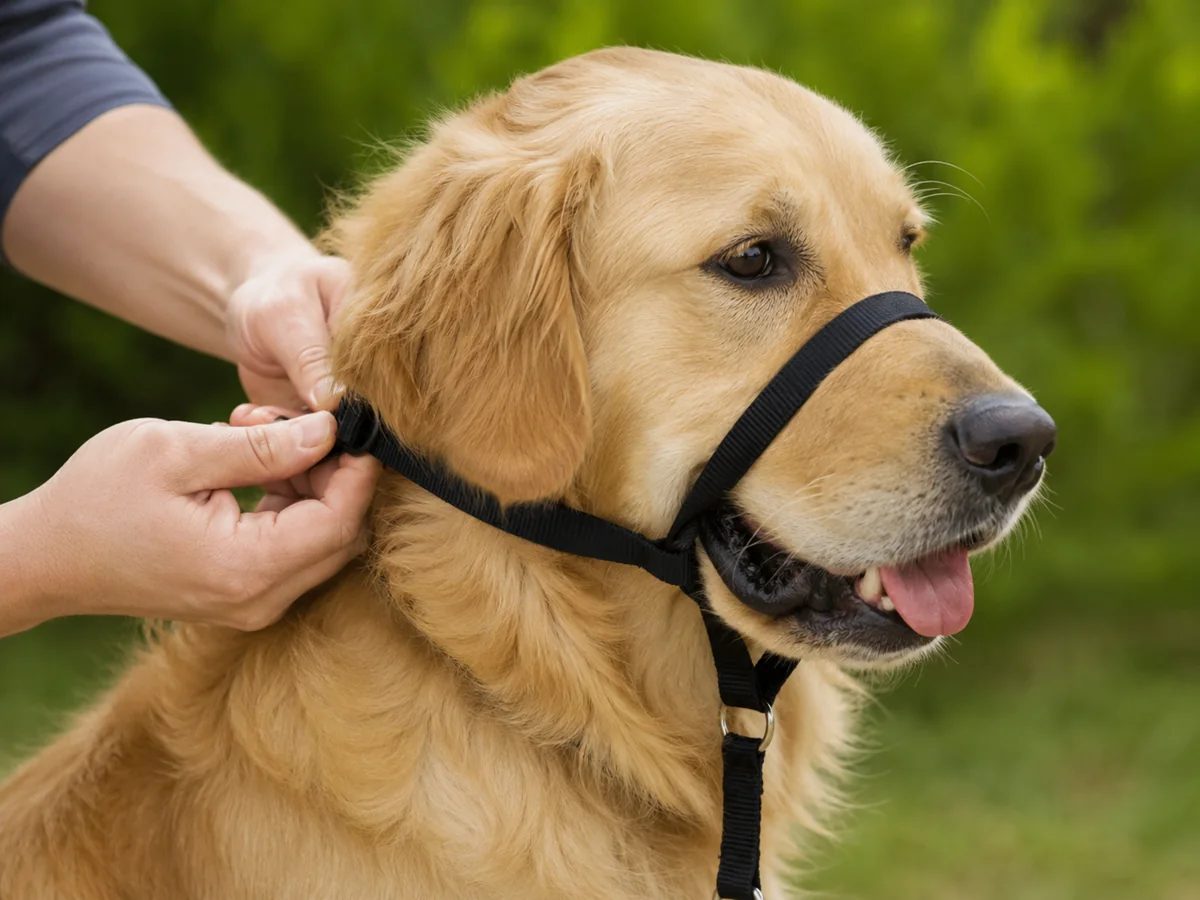
Fitting it correctly, step by step
Almost every complaint about head halters traces back to fit. A halter that is too loose slips and gets pawed off, and one that is too tight on the muzzle stops the dog opening its mouth. Follow the fitting instructions that came with your specific halter, since sizing differs between brands, and use this sequence as your check.
- Size by weight and muzzle shape, then verify on the dog. Manufacturer size charts are a starting point. Two dogs of the same weight with different muzzle lengths will not take the same halter.
- Fasten the neck strap first, high and snug. It should sit right behind the ears at the top of the neck, not down where a flat collar sits. Correctly adjusted, you should be able to slip one finger underneath it but not two.
- Check the nose loop is loose, not tight. The loop should slide down the muzzle far enough that your dog can open its mouth fully and pant, but not so far that it can be pushed off over the nose. Loose is correct here, which surprises people.
- Confirm the mouth opens. Offer a treat and watch. If your dog cannot take it comfortably or cannot pant, the nose loop is too tight and needs loosening before you go anywhere.
- Check the eyes and the fold behind the nose. The loop should not sit so far up the muzzle that it presses near the eyes, and it should not pinch the loose skin at the corner of the mouth.
- Recheck after ten minutes of movement. Straps settle. What was snug in the hallway may be loose by the end of the street.
Recheck the fit periodically after that too, not just on day one. Dogs gain and lose weight, coats thicken and thin with the seasons, and webbing stretches with use.
Introducing it without a fight
The mistake almost everyone makes is putting the halter on and immediately walking out of the door. Most dogs find something on their muzzle strange at first and will paw at it, rub their face on the ground, or freeze and refuse to move. That reaction is normal, and it is also entirely avoidable with a few short sessions.
The approach that works is the one veterinary behavior guidance recommends for any unfamiliar equipment: pair the new thing with something the dog already likes, in steps small enough that the dog never rehearses the panic. The Merck Veterinary Manual describes desensitization and counterconditioning as the core of behavior modification in its overview of canine behavior problems, and the same logic applies to a piece of gear.
- Day one: the halter predicts food. Show it, feed a treat, put it away. Repeat a handful of times. Do not put it on the dog at all.
- Day two: nose through the loop, then out. Hold a treat through the nose loop so your dog puts its own muzzle through to reach it. Let the muzzle come straight back out. Repeat.
- Day three: fasten it for seconds, not minutes. Buckle the neck strap, feed continuously for five to ten seconds, unbuckle. End while your dog is still happy.
- Day four: wear it indoors during something fun. Dinner, a game, a training session. Keep the leash off entirely.
- Day five: attach the leash indoors. Walk a few steps around the house with slack in the line, rewarding movement.
- Day six onward: take it outside somewhere quiet and boring. Not the busy park. A short stretch of familiar pavement with nothing to react to.
If your dog paws or rubs at any stage, that is feedback that you moved faster than the dog was ready for. Go back a step rather than pushing through. Rushing this is what produces a dog that fights the halter for the rest of its life.
Mistakes that make a head halter unsafe
Used carelessly, the leverage that makes a head halter effective becomes the thing that makes it risky. These are the errors worth ruling out deliberately.
- Jerking or snapping the leash. The leash is attached to your dog's head. Corrections that a body harness would absorb are transmitted straight to the neck. Keep the line loose and guide rather than yank.
- Using it with a long line, a flexi lead, or a tie out. A dog that hits the end of a long line at speed while wearing a head halter can be spun hard. Use a standard fixed length leash, and read our notes on why a retractable leash is a poor pairing for this kind of gear.
- Leaving it on unsupervised. A head halter is walking equipment. It comes off at home, in the crate, and in the garden, where it can snag or be chewed off.
- Letting the dog run at full speed in it. Off leash play, fetch, and the dog park are not head halter activities.
- Tightening the nose loop to stop it slipping. If the loop slides off, the fix is the neck strap being too low or too loose, not a tighter muzzle loop.
- Skipping the introduction. Covered above, and the most common of all.
A practical safety habit that many trainers use is a backup connection: a second point of attachment to a flat collar or harness, so that if the halter comes off mid walk your dog is still connected to you. It costs nothing and removes the worst failure mode.
Dogs a head halter is wrong for
This is not a universal tool, and pushing it onto the wrong dog causes real problems.
- Flat faced breeds. Pugs, French Bulldogs, Boxers, and similar breeds often have too little muzzle to hold a nose loop at all. They also frequently have the airway abnormalities VCA describes in brachycephalic obstructive airway syndrome, including narrowed nostrils and an elongated soft palate, which means anything near the nose and mouth deserves veterinary input first rather than a guess from a size chart.
- Puppies still growing. Fit changes month to month, and there is rarely a need for this level of leverage on a small puppy.
- Dogs with neck, spine, eye, or facial injuries, or any facial skin condition. Check with your veterinarian before putting pressure or a strap anywhere near an existing problem.
- Dogs that stay panicked despite proper conditioning. If several careful sessions produce genuine distress rather than mild novelty, this is the wrong equipment for that dog. A well fitted front clip harness is a reasonable alternative.
- Reactive or aggressive dogs, as a standalone answer. A halter can be part of a management plan, but VCA's guidance on getting started with aggression problems makes clear that these cases need a proper behavioral assessment. Equipment alone is not a treatment plan.
It is a management tool, not the training
The most useful mental model is that a head halter buys you time. It gives you controllable walks today so that you can teach loose leash walking over the coming weeks, rather than reinforcing a year of dragging while you wait for training to work.
Use the calm walks it creates. Reward your dog for the position you actually want, generously and often, at the moment the leash is slack rather than after the pulling has resumed. That is the reward based approach VCA describes, and it is what eventually makes the halter unnecessary. Many owners find they can fade back to a flat collar or a harness once the habit of walking beside them is established, and some keep the halter only for busy environments.
If pulling is tangled up with lunging, barking, or fear rather than simple enthusiasm, equipment is the wrong layer to solve it at. That is a behavior case, and the Merck Veterinary Manual's discussion of canine behavior problems is a reasonable orientation before you speak to your veterinarian or a qualified behaviorist. Getting the diagnosis right matters more than getting the gear right.
Frequently asked questions
Is a Gentle Leader a muzzle?
No. A correctly fitted head halter lets a dog open its mouth completely, so it can pant, drink, take treats, and bark normally. A muzzle is designed to prevent biting and a head halter is not, so it should never be used for bite safety. If bite risk is your concern, ask your veterinarian about conditioning a properly fitted basket muzzle instead, which is a different tool for a different purpose.
Is a head halter cruel or painful for dogs?
It should not be. The device works by leverage rather than discomfort, since guiding the head removes the leverage a dog needs to pull. Problems come from poor fit, skipped introduction, and jerking the leash, all of which are avoidable. Use a loose leash and soft hands, fit it properly, and introduce it gradually with rewards rather than forcing it on.
How tight should a Gentle Leader be?
The two straps want opposite things. The neck strap should sit high behind the ears and be snug, with room for about one finger underneath but not two. The nose loop should be loose enough that your dog can open its mouth fully and pant, while still not sliding off over the end of the nose. If the halter slips off, tighten the neck strap rather than the nose loop.
Why does my dog keep pawing at the head halter?
Almost always because it was introduced too quickly. Something resting on the muzzle is novel, and dogs need a few short sessions to accept it. Go back to pairing the halter with food in very brief steps, fastening it for only seconds at a time, and ending each session while your dog is still relaxed. Rubbing and pawing are a signal to slow down, not to push through.
Can a puppy wear a Gentle Leader?
It is usually better to wait. A growing puppy needs the fit rechecked constantly, and most puppies do not have the strength that makes head halter leverage necessary in the first place. Early loose leash training with rewards, on a flat collar or a harness, tends to be a better investment. Ask your veterinarian or trainer if you are unsure about your individual dog.
Can flat faced breeds like pugs use a head halter?
Often not. Brachycephalic breeds frequently have too little muzzle for a nose loop to sit correctly, and VCA notes that these breeds commonly have upper airway abnormalities such as narrowed nostrils and an elongated soft palate. Anything fitted around the nose and mouth of a flat faced dog deserves veterinary input first. A well fitted front clip harness is usually the more sensible option.
Will my dog need to wear it forever?
Many dogs do not. The halter is a management tool that gives you calm walks in which to teach loose leash walking with rewards. As that habit becomes reliable, plenty of owners fade back to a flat collar or a harness, keeping the halter only for busy or difficult environments. How quickly that happens depends on the training you do while the halter is on, not on the halter itself.
The bottom line for dog owners
A Gentle Leader is a specific answer to a specific problem: a dog strong enough that steering its body no longer works, walked by a person who wants that control without hauling on its neck. It is its own category of equipment, distinct from the collars, harnesses, and leashes covered elsewhere on this site, and it rewards being treated that way. Fit the neck strap high and snug and the nose loop loose, spend a week introducing it with food before you rely on it, keep the leash slack, take it off at home, and add a backup connection to a collar or harness. Then use the calm walks it gives you to actually teach the behavior you want, because the halter manages pulling while the training is what ends it. If your dog is flat faced, still growing, injured, or genuinely distressed by the halter after careful conditioning, that is your answer to stop and ask your veterinarian about a different option.