You grab your keys and your dog's whole body changes. The pacing starts. The whining begins. You close the door and, somewhere behind it, the destruction unfolds - chewed doorframes, shredded cushions, a neighbor who is slowly running out of patience. If this sounds familiar, your dog is not being vindictive, attention-seeking, or poorly trained. They are genuinely distressed. And the right separation anxiety dog toys can make a real difference in how they cope while you are gone. According to the ASPCA separation anxiety in dogs resource, choosing the right toys can support your pet's mental and physical wellbeing.
Separation anxiety is not the same as boredom, and it is not cured by toys alone. But enrichment tools - used thoughtfully and consistently - reduce the emotional intensity of alone time, give anxious dogs an outlet for their distress, and can form the foundation of a positive departure ritual that reframes leaving as something predictable and even rewarding. This guide covers the 11 best toys for separation anxiety in dogs, the science behind why they work, and how to use them correctly. For broader enrichment strategies, our roundup of dog anxiety toys covers the full category.
Understanding Separation Anxiety in Dogs
Separation anxiety affects an estimated 14 to 20 percent of pet dogs - a significant proportion of the roughly 90 million dogs in the United States alone. It is classified as a behavioral disorder rather than a training failure, rooted in the dog's inability to regulate their emotional state when separated from their primary attachment figure or figures. Unlike normal boredom - which any dog may experience when under-stimulated - separation anxiety produces a genuine panic response triggered specifically and solely by the act of being left alone.
In our experience writing about pet health topics like separation anxiety dog toys, we've found that owners benefit most when guidance separates clinical signs from normal variation. We try to flag that distinction clearly throughout this piece.
If stress is a concern, our guide to calming toys for dogs covers more solutions.
The distinction matters because the two problems require different solutions. A bored dog needs more enrichment. A dog with separation anxiety needs a combination of behavior modification, environmental management, and often professional support. Toys address the management component: they do not retrain the emotional response, but they can lower its intensity and duration while a more comprehensive program takes effect.
Common Triggers
Separation anxiety frequently develops or worsens following significant changes to a dog's routine or environment. Common triggers include a new work schedule after a period of consistent home presence, a move to a new home, the loss of a family member or companion animal, a major illness, or - as many owners discovered - a return to office work after an extended period of working from home. Puppies separated too early from their litter and dogs with a history of rehoming or shelter stays are also at elevated risk.
Toys Are a Management Tool, Not a Cure
It is important to set realistic expectations. The toys in this guide will not resolve severe separation anxiety on their own. A dog in a full-panic state - trembling, vocalizing nonstop, attempting to escape - is too overwhelmed to engage with even the most enticing food puzzle. For moderate to severe cases, a certified applied animal behaviorist or veterinary behaviorist is the appropriate first step. That said, for mild to moderate anxiety, and as a complement to professional treatment for more serious cases, enrichment toys are one of the most effective management tools available. For a broader look at calming strategies, see our guide to calming toys for dogs.
The goal of separation anxiety dog toys is not distraction - it is replacing a panic state with a focused, calm, rewarding activity. The right toy at the right moment lowers cortisol, occupies the mouth and nose, and gives the dog something to do other than spiral.
Signs Your Dog Has Separation Anxiety (vs. Boredom)
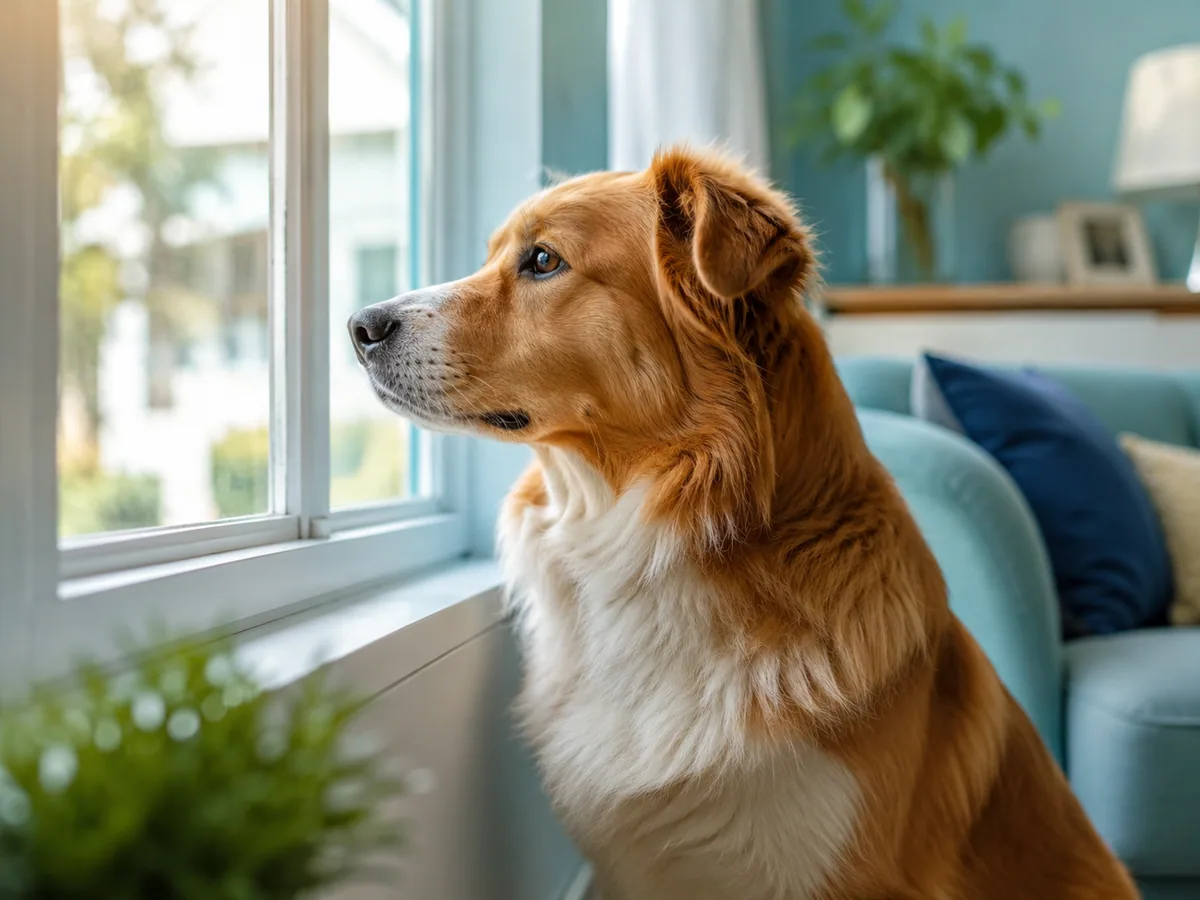
Misidentifying boredom as separation anxiety - or vice versa - leads to applying the wrong solution. Here is how to tell the difference based on the behavioral profile of each.
Separation Anxiety: The Key Distinguishing Markers
- Destructiveness that occurs only when alone. A dog that chews furniture, scratches at doors, or tears up cushions only during your absence - and never when you are home - is exhibiting a classic separation anxiety pattern. A bored dog will often engage in destructive behavior regardless of whether their owner is present.
- Excessive vocalization when alone. Neighbors report barking, howling, or whining that begins shortly after your departure and continues for extended periods. This is distinct from alert barking at passing stimuli; it is sustained, distress-driven vocalization.
- Panting, drooling, and pacing. Dogs with separation anxiety often show physical signs of stress - heavy panting, salivation, pacing in a fixed route - that are absent when their owner is present. These are autonomic nervous system responses to genuine fear, not behaviors driven by boredom or mischief.
- House soiling despite being reliably trained. A house-trained dog that urinates or defecates indoors only when left alone is not having a lapse in training. This is a stress response. Punishing it is both ineffective and counterproductive.
- Extreme greeting behavior. Frantic, prolonged, almost hysterical greeting when you return - lasting ten minutes or more - suggests the dog experienced significant distress during the absence, not just mild frustration.
Boredom: The Distinguishing Markers
- Destructive behavior happens in your presence as well as your absence.
- The dog settles within 30 to 60 minutes of your departure (visible on home cameras).
- Behavior improves dramatically with more exercise and enrichment.
- No physical stress signs - no panting, drooling, or frantic pacing.
If you are unsure whether your dog has separation anxiety or boredom, set up a camera before your next departure and watch the footage. The answer will usually be clear within the first 30 minutes. Separation anxiety typically escalates immediately upon your departure; boredom manifests gradually once the dog runs out of entertainment.
Honestly, the most important takeaway we share with readers on separation anxiety dog toys is to involve a veterinarian early. We've seen how much smoother outcomes are when concerns are checked promptly.
How Toys Help With Separation Anxiety
The mechanism by which toys reduce separation anxiety is well-grounded in behavioral and physiological research. Understanding why they work helps you choose the right type and use them most effectively.
Mental Occupation Interrupts the Anxiety Cycle
Separation anxiety involves a feedback loop: the dog anticipates your departure, becomes aroused, and that arousal escalates into panic. A sufficiently engaging toy - ideally one introduced during the departure ritual itself - gives the dog's brain something concrete to focus on at the critical moment when anxiety typically spikes. The mental demand of working a food puzzle or licking out a frozen Kong occupies cognitive resources that would otherwise fuel the spiral. This is not about distraction in the trivial sense; it is about redirecting the dog's attention and energy toward a productive, calming task before the panic state fully establishes itself.
Positive Association with Departure
When a special toy - one the dog only receives at departure time - is consistently paired with your leaving, the toy itself becomes a conditioned stimulus for a positive experience rather than a negative one. Over time, seeing the departure toy can shift the dog's emotional response from they are leaving to I am about to get the good frozen Kong. This is a core principle of systematic desensitization, and it is one reason that consistency in the departure ritual matters as much as the toy itself.
Anxious pets may also benefit from the products in our calming toys for cats guide.
Licking and Chewing Reduce Cortisol
Research in veterinary behavioral medicine consistently finds that repetitive oral behaviors - licking in particular - activate the parasympathetic nervous system and measurably reduce salivary cortisol levels in dogs. This is the physiological basis for why lick mats and stuffed Kongs are so effective for anxious dogs: the act of licking is intrinsically calming, not merely occupying. Chewing has a similar, though somewhat less pronounced, effect. Toys that encourage long-duration licking or chewing are therefore physiologically active interventions, not just entertainment. For more on this mechanism, our guide to best dog toys covers the science of enrichment in depth.
11 Best Separation Anxiety Dog Toys
These picks are organized to cover the full range of anxious-dog needs: long-duration occupation, licking and chewing, puzzle challenge, self-soothing, and solo play. Browse our full dog toys collection to find these and similar enrichment options.
1. KONG Classic - Best Overall Departure Toy
The frozen stuffed KONG Classic is the single most recommended toy for dogs with separation anxiety, and for good reason: it combines long-duration occupation, the cortisol-lowering licking mechanism, and the positive departure association all in one object. Stuff it with a layer of peanut butter, kibble mixed into yogurt, or mashed banana, then freeze it overnight. A well-frozen KONG takes 30 to 45 minutes to work through - long enough to bridge the critical post-departure window when anxiety is most likely to spike. Give it to your dog only at departure time so the KONG becomes a reliable signal that something good is about to happen. Batch-prepare five or six at once and rotate them from the freezer each morning.
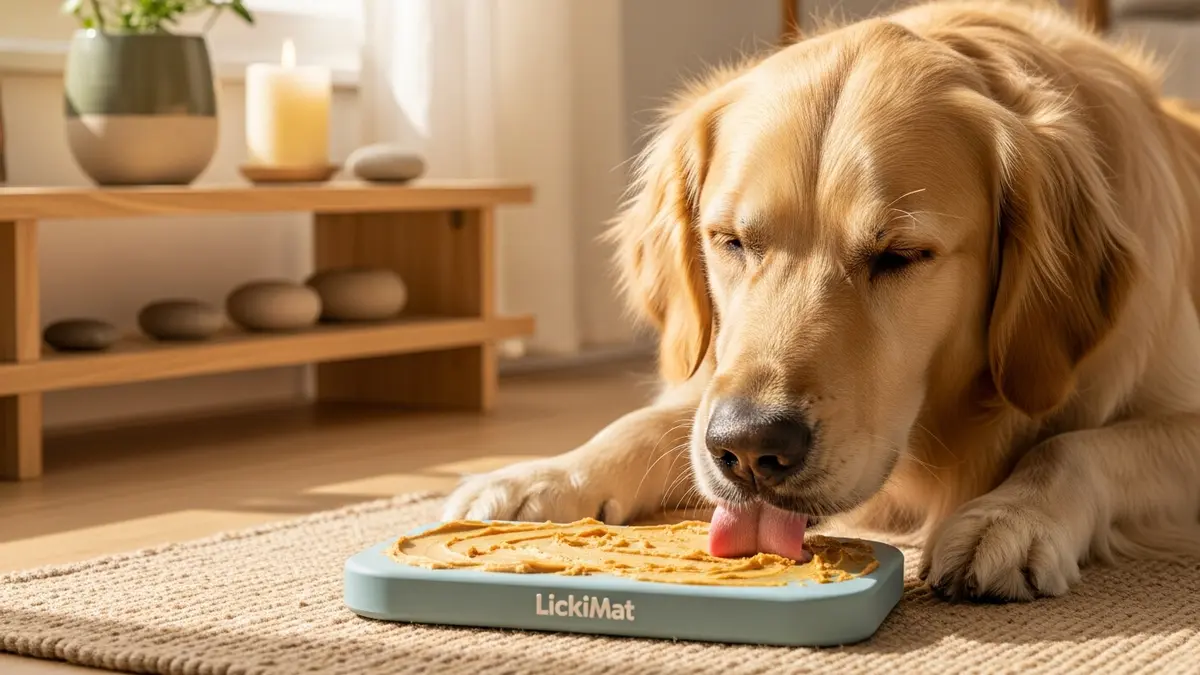
2. LickiMat Splash - Best Wall-Mounted Lick Mat
The LickiMat Splash mounts directly onto a wall, tile surface, or the inside of a crate door via suction cups, positioning the lick mat at your dog's natural head height. The textured surface - a grid of raised squares and channels - extends the time it takes to lick clean by making the food harder to access than a smooth surface. Spread with a thin layer of plain Greek yogurt, pumpkin puree, or diluted peanut butter. The wall mounting has a practical advantage for anxious dogs: it keeps the mat stationary, preventing the frustration of a lick mat sliding around the floor. For dogs prone to gulping rather than licking, the resistance of the textured surface encourages the slower, more beneficial licking behavior that produces the calming effect.
3. West Paw Toppl - Best Puzzle Challenge
The West Paw Toppl is a step up in puzzle complexity from the KONG Classic - its wider opening and stackable design (a small Toppl can be tucked into a large Toppl, hiding the inner treat chamber) make it a more engaging cognitive challenge for dogs that empty a standard KONG too quickly. The wide-mouth design also accommodates larger treat pieces - whole blueberries, chunks of banana, larger kibble - which slow the extraction process and require more deliberate pawing and licking. Made from West Paw's non-toxic, recyclable Zogoflex, it is durable, cleans easily in the dishwasher, and safe for dogs that tend to chew rather than just lick their food toys. Available in two sizes for a proper breed match.
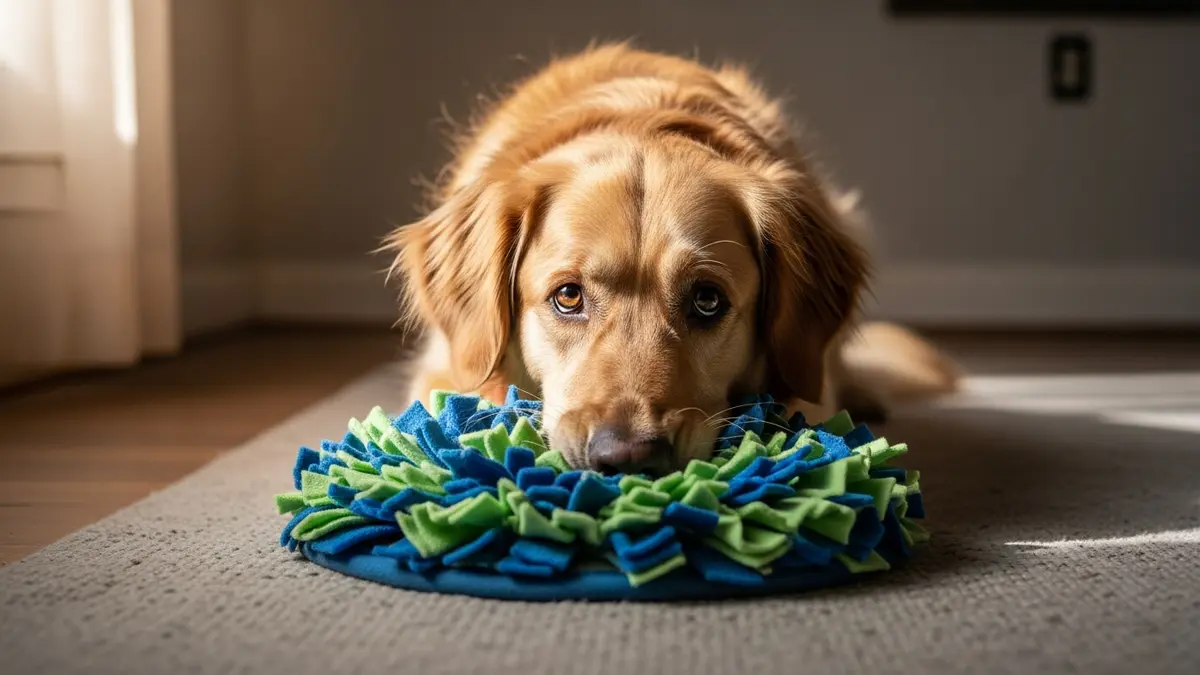
4. Snuffle Mat - Best Pre-Departure Calming Tool
A snuffle mat is most effective when used in the 15 to 20 minutes before you leave rather than during your absence. Scatter a portion of your dog's daily kibble allowance into the dense fabric strips and let them nose-work their way through it. Fifteen minutes of active sniffing is as mentally draining as a full hour of physical exercise, and a mentally tired dog enters the alone period in a significantly calmer baseline state than one that has been sitting idle. The nose-work involved also activates the parasympathetic system - sniffing, like licking, is intrinsically calming. Use the snuffle mat as the pre-departure ritual activity, then hand off the frozen KONG as you walk out the door for a two-stage departure enrichment sequence.
5. Heartbeat Plush Toy - Best for Puppies and Newly Adopted Dogs
Heartbeat plush toys - soft stuffed animals with a battery-operated pulsing insert that mimics a heartbeat at approximately 60 to 80 beats per minute - were originally designed for neonatal puppies missing their littermates, but they are equally valuable for any dog experiencing attachment-based anxiety. The rhythmic pulse provides a subtle, continuous sensory stimulus that many dogs find grounding in the same way human infants are calmed by being held against a beating chest. They are not a substitute for a food-based occupation toy but serve a different function: providing a comfort object and sensory anchor. For puppies under six months, newly rehomed dogs, or shelter dogs in adjustment periods, a heartbeat plush placed in the sleeping area can noticeably reduce distress vocalizations in the first weeks of a new home.
6. Puzzle Feeder (Level 1–2) - Best Mental Occupation Toy
An intermediate puzzle feeder - one with sliding covers, rotating pieces, or flip-top compartments - transforms part of the dog's daily meal into an extended solo enrichment session. For separation anxiety specifically, a Level 1 or Level 2 puzzle is the right starting point: challenging enough to occupy 10 to 20 minutes, but not so difficult that the dog becomes frustrated and abandons it. Frustration in an already-anxious dog can compound distress rather than reducing it. Load it with a mix of kibble and small high-value treats and present it as part of the departure ritual. As the dog becomes skilled at the puzzle, graduate to Level 3 complexity to maintain the engagement duration. Avoid leaving puzzles with small removable pieces unsupervised with dogs that mouth and swallow toy components.
7. Automatic Ball Launcher - Best for Self-Directed Physical Play
For dogs whose separation anxiety manifests primarily as restless, pacing energy rather than vocalizing or destruction, an automatic ball launcher offers a physical outlet for that energy during alone time. The dog drops a ball into the top of the machine, which launches it at a selectable distance, and the dog retrieves and reloads - a fully self-directed fetch loop. Most dogs learn to operate the loader within one or two supervised sessions. The physical exertion burns the restless energy driving the pacing behavior, and the repetitive fetch loop provides the structured, predictable activity that anxious dogs find regulating. Use it in a safe, clear indoor space - a hallway or open living room - and introduce it while you are present before leaving the dog to use it alone.
For more calming solutions, see our detailed anxiety toys for dogs review.
8. Dog TV or Calming Music - Best Auditory and Visual Complement
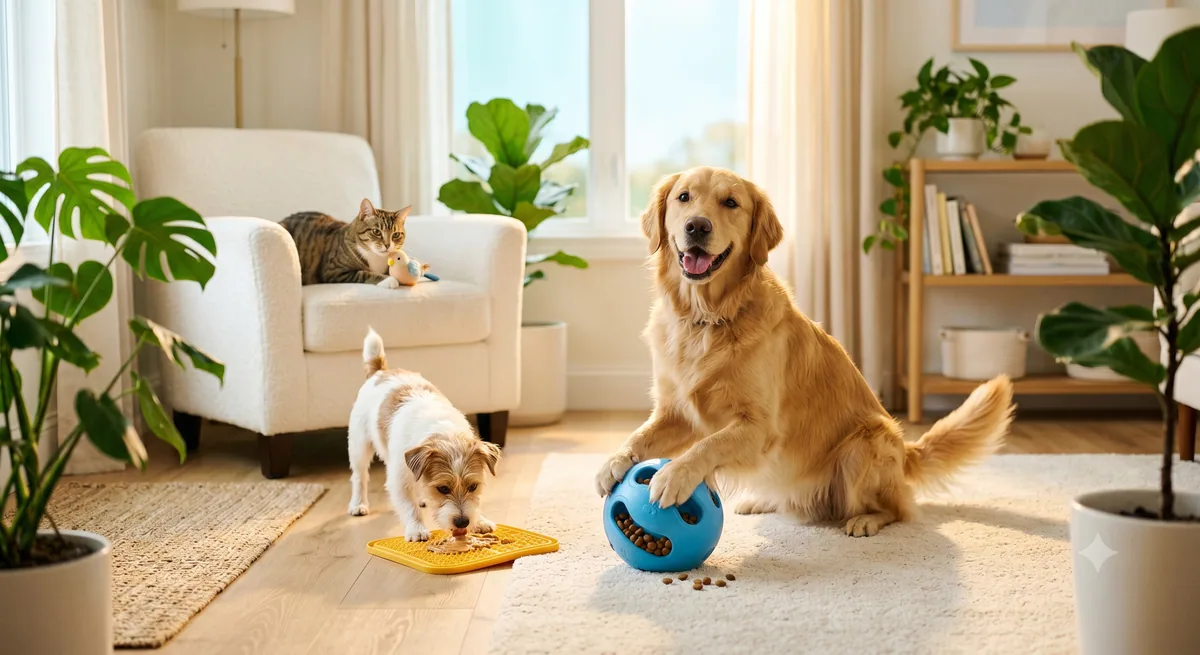
Strictly speaking, Dog TV and purpose-composed calming music playlists are not toys - but they are one of the most effective complements to a physical enrichment strategy for separation anxiety. An empty, silent house amplifies every external noise into a potential trigger for alerting and anxiety. Dog TV (a dedicated streaming channel with content designed for canine visual acuity and hearing ranges) and calming music (particularly classical music or specifically composed through-a-dog's-ear recordings) create an ambient sensory environment that buffers external triggers and masks the silence that many anxious dogs find distressing. Play them during your departure routine so the sound becomes part of the positive association, rather than starting them only after you leave and making the switch an additional departure cue. For additional guidance, see the VCA Hospitals separation anxiety guidance.
9. Slow Feeder Bowl - Best for Mealtime Alone
If part of your dog's alone time coincides with a meal, a slow feeder bowl is a straightforward upgrade from a standard dish that extends the mealtime from two minutes to fifteen or twenty. The raised ridges, spirals, or maze patterns force the dog to use their tongue and snout to extract kibble from the channels, slowing intake and extending engagement. For anxious dogs, the extended, focused mealtime activity has a measurable calming effect - the combination of eating (inherently rewarding) and the slow licking behavior (cortisol-reducing) makes slow feeder mealtimes meaningfully different from wolfed-down bowl meals. Choose a size and maze complexity matched to your dog's muzzle; a maze too tight for their tongue will frustrate rather than calm.
10. Bully Stick Holder - Best Safe Chew Anchor
Bully sticks are among the longest-lasting single-ingredient chews available - a dedicated chewer can work one for 30 to 60 minutes - and chewing is physiologically stress-relieving through the same cortisol-reduction mechanism as licking. The problem is the end stub: once the bully stick gets short, it becomes a choking hazard as dogs try to gulp the last piece. A bully stick holder - a rubber or nylon grip device that clamps the end of the stick and prevents the dog from swallowing the final segment - solves this problem entirely, making unsupervised chew sessions safe. Anchor it to a stationary object or use a floor anchor version for dogs that tend to carry their chews to hidden locations. A bully stick in a holder is one of the best long-duration occupation tools for dogs that are too anxious to engage with puzzle toys but respond well to the calming effect of chewing.
11. Pet Camera with Treat Dispenser - Best Monitoring and Interaction Tool
A pet camera with remote treat dispensing capability - the Furbo and similar devices - occupies a unique position: it is simultaneously a monitoring tool and an interactive enrichment device. The monitoring function is invaluable for owners working on separation anxiety, as it provides objective footage of your dog's actual behavior during absences rather than evidence gathered only from destruction upon return. The remote treat dispenser allows you to reward calm behavior in real time - reinforcing settling and lying down rather than pacing - and the two-way audio lets you speak to your dog if they are escalating. Use the treat-dispensing feature judiciously: rewarding the dog specifically when they are calm, not in response to vocalization, which would inadvertently reinforce the anxiety behavior. Over time, the camera helps you track whether your enrichment strategy is working and identify which parts of the alone period are hardest for your dog.
Creating a Positive Departure Ritual with Toys
The single most important principle in using toys for separation anxiety is consistency. A toy presented randomly has far less impact than one that is reliably part of a predictable, positive departure sequence. Here is how to build an effective departure ritual from scratch.
The KONG Departure Routine
The most widely recommended departure ritual is built around the frozen stuffed KONG. Begin your departure preparations - getting dressed, gathering your bag, putting on shoes - without changing your behavior toward your dog. These pre-departure cues are often the primary anxiety triggers because the dog learns to read them as departure signals. The goal is to keep those cues neutral rather than charged.
Two to three minutes before you leave, take the frozen KONG from the freezer and give it to your dog in their designated safe space - a crate if they are crate-trained and comfortable, or a specific mat or room. Do not make a production of leaving: say one calm, consistent phrase ("I'll be back"), and walk out. The dog's attention should already be on the KONG. Repeat this sequence identically every single departure, including on weekends, days off, and short trips. Consistency is what builds the conditioned positive association.
The Special Toy Rule
Departure toys work best when they are only available at departure time. A toy available all day loses its novelty and its power as a positive departure predictor. When you return home, pick up the Kong, lick mat, or puzzle toy and put it away until the next departure. This scarcity maintains the toy's emotional value and preserves its role as a reliable anchor for the departure ritual.
Gradual Buildup for Severe Cases
For dogs with more severe anxiety, the departure ritual itself may need to be introduced gradually. Begin by running through the ritual - picking up the KONG, handing it over, walking to the door - without actually leaving. Do this multiple times a day for several days, building the dog's positive association with the routine without triggering the full anxiety response. Then begin stepping out for 30 seconds, returning calmly, and gradually extending the duration over days and weeks. This graduated approach, combined with consistent enrichment tools, forms the core of systematic desensitization for separation anxiety.
Keep departures and arrivals emotionally flat. No long emotional goodbyes, no dramatic reunions. Calm, matter-of-fact exits - KONG in hand, door closed - paired with equally calm returns once the dog has settled. Consistency and low emotional temperature are your most powerful tools.
Comparison: Budget vs Mid-Range vs Premium
This quick comparison helps you understand what you actually get at each price band, so you can decide where to spend and where to save without compromising safety.
Comparison reflects typical US retail ranges as of 2026. Always verify safety labels before purchase.
Conclusion
Choosing the right approach for your dog comes down to matching the recommendations in this guide with the specifics of your situation. Pay close attention to age, breed, activity level, and any existing health concerns. When in doubt, talk to your veterinarian before making changes.
Use this guide as a starting point, observe your dog closely after any change, and update your routine as your dog's needs evolve. Small adjustments over time lead to the biggest improvements in well-being and behavior.
Frequently Asked Questions
Should I consult a veterinarian about my pet's play and enrichment needs?
Yes, especially if your pet shows signs of anxiety, sudden behavior changes, or destructive habits that may indicate a medical issue. A licensed veterinarian or veterinary behaviorist can rule out pain, dental problems, or cognitive decline before you adjust toys or routines. The guidance in this article is educational, not a substitute for professional veterinary advice.
How long does it take to see results from new toys or enrichment?
Most pet owners notice small changes within a week (calmer evenings, less destructive chewing, more interest in mealtime puzzles) and clearer behavior shifts within 4 to 6 weeks of consistent rotation. Older pets and rescues may take 8 to 12 weeks to adjust. Keep a short weekly journal so you can track real progress instead of relying on memory.