You grab your keys. Your dog's ears pin back. You reach for your jacket and they're already pacing, whining, or pressing themselves against the front door. Before you've even stepped outside, the spiral has begun. By the time you're in your car, your dog is barking - or worse, silently shutting down - and the destruction or the distress has already started. According to the ASPCA separation anxiety in dogs resource, choosing the right toys can support your pet's mental and physical wellbeing.
For the millions of dog owners dealing with separation anxiety, the question isn't just "what can I do when I'm home?" It's: what actually works when I'm not there? That's a fundamentally different question, and it has a fundamentally different answer. This guide focuses entirely on toys for dogs with separation anxiety that are designed to work without you - unsupervised, independently, and reliably. We've also included guidance on the departure ritual that matters, the toys that are never safe to leave alone, and what to do when your dog won't engage at all. Browse our full range of dog toys and accessories to find the right starting point for your dog.
What Anxious Dogs Experience When You Leave
Separation anxiety is not disobedience and it is not spite. It is a genuine panic response - a neurological and emotional reaction to perceived abandonment that hijacks the dog's ability to think, self-regulate, or engage with the environment in any normal way. When the stress response is activated, cortisol and adrenaline flood the body. The dog's heart rate elevates. Their ability to access the "thinking" parts of their brain diminishes dramatically. They are, in a very real physiological sense, running on emergency settings.
In our experience writing about pet health topics like toys for dogs with separation anxiety, we've found that owners benefit most when guidance separates clinical signs from normal variation. We try to flag that distinction clearly throughout this piece.
If stress is a concern, our guide to calming toys for dogs covers more solutions.
This matters enormously for toy selection, because a dog deep in an anxiety spiral cannot engage with toys the way a relaxed dog can. A puzzle toy that entertains your dog brilliantly when you are sitting on the couch nearby becomes invisible once the front door closes. Toys that require sustained cognitive engagement - or that only become interesting when a human is driving the play - will do nothing for an anxious dog left alone. The toys that work are the ones that:
- Require almost no mental "entry cost" - the dog does not need to feel calm to begin engaging
- Are food-motivated and physically self-reinforcing - licking, chewing, and foraging trigger natural calming pathways regardless of the dog's emotional state
- Sustain engagement over a long duration - 30 minutes or more buys critical time for the anxiety peak to pass
- Are genuinely safe to use with zero human supervision - no parts that can be swallowed, no hazards that require monitoring
The best separation anxiety dog toys are not the most elaborate or impressive-looking items on the market. They are the simplest, most durable, and most reliably self-sustaining options available - and the list is shorter than most owners expect.
Why Most Toys Don't Work for Anxious Dogs Alone
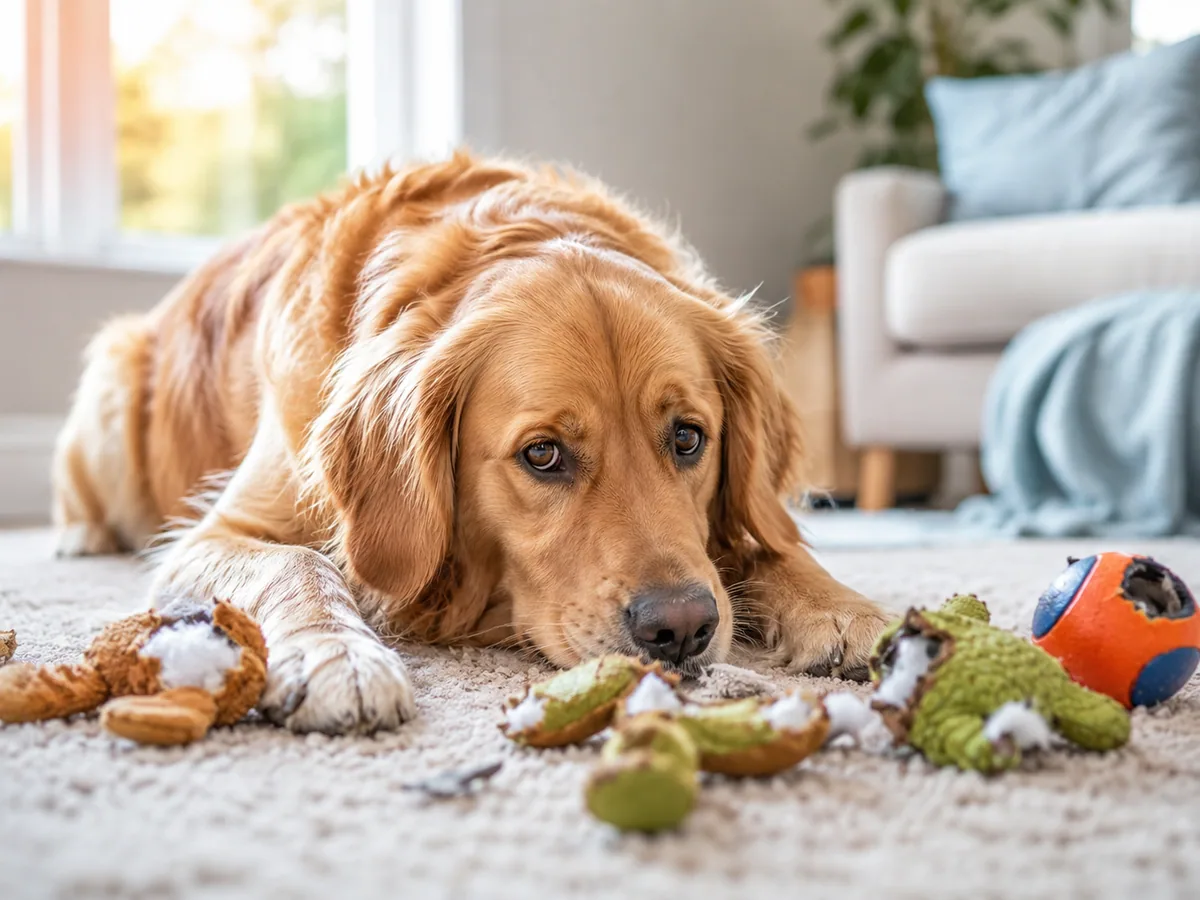
Walk through any pet store and you will find shelves of toys marketed toward separation anxiety and boredom. The majority of them fail the one test that matters: will a genuinely distressed dog engage with this toy independently, without a human present, for more than five minutes?
The Engagement Problem
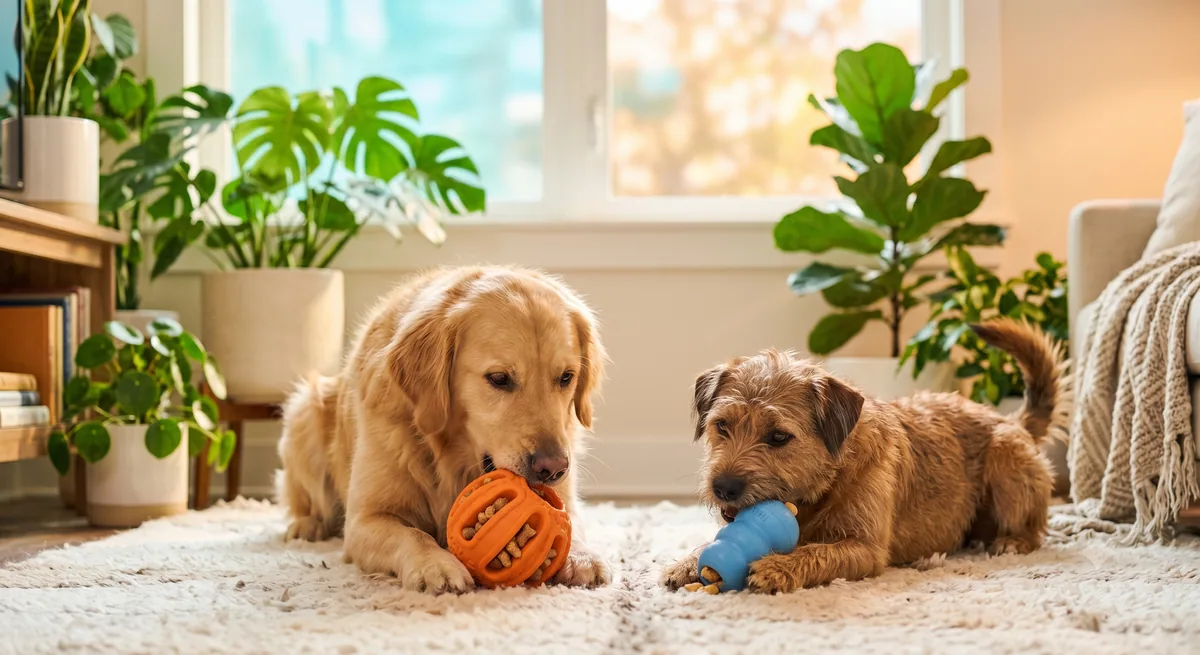
Many toys - squeaky plush, tug ropes, fetch balls, interactive puzzle games - are fundamentally social objects. They are designed to be activated by human interaction. A squeaky toy squeaks because you throw it, your dog chases it, and you react. The feedback loop requires you. Remove you from the equation and the toy is just an inert object sitting on the floor. For a dog with separation anxiety, an inert object holds zero appeal when the only thing in the world their brain is screaming about is your absence.
Honestly, the most important takeaway we share with readers on toys for dogs with separation anxiety is to involve a veterinarian early. We've seen how much smoother outcomes are when concerns are checked promptly.
The Duration Problem
Even toys that do engage a dog independently often do so for only a few minutes. A treat ball that dispenses all its kibble in five minutes provides five minutes of distraction - barely enough time for you to drive to the end of your street. The toys that work for anxious dogs alone need to sustain engagement for at least 20 to 30 minutes, ideally longer. That window covers the critical period after departure when anxiety typically peaks. Research into canine separation anxiety consistently shows that the first 30 to 60 minutes after the owner leaves are the highest-distress period. Outlast that window and many dogs settle into a lower-anxiety state for the remainder of the absence.
The Safety Problem
An unsupervised dog is a dog with no one to intervene if something goes wrong. Toys that are perfectly safe in supervised play - rope toys that can be dropped if fraying is noticed, plush toys that can be confiscated before stuffing is ingested, squeaker toys that can be removed if the squeaker becomes accessible - are not the same toys you should leave with a dog who will be alone for hours. The solo-safe shortlist is genuinely short: durable rubber stuffables, silicone lick mats, bully sticks in a locked holder, and snuffle mats top the list. Everything else requires a human in the room.
If a toy has removable parts, stuffing, squeakers, rope fibers, or anything that can be chewed off and swallowed, it is not a solo-safe toy. For dog anxiety toys to be used alone, simplicity and durability are the only metrics that matter.
10 Best Toys for Dogs With Separation Anxiety
Every toy on this list meets the three core criteria: it works without human involvement, it sustains engagement for an extended duration, and it is genuinely safe to leave with an unsupervised dog. These are not ranked by excitement or impressiveness - they are ranked by real-world effectiveness with anxious dogs left alone.
1. KONG Classic Stuffed and Frozen - Best Overall
The frozen stuffed KONG is the gold standard for separation anxiety management and the single most recommended tool by veterinary behaviorists and certified separation anxiety trainers worldwide. The concept is simple: stuff a KONG Classic with a mixture of kibble and peanut butter (or plain yogurt, canned pumpkin, banana, or cream cheese), pack it tightly, and freeze it solid overnight. The frozen filling takes far longer to extract than a room-temperature KONG, producing 30 to 45 minutes of sustained licking and chewing. This is not trivial - licking activates the parasympathetic nervous system, slowing heart rate and triggering a physiological calm response. A dog working on a frozen KONG is, at a biological level, moving toward a calmer state even if anxiety initially prevents them from noticing the toy. Choose the correct size for your dog's weight and opt for the black KONG Extreme if your dog is a powerful chewer. Batch-prepare five KONGs at a time and keep them in the freezer - you should always have one ready at departure time.
2. LickiMat Mounted on a Wall - Best Lick Toy
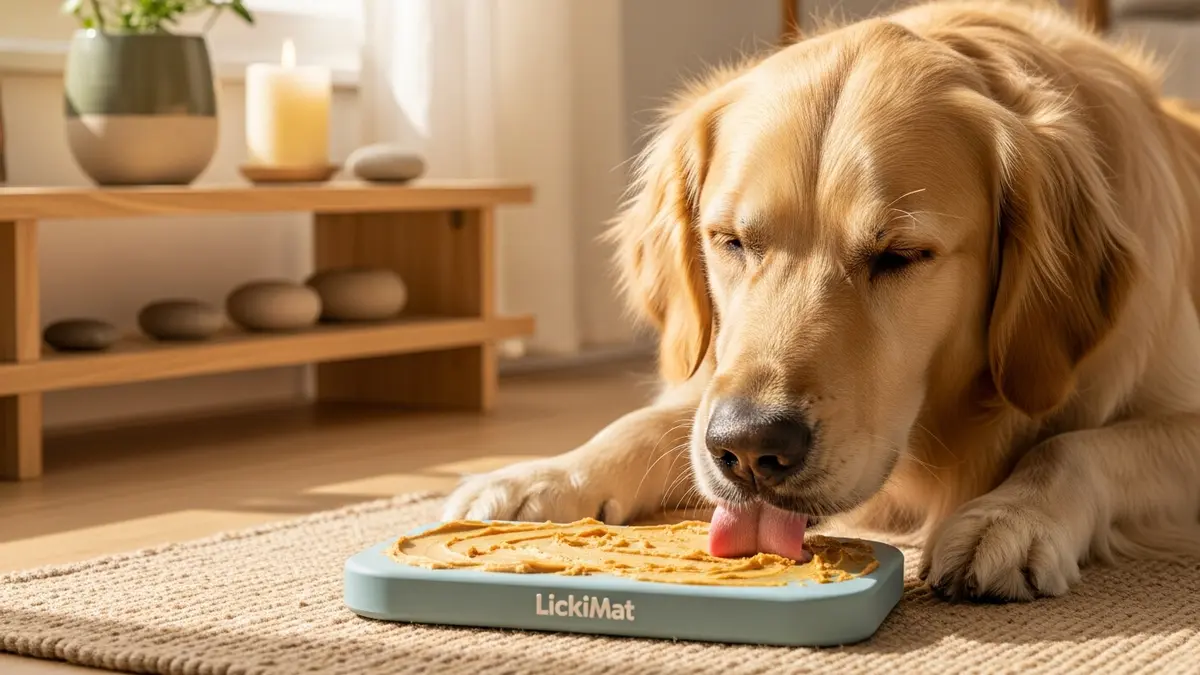
A LickiMat is a textured silicone mat designed to hold spreadable foods - peanut butter, wet food, plain yogurt, squash puree - in a pattern that requires sustained licking to access. When mounted to a wall at your dog's nose height using the suction cups or a purpose-made bracket, a LickiMat becomes a genuinely solo-safe enrichment tool. The key to using it safely alone is mounting: a flat LickiMat on the floor can be picked up, carried, and chewed - and if chewed, silicone fragments can be ingested. Fixed to a wall, it cannot be moved and can only be interacted with by licking. Spread it with a frozen filling (freeze the mat after spreading) for 20 to 30 minutes of engagement. The wall-mount setup also means your dog is standing in a natural, calm posture while licking - nose forward, body relaxed - rather than hunched over a floor toy in a position that can amplify anxiety. Explore our collection of calming toys for dogs for more licking and chewing options.
Anxious pets may also benefit from the products in our dog anxiety toys guide.
3. West Paw Toppl Stuffed and Frozen - Best Kong Alternative
The West Paw Toppl serves exactly the same function as a frozen KONG but with a wider opening that makes it easier to stuff with larger kibble, chunks of food, or bulkier fillings. The Zogoflex material is non-toxic, durable, and dishwasher-safe. Dogs that find the narrow KONG opening frustrating tend to engage more readily with the Toppl. Two Toppl units can be connected together (Small inside Large) to create an even longer-lasting puzzle that holds more filling - an excellent option for longer absences. As with the KONG, freeze it solid before use. The Toppl is available in two sizes; choose based on your dog's weight. Because it has no moving parts, no squeaker, and no separate components that can be chewed off, the Toppl earns full marks for solo safety.
4. Snuffle Mat - Best Pre-Departure Setup
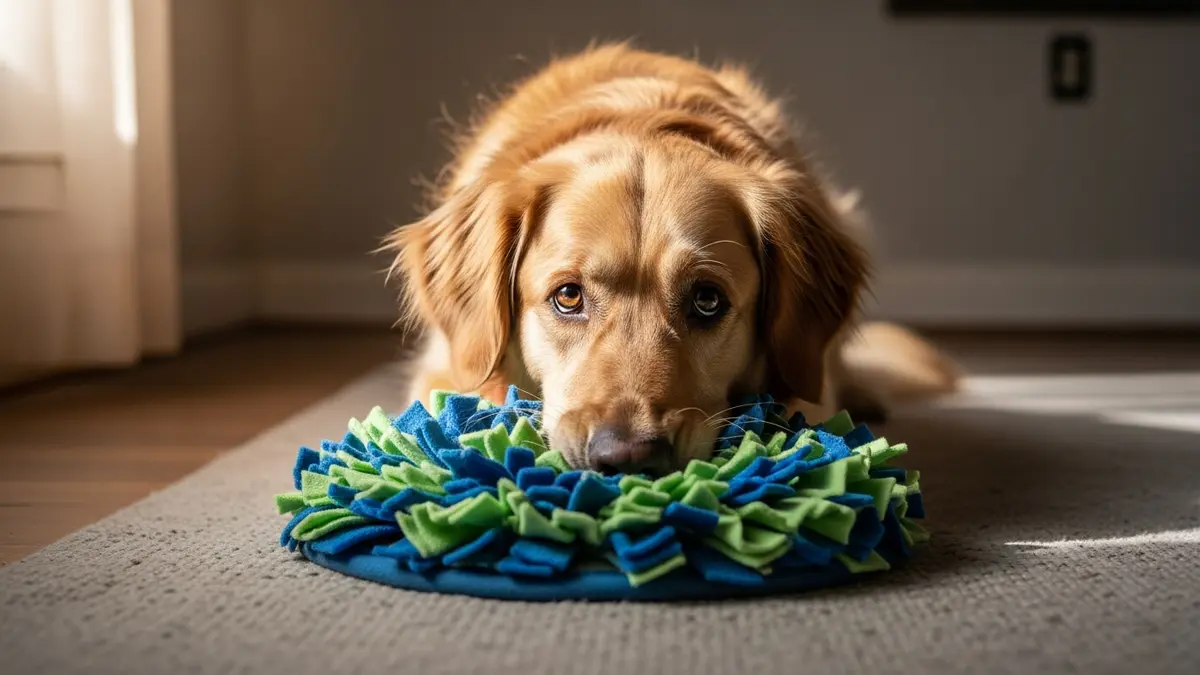
A snuffle mat is a fabric mat with dense strips, pockets, and folds that hide kibble or small treats within the material, requiring your dog to use their nose to locate and extract each piece. The foraging behavior this triggers is one of the most reliably calming activities available to dogs - the cognitive and olfactory engagement of active sniffing produces a focused, absorbed state that competes directly with anxious rumination. Set up the snuffle mat five minutes before you leave, scatter a portion of your dog's daily kibble allowance within it, and place it in your dog's designated safe space. The mat should not contain any loose parts small enough to be swallowed and should be made from tightly woven, non-fraying fleece. A quality snuffle mat will occupy most dogs for 10 to 20 minutes. For mild to moderate separation anxiety, this 10 to 20 minutes of absorption immediately following departure is the most important window to cover.
5. Automatic Ball Launcher - Best Self-Directed Active Toy
An automatic ball launcher - a motorised unit that your dog loads a ball into and which then launches it across the room - is one of the few genuinely self-directed active toys available. Once a dog learns to retrieve the ball and return it to the launcher, they can initiate and sustain play sessions entirely independently. This option works best for dogs with mild to moderate separation anxiety who retain enough engagement capacity to play when alone. Dogs with severe anxiety will not use it. Key features to look for: adjustable launch distance (to suit your indoor space), a timed auto-off function (to prevent overexertion), and a ball size that suits your dog's mouth. Use foam or lightweight balls rather than hard rubber to reduce noise and avoid damage. Introduce the launcher thoroughly while you are home before relying on it as a solo tool.
6. Bully Stick in a Locking Holder - Best Long Chew
A bully stick (also called a pizzle stick) is a single-ingredient natural chew that most dogs find irresistible, and sustained chewing - like licking - is physiologically calming. The critical detail for solo safety is the holder: a bully stick left loose becomes a choking hazard when it is chewed down to a short nub that can be swallowed whole. A locking bully stick holder secures the stick so that only a controlled length is exposed, preventing the dog from accessing the end piece. Quality holders grip the stick firmly and cannot be disassembled by the dog. A 6-inch bully stick in a good holder typically lasts 20 to 45 minutes depending on the dog's size and chewing intensity. Reserve bully sticks exclusively for when you leave - their high value as a departure-only treat strengthens the positive association with your absence over time.
7. Slow Feeder Bowl - Best Mealtime Alone
If your dog eats one of their daily meals while you are away, that meal is an untapped enrichment opportunity. Switching from a flat bowl to a slow feeder - a bowl with raised ridges, mazes, or channels that force the dog to work their tongue and snout around obstacles to reach food - converts a 60-second bolt of kibble into a 10 to 15 minute foraging session. The mental engagement involved in navigating the feeder also reduces post-meal restlessness. For anxious dogs, mealtime in a slow feeder can anchor the mid-absence period with a predictable, absorbing activity that is entirely self-contained. Choose a food-grade, non-toxic slow feeder with a non-slip base, and select a maze complexity that challenges your dog without frustrating them into abandoning the bowl. Adjust the difficulty level upward as they become skilled at the current pattern.
8. Level 1 Puzzle Feeder - Best Cognitive Toy (Mild Anxiety Only)
A basic Level 1 puzzle feeder - one with simple sliding covers or single-action compartments - can work for dogs with mild separation anxiety whose stress level does not completely override food motivation. The key word is Level 1: a dog that is already stressed does not have the cognitive bandwidth to work a complex puzzle. A Level 2 or Level 3 puzzle will frustrate them, not engage them, and an anxious frustrated dog is worse off than an anxious bored dog. A Level 1 puzzle with obvious, single-motion food access points acts more like a slow feeder than a true cognitive challenge - and that is exactly right for this application. Load it with high-value small treats (not just kibble) to maximise the motivation to engage despite the mild stress. If your dog ignores the puzzle entirely once you leave, step down to a snuffle mat or frozen KONG - those have lower entry thresholds for distressed dogs.
9. Heartbeat Plush Toy - Best Comfort Object
A heartbeat plush toy - a stuffed animal with a battery-powered heartbeat unit inside - is not an engagement toy. It does not entertain or occupy your dog the way a frozen KONG does. Its role is entirely different: it provides a soft, warm, rhythmically pulsing object that mimics the physical comfort of a sleeping companion. For dogs whose separation anxiety includes a strong social comfort deficit - dogs that were previously used to sleeping against a human or another pet - a heartbeat plush placed in their bed or crate can reduce the acute sense of physical isolation. Use it as a complement to the engagement toys on this list, not as a replacement. Many heartbeat plush toys include a reusable heat pack for warmth; this warmth element is particularly effective for small dogs, senior dogs, or puppies. Choose a version with a sealed, dog-safe casing on the heartbeat unit and no removable embellishments.
10. Dog TV / Calming YouTube Music - Best Tech Add-On
Leaving a television on or playing purpose-made calming music through a speaker while you are away does not function as a toy, but it is a meaningful environmental modification that complements the rest of this list. An empty, silent house amplifies every ambient sound - a car door, a neighbor's dog, a distant alarm - turning each one into a potential triggering event. Consistent, low-level audio background masks these sounds and reduces the frequency of startle responses that spike anxiety. Dedicated streaming services offer content specifically designed for dogs, featuring calming wildlife visuals at dog-visible flicker rates. Free alternatives abound on YouTube: channels with hours of calming classical music, nature sounds, or purpose-made dog relaxation content work well. Set the volume low enough that it is ambient rather than stimulating. Pair with a frozen KONG or LickiMat for the first 30 minutes of absence and you have covered the two highest-impact intervention windows.
The Departure Ritual That Actually Helps
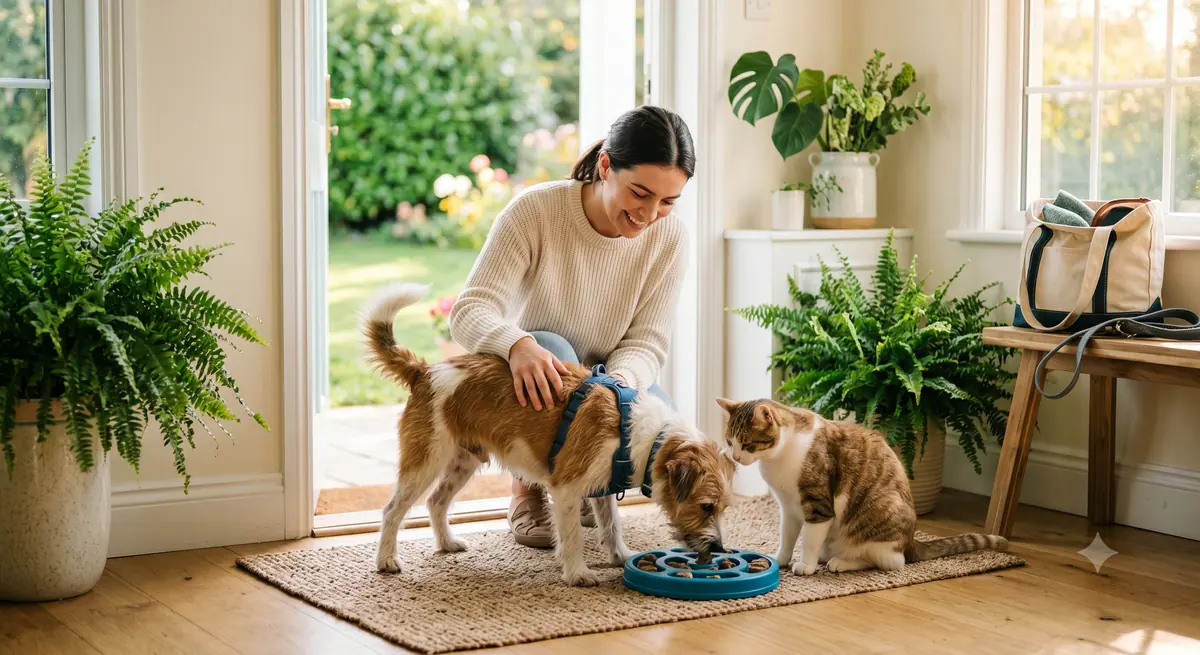
The toys you choose matter, but so does how you deploy them. The departure ritual - the five to ten minutes before you leave - has an outsized effect on how your dog experiences the next several hours. Done well, it primes your dog for successful engagement with their solo toys and lowers the peak anxiety spike. Done poorly, it teaches your dog to read every small cue as a countdown to distress.
The KONG-Only-When-Leaving Rule
The frozen KONG (and any other high-value departure toy) must be reserved exclusively for when you leave. Never give your dog a frozen KONG when you are staying home. If they get a KONG randomly throughout the day, it loses its power as a departure signal and motivator - and, critically, it loses its ability to create a positive association with your absence. Over time, the KONG given only at departure becomes a conditioned predictor of a positive event ("owner leaves = I get the amazing frozen thing"), which directly competes with the anxiety response. This counterconditioning effect is subtle but cumulative and is one of the most effective non-pharmaceutical tools available for mild to moderate separation anxiety. For additional guidance, see the VCA Hospitals separation anxiety guidance.
For more calming solutions, see our detailed calming toys for cats review.
Ignore Your Dog 10 Minutes Before Leaving
The goodbye ritual is one of the most damaging things well-meaning owners do. Long, emotional goodbyes - sustained eye contact, baby talk, extended petting, apologizing to your dog - prime the anxiety response before you have even left. Your dog reads every element of the goodbye as a signal that something significant and distressing is about to happen. The calmer and more matter-of-fact your departure, the lower the anxiety spike that follows it. In the 10 minutes before you leave, disengage from your dog completely: no petting, no eye contact, no talking to them. Place the KONG or other departure toy in their space, pick up your keys and bag without ceremony, and leave without looking back. This is genuinely harder for the owner than for the dog - but the data consistently shows it produces better outcomes.
Calm Energy Communicates Safety
Dogs are extraordinarily sensitive to human emotional states. Your anxiety about leaving an anxious dog communicates to them that leaving is, in fact, an event worth being anxious about. Projecting calm, neutral, matter-of-fact energy during the departure routine - including the minutes before you leave - communicates that this is an ordinary, unremarkable event. Pair this with the pre-set toys, the background audio, and the departure KONG, and you have built a departure environment that gives your dog the best possible chance of settling.
Set up snuffle mat and background audio before you get ready. Place frozen KONG in dog's space. Ignore dog for 10 minutes before leaving. Leave calmly without looking back. Repeat the same sequence every single day - predictability reduces anticipatory anxiety dramatically.
Toy Safety When Dogs Are Left Alone
The unsupervised toy shortlist is genuinely short. When no human is present to observe, intervene, or remove a hazard, every toy must meet a higher safety standard than it would during supervised play. The following categories are never appropriate for solo use.
Rope Toys
Rope toys are interactive play toys, not solo enrichment tools. A dog left alone with a rope toy will chew it, and chewing rope produces loose fibers. Ingested rope fibers are a linear foreign body - they can cause life-threatening intestinal obstruction requiring emergency surgery. Even a small amount of ingested rope can anchor in the intestine and create a plication injury as subsequent rope bunches against the anchor point. Rope toys should be used only for supervised tug sessions and removed immediately after play ends. No exceptions.
Plush Toys With Squeakers
Plush toys with internal squeakers are supervised-only items. An unsupervised dog that removes the squeaker - which most dogs can do within minutes - can inhale or swallow it. Squeakers are sized precisely to lodge in an airway or intestine. Beyond the squeaker, the stuffing inside most plush toys is also an ingestion risk if the toy is gutted. Heartbeat plush toys (listed above as appropriate for solo use) are a specific exception: they are designed with sealed, non-removable components and without loose stuffing. Standard plush toys are not this category.
Anything With Removable Parts
Puzzle toys with sliding pieces, treat balls with adjustable openings, toys with attached squeakers, and any toy where a component can be separated from the main body should not be left with a dog alone. Even toys marketed as "indestructible" warrant scrutiny - no toy is indestructible for every dog, and a determined, anxious dog working on a toy for hours in your absence will stress-test it far beyond what a supervised play session would.
Rope toys, plush toys with squeakers, stuffed toys with loose filling, puzzle toys with removable pieces, and any toy with small detachable parts are not safe for unsupervised use. When in doubt, leave only frozen rubber stuffables (KONG, Toppl), mounted silicone lick mats, snuffle mats, or bully sticks in a locking holder.
Rawhide and Low-Quality Chews
Rawhide chews are a particular hazard when unsupervised. Dogs that chew rawhide aggressively can tear off large chunks that swell in the stomach or create blockages. Even rawhide marketed as "digestible" presents a meaningful choking risk when no one is watching. Stick to bully sticks in locking holders (which control the accessible length) or purpose-made safer chew alternatives from reputable brands with documented safety profiles. Always check that any chew you leave alone is appropriately sized for your dog - a chew that is too small for the breed can be swallowed whole.
Comparison: Budget vs Mid-Range vs Premium
This quick comparison helps you understand what you actually get at each price band, so you can decide where to spend and where to save without compromising safety.
Comparison reflects typical US retail ranges as of 2026. Always verify safety labels before purchase.
Conclusion
Choosing the right approach for your dog comes down to matching the recommendations in this guide with the specifics of your situation. Pay close attention to age, breed, activity level, and any existing health concerns. When in doubt, talk to your veterinarian before making changes.
Use this guide as a starting point, observe your dog closely after any change, and update your routine as your dog's needs evolve. Small adjustments over time lead to the biggest improvements in well-being and behavior.
Frequently Asked Questions
Should I consult a veterinarian about my pet's play and enrichment needs?
Yes, especially if your pet shows signs of anxiety, sudden behavior changes, or destructive habits that may indicate a medical issue. A licensed veterinarian or veterinary behaviorist can rule out pain, dental problems, or cognitive decline before you adjust toys or routines. The guidance in this article is educational, not a substitute for professional veterinary advice.
How long does it take to see results from new toys or enrichment?
Most pet owners notice small changes within a week (calmer evenings, less destructive chewing, more interest in mealtime puzzles) and clearer behavior shifts within 4 to 6 weeks of consistent rotation. Older pets and rescues may take 8 to 12 weeks to adjust. Keep a short weekly journal so you can track real progress instead of relying on memory.