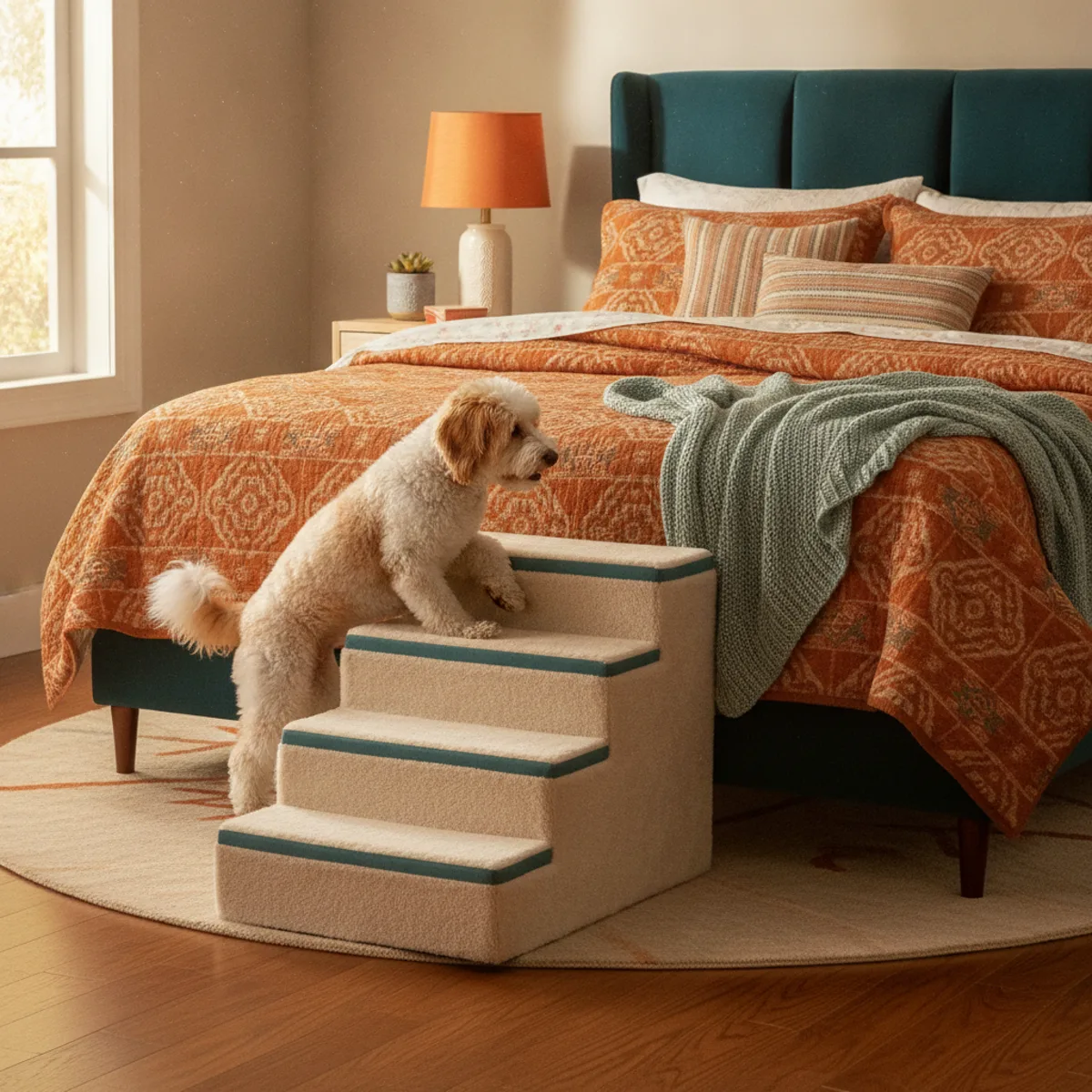
Many puppies want to follow their family onto the bed, but a human bed is a surprisingly tall landing spot for a young dog. A puppy may be brave enough to jump up and still lack the balance, coordination, or body control needed to land safely. Jumping down can be harder because a puppy has to judge distance while looking over the edge. Puppy stairs for bed offer a simple alternative: a series of stable steps that lets a young dog move between the floor and the mattress at a slower pace.
The best puppy stairs for bed are not a shortcut to unsupervised furniture access. They are a training aid and a household setup. The stairs need to match the puppy's size, the bed's height, the available floor space, and the way your family uses the room. A tiny toy breed, a long-backed puppy, and a growing medium-sized dog will not have the same needs. Before buying, decide whether bed access is part of your routine and whether your puppy can use the stairs calmly.
This guide focuses on practical selection and training. It does not replace veterinary advice. A puppy that limps, cries during movement, avoids a step, or suddenly loses confidence should be checked by a veterinarian rather than pushed through a training session.
Why puppy stairs for bed can help
Puppy stairs for bed can reduce the need for repeated leaps. A puppy that jumps from a mattress may land on a slippery floor, twist while turning, or collide with furniture. Stairs give the puppy a visual path and a lower step height. They also make it easier for a pet parent to guide the puppy with a treat, a calm hand signal, and a consistent cue.
Stairs can be useful for small puppies whose legs cannot reach the floor comfortably, for short-legged breeds, and for puppies that are still learning where their paws are in space. They may also help a puppy that is allowed on a low bed but is not ready to jump. The goal is controlled movement, not maximum independence. During the first weeks, a puppy should still be supervised whenever it uses puppy stairs for bed.
Bed stairs also protect a routine. If the puppy is always lifted up but allowed to jump down, it learns that jumping is part of the route. If the stairs stay in one position and are rewarded every time, the puppy learns a repeatable pattern. That pattern becomes more valuable as the puppy grows, because a larger dog can create more impact when it lands.
When a puppy is ready to use bed stairs
Readiness is about behavior and movement, not only age. A puppy is more ready when it can walk steadily on a flat floor, place each paw deliberately, follow a simple lure, and recover from a small surprise without bolting. The puppy should be able to pause, sniff, and turn around without scrambling. If a puppy is extremely young, sleepy, ill, or overtired, use a floor-level resting place instead of beginning a stairs lesson.
Start with the puppy's normal movement. Watch the puppy walk, turn, and climb one or two ordinary household steps while supervised. Do not use a tall flight as a test. A puppy that slips on regular steps, rushes with its front legs, or refuses a low step needs a simpler setup. The puppy should never be dragged, carried to the top, or pushed from behind.
Consider the puppy's proportions. Long-backed puppies may need deeper treads and a lower rise. Small puppies may need a narrow enough design to feel secure, but the steps must still be wide enough for all four paws. A growing puppy may outgrow a small stair set quickly, so check the weight rating and the usable tread dimensions, not just the product's decorative size.
How to choose puppy stairs for bed
Stability comes first. Put the stairs on a flat surface and test them with both hands. They should not rock from side to side, slide when pressed, or fold unexpectedly. A heavy base can feel reassuring, but weight alone does not guarantee safety. Look for rubber feet, a broad footprint, and a top landing that does not wobble when a puppy steps onto it.
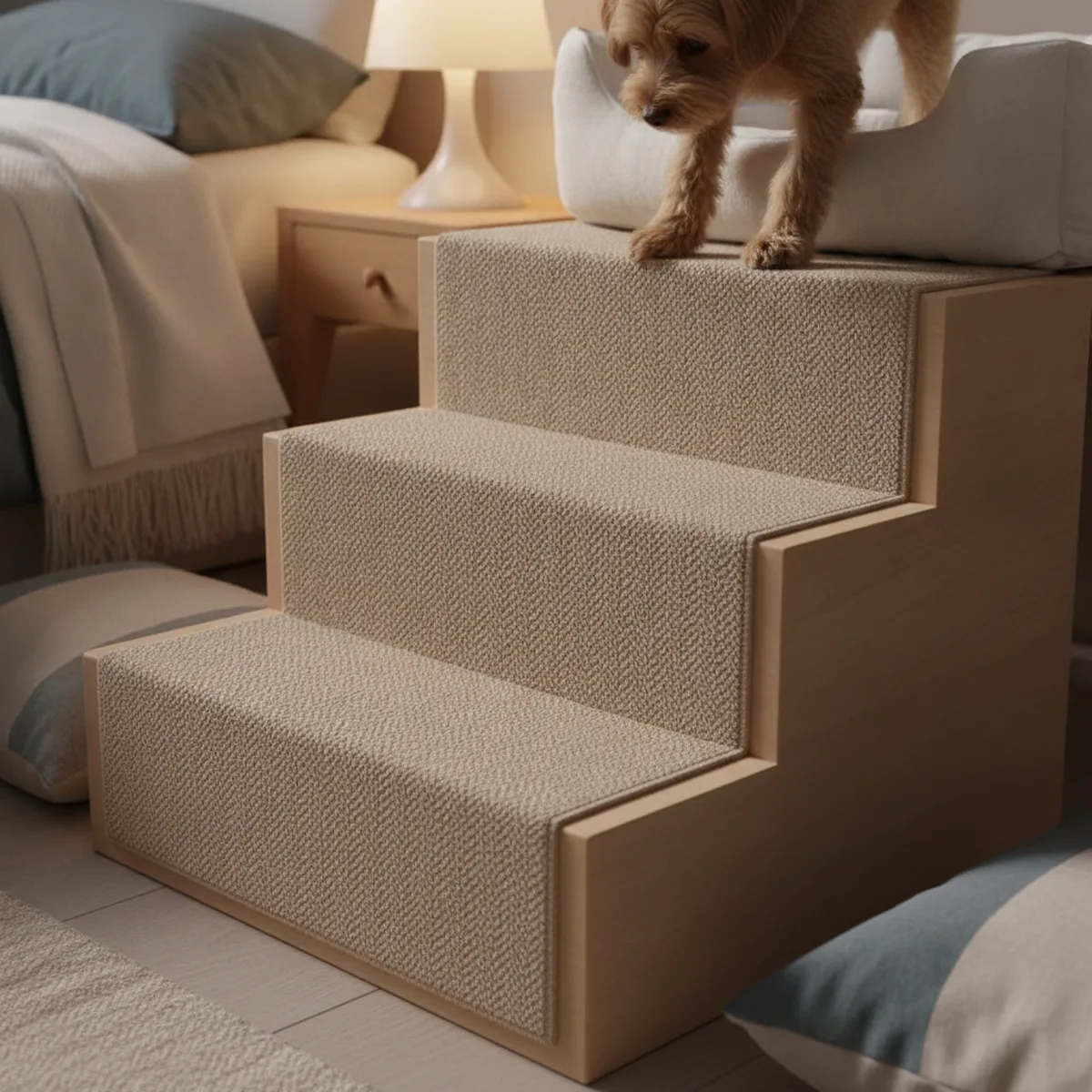
Traction is the next priority. Puppy paws can slide on smooth plastic, polished wood, or loose fabric. Choose treads with a secure carpet, textured cover, or other non-slip surface. Check the edges for loose threads that a puppy could chew. Removable covers are practical, but they must stay tight after washing. If the fabric bunches under a paw, the puppy may avoid the stairs or jump from the side.
Step height and depth work together. Low steps are easier for a puppy than tall steps, but shallow treads can be just as awkward because the puppy has nowhere to place the back paws. Look for enough depth for a full paw placement and enough width for the puppy to walk straight. A side rail can help a cautious puppy, but do not choose a design with gaps where toes or collars could catch.
Choose a design that fits the room. A set of puppy stairs for bed should not block a doorway, drawer, heater, or escape route. A stair set that is moved every night will be less consistent during training. Measure the floor area before ordering. If the room is narrow, a compact stair set may be better than a long ramp, but only if the rise is comfortable and the puppy does not have to hop between steps.
Finally, choose a surface that is easy to inspect. Puppies chew, scratch, and have accidents. Look underneath the cover, check the seams, and confirm that cleaning instructions make sense for your household. Replace or repair the stairs if foam collapses, a frame cracks, a tread separates, or the feet stop gripping the floor.
How to measure the bed and stairs
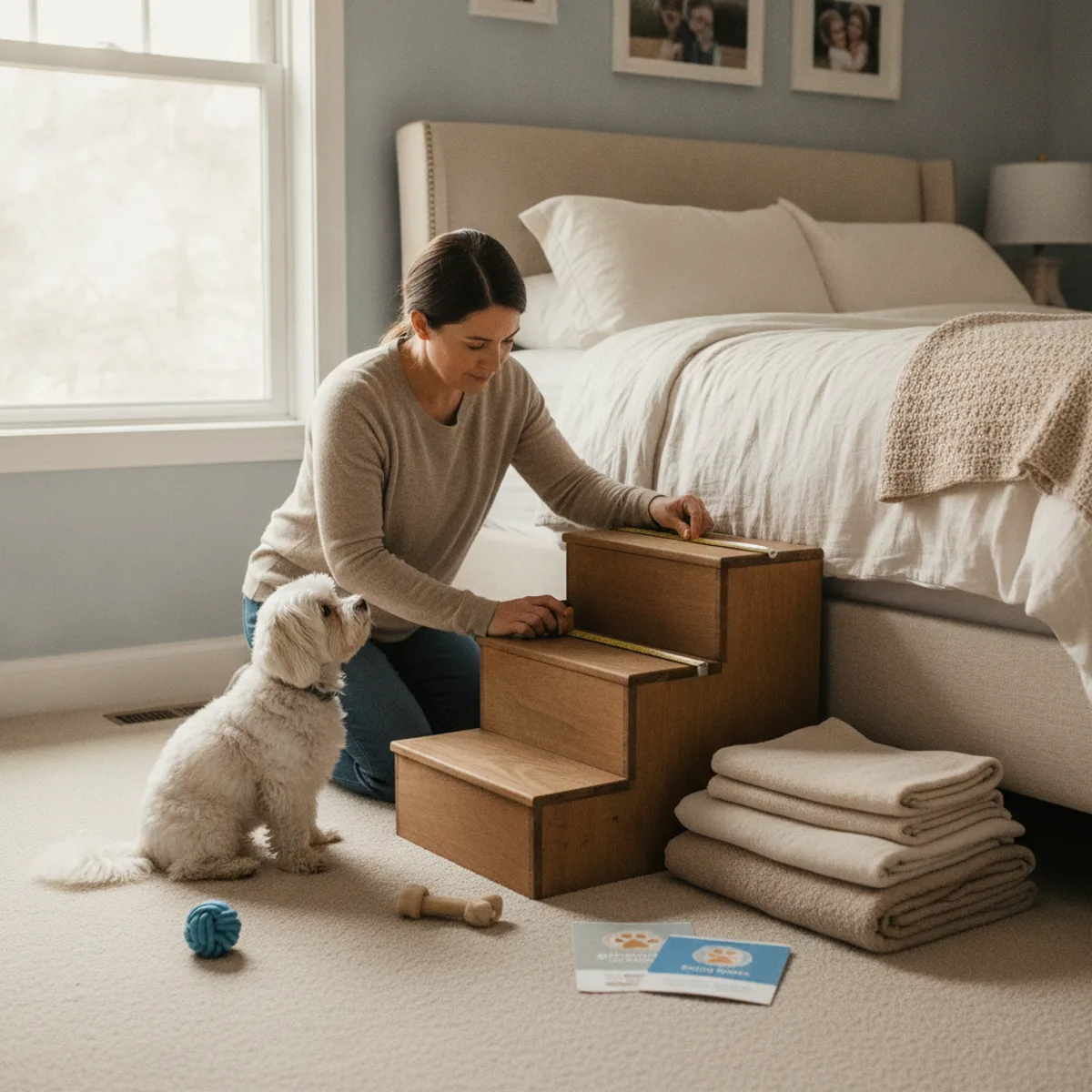
Measure from the floor to the top of the mattress, including a topper or thick blanket if the puppy will land on it. Do not measure only to the bed frame. The top step should finish close to the landing surface. A large final gap defeats the purpose of puppy stairs for bed because the puppy still has to jump at the end.
Mark the stair footprint on the floor with painter's tape. Walk around it at night, open nearby drawers, and check that the puppy can approach in a straight line. Place the top of the stairs against the bed so it cannot drift away. If the bed frame is slippery, use a design with a secure top connection or a non-slip mat that does not create a trip hazard for people.
Check the step rise against the puppy's leg length. A puppy should be able to lift one paw without stretching or launching its body forward. If the first step is high, add a lower training step only if it is stable and designed for that purpose. Never improvise a stack of books, loose boxes, or cushions. Temporary objects can slide and teach the puppy that stairs are unpredictable.
How to train a puppy to use stairs
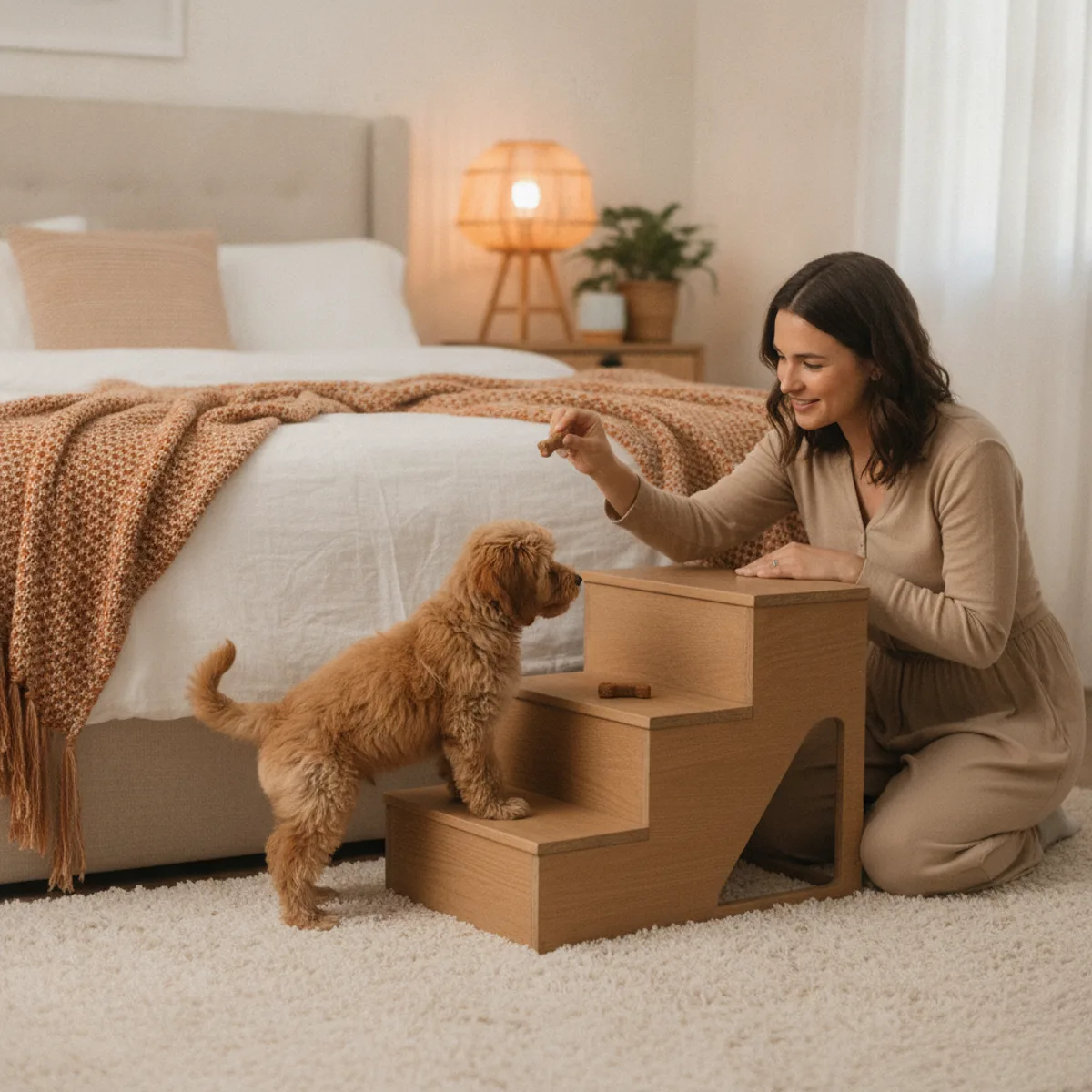
Begin on the floor with the stairs in their final position. Let the puppy sniff them without asking for a climb. Reward a calm glance, a nose touch, or one paw on the first step. Use tiny treats so the puppy stays focused. Keep the first session to a few minutes and stop while the puppy is still interested.
Next, place a treat on the first step and wait. When the puppy places a paw on it, praise softly. Put a second treat on the next step only after the first step feels easy. Move slowly enough that the puppy can look at the surface, find its balance, and choose the next paw placement. Puppy stairs for bed should be learned as a walking path, not as an exciting obstacle course.
Teach going down separately. Many puppies climb toward a person confidently and then rush when descending. Stand beside the stairs, keep the puppy's path straight, and reward each controlled step. Block side exits with your body during early lessons so the puppy cannot launch from halfway up. If the puppy jumps, do not scold. Reset the exercise at an easier step and reward a slower attempt.
Use a consistent cue such as "stairs" or "slow." Keep the same cue for going up and down. Practice after a calm walk rather than during a burst of zoomies. A puppy that is hungry, overexcited, or tired may make poor choices. Three calm repetitions are more useful than twenty rushed repetitions.
Once the puppy can use the stairs with you beside it, add small distractions one at a time. Keep a blanket on the bed, turn on a soft lamp, or have one quiet person sit nearby. Do not introduce children, toys, and other pets all at once. Make the route predictable. If the puppy stops using the stairs, check for a changed surface, a loose tread, a new noise, or a painful movement before offering more treats.
Puppy stair safety checks
Inspect the stairs before every early session. Confirm that the base is flat, the feet grip, the top is close to the mattress, and no cover has shifted. Keep the landing clear of pillows and loose blankets that can slide. The floor below should not be wet or cluttered. Good lighting helps a puppy see edges, especially during evening training.
Supervise bed access until the puppy has demonstrated a calm, repeatable route over many sessions. Even then, consider a gate or closed bedroom when nobody can watch. A puppy may chew a stair corner, race another pet, or use the side as a launching point. Supervision is especially important when the puppy is teething or when the stairs are a new object in the room.
Do not use puppy stairs for bed as a reason to encourage repeated jumping games. A puppy still needs age-appropriate play on safe surfaces, regular rest, and a quiet place at floor level. If the puppy has a history of slipping, weakness, pain, or a diagnosed orthopedic problem, ask your veterinarian whether stairs, a ramp, or no furniture access is the safest choice.
For additional safety context, the American Kennel Club guidance on puppy jumping recommends limiting risky jumping in everyday activities, including jumping on beds. The VCA Animal Hospitals mobility guidance also explains that stairs or ramps can help dogs move onto furniture when a veterinarian says that access is appropriate.
When a floor bed or ramp is better
Some puppies do not need bed access at all. A supportive floor bed beside your bed can keep a young dog close while avoiding a tall climb. This can be a good choice during house training, after a move, or while the puppy is learning to settle. You can compare sleep options in our guide to the best dog beds and use a familiar blanket to make the new spot inviting.
A ramp may be better for a puppy that struggles with step patterns, has a longer body, or shows discomfort when flexing its joints. A ramp needs enough length to avoid a steep slope and must have strong traction. It also takes more floor space than puppy stairs for bed. If you are comparing both options, our broader dog stairs for bed guide explains how stairs and ramps differ for individual dogs.
The right decision is the one that makes the puppy move slowly and confidently. If a young dog keeps rushing, slipping, twisting, or jumping from the side, stop the session and change the setup. Equipment cannot replace a safe environment or professional advice when a movement problem appears.
More dog care resources
Once your puppy has a safe route to the bed, these related guides can help you build a calmer home routine. Compare best dog beds with the height and support your puppy needs, then review the dog stairs for bed guide if you are comparing step styles. For play and enrichment, see teething toys for puppies, puppy teething toy ideas, and the guide to whether plush toys are safe for dogs.
If your puppy chews heavily, use the checks in safe dog toys and best chew toys for dogs. For mental exercise, explore interactive dog toys and toys for dogs home alone. Finally, best dog toys gives you a broader starting point for choosing age-appropriate play items.
FAQ about puppy stairs for bed
Are puppy stairs for bed safe?
Puppy stairs for bed can be safe when they are stable, correctly sized, non-slip, and used with supervision. The puppy should learn one controlled step at a time, and a veterinarian should assess any puppy that shows pain, weakness, or persistent reluctance.
What age can a puppy use stairs to reach a bed?
There is no single age that fits every puppy. Readiness depends on balance, coordination, body size, confidence, and the stair design. Begin only when the puppy can walk steadily and follow a calm lure, and use a floor bed if the puppy is too young or tired.
Should puppies use stairs or a ramp?
Stairs may suit a small, coordinated puppy when each step is low and stable. A ramp may be gentler for a long-backed puppy or one that struggles with repeated steps, but it needs enough length and traction. Ask a veterinarian when pain or a medical condition is involved.
How do I stop my puppy from jumping off the bed?
Provide one clear route, train the puppy to use it with small rewards, block side exits during early practice, and keep the stairs in the same place. If the puppy still jumps, reassess the height, traction, stability, lighting, and whether a floor bed is more appropriate.
Can a puppy sleep on a floor bed instead?
Yes. A comfortable floor bed beside your bed is often the simplest option while a puppy is young, during house training, or when furniture access is not part of the household routine. It gives the puppy a nearby rest space without a climb.