Yes, plush toys are safe for most dogs, but only under four conditions: the toy is too big to fit entirely in your dog's mouth, nothing on it can be chewed off, you supervise dogs that hunt for the squeaker, and you throw the toy away as soon as stuffing shows. A plush toy becomes unsafe the moment its insides become edible, so the real question is not "is plush safe" but "is this dog likely to open this toy".
How this guide was built: we did not lab-test plush toys. Each safety rule below links to the veterinary or animal welfare source it came from (VCA Animal Hospitals, the American Kennel Club, the ASPCA and Humane World for Animals, formerly the Humane Society of the United States). Where a point is our own practical advice, we say so.
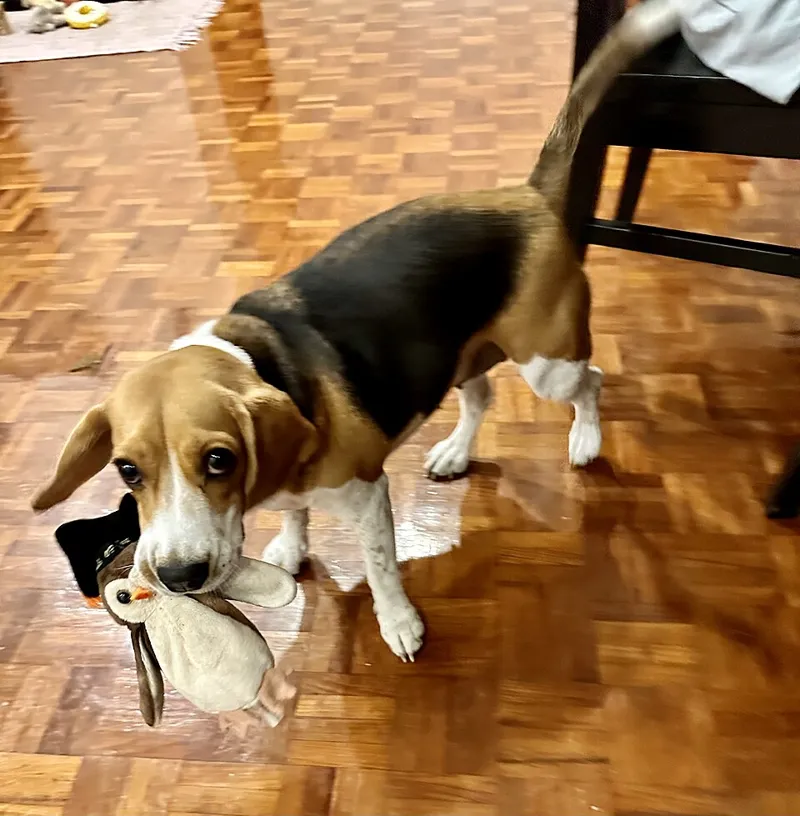
Short Answer: Yes, If These Four Conditions Hold
Safe to give when all four are true:
- Right size. VCA's chew toy guide says a toy should never be small enough to fit entirely in your dog's mouth, because that makes it a choking danger.
- No detachable parts. The same VCA guide rules out ribbons, eyes and other removable parts that can be swallowed or inhaled. On plush, that usually means plastic eyes, sewn-on noses, tags and bows.
- Supervision for squeaker hunters. Humane World for Animals warns that a dog may feel it must find and destroy the source of the squeak, and could swallow it if left alone.
- Retired when opened. VCA: if stuffing is showing, it is time to retire the toy.
Not a good fit: a dog that eats fabric or stuffing (rather than just tearing it), and any dog that will be left alone with the toy for hours. For those dogs, a solid rubber toy is the safer default; our rubber dog toys comparison sorts options by chew style.
Safe vs Unsafe Plush Toys: Signs to Check
Use this table in the store or when a gift arrives. Each row pairs something you can see or feel with the reason it matters.
| Check | Safer sign | Warning sign | Why (source) |
|---|---|---|---|
| Size | Clearly bigger than your dog's open mouth | Fits entirely in the mouth, or has small limbs that do | Choking risk (VCA) |
| Face and trim | Embroidered eyes and nose, no bows | Plastic eyes, glued parts, ribbons, bells | Removable parts can be swallowed or inhaled (VCA) |
| Filling | Soft fiber fill, or a stuffing-free design | Beads, pellets, nutshell or crunchy fill you can feel through the fabric | Nutshells and polystyrene beads are problem fillings (Humane World for Animals) |
| Squeaker | Buried deep in the body, not near a seam | You can feel the squeaker right under a single seam | Dogs dig for the squeak and may swallow it (Humane World for Animals) |
| Label | Marked safe for children under 3; maker named | No maker, no fiber content, strong chemical smell | No specific chemical rules exist for pet toys (VCA); under-3 label advice from Humane World for Animals |
| Condition | Seams closed, fabric intact | Any hole, open seam or loose limb | Retire when stuffing shows (VCA) |
| Care | Machine washable | Spot clean only, or has electronics sewn in | Soft toys should be machine washable (Humane World for Animals) |
Which Dogs Do Well With Plush Toys
Plush safety depends more on the dog than on the toy. The Humane World for Animals guide splits soft-toy fans into two groups, and the split is a useful test at home.
Carriers and cuddlers
These dogs pick a toy up, carry it from room to room and lie down with it. The AKC notes that a dog may bond with a special toy and even sleep with it, and suggests soft fleece or plush toys for dogs that like to cuddle and carry. For this group, Humane World for Animals suggests a toy small enough to carry comfortably, while still too big to swallow.
Shakers and "killers"
Some dogs grab a plush toy by the neck and shake it hard. That is normal prey play, but it puts stress on seams. Humane World for Animals recommends a toy large enough to prevent accidental swallowing and sturdy enough to withstand the attack. In our experience this is the group that opens toys within days, so check seams after every session.
Dissectors
If your dog's goal is to open the toy and pull out the stuffing, plush can still be a supervised game, but never an alone-time toy. The Humane World for Animals guidance is direct: if your dog likes to destroy soft toys, do not let it have them unsupervised. Our squeaky toy safety guide covers how to trade a dissector over to sturdier squeakers.
Stuffing and Squeakers: The Real Risks
The fabric shell of a plush toy is rarely the problem. The risk sits inside it.
- Stuffing does not digest. Humane World for Animals points out that even "safe" stuffings are not truly digestible. A few strands usually cause no trouble, but a dog that swallows a mouthful of fiberfill is swallowing a wad of material its gut cannot break down.
- Some fillings are worse than others. The same guide names nutshells and polystyrene beads as problem fillings. Bead-filled "heat pack" or weighted plush is designed for people or for supervised use, not for chewing.
- Squeakers are small, hard and swallowable. A squeaker is often the only rigid object in the toy. Because some dogs work specifically to find it, Humane World for Animals advises supervising play with squeaky toys.
- Swallowed toy pieces can need surgery. VCA warns that swallowed chunks of toys can get lodged in the stomach and require surgical removal.
A practical habit we recommend: squeeze the toy before each play session. If you can feel the squeaker sitting right under a seam, or the stuffing has shifted into one lump, the toy is close to opening.
Labels and Materials Worth Reading
There is no pet-toy equivalent of a children's toy safety standard to rely on. VCA Animal Hospitals notes that there are no specific rules about which chemicals can be used in pet toys, and that some cheap toys are colored with paint or ink that may contain toxic levels of lead. For plush, that means:
- Prefer a toy whose maker is named and whose fiber content is listed.
- Look for the children's label: Humane World for Animals suggests checking that stuffed toys are labeled safe for children under 3 years old and do not contain dangerous fillings. That label is about choking-size parts, which matters for dogs too.
- Skip painted or printed details on parts your dog is likely to mouth, such as the face.
For a wider look at claims like "non-toxic" and "BPA-free", see our non-toxic dog toys guide.
Plush Toys for Puppies
Puppies are the one group where plush has a special job. The AKC's puppy toy guide describes plush comfort toys that mimic a mother's heartbeat or warm up to help a new puppy settle, and it also advises against leaving comfort toys with your dog for extended periods unsupervised. The same guide steers teething puppies toward nylon or hard rubber, because those materials are less likely to break apart.
Heartbeat and warming toys add a second consideration: an insert. If the insert is removable, take it out before free play and put it back only for rest time. Battery-powered pet products are not risk-free; in August 2025 the U.S. Consumer Product Safety Commission announced a recall of Pet Zone light-up pet toys because a ball could break and expose button cell batteries. Our plush toys for puppies page lists puppy-sized options.
Washing and Retiring Plush Toys
Soft toys hold saliva, dirt and food. Humane World for Animals recommends choosing soft toys that are machine washable, and the RSPCA's dog care guidance suggests cleaning plush and rope toys on a hot cycle and letting them air dry. Washing is also a free inspection: seams that were fine dry often gape once the fabric is wet.
Retire the toy when: any seam opens, stuffing is visible, a limb or ear hangs by threads, or the squeaker can be pushed out through a hole. VCA's "out with the old" rule applies to plush exactly as it does to rope and rubber.
If Your Dog Swallows Stuffing or a Squeaker
- Take away the rest of the toy and collect the pieces so you can estimate what is missing.
- Call your veterinarian and describe what was swallowed and roughly how much. Do not try to make your dog vomit unless the vet tells you to.
- Watch for vomiting, not eating, lethargy or a painful belly, the same warning signs the ASPCA lists for pets that swallow indigestible Easter basket grass in its holiday safety tips.
If the toy was a seasonal plush, such as an Easter bunny, the same rules apply. Our pet Easter toys guide covers the extra holiday hazards that tend to sit next to those toys in a basket.
Plush Toy Safety: Frequently Asked Questions
Are plush toys safe for dogs?
Yes for most dogs, as long as the toy is too big to fit entirely in the mouth, has no ribbons, eyes or other parts that can be chewed off, is used under supervision if your dog likes to dig out the squeaker, and is thrown away once stuffing starts to show. These conditions come from VCA Animal Hospitals and the Humane World for Animals toy guide.
Is it OK for my dog to rip up plush toys?
Shredding itself is normal play, but eating what comes out is not. The Humane World for Animals guide says a dog that likes to destroy soft toys should never have access to them unsupervised, and notes that even "safe" stuffing is not truly digestible. Swap the toy for a sturdier option once it is opened.
Can dogs sleep with a plush toy?
Many dogs bond with one soft toy, and the AKC says a dog may even sleep with it. Leave it overnight only if your dog carries and cuddles the toy rather than chewing it, and check the seams every morning.
What stuffing is dangerous for dogs?
The Humane World for Animals guide names nutshells and polystyrene beads as problem fillings. Standard polyester fiberfill is less of a choking risk, but it does not digest either, so a dog that eats large amounts of any stuffing needs a call to the vet.
Are plush toys safe for puppies?
A puppy-sized plush can be a good comfort toy in the first weeks at home, and the AKC describes heartbeat plush toys for that purpose. The AKC also advises not leaving comfort toys with a puppy for extended periods unsupervised, and it points teething puppies toward nylon or hard rubber instead.
How often should I replace a plush dog toy?
Replace it as soon as a seam opens, stuffing shows, or any part hangs loose. VCA's rule is simple: if stuffing is showing, retire the toy so broken bits cannot be swallowed.
Pick a Plush Toy That Fits Your Dog
Our plush sound toys ship free within the US. Run the four-condition check above before the first play session.
Browse Dog Toys →