Choose dog beds by usable sleeping space, entry height, cleaning requirements and your dog's resting habits. Start with those four checks before comparing colors or marketing labels. A bed that fits the room but squeezes the dog, or has a cover you cannot realistically clean, is the wrong purchase even if it looks luxurious.
This guide compares bed styles and explains what to check in a product listing. It is not a hands-on product ranking: we have not laboratory-tested the beds pictured or the manufacturers mentioned. The examples below are shopping exercises, not reports of medical outcomes. For a dog with pain or difficulty moving, ask your veterinarian about suitable support and access.
Start with your dog's sleeping habits
Watch where your dog already chooses to rest. Does the dog stretch across the floor, curl against a cushion, or move between both positions? Note the shape of the occupied space, not only the dog's standing height. A tightly curled photograph can make a small bed look adequate even when the same dog needs considerably more room when stretched out.
Our starting point is observation, not a breed label. Breed recommendations can help narrow a catalog, but individual dogs differ in proportions and preferences. A bed should allow the positions your dog actually uses. If the dog rests a head against a sofa cushion, a raised edge may be worth considering. If the dog spreads out with legs extended, tall sides may consume useful room without adding much value.
Keep a short note across several normal rest periods: position, location, and whether the dog changes surfaces. You do not need to wake or reposition the animal. This small household check is more informative than assuming every senior dog wants the same mattress or every small dog wants a deep nest.
Pets also need alternatives. A cat may prefer a separate location even when both animals sometimes share furniture. Use our cat-specific bed selection guide and indoor resting-place guide when planning a mixed-pet home.
Compare dog beds by construction, not names
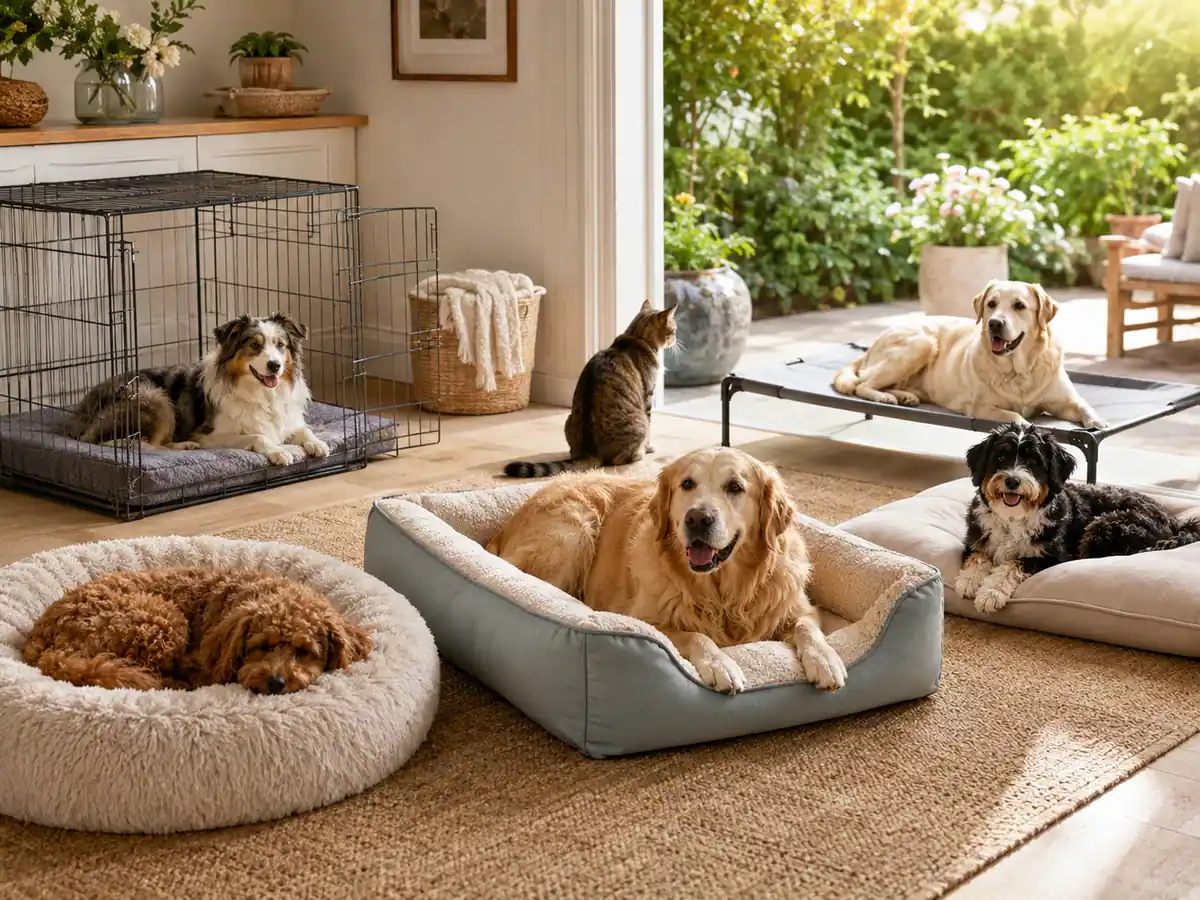
Retail names overlap. A bed can be both rectangular and bolstered, or both orthopedic and washable. Separate its shape from its filling, cover and support structure. Otherwise you may compare a design feature on one product with a material claim on another and still not know which fits your dog.
The Foggy Dog sleep collection, for example, distinguishes bolster beds, pillow beds and travel mats. Those are useful construction categories, not evidence that one style is universally better. For a practical shortlist, identify the sleeping surface, surrounding edges and route into the bed.
| Construction | What it offers | What to inspect |
|---|---|---|
| Flat cushion or mat | Open sides and flexible resting positions | Filling, thickness and whether it shifts on the floor |
| Bolster bed | A raised edge around some or all sides | Interior area and height of the entrance |
| Round nest | A curved resting area with surrounding padding | Space when the dog stretches, not only curls |
| Elevated cot | A tensioned surface held above the floor | Frame stability, entry height and surface specifications |
| Crate mat | A shape intended for an enclosure | Actual interior crate dimensions and door clearance |
We would not choose an elevated design solely because a listing says it is cooling. The frame, fabric, environment and dog's willingness to step onto it all matter. Similarly, a very fluffy surface can look inviting while hiding how much usable area remains inside its sides. Pick a construction that addresses an observed need.
Measure the sleeping area, not just the outside
Product dimensions can describe the outside footprint. That is useful for checking whether a bed fits beside your sofa, but it may not describe the space available to the dog. Bolsters, curved corners and thick walls can reduce the interior substantially. Ask for both measurements when the listing does not distinguish them.
Here is a worked example, using hypothetical measurements rather than a real product. Two beds each occupy a 36-by-28-inch rectangle on the floor. The flat cushion may offer nearly that full area. If the second design has four-inch-wide sides on every edge, its rectangular interior would be only 28 by 20 inches. The arithmetic is simple, but the difference is easy to miss in a photograph.
Measure the space your dog occupies while resting naturally and compare that with the manufacturer's usable dimensions. Allow comfortable movement instead of treating the measurement as a tight outline. Our step-by-step sizing guide focuses on that process. For a large dog, also read the large-bed fit checklist before ordering.
If the bed will go inside a crate, measure the interior rather than relying on the crate's advertised outside size. Check that the mat lies flat and does not interfere with the entrance. A floor bed that fits the dog may still be the wrong shape for the enclosure.
Check the filling, support and entrance together
“Orthopedic” is a starting point for questions, not a complete specification. Find out what is inside the bed, how it is constructed, whether the filling is replaceable, and which dimensions refer to the mattress rather than a raised border. A thick-looking side wall does not tell you the thickness beneath the dog.
We would prioritize a clear material description over a dramatic comfort promise. Ask how the manufacturer describes the core and its intended use. Check whether a removable liner protects that core and whether replacement covers are sold. These details help compare products without pretending that a product photograph establishes pressure relief or medical effectiveness.
Access matters as much as the resting surface. A tall edge can be inconvenient if the dog hesitates to step across it. An open side or lower entrance may make a design easier to approach. Observe the dog entering, turning and leaving during a supervised introduction; do not push the animal into a position to prove the purchase was suitable.
If your dog seems painful, struggles to rise, or changes movement unexpectedly, get veterinary advice. A shopping guide cannot diagnose the cause, and a new mattress is not a substitute for care. Our supportive-bed comparison guide explains product questions without promising treatment. For everyday selection, keep the decision concrete: suitable usable area, manageable entrance and clearly described construction.
Read the instructions before buying a washable bed
A washable cover and a washable entire bed are different things. Separate the outer fabric, inner liner, filling and base in your notes. Each may have its own care instructions. If only the cover can be machine washed, you still need to know how the interior should be cleaned after a spill.
Manufacturer instructions illustrate why a universal washing recipe is unhelpful. Molly Mutt's care guidance distinguishes bed covers from liners and gives them different drying instructions. Apply the instructions for your exact item, not another company's product or a generic social-media tip.
Check the practical details in your home: whether the cover comes off easily, whether the whole item fits your machine, and where it can dry as instructed. A giant bed that requires equipment you cannot access may be less convenient than two manageable components. Do not force an oversized item into a washer or assume high heat is suitable for every fabric.
Keep a suitable resting alternative available while bedding is being cleaned and dried. The aim is a usable routine, not an impressive feature list. Our washable-bed guide goes further into covers, filling and drying. Inspect seams and fasteners when reassembling the bed, and follow the manufacturer if components must be removed first.
Chew resistance is not an indestructibility promise
Be wary of treating “chew proof” as permission to leave a destructive dog with an unfamiliar bed. A material can resist one kind of wear and still fail under another. Scratching the surface, pulling a seam and repeatedly biting an exposed corner are different stresses. Ask which behavior the specific design is intended to tolerate.
This is not just our caution. K9 Ballistics' own FAQ distinguishes its product lines and explicitly says no bed is completely indestructible. It advises supervising persistent chewers during introduction and removing a bed if damage occurs. That is a more useful purchasing framework than assuming the strongest marketing phrase eliminates risk.
Read the remedy as well as the headline guarantee. The company's published warranty terms distinguish replacement or store credit from a refund and include eligibility conditions. Terms can change, so verify the current policy for the exact item, seller and delivery location before buying. We are citing the policy as an example, not endorsing a product or applying its terms to other brands.
For any bed, check seams, exposed fasteners and loose filling during ordinary use. Stop using damaged bedding rather than hiding a tear beneath a blanket. Our chew-resistant construction guide covers the questions to ask. The better question is “What can this design realistically withstand?” rather than “Which bed can never be destroyed?”
Give the bed a suitable place in the home
The location can undermine an otherwise sensible purchase. A comfortable bed beside a noisy appliance or in a busy doorway may not offer much undisturbed rest. The RSPCA's home-environment guidance recommends a comfortable, clean, dry and quiet resting place, as well as enough resources when several dogs live together.
Look for a spot where the dog can approach and leave without squeezing past furniture. Check the entire footprint, including any legs or projecting frame. Do not block a walkway simply to fit the largest available mattress. If you move the bed, change one thing at a time so you can observe whether the location works better.

In a mixed-pet household, occasional sharing does not remove the need for alternatives. One animal should not have to approach another to reach its only sleeping place. Our preference is to plan individual options first, then allow voluntary sharing where appropriate. Do not force a cat to use a dog-sized bed just because there is room.
When introducing new bedding, let your dog investigate at its own pace. Keep the area calm and observe use over normal rest periods. A refusal to use the bed is information about fit, surface, location or preference, not a reason to restrain the dog on it.
Compare the complete purchase, not the sticker price
Two similarly priced dog beds can create different costs and practical burdens later. One may include a removable cover while another sells that separately. A replacement cover may keep a sound mattress useful, but only if the correct size remains available. We would rather see a clear list of replaceable components than an unsupported claim that a bed will last for years.
Make a short comparison sheet and fill it from the actual listing or written manufacturer response. Leave unknown fields blank and ask before ordering. This avoids turning uncertainty into an assumption. You can also save the care instructions and return conditions with the order confirmation, so you are not relying on a listing that may change.
| Question | Useful evidence | Reason to pause |
|---|---|---|
| Will the dog fit? | Usable interior dimensions | Only a breed photo or size name |
| Can I maintain it? | Instructions for cover, liner and filling | An undefined “washable” claim |
| What can I replace? | Exact compatible parts or covers | No explanation of replaceable components |
| Can I return it? | Current policy for that item and seller | Unclear exclusions or return shipping |
| What is guaranteed? | Written eligibility and remedy | A badge with no accessible terms |
Do not assume a higher price establishes medical benefit or stronger construction. Nor does a lower price automatically make a product unsuitable. Compare the features you can verify against the needs you observed. The deciding factor should be whether the purchase solves your dog's resting needs in a way your household can maintain.

Questions to ask before choosing dog beds
Should I choose a round or rectangular bed?
Start with your dog's observed sleeping positions. A curled sleeper may use a round nest, while a dog that stretches needs enough open length and width. Compare usable interior space instead of assuming a shape guarantees a good fit.
Is a larger bed always better?
No. It still needs to fit safely in the room, be manageable to clean, and provide an appropriate entrance and surface. Choose enough usable space for comfortable movement, rather than buying the largest size without checking the other details.
Does orthopedic mean a bed treats joint problems?
Do not treat the label as a diagnosis or treatment promise. Examine the construction and discuss your dog's specific needs with a veterinarian if pain or reduced mobility is involved. This guide does not establish medical effectiveness for any product.
Can I machine wash the whole bed?
Only if the instructions for that exact item permit it. Some products have washable covers but cores requiring different care. Check the cover, liner, filling and base separately, including drying instructions and machine capacity.
Can a dog bed be completely chew proof?
Do not assume any bed is indestructible. Check what the manufacturer actually claims, supervise introduction when chewing is a concern, and remove damaged bedding. A replacement warranty is a commercial remedy, not a safety guarantee.
Can my dog and cat share one bed?
Some animals choose to share, but provide suitable separate resting options. Neither pet should have to approach the other to reach its only bed. Observe their preferences and do not force sharing because a large mattress appears spacious.
What should I check first when the bed arrives?
Confirm the dimensions, components and instructions match the order. Inspect seams and fasteners, assemble as directed, and make sure the bed sits securely in its intended location. Let the dog explore voluntarily and observe access and resting positions.
Make the final choice with a short trial checklist
Begin with the feature that rules out a poor fit: usable area, entry height, maintenance, or the dog's treatment of bedding. Shortlist dog beds that pass that test, then compare secondary preferences such as shape and color. This order keeps attractive photography from making the decision for you.
Before removing packaging or allowing use, understand the seller's return conditions. Then check the bed in the place where it will stay. Does it lie securely? Can the dog enter and leave easily? Can you access the cover fastener without dismantling surrounding furniture? These are simple checks you can perform without inventing a product-test score.
Revisit the choice if the dog's size, mobility or habits change. A once-useful bed may need a different location, replacement component or another design later. Avoid setting an arbitrary replacement calendar: condition, fit and the manufacturer's guidance are more useful than a blanket lifespan claim.
Use the linked sizing, cleaning, support and cat-resting guides for the issue that matters most to your household. If you browse our pet collection, compare the specifications on the individual product page before ordering. You can also read about the editorial team or ask us a product question. Clear answers should come before checkout.