Cat biting toys exist for one job: giving the bite at the end of a cat's hunt somewhere harmless to land. If your cat grabs your wrist, ambushes your ankles or nips halfway through a stroke, the problem is rarely the cat. It is usually a missing target. This guide is about adult and adolescent cats who bite in play, and about the toys and habits that move those teeth off your skin. If you have a young kitten cutting new teeth, our separate guide to kitten teether toys covers that stage in more detail.
Quick Answer: What Are Cat Biting Toys and Which Ones Work?
Cat biting toys are toys a cat can grab, bite hard and kick without hurting anyone: long kickers, prey-sized plush, and wand toys that keep your hand at a distance. Pair them with short daily hunting sessions, stop play the moment teeth touch skin, and remove string toys between sessions.
Why Do Cats Bite Toys So Hard?
Answer: Cats bite toys hard because the bite is the final step of a hunting sequence: watch, stalk, chase, pounce, grab and bite. Indoor cats still run that sequence every day. When it has no prey to finish on, it often finishes on hands, feet or whatever object is closest and moving.
Watch a cat play and you will see a hunt in miniature. The ASPCA guide to aggression in cats describes the predatory sequence as silent stalking, a sprint, a strike with the front paws and then a bite. Cats do not grow out of this. A well-fed indoor cat still has the wiring, and it still wants the ending.
That is why a cat that only ever watches a laser dot can seem more wound up after play than before it. The chase happens but the catch never does. A biting toy gives the cat something to close its jaws on, which is the part of the sequence that lets the arousal drop.
Cats also explore with their mouths. A curious cat will test a new object by sniffing it, pawing it and then biting it to see what it is made of and whether it moves. Most of that is harmless curiosity. It becomes a problem only when the object is a cable, a plant or a person.
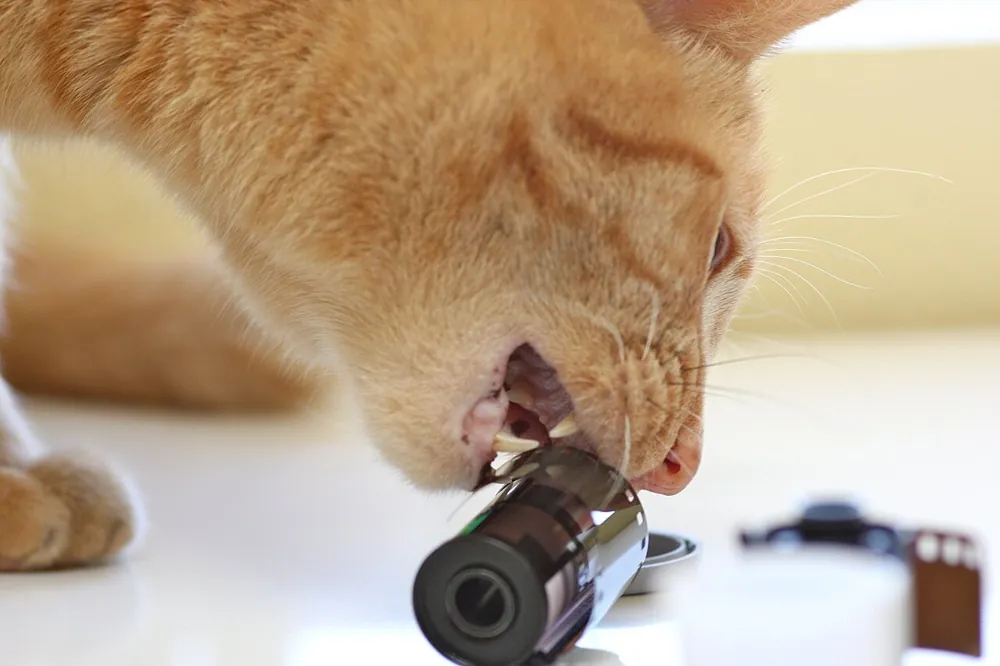
Photo: kevindooley / Wikimedia Commons, CC BY 2.0
The ASPCA also notes that play aggression is the most common type of aggressive behaviour cats direct toward their owners, and that long hours alone without play and owners encouraging cats to chase hands and feet both contribute. In other words, most biting cats are bored hunters who were taught the wrong target. Both halves of that are fixable.
What Makes a Good Cat Biting Toy?
Answer: A good cat biting toy is long enough to hold with the front paws while the back legs kick, soft enough for teeth to sink in, tough enough to survive it, and roughly prey-sized. It should have no glued eyes, loose bells or dangling threads, and it should keep your fingers out of range.
Length matters more than most buyers expect. When a cat catches something it wraps its front legs around it, bites, and rakes with the back feet. That rabbit kick only works on a toy long enough to reach from the chin to the hind paws. Short toys get bitten once and batted away. A kicker roughly the length of the cat's body gets the full sequence.
Texture comes next. Cats like to feel their teeth go in, so firm fabric, tight canvas and dense plush tend to hold attention better than hard plastic. Crinkle layers and a little catnip or silvervine inside can make a kicker more interesting, though some cats ignore both and that is normal.
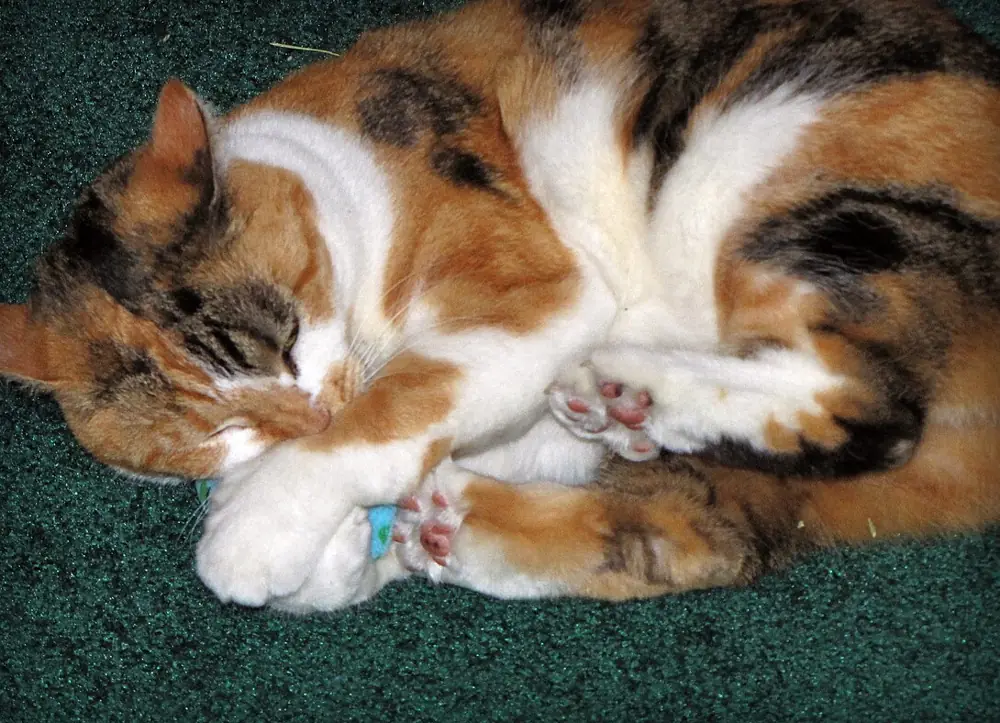
Photo: Trish Hamme / Wikimedia Commons (cropped), CC BY 2.0
Construction is what decides whether a toy is still safe a month from now. Look for locked or double stitching, no sewn-on plastic parts, and filling that cannot spill out through a single torn seam. Rub the surface hard between your fingers in the shop. If fibres come away on your hand, the cat will swallow them.
Which Biting Toy Suits Your Cat?
Answer: Match the toy to the way your cat bites. Ankle ambushers need a scheduled wand session and a kicker. Cats left alone all day need a safe solo kicker. Petting biters need a toy offered the moment they tense. Older or gentle cats often prefer small plush prey they can carry.
There is no single best biting toy, because cats bite for different reasons and in different moods. The quickest way to choose is to notice when your cat bites and what it does just before. A cat that launches at feet in the hallway at dusk needs something different from a cat that nibbles your hand while lying on your lap.
Many cats have a favourite style and ignore the rest. Rotate two or three types for a couple of weeks before deciding a toy does not work. A kicker that sat untouched in a corner often becomes interesting once you drag it past the cat or rub it on a bit of fresh silvervine.
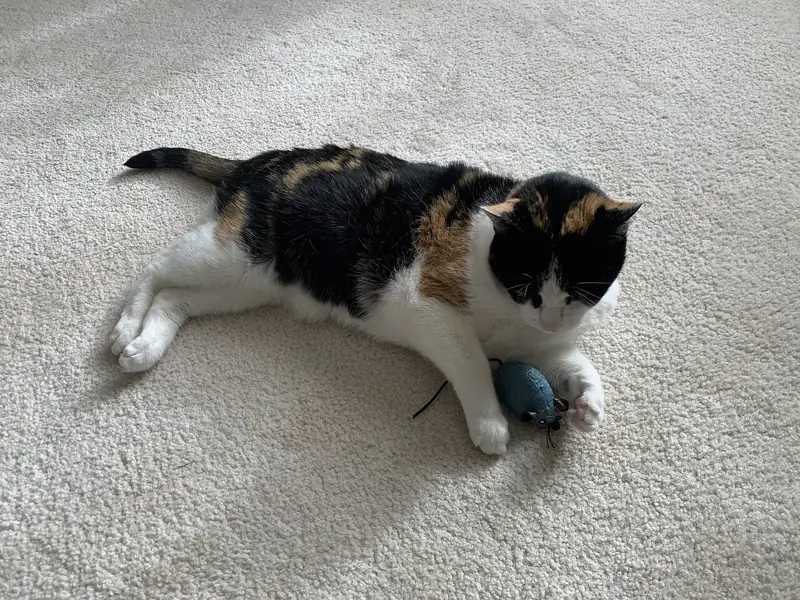
Photo: Famartin / Wikimedia Commons, CC BY-SA 4.0
For more ideas on keeping a solo cat busy, see our guides to toys for cats home alone and the best toys for bored cats.
How Do You Stop a Cat Biting Hands and Ankles?
Answer: Make hands boring and toys rewarding, every time. Stop the game quietly the moment teeth touch skin, then restart with a wand or kicker between you. Play before your cat's usual ambush times, never wrestle with bare hands, and never punish, because punishment teaches a cat to fear touch, not to stop biting.
A cat that bites hands has usually learned that hands are part of the game. It often starts with a tiny kitten wrestling with fingers, which is cute at a few weeks old and painful once the cat is grown. Unlearning it takes consistency from everyone in the house, not one big correction.
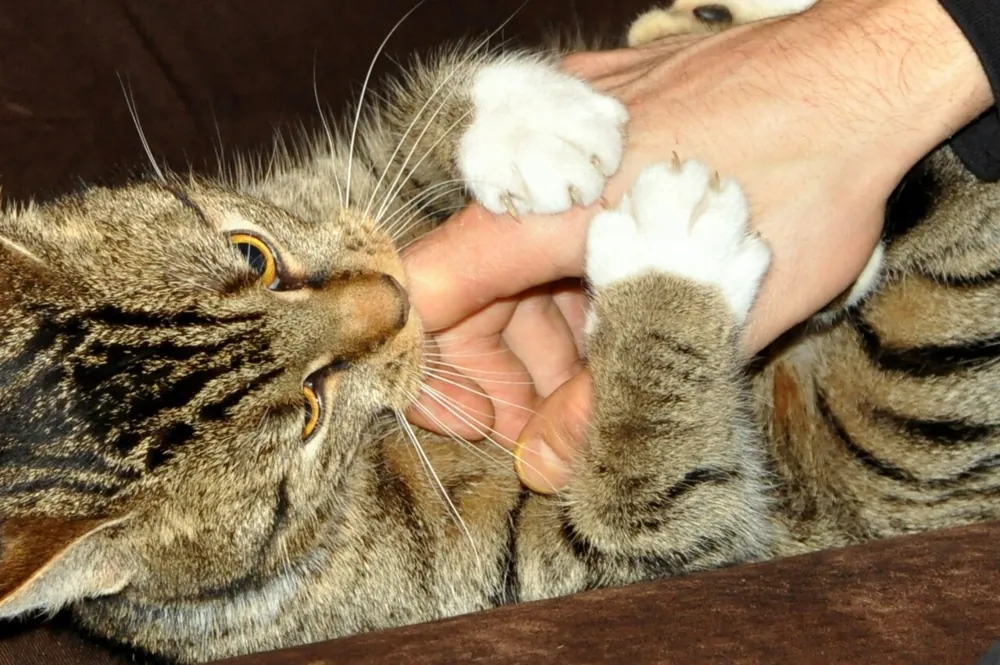
Photo: Stiopa / Wikimedia Commons, CC BY-SA 4.0
- End the game the instant teeth touch skin. Go still, withdraw the hand slowly and say nothing. Pulling away fast looks like prey escaping and invites a harder bite.
- Pause briefly. Walk away or turn your attention elsewhere so the cat learns that biting people ends the fun.
- Restart with a toy, not a hand. Offer a wand or drag a kicker so the next bite lands where it should.
- Schedule play before trouble. Run a short wand session before the times your cat usually ambushes, so the hunt is already spent.
- Finish with a catch. Let the cat grab and bite the lure at the end, then offer a small meal or treat, which mirrors hunt, catch, eat.
- Keep everyone on the same rules. One person who still plays rough with hands undoes the rest.
The Cornell Feline Health Center advises keeping any object used to redirect play aggression at a distance from your hands, so the cat can vent on the toy without reaching you, and never physically punishing a cat during these moments. That is the core reason wands and long kickers work so well: they put length between teeth and skin.
If the biting is sudden, intense, or new in an adult cat that never did it before, treat it as a health question first. Pain makes even gentle cats bite, and the ASPCA recommends a veterinary workup for any aggressive cat before working on behaviour.
Why Does My Cat Bite During Petting?
Answer: Biting during petting usually means the stroking has gone on too long or too repetitively. Watch for warning signs such as the head whipping toward your hand, a twitching or flipping tail, ears rotating or flattening, restlessness and widening pupils. Stop at the first sign and offer a toy instead.
Many owners are puzzled by a cat that asks for attention, settles happily, then turns and bites. The ASPCA guide to aggression in cats calls this petting-induced aggression and explains that repeated contact in one spot can quickly become irritating. The cat is not being treacherous. It is asking you to stop in the only way left once politer signals were missed.
The warning signs the ASPCA lists are quick to learn: the cat turns its head sharply toward your hand, its tail twitches or flips, its ears flatten or swivel back and forth, it becomes restless, and its pupils widen. When you see any of these, take your hand away. The best response, as the ASPCA puts it, is simply to stop.
This is where a small kicker earns its place on the sofa. If your cat is clearly winding up, slide the kicker in front of it rather than continuing to stroke. Many cats will grab it, give it a few bites and kicks, and then settle again. Over time you learn the length of petting your cat enjoys, and the toy takes the bites that used to land on your wrist.
Keep petting sessions shorter than you think and favour the places most cats like, such as the cheeks and under the chin, over long strokes down the back or belly rubs. Let the cat choose when to come back for more.
Which Cat Biting Toys Are Unsafe?
Answer: The most dangerous biting toys are anything with string, ribbon, elastic, yarn or shoelace that a cat can swallow. Never leave those out unsupervised. After that, avoid glued-on eyes, small bells, loose feathers and fabric that sheds fibres, and replace any toy at the first real split.
String is the hazard that matters most. A swallowed length of thread, ribbon, tinsel or shoelace can catch at one end while the gut keeps trying to move the rest along, which is a veterinary emergency rather than something to watch and wait on. If you ever see thread hanging from a cat's mouth or rear end, do not pull it. Call your veterinarian straight away.
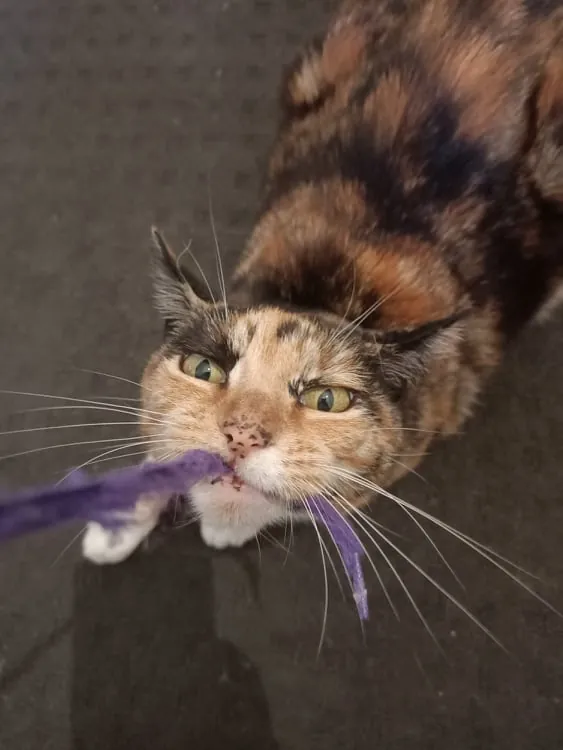
Photo: Cameron.coombe / Wikimedia Commons, CC BY-SA 4.0
Wand toys are excellent biting targets, but only while you are holding the other end. Put them in a closed drawer or cupboard after every session. The same goes for any toy with a cord, a feather bundle on a string, or an elastic tail.
Use a quick checklist on every new toy and again each week:
- No glued-on plastic eyes, noses or buttons.
- No bells or beads small enough to work loose.
- No loose threads, ribbons or long feathers.
- No part small enough to fit entirely in the cat's mouth.
- No fibres coming off when you rub it hard between your fingers.
- Seams intact, with no stuffing showing through.
A cat that bites hard will find any flaw and widen it. Replace a damaged toy rather than stitching it back together, because a repaired seam usually opens again in the same place.
What If Your Cat Bites Plants, Cables or Plastic?
Answer: Biting plants, cables and plastic is common in bored cats, but it can also signal dental pain or other health problems. Cover or reroute cables first, check every houseplant against a toxic plant list, add daily play and a safe chew, and book a vet check if the habit is new or intense.
Some cats direct their biting at the house rather than at people. Houseplants are a favourite, partly because leaves move when touched and partly because many cats like to chew greenery. Before anything else, check each plant in your home against the ASPCA list of toxic and non-toxic plants for cats. Lilies in particular are dangerous for cats, so anything you are unsure about should go.
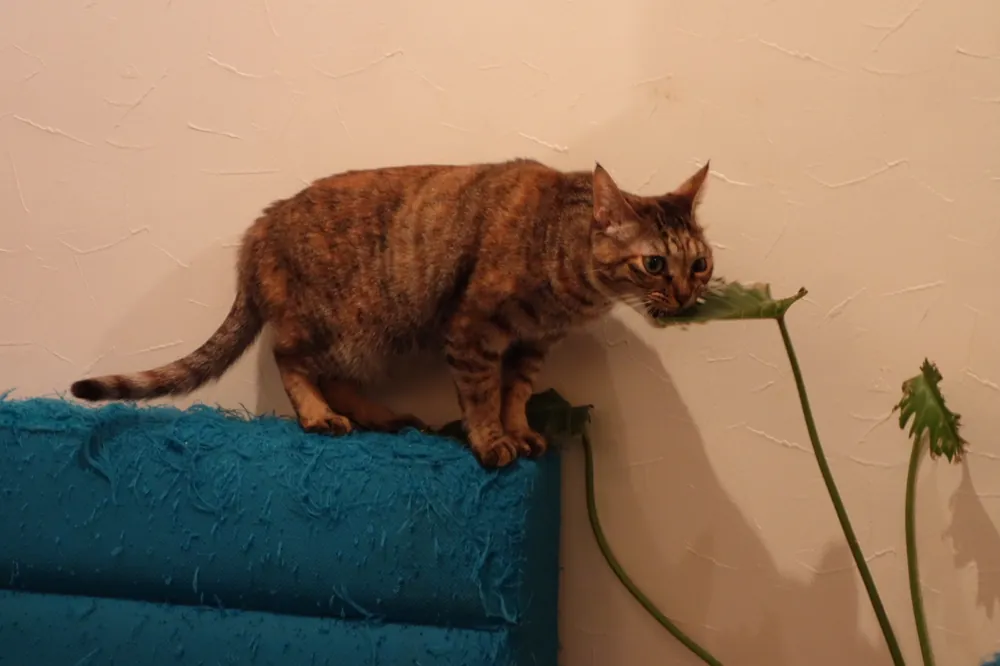
Photo: Yamaguchi Yoshiaki / Wikimedia Commons, CC BY-SA 2.0
Cables carry an immediate electrical risk, so deal with them physically rather than by training: run them behind furniture, use cord covers, and unplug chargers when they are not in use. Then give the cat something better to bite in the same spot, such as a kicker on the windowsill or a pot of cat grass.
If an adult cat suddenly starts biting or chewing things it never touched before, or chews fabric and plastic persistently, mention it to your veterinarian. Mouth pain, stomach upset and stress can all show up as unusual chewing, and a sore mouth is something no toy will fix. For background on feline dental care, see our guide to cat toothpaste.
How Do You Clean and Rotate Biting Toys?
Answer: Biting toys collect saliva and food residue, so wash fabric kickers on a gentle cycle without fabric softener and clean rubber chews in hot soapy water. Dry everything fully, keep a few toys in rotation so they stay interesting, and retire any toy that has split or lost stuffing.
A toy that has been bitten and kicked for a week smells strongly of cat and is usually damp in places. Most fabric kickers can go into a laundry bag on a gentle wash. Skip fabric softener, since the coating it leaves can put cats off. If the kicker has a removable catnip or silvervine pouch, take it out first.
Let everything dry completely before it goes back on the floor. A kicker that is still damp inside can turn musty where you cannot see it. Owning two of the toys your cat loves most makes this easy, because one can dry while the other is in use.
Rotation keeps biting toys working. A toy that has sat in the same corner for weeks stops registering as prey. Put most of the collection away and bring out a different two or three every few days. For more on keeping play varied, read our guides to cat enrichment toys, catnip toys and choosing a cat wand toy. Our cat toy range has interactive options when you are ready to add a new one.
What Questions Do Owners Ask About Cat Biting Toys?
Answer: Most questions about cat biting toys come down to three things: why the cat bites, which toy gives that bite a safe target, and how to stop the teeth landing on people. The answers below cover kickers, play biting, petting bites, safety and when to involve a veterinarian.
What is the best toy for a cat that bites?
A long kicker is the most useful single toy for a cat that bites, because the cat can hold it with its front paws, bite it and rabbit-kick it with its back legs, which completes the whole catch. Pair it with a wand toy for daily interactive sessions that keep your hands well out of reach.
Why does my cat bite my hands when we play?
Usually because hands became part of the game, often when the cat was a kitten. The cat treats them as prey. Stop play quietly whenever teeth touch skin, restart with a wand or kicker, and make sure nobody in the house wrestles with the cat using bare hands.
Do kicker toys really reduce biting?
They help when they are used as a replacement target, not just left on the floor. Offer the kicker the moment your cat starts to wind up, and use it at the end of wand sessions so the cat finishes the hunt by biting the toy. Consistency matters more than the brand.
Why does my cat bite me while I am petting it?
Stroking can become irritating if it goes on too long or repeats in one spot. Watch for a tail twitch, ears turning back, restlessness, widening pupils or the head swinging toward your hand, and stop at the first sign. Keeping a small kicker nearby gives the cat something else to bite.
Are string and wand toys safe for cats that bite?
Only while you are holding them. Swallowed string, ribbon or shoelace can cause a serious intestinal emergency. Use wands for supervised play, then put them away in a closed cupboard. Never pull on thread you can see in a cat's mouth or under its tail; call your veterinarian.
Should I punish my cat for biting?
No. Punishment does not teach a cat what to bite instead, and it can make the cat fearful of hands and touch. Go still, withdraw, and redirect to a toy. If biting is sudden or new in an adult cat, book a veterinary check, because pain is a common cause.
Can catnip or silvervine make biting worse?
Some cats become more playful and grabby under catnip or silvervine for a short while, so use them in toys rather than as a cue for hand play. A scented kicker gives that excited burst a safe place to land. Cats that do not react to either are common and perfectly normal.
When should I worry about my cat biting?
Talk to your veterinarian if biting starts suddenly in an adult cat, comes with hiding or flinching when touched, happens around the mouth or while eating, or is hard enough to break skin. Cat bites can become infected easily, so have any deep bite on a person checked by a doctor as well.
Sources: ASPCA guide to aggression in cats (predatory sequence, play and petting-induced aggression, warning signs); Cornell Feline Health Center on feline aggression; ASPCA list of toxic and non-toxic plants for cats.