Small dogs carry an unfair reputation. The casual observer sees a Chihuahua, a Maltese, or a Toy Poodle and assumes they need little more than a lap to curl up on and an occasional gentle stroll around the block. This assumption is not just wrong - it is one of the primary reasons small dog owners end up with a tiny companion who yaps relentlessly, shreds furniture, spins in circles, or snaps at strangers. The problem is almost never temperament. The problem is boredom. According to the American Kennel Club breed standards directory, choosing the right toys can support your pet's mental and physical wellbeing.
When we evaluate interactive dog toys for small breeds for the Livehappypet readers, we focus on three things we wish more buying guides flagged: material safety, sizing accuracy, and supervision requirements. We've found those decide the buying outcome more than brand alone.
Small breeds are descended from working, hunting, and companion dogs who were bred to think, problem-solve, and stay engaged with their humans. A Jack Russell Terrier is genetically wired to hunt. A Dachshund was built to track badgers underground. A Miniature Schnauzer was a farm ratter. Strip away the physical outlet and you are left with a highly intelligent brain in a small body - and that brain will find something to do, whether you like it or not.
The solution is the best interactive dog toys for small breeds: toys designed to challenge, stimulate, and satisfy the mental needs of dogs who are regularly underestimated. This guide covers 14 top picks matched specifically to the size, jaw strength, and cognitive needs of small breed dogs, plus guidance on how to choose and how to rotate them for maximum effect. You will also find our complete guide to the best dog toys for a broader overview across all sizes and play styles.
For breed-specific recommendations, see our new kitten essentials picks.
This article is for general informational purposes only and is not a substitute for professional veterinary advice, diagnosis, or treatment. Always consult your veterinarian about any health concerns, dietary changes, medication, or product safety questions specific to your pet. If your pet shows signs of distress, illness, or injury, contact a licensed veterinarian or emergency animal hospital immediately.
Why Small Dogs Need Interactive Toys
Before diving into the toy list, it is worth understanding the science behind why interactive toys matter so much for small breeds specifically - and why a ball in the garden simply is not enough.
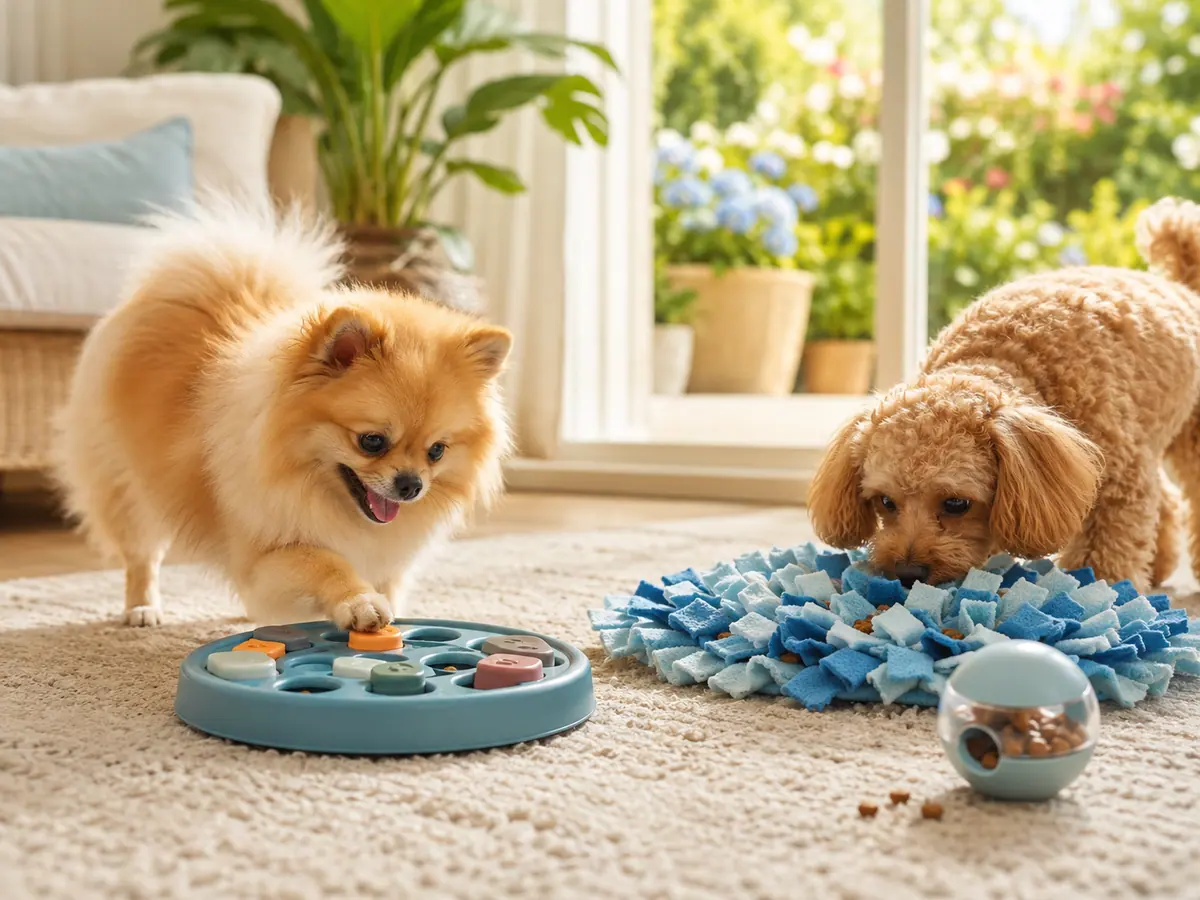
Mental exhaustion is cumulative and real. Canine cognition research consistently shows that problem-solving and scent-work activities activate the prefrontal cortex in dogs and deplete cognitive energy much as physical exercise depletes muscular energy. A small dog who has spent 20 minutes working a puzzle feeder and 15 minutes on a snuffle mat will settle far more readily than one who has simply had a walk - even a long one.
Honestly, we've reviewed enough interactive dog toys for small breeds listings to know that the cheapest option is rarely the best value once durability is factored in. We weigh longevity in our recommendations.
Problem behaviours are communication, not personality. When a small dog barks incessantly, shreds cushions, steals socks, or circles obsessively, it is almost always expressing unmet mental needs. Interactive toys address the root cause rather than the symptom. Many owners report that introducing a structured enrichment routine of 30-45 minutes daily eliminates problem behaviours within two to three weeks - without any training, medication, or punishment.
Owner bonding is a genuine benefit. Small dogs are highly social. Toys that require owner participation - flirt poles, hide-and-seek puzzle games, tug - are not just fun; they are relationship-building tools. A small dog who plays interactively with their owner multiple times per day develops stronger recall, better impulse control, and a deeper trust-based relationship. See our breed-specific guide to toys for Chihuahuas for a deep-dive into one of the most commonly under-stimulated small breeds.
Small dogs often receive less mental stimulation than large dogs because owners assume their small size means small needs. The reverse is frequently true - many small breeds are among the most cognitively demanding dogs to keep properly enriched.
14 Best Interactive Dog Toys for Small Breeds
Every toy on this list has been selected with small breed bodies in mind: appropriate scale, safe materials, and a difficulty level calibrated to a small dog's paw dexterity and muzzle reach. For breed-specific advice, also see our guides to the best toys for Corgis and best toys for puppies.
Nina Ottosson Dog Smart (Level 1 Puzzle)
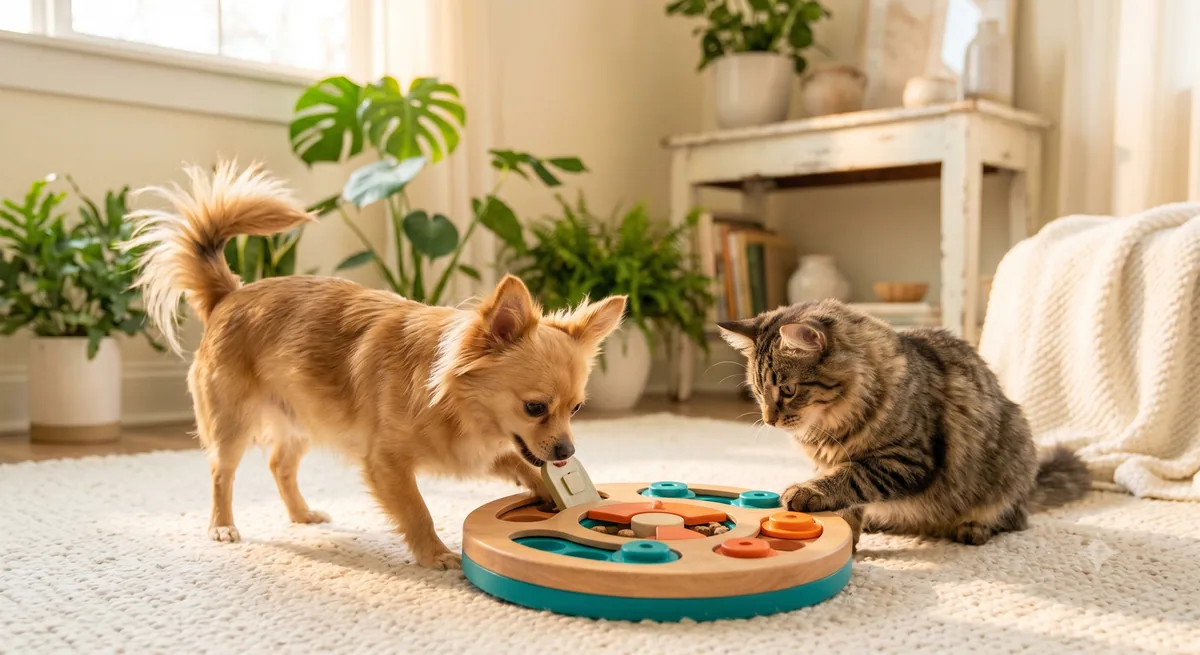
The Nina Ottosson Dog Smart is the gold standard entry-level puzzle feeder and the single best starting point for any small dog new to interactive toys. The puzzle features a series of circular covers that the dog must nose or paw aside to reveal hidden treats in the wells beneath. The mechanism is simple enough for a first-time puzzle dog to grasp within a few minutes, yet engaging enough to occupy an average small dog for 10-15 minutes per session. Its flat, stable base is ideal for small breeds who may not have the leverage to hold down larger, taller puzzles. Start here before moving to any higher-difficulty option.
Nina Ottosson Dog Tornado (Level 2 Puzzle)
Once your small dog has mastered the Dog Smart, the Dog Tornado is the natural next step. This multi-layered puzzle requires the dog to rotate three separate spinning discs in sequence to uncover hidden treat compartments beneath. The rotating mechanism introduces a new physical challenge - controlling a spinning object - that engages both problem-solving and fine motor coordination in small paws. The Dog Tornado typically occupies a dog who knows it for 15-20 minutes and provides genuine cognitive work for small, intelligent breeds like Toy Poodles, Miniature Schnauzers, and Papillons. Add bone-shaped blockers to increase the difficulty further.
Outward Hound Hide-A-Squirrel (Plush Puzzle)
The Hide-A-Squirrel combines a plush toy with a puzzle concept: a hollow tree-trunk toy holds several small squeaky squirrel figures that the dog must nose and paw out one at a time. For small breeds with a strong prey drive - terriers, Dachshunds, Beagles - this toy triggers the "search and retrieve" sequence in a controlled, safe format. Choose the Small size (typically 3 squirrels) for dogs under 15 lbs, as the squirrels in the Junior size are scaled appropriately for small mouths and carry no choking risk. The squeaky squirrels can also be used independently as carry-around comfort toys.
KONG Classic XS / S (Stuffable Rubber)
The KONG Classic is an institution for good reason. For small breeds, the XS size suits toy breeds under 5 lbs (Chihuahuas, Yorkshire Terriers, Toy Poodles), while the Small suits dogs between 5-20 lbs. Stuffed with a mixture of kibble, a teaspoon of peanut butter, and sealed with a plug of banana or cream cheese, then frozen overnight, a KONG provides 20-40 minutes of sustained licking, chewing, and problem-solving. The unpredictable bounce on hard floors also triggers short bursts of chase behaviour. Frozen KONGs are especially effective for managing mild separation anxiety - introduce the toy a few minutes before departing to create a positive association with alone time.
West Paw Tux (Treat Dispenser)
The West Paw Tux is an excellent KONG alternative for small breeds, particularly for dogs who have mastered the Classic and need a fresh shape to re-engage curiosity. The Tux's wide, accessible cavity holds chunky treats, lick mat fillings, or wet food with ease, and its distinctive hourglass silhouette produces a more erratic roll than a standard ball or KONG. Made from Zogoflex - a certified non-toxic, recyclable rubber - the Tux is also dishwasher safe, which is a practical bonus when you are using it at every meal. Choose the Small size for dogs under 25 lbs.
Our best toys for old dogs guide is tailored to the unique needs of specific breeds.
Snuffle Mat (Nose Work)
A snuffle mat is one of the most powerful and underrated enrichment tools for small dogs. Kibble or small treats are scattered among the densely layered fleece strips, and the dog must use its nose to forage and find them - mimicking the natural foraging behaviour dogs would perform in the wild. Nose work activates the parasympathetic nervous system, which explains why a 15-minute snuffle mat session reliably calms over-excited or anxious small dogs. Choose a mat with a non-slip rubber backing to prevent it from skidding across hard floors during enthusiastic foraging, and size the mat to give your small dog enough surface area to explore properly without feeling confined.
LickiMat (Slow Licking Enrichment)
The LickiMat is a textured rubber mat spread with a thin layer of peanut butter, plain yoghurt, mashed banana, or wet food. The repetitive licking motion releases endorphins and serotonin, producing a measurable calming effect that makes this toy particularly valuable for small breeds prone to anxiety or reactivity. For small dogs, the LickiMat Buddy or LickiMat Soother are the best sizes - the textured surface pockets hold a spread without overflow, and the mat stays flat during use. Use it during thunderstorms, fireworks, grooming sessions, nail trims, or any situation where your small dog needs to self-regulate. Freeze for extended engagement.
Tug-E-Nuff Mini Tug Toy
Tug is one of the most misunderstood games for small dogs - many owners avoid it, believing it encourages aggression. Research consistently shows the opposite: structured tug play, where the dog is taught to start and stop on cue, builds impulse control and trust. The Tug-E-Nuff mini range is designed specifically for small breeds, with a fleece or rabbit-fur lure on a short bungee cord that absorbs the force of the dog's pull and protects their small neck and jaw from jarring impact. Keep sessions short (3-5 minutes), always let the dog "win" occasionally to maintain motivation, and always end on a "drop it" or "leave it" command.
Outward Hound Fun Feeder Slo-Bowl
The Fun Feeder Slo-Bowl transforms every mealtime into a 10-15 minute foraging exercise. The maze-like ridges and channels inside the bowl require the dog to use their tongue to navigate kibble out of narrow passages, slowing consumption by up to ten times compared to a standard bowl. This has two benefits: it provides daily mental enrichment without any extra effort from the owner, and it dramatically reduces the risk of bloat and indigestion - a genuine concern for fast-eating small breeds. Choose the Mini size for small dogs; the ridges are shallower and appropriately spaced for small muzzles to navigate comfortably.
PetSafe Busy Buddy Twist 'n Treat (Small)
The Twist 'n Treat is a flying-saucer shaped treat dispenser consisting of two halves that the dog must roll, nose, and paw to release treats through a central opening. The difficulty is adjustable - twist the two halves closer together to reduce the opening and make treats harder to dispense, or twist them apart for an easier setting. This makes it ideal for progression: start easy, then tighten the fit as your small dog's problem-solving improves. The Small size is proportioned for dogs under 20 lbs and dispensed kibble fits cleanly without jamming. This is an excellent solo-play toy for dogs left alone during the day.
ZippyPaws Burrow Toy
ZippyPaws Burrow toys follow the same hide-and-seek concept as the Hide-A-Squirrel but offer a wider range of themes - a log with bees, a taco with small food characters, a pizza with toppings - giving you options to refresh novelty without buying a completely different type of toy. The mini characters inside are sized for small dog mouths and are plush with internal squeakers, satisfying the prey-drive sequence of search, retrieve, squeak, and shake. Rotate different Burrow themes in your enrichment schedule to maintain interest; small dogs quickly habituate to familiar toys but often re-engage enthusiastically with a new character set.
Mini Flirt Pole / Wand Toy
A mini flirt pole - a short flexible wand with a lure on a cord - is one of the highest-value interactive toys for small dogs with a strong prey drive. Dragging the lure along the floor and switching directions unpredictably triggers the full chase sequence: stalk, sprint, pounce, grab. For small dogs, the wand length should be short enough (30-50 cm) that you can control the lure's movement precisely without the dog over-extending into jumps or sharp turns. Use a soft fleece lure rather than a hard plastic one to cushion the catch. Pair with impulse-control commands - asking for a "sit" before releasing the lure - to build obedience alongside aerobic exercise.
Automatic Mini Ball Launcher
For small dogs who love fetch but whose owners cannot always throw for extended periods, an automatic mini ball launcher set to its lowest arc provides sustained indoor exercise. The dog drops the ball into the launcher, the machine re-launches it, and the dog retrieves it again - creating a self-sufficient fetch loop. Critically, for small breeds, always use the launcher at its minimum range and lowest angle setting to prevent high arcing throws that encourage jumping and landing impact on small joints. Use tennis-ball-sized mini balls specifically scaled for small breed mouths, and limit sessions to 15-20 minutes to prevent overexertion.
Treat-Dispensing Rolling Ball (Small Size)
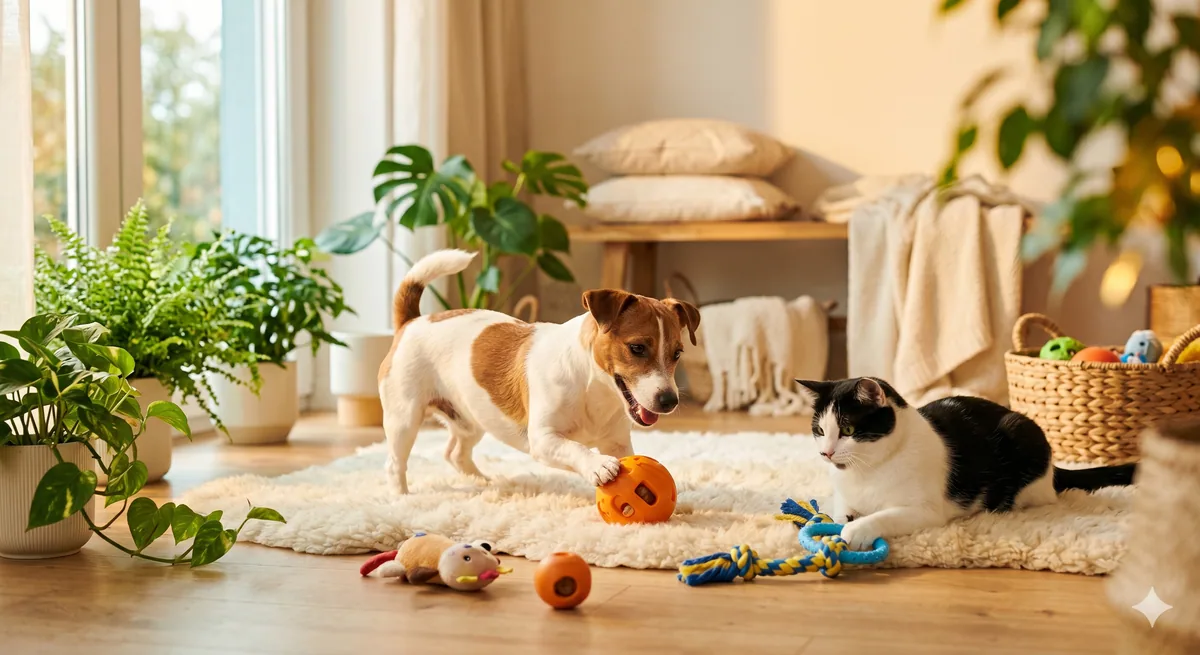
A treat-dispensing rolling ball requires the dog to nudge, nose, and bat it across the floor to release kibble through an adjustable opening. Unlike a static puzzle feeder, the rolling ball gets a small dog moving around the room - providing a light cardio element alongside the cognitive challenge. Use it to replace one meal per day entirely, turning a 90-second food bowl interaction into a 20-minute enrichment session. Choose a ball sized to your dog - too large and small dogs cannot move it effectively; too small and there is a choking risk. Most brands offer a Small or Mini variant specifically for dogs under 15 lbs.
Browse our dog toys collection for a curated selection of enrichment toys, puzzle feeders, and treat dispensers scaled for small breeds. Every US order ships free. For additional guidance, see the ASPCA dog care guidelines.
How to Choose the Right Interactive Toy for Your Small Dog
Not every interactive toy is suitable for every small dog. The wrong choice can lead to frustration, disengagement, or safety risks. Use the following criteria to narrow your selection.
Different breeds have different needs. Our best dog toys for large breeds guide helps you choose.
Size and Scale
This is the most critical factor. Toys designed for medium or large breeds carry genuine choking hazards for small dogs - removable parts, large balls, or wide opening dispensers sized for a Labrador's mouth can become dangerous in a Chihuahua's. Conversely, toys designed for very tiny toy breeds may be too small for a moderately sized small dog like a Cocker Spaniel. Always check the manufacturer's weight recommendation, and choose toys where all components - including any dispensed treats - are larger than the dog's oral cavity when open wide.
Difficulty Level
Starting too hard is the most common mistake with puzzle toys. A dog who encounters a puzzle beyond their current problem-solving experience will attempt it briefly, fail, and develop a negative association with puzzle toys that is difficult to reverse. Always start at Level 1, regardless of how intelligent you believe your dog to be. The concept of "moving things to reveal food" is not intuitive to all dogs - many need several sessions at an easy level before the mental model clicks. Graduate difficulty in small increments, and measure engagement by whether the dog persists for a full session rather than abandoning the toy.
Material Safety
Small dogs are persistent chewers relative to their size. For rubber toys, choose natural rubber or certified non-toxic synthetic rubber (such as Zogoflex). For plush toys, look for reinforced seams and enclosed squeakers that cannot be easily extracted. Avoid toys with small glued-on eyes, buttons, or plastic accessories that can be chewed off and swallowed. For puzzle feeders, check that the plastic is BPA-free and food-grade. Always retire any toy that develops sharp edges, cracks, or begins shedding material.
Solo vs. Supervised Play
Some interactive toys are designed for unsupervised solo play - treat-dispensing balls, frozen KONGs, snuffle mats, and LickiMats are all safe to leave with a dog unattended. Others require supervision: tug toys, flirt poles, and plush puzzle toys with removable small parts should only be used when you are present to intervene if the dog begins destroying them. Build your enrichment routine around both categories so your small dog is covered during both supervised play sessions and periods when you are unavailable.
Always inspect interactive toys before each session. Small breeds can destroy toys faster than their size suggests. A compromised toy - cracked rubber, torn seams, detached parts - should be retired immediately, as swallowed fragments can cause intestinal blockages requiring emergency veterinary care.
The 7-Day Toy Rotation System
Even the best interactive toy loses its novelty if it is available every day. Dogs habituate to familiar objects quickly - the same neural pathways fire, the same reward is delivered, and engagement drops. A structured rotation system preserves novelty, maintains motivation, and prevents your small dog from becoming bored with their entire enrichment library simultaneously.
The principle is simple: keep only two or three toys available at any given time, rotating the full library on a weekly cycle. This means a toy that was "new" a week ago feels fresh again when it reappears. Below is a sample 7-day rotation framework based on the 14 toys listed in this guide.
| Day | Morning Session | Evening Session |
|---|---|---|
| Monday | Dog Smart puzzle (meal replacement) | Snuffle mat (treat scatter) |
| Tuesday | Frozen KONG (solo while owner is out) | Mini flirt pole (supervised, 5 min) |
| Wednesday | Fun Feeder Slo-Bowl (breakfast) | Dog Tornado puzzle |
| Thursday | Treat-dispensing rolling ball (meal) | LickiMat (wind-down before bed) |
| Friday | Twist 'n Treat (solo play) | Hide-A-Squirrel (supervised, plush) |
| Saturday | West Paw Tux (stuffed, outdoor) | Tug-E-Nuff mini tug (training session) |
| Sunday | ZippyPaws Burrow toy (supervised) | Automatic ball launcher (indoor fetch) |
Adapt this schedule to your dog's routine and energy levels. The key principles are: vary the toy type each session, keep most of the library stored away and out of sight, and reintroduce toys after at least 3-4 days of absence. You will notice that toys your dog seemed to lose interest in become exciting again after a brief rotation break.
Over time, increase the difficulty of puzzle sessions as your small dog's problem-solving improves. Introduce one new toy every 4-6 weeks to refresh the rotation without overwhelming your budget. For puppies building their enrichment vocabulary for the first time, see our guide to the best toys for puppies for age-appropriate starting recommendations.
Store off-rotation toys in a closed box or cupboard rather than in the dog's toy basket. A toy your dog can see but not access can create frustration. Out of sight genuinely means out of mind - and that makes reintroduction far more exciting.
Frequently Asked Questions
Should I consult a veterinarian about my pet's play and enrichment needs?
Yes, especially if your pet shows signs of anxiety, sudden behavior changes, or destructive habits that may indicate a medical issue. A licensed veterinarian or veterinary behaviorist can rule out pain, dental problems, or cognitive decline before you adjust toys or routines. The guidance in this article is educational, not a substitute for professional veterinary advice.
How long does it take to see results from new toys or enrichment?
Most pet owners notice small changes within a week (calmer evenings, less destructive chewing, more interest in mealtime puzzles) and clearer behavior shifts within 4 to 6 weeks of consistent rotation. Older pets and rescues may take 8 to 12 weeks to adjust. Keep a short weekly journal so you can track real progress instead of relying on memory.
2026 Search Intent Refresh: What to Check Before You Buy
Shoppers searching for interactive dog toys for small breeds usually want a quick product shortlist, proof that the toy fits their pet's size and play style, and a clear safety tradeoff. Use this section as a fast buying filter before comparing individual products.
Related searches we are answering on this page include small dog puzzle toys, enrichment toys for small dogs. The strongest pages in this topic cluster combine product comparisons, safety guidance, and internal paths to deeper dog toy categories.
| Option | Best role | Buyer check |
|---|---|---|
| Lightweight puzzles | Primary match | Compare size, material, supervision needs, and replacement timing before buying. |
| Small plush toys | Good alternative | Compare size, material, supervision needs, and replacement timing before buying. |
| Soft tug toys | Add-on pick | Compare size, material, supervision needs, and replacement timing before buying. |
Fast path: if you already know the toy type, go straight to Find small-dog enrichment toys. If you are still comparing intent, read the adjacent guides on indestructible toys, interactive dog toys, and chew toys.
Conclusion
Picking the right option for your dog is less about finding a single "best" product and more about matching the choice to your dog's size, age, play style, and your home environment. The recommendations above cover the main scenarios most pet owners run into, so use them as a checklist when comparing options.
Start with one or two changes, watch how your dog responds for a week or two, then iterate. Pets show you very quickly what works for them. If a toy, feeder, or routine is ignored or causes stress, swap it out without hesitation. The goal is a happier, healthier dog every day.