If you are looking for the best seresto collar for puppies, this comprehensive guide covers everything you need to know. Whether you are a first-time pet owner or an experienced one looking to upgrade, you will find practical advice, safety tips, and honest comparisons below.
Can Puppies Wear a Seresto Collar? The Short Answer

Yes, but only once a puppy has reached the age and weight the label allows. The EPA-accepted label for Seresto (EPA Reg. No. 11556-155, product name PNR1427 Insecticide, brand names Seresto Small Dog and Seresto Large Dog) states plainly: "Do not use on puppies under 7 weeks of age." That single line is the rule, not a general guideline, because Seresto is registered with the EPA as a pesticide product, and using it outside the label is a violation of federal law under FIFRA.
Past that age threshold, sizing takes over. The label splits the product into two collars by body weight rather than by age: Seresto Small Dog covers small dogs and puppies 7 weeks of age and older up to 18 lb (8 kg), and Seresto Large Dog covers large dogs and puppies 7 weeks of age and older above 18 lb (8 kg). A fast-growing large-breed puppy can cross that 18 lb line in a matter of weeks, so weight, not just age, decides which collar goes on the shelf.
The source for every age, weight and duration figure in this article is the Seresto product label itself, most recently amended by the EPA on July 13, 2023 and published at the EPA's own pesticide product label archive.
Minimum Age and Weight: What the Seresto Label Actually Says
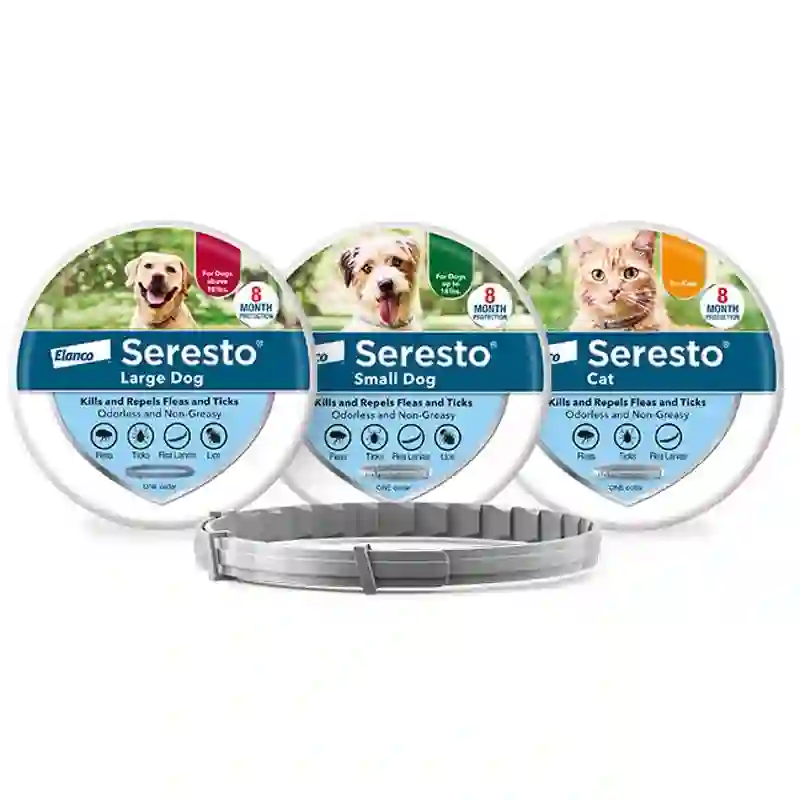
Seresto's active ingredients are flumethrin (4.5% by weight) and imidacloprid (10.0% by weight), combined in what the label calls a polymer matrix that releases both substances slowly onto the skin and coat for up to 8 months. The label's own marketing language for the two collars is worded almost identically apart from the weight cutoff: the Small Dog collar is "for 8-month prevention and treatment of ticks, fleas, and lice on small dogs and puppies 7 weeks of age and older and up to 18 lbs", and the Large Dog collar is "for 8-month prevention and treatment of ticks, fleas and lice for 8 months on large dogs and puppies 7 weeks of age and older and above 18 lbs".
For more expert recommendations, check out our martingale collar guide.
The official Elanco product photo below shows how the three retail packages are differentiated on shelf: Large Dog, Small Dog, and a separate Cat collar, each stamped with its own weight range and the same 8-month protection claim.
There is no separate "puppy" version of the collar. A puppy over 7 weeks old wears the same Small Dog or Large Dog collar an adult dog of the same weight would wear. That is also why the label tells owners to weigh the puppy, not guess from its breed or litter size, before choosing between the two boxes.
How a Seresto Collar Protects a Growing Puppy
According to the label, the collar kills fleas already on the dog within 24 hours of the first application. After that first day, any new flea that gets on the puppy is killed within 2 hours, and that fast turnaround is what keeps a flea population from building up on the dog for as long as the collar remains within its 8-month window.
Ticks work on a slightly longer clock. The label states that prevention of new tick infestations begins 48 hours after the collar goes on, and once that 48-hour mark has passed, any new tick that attaches is repelled or killed in as little as 6 hours. Ticks already attached before the collar was fitted are not necessarily killed right away, so the label instructs owners to remove any ticks found on the puppy at the time of application rather than assume the collar will clear them.
One detail worth knowing before a first-time flea season: the label notes that pre-existing flea pupae already living in the house, carpet or bedding can keep emerging for six weeks or longer after treatment starts, regardless of the climate. A puppy owner who sees an occasional flea in the first month and assumes the collar has failed is usually seeing the tail end of an existing household population hatch out, not a new infestation getting past the collar.
Fitting a Seresto Collar on a Puppy That Is Still Growing
The application steps on the label are the same for every dog: thread the end of the collar through the buckle, adjust it around the neck without pulling it tight, and use two fingers as the fit gauge, comfortably sliding between the collar and the neck. The label then adds language that only matters for a puppy: cut the excess collar to no more than one inch (2 cm) past the loop, "unless it is on a growing puppy where some additional length may be needed for adjustment as the animal grows."
You might also find our dog and leash article helpful when shopping.
That is a direct instruction to leave slack on a puppy's collar rather than trim it flush the way you would on a fully grown dog. The label follows up with a second puppy-specific line under wear instructions: check the fit periodically and adjust it if necessary, "especially when puppies are rapidly growing." A collar fitted correctly at 10 weeks can be too tight by 14 weeks on a fast-growing breed, so this is not a one-time check.
The collar is not designed to double as a walking collar or leash attachment point. The label states plainly not to attach a leash to the collar, because doing so may cause it to break. A puppy still needs its own separate everyday collar or harness for walks and identification tags; the Seresto collar stays dedicated to flea and tick control.
If a puppy loses the collar, the label allows a new one to be applied immediately rather than waiting out any interval.
Bathing, Swimming and the 8-Month Countdown
Puppies get bathed more often than most adult dogs, whether that is a real bath or an accidental swim in a backyard pool, and the label is specific about what that does to the 8-month protection window. The collar is described as water resistant and remains effective after a shampoo, swimming, rain or sunlight exposure under normal conditions, but the full 8-month duration depends on the dog not being bathed more than once a month.
For a puppy that swims or is bathed once a month or more, the label states the control duration is reduced: flea control drops to 5 months and tick control drops to 7 months instead of the full 8. That is a meaningful gap for an owner who assumed the collar was good for 8 months regardless of bathing habits, and it is worth marking a shorter replacement date on the calendar if a puppy is being bathed frequently during house-training or a wet summer.
Side Effects to Watch For and When to Call the Vet

The label notes that occasional scratching is normal in the first few days after fitting, particularly in an animal not used to wearing a collar of any kind, and that slight hair loss or mild skin reactions at the application site usually clear up within 1 to 2 weeks without needing to remove the collar. If a puppy is scratching persistently at the neck rather than settling down after those first few days, that crosses from expected adjustment into something worth watching.
Looking for more options? Our dog gps tracker roundup covers additional top picks.
The label lists adverse events reported to the EPA in decreasing order of frequency: pruritus (itchy skin), vomiting, lethargy, behavioral disorders, application site reactions such as dermatitis, inflammation, eczema, alopecia or lesions, anorexia, hyperactivity, muscle tremor, vocalization, convulsion, and ataxia, meaning problems with balance and coordination. The instruction is direct: remove the collar if these symptoms occur and consult a veterinarian. Because puppies are smaller and often more sensitive to any new product than an adult dog, owners are usually advised to check the collar site daily during the first week rather than only glancing at it occasionally.
The label also asks owners to consult a veterinarian before using the product on debilitated, aged, breeding, pregnant or nursing animals, and before using it on any dog that is already on other medication. That applies to a nursing mother in the same household as puppies even once the puppies themselves are old enough for their own collar. Keep the collar and its packaging on hand if you ever need to call a vet or poison control line, since the active ingredient names are printed there.
Because the collar contains small parts and is treated with a pesticide, the label is explicit that children should not be allowed to play with the collar or put it in their mouths, and that hands should be washed with soap and cold water after fitting or adjusting it, which is worth building into the routine in a household where kids help take care of a new puppy.
Seresto Small Dog vs. Large Dog: Which One Fits Your Puppy
Weigh the puppy on the day you buy the collar rather than relying on a breed chart, since littermates in the same breed can fall on either side of the 18 lb line by a few weeks apart. If a puppy is close to the cutoff and still growing, recheck its weight before the collar is due for replacement, because a puppy that was a Small Dog fit at 7 weeks may need the Large Dog collar for its next one.
If you want to dig deeper into the research, the ASPCA pet care library publishes practical, expert-reviewed resources for pet owners.
Frequently Asked Questions
What is the minimum age for a puppy to wear a Seresto collar?
Seven weeks. The EPA-accepted label states "Do not use on puppies under 7 weeks of age" for both the Small Dog and Large Dog versions. There is no separate minimum age for the two sizes, only a minimum age for the product as a whole.
Which size Seresto collar does my puppy need?
It depends on weight, not age or breed. The label assigns the Small Dog collar to puppies 7 weeks and older up to 18 lb (8 kg), and the Large Dog collar to puppies 7 weeks and older above 18 lb (8 kg). Weigh the puppy at the time of purchase, since fast-growing breeds can cross that line within weeks.
How tight should a Seresto collar be on a puppy?
Loose enough that two fingers slide comfortably between the collar and the neck. The label also tells owners not to cut the excess collar flush the way they would on an adult dog: leave extra length on a growing puppy for future adjustment, and recheck the fit periodically as the puppy grows.
Can I clip a leash to my puppy's Seresto collar?
No. The label states not to attach a leash to the collar because it may cause the collar to break. Keep a separate everyday collar or harness on the puppy for walks and ID tags, and leave the Seresto collar doing only its flea and tick job.
Is it normal for my puppy to scratch after a Seresto collar is fitted?
Some scratching in the first few days is described on the label as normal, especially in an animal not used to wearing a collar, and mild hair loss or skin reaction at the site usually clears within 1 to 2 weeks. Scratching that does not settle down, or that is accompanied by vomiting, lethargy, tremor or loss of balance, means the collar should come off and a veterinarian should be consulted.
Does bathing or swimming shorten how long a Seresto collar protects my puppy?
Yes, if it happens often. The label states the full 8-month duration holds as long as the dog is not bathed more than once a month. Puppies bathed or swimming once a month or more see the duration drop to 5 months for flea control and 7 months for tick control.
What should I do if my puppy's Seresto collar comes off?
The label allows a new collar to be applied immediately if the original is lost. It is also worth rechecking the fit at that point, since a collar that came off on a puppy is sometimes a sign it was already due for loosening as the puppy grew.
Browse Accessories
Free worldwide shipping on every order. No minimum purchase required.
Browse Accessories →