The safest dog and leash setup is a matched system: a fixed-length leash with dependable hardware, attached to a correctly fitted collar or harness that suits the dog, handler, and walking environment. There is no single perfect product for every pair. Safe selection means considering size, strength, anatomy, escape risk, weather, visibility, and the amount of close control the route requires, then inspecting every connection before leaving home.
In This Article
Think of a Dog and Leash as One Safety System
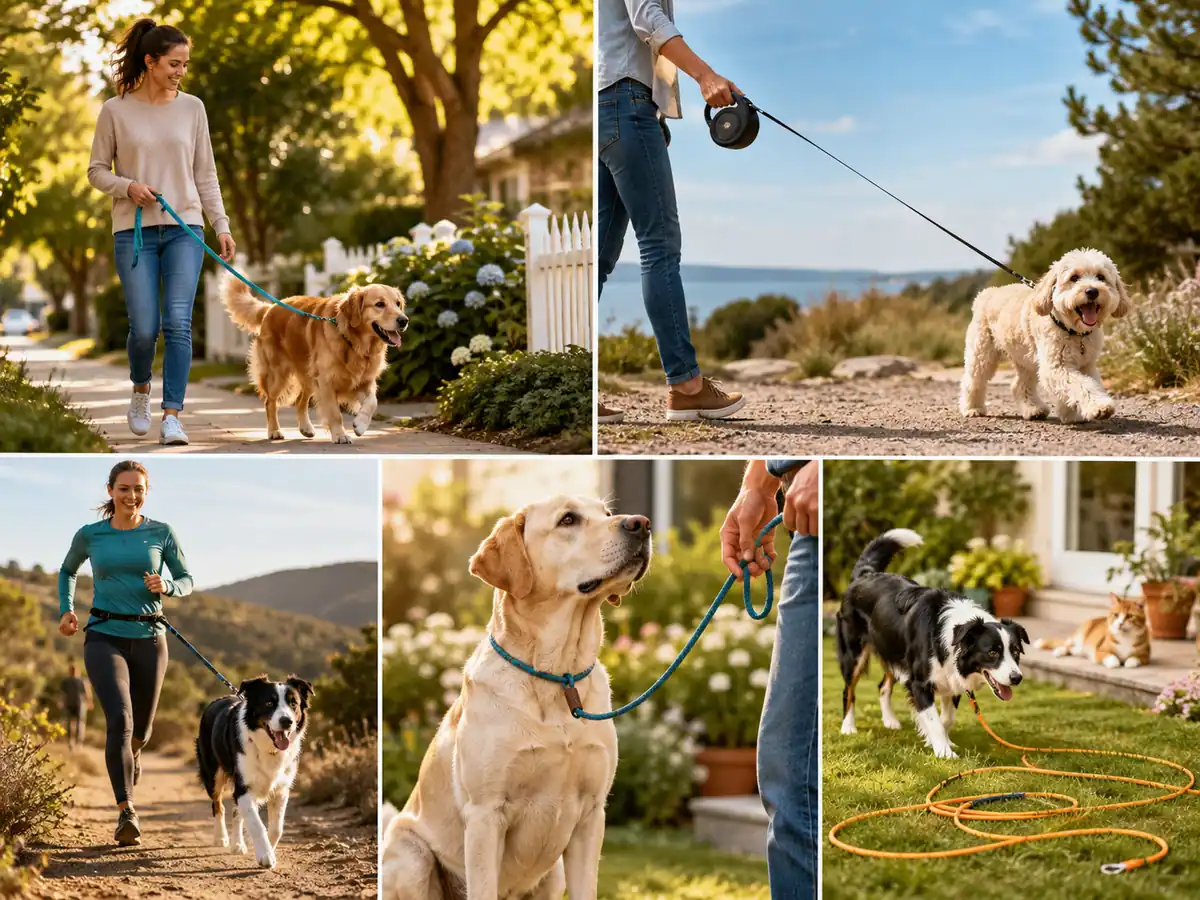
A leash is only as secure as its weakest connection. Strong webbing cannot compensate for a clip that does not close, a D-ring with a cracked weld, a harness the dog can reverse out of, or stitching that has begun to separate. Evaluate the complete path from the dog’s body to your hand: garment or collar, attachment ring, leash clip, leash material, seams, and handle.
The American Kennel Club’s overview of choosing the right dog leash describes different materials and formats and stresses matching the leash to its use. That is more useful than choosing on color or a broad weight label alone. A compact dog who chews the line may need a different material than a large, calm dog. A crowded urban sidewalk calls for different reach than an open, permitted trail.
Walking equipment is safety gear, not a training program. This guide focuses on selection, fit, hardware, inspection, and route readiness. If pulling, fear, or reactivity makes walks unsafe, equipment may improve management, but a qualified reward-based professional should address the behavior itself.
Choose the Right Leash Type and Length
A fixed-length leash is the practical everyday default for many dog and handler teams. Its consistent length helps the handler know how much reach is available, and the broad flat material is generally easy to hold and inspect. Common materials include nylon webbing, polyester, rope, leather, coated webbing, and chain. Each has tradeoffs in grip, water absorption, weight, flexibility, visibility, and resistance to chewing or abrasion.
Length should follow context. A shorter leash can help maintain a compact footprint near traffic or in busy public space, provided it does not keep the line continuously tight. A longer fixed leash gives more sniffing room in uncrowded settings. A long line is specialized equipment for open areas where it is allowed and where the line will not wrap around people, dogs, brush, or street furniture. Gloves, deliberate line handling, and a harness attachment can reduce some risks, but sudden high-speed stops remain hazardous.
Retractable leashes are not simply longer fixed leashes. Their cord or tape extends and retracts through a spring-loaded handle, creating variable reach and often continuous light tension. The thin line can entangle skin or limbs, the handle can be dropped, and the dog may be far away before the handler can respond. They are a poor choice where close control is essential. If one is used in a suitable open setting, the handler must understand the mechanism and inspect it carefully.
Hands-free and multi-connection designs deserve the same risk assessment. A waist attachment may be convenient, but it can transfer a sudden load to the handler’s body and increase fall risk. Quick-release parts must not open accidentally. Double-ended leashes can connect to two harness rings or provide redundancy, but added straps can tangle. Convenience is valuable only when it does not weaken control.
| Leash style | Best suited to | Main advantages | Watch for |
|---|---|---|---|
| Fixed-length flat leash | Most neighborhood walks and shared paths | Predictable length, direct handling, simple inspection | Frayed webbing, weak stitching, poor handle comfort |
| Long line | Open-space exploration where permitted | More freedom while maintaining a physical connection | Entanglement, rope burn, sudden stops, nearby people |
| Double-ended leash | Compatible harnesses with two attachment points | Flexible connection and possible backup attachment | Complexity, twisting, incompatible ring placement |
| Hands-free leash | Suitable dogs and handlers in low-risk settings | Keeps hands available and can support steady routines | Fall risk, poor quick-release design, unsafe waist loading |
| Retractable leash | Limited controlled settings with experienced handling | Variable roaming distance | Thin cord, dropped handle, changing tension, delayed close control |
Choose Between a Collar and a Harness Attachment
A flat collar provides a place for identification and may serve as a leash attachment for some dogs. It should be smooth, appropriately wide, in sound condition, and fitted so the dog cannot slip out. Neck attachment may be unsuitable for dogs with airway disease, neck or spinal pain, certain eye concerns, or anatomy that makes escape likely. A veterinarian can advise when medical factors affect equipment choice.
A harness distributes contact over the torso, but design and fit vary widely. A Y-shaped front that follows the chest and leaves the shoulder area free may allow more natural movement than straps that cross restrictive areas, though individual structure matters. The girth strap should sit behind the front legs without rubbing the armpits. Buckles should not press on the spine or a bony point, and leash tension should not rotate the harness dramatically.
Front-clip, back-clip, and dual-clip harnesses alter where leash force is applied. A front ring may help a handler redirect the dog’s body, while a back ring often keeps the leash clear of the legs. Neither attachment automatically stops pulling or teaches walking skills. Check whether the selected ring and webbing are intended by the manufacturer as a primary load-bearing point.
Dogs with narrow heads, deep chests, thick coats, or a history of backing out may need an escape-resistant design with an additional body strap or a correctly configured safety backup. More straps are not automatically safer. Each must lie flat, permit normal gait and breathing, and remain secure when the dog moves backward. Our overview of a dog with a harness provides additional points to consider.
Measure, Fit, and Recheck Every Contact Point
Use the manufacturer’s size chart and measure the locations it specifies with a flexible tape. Weight alone cannot predict fit because two dogs at the same weight may have very different necks, chests, and proportions. Measure over the coat as the equipment will be worn. If the dog falls between sizes, contact the manufacturer rather than assuming the larger or smaller option will adjust safely.
The familiar two-finger check can be a quick starting point for many flat collars, but it is not a universal rule. Finger size, coat thickness, strap width, and dog anatomy vary. The more meaningful test is that the gear stays in position without restricting breathing, swallowing, shoulder movement, or gait. You should see no pinching, hair pulling, redness, or repeated scratching.
Test a harness indoors before the first walk. Let the dog stand, sit, turn, lower the head, and walk. Check behind the elbows, across the sternum, around the neck opening, beneath buckles, and along strap edges. Apply gentle pressure in the direction the dog might pull or back out, without frightening the dog. If the neck opening slides over the head or a leg can pass through an opening, refit or select another design.
Fit is not permanent. Puppies grow, adults gain or lose weight, seasonal coats change, and webbing can loosen. Recheck after grooming, bathing, a coat change, or any weight change. Marking an adjustment position with a small stitch on non-load-bearing excess webbing can make movement easier to notice, but never alter structural seams.
Match Clips, Rings, and Connectors to the Dog
Common leash clips include bolt snaps, trigger snaps, and locking carabiner-style connectors. Names alone do not establish quality. Examine material, gate design, spring action, opening size, swivel construction, corrosion resistance, and the manufacturer’s stated use. The hardware should be proportionate: overly heavy clips can strike or burden a small dog, while undersized clips may not tolerate a large dog’s force.
Operate the gate repeatedly before use. It should open smoothly and return to a fully closed position without help. Dirt, sand, hair, salt, and moisture can interfere with springs and swivels. A clip that sticks once is not reliable enough for a walk until cleaned and confirmed safe, and any bent, cracked, sharply worn, or corroded piece should be retired.
Attachment rings deserve equal attention. A welded metal ring should not show a gap, deformation, deep wear, or rust. Fabric loops should have intact load-bearing stitching. Plastic accessory loops may be intended only for tags or lights, not leash force. Read the product instructions rather than assuming every loop is structural.
A locking backup connector can add redundancy for an escape-risk dog, but only if it is suitable for the load and connected to independent secure points. Novelty carabiners may have no useful strength rating. The backup should not crowd the primary clip gate, press into the dog, or create a snag. For more on identification hardware, see our dog tags guide.
Complete a 60-Second Pre-Walk Safety Inspection
Inspect equipment before every walk, not after it fails. Run your fingers along both sides of the leash, paying close attention near the clip and handle where repeated bending concentrates wear. Look for fraying, cuts, melted fibers, tooth marks, stiff areas, stretching, thinning, and color changes that may reveal abrasion. Flex leather gently and check for deep cracks or weakened stitching.
Check every seam and load-bearing bar tack. Loose decorative stitching may be cosmetic, but separation at a handle, clip loop, or harness junction is a reason to stop using the item. Pull moderately on adjustments to confirm they do not slide. Close all buckles and listen or feel for full engagement, then tug each side. Inspect hidden surfaces under padding where wear can be missed.
Confirm the dog’s identification is present and legible. A collar tag and registered microchip serve different roles and work well together. Update phone numbers after a move or account change. At dawn, dusk, or night, add visible reflective or illuminated elements without attaching heavy accessories to a weak tag loop.
Finish with the handler side. Untangle the leash before opening the door, put the handle securely in hand, store the phone, and distribute bags and treats so they do not compete with your grip. Avoid wrapping a leash tightly around fingers, wrist, or hand because a sudden pull can cause injury. Choose footwear and a route appropriate to the surface and weather.
| Checkpoint | Pass condition | Replace, refit, or repair if |
|---|---|---|
| Leash body | No cuts, fuzzing, melted spots, chew marks, or thinning | Fibers are damaged or material has become stiff or brittle |
| Handle and stitching | Seams are tight and handle lies flat without tears | Threads are loose, seam separates, or padding shifts |
| Clip and swivel | Gate closes fully and swivel rotates without sticking | Gate is bent, spring is weak, or corrosion is visible |
| Collar or harness | Secure fit with normal breathing and free movement | Dog can back out, straps rub, or adjustments slide |
| ID and visibility | Tag is legible and reflective gear is clean and visible | Contact details are outdated or reflective surface is worn |
| Handler readiness | Leash is organized, route chosen, essentials secured | Hands are overloaded or conditions exceed safe control |
Adapt the Walking Setup to Weather, Traffic, and Trails
Urban sidewalks favor visibility and close, predictable reach. Inspect the route for broken glass, hot pavement, deicing chemicals, narrow corners, uncontrolled driveway exits, and places where the leash could catch. Reflective webbing or a light can help others see the team, but lighting does not replace situational awareness. Keep the dog on the side away from moving traffic when practical.
Heat, cold, rain, and salt affect equipment and the dog. Wet materials may become slippery, heavy, stiff, or prone to mildew. Metal hardware can become very hot or cold. Rinse salt and grit after walks, dry gear fully away from direct high heat, and check skin beneath damp straps. Waterlogged padding that remains against the body can promote rubbing.
Trails require preparation beyond buying a longer leash. The National Park Service advises visitors to check the specific park’s rules before arriving because pet access differs by site. Its pet visit guidance emphasizes planning, leash compliance, waste disposal, and protecting pets and wildlife. Some trails, buildings, beaches, or backcountry areas do not allow pets even when other park areas do.
In wildlife habitat, a leash protects more than the dog. It reduces chasing, close encounters, habitat disturbance, and the chance of approaching hazardous plants, cliffs, or water. Keep enough control to prevent greetings with wildlife or unfamiliar dogs. Pack water and waste bags, know the turnaround point, and leave if conditions exceed the dog’s physical ability or equipment capacity.
Plan for Puppies, Seniors, Small Dogs, and Escape Risks
Puppies need lightweight gear that is checked frequently as they grow. A clip that seems modest to an adult dog may pull heavily on a very small puppy. Introduce wearing and handling gradually in a calm setting, and prevent chewing on the leash because hidden internal damage can remain after surface tooth marks appear. Replace gear rather than waiting for a growing puppy to exceed its adjustment range.
Senior dogs may have arthritis, weakness, vision loss, or changing balance. Choose easy-to-operate buckles and padding that does not create pressure, but avoid bulky equipment that alters gait. Shorter, familiar routes may be safer than adding restraint. A veterinarian or rehabilitation professional can help assess support harnesses, lifting handles, or mobility needs.
Small dogs need appropriately light clips, narrow but strong webbing, and hardware that does not swing against the legs. Large or powerful dogs need material and seams suitable for expected force, but handler capability is equally important. A very strong system can still be unsafe if the handler cannot maintain balance. Another capable adult or behavior professional may be needed while underlying walking issues are addressed.
For an escape-risk dog, use layered prevention. A properly fitted escape-resistant harness may be paired with a separate collar through a suitable safety connector, provided neither restricts movement. Secure doors and gates before changing equipment, attach the leash before exits open, and keep microchip details current. Practice handling in a closed indoor space before relying on a new configuration outdoors.
Clean, Store, and Replace Walking Gear Responsibly
Follow the maker’s cleaning instructions because heat, bleach, solvents, and machine agitation may damage fibers, coatings, leather, reflective strips, or hardware. Remove loose dirt, wash with compatible products, rinse thoroughly, and air-dry completely. Do not return damp gear to a closed bin. Saltwater exposure deserves prompt fresh-water rinsing, especially around springs and swivels.
Store leashes away from dogs who chew them, direct sunlight, heaters, and sharp tools. Hang or loosely coil them so clips are not trapped under weight and coated materials are not sharply kinked. Keep a clean backup setup that has already been fitted and inspected. An unknown old leash at the bottom of a drawer is not an emergency plan.
Replacement should be condition-based, not calendar-based. Usage frequency, dog strength, chewing, surface abrasion, climate, storage, and construction all affect lifespan. Retire equipment immediately when load-bearing material or hardware is compromised. Do not knot a damaged leash, tape over fraying, or rely on glue at structural seams.
Before each outing, make the final decision based on the whole system and current conditions. The right dog and leash pairing feels secure in your hand, stays comfortably fitted through normal movement, uses sound hardware, suits the route, and passes inspection. This simple routine provides more safety value than chasing a universal “best” product.
Evidence trail: Equipment choice and training method should be evaluated together. For deeper reading, review the comparative welfare study archived by the U.S. National Library of Medicine, the Frontiers analysis of electronic-collar versus reward-focused training, and the AKC safety guidance for retractable leashes. They reinforce why a predictable fixed leash and reward-based practice are sensible defaults.
Frequently Asked Questions
What type of leash is safest for everyday dog walks?
A sturdy fixed-length leash is a practical default for most everyday walks because it provides a consistent connection and is easy to inspect. Choose a width, material, handle, and clip appropriate to the dog’s size, strength, environment, and handler.
Should I attach the leash to a collar or a harness?
Either may work for some dogs, but the choice depends on anatomy, health, escape risk, and walking conditions. A well-fitted harness can distribute force across the torso, while a flat collar is useful for identification. Ask a veterinarian for guidance if the dog has neck, airway, eye, spine, or mobility concerns.
How tight should a dog collar or harness be?
It should be snug enough to resist escape but not restrict breathing, shoulder motion, or normal movement. Use the maker’s fitting instructions, check every contact area, and reassess after weight or coat changes. A two-finger check is only a starting point, not a universal guarantee.
Are retractable leashes safe?
Retractable leashes introduce a long thin line, changing tension, and a bulky handle, so they require careful environment and risk assessment. They are generally a poor fit for crowded sidewalks, road edges, shared trails, veterinary waiting areas, or any place where close control is needed.
How often should I inspect a dog leash?
Give the full setup a quick check before every walk and a more detailed inspection regularly. Look for cuts, fraying, chewed sections, loose stitching, cracks, corrosion, bent gates, sticking swivels, and adjustment points that slide under pressure.
Can I use a carabiner to back up a leash clip?
A locking connector rated for the expected load can provide a backup when correctly positioned, but an unknown novelty carabiner should not be treated as safety equipment. A backup must not create tangles, pinch the dog, interfere with clip closure, or replace worn primary hardware.
What should I carry on a dog walk?
Carry waste bags, identification, water when conditions or distance warrant it, and any medical supplies your dog needs. A charged phone and a small light or reflective element can improve preparedness. Bring only items you can manage without compromising your grip on the leash.
Prepare for Safer Everyday Walks
Browse practical dog accessories and review fit and hardware before use.
Browse Dog Accessories →