A herding ball is an oversized ball that a dog pushes, drives and chases with its nose and shoulder instead of carrying it in its mouth. It gives herding breeds a safe outlet for the urge to gather and move things, and it is the equipment behind the dog sport Treibball. The right one is too big for your dog to bite, tough enough for rough play, and used on grass or another soft, open surface. This guide covers how to choose a herding ball, how to teach pushing, and how the sport works, using guidance from the American Kennel Club and the Treibball rules summarized on Wikipedia.
Published October 2, 2026. Header photo: Eva Holderegger Walser / Wikimedia Commons, CC BY-SA 3.0, cropped and resized. An Australian Cattle Dog named Mayumi circles a large turquoise herding ball on a dirt field.
In This Article
- The Short Answer
- What a Herding Ball Is For
- Which Dogs Enjoy Herding Balls?
- How to Choose a Herding Ball
- Getting the Size Right
- Teaching Your Dog to Push the Ball
- Treibball: The Sport Built on Herding Balls
- Safety Rules for Herding Ball Play
- Fitting Herding Ball Play Into Your Week
- Frequently Asked Questions
- Sources
The Short Answer
- Buy big. A herding ball should be too large for your dog to grab in its jaws. Competition Treibball balls run from 45 to 75 centimeters across.
- Choose the shell to match the dog. Hard plastic balls stand up to nipping; inflatable exercise balls are lighter and gentler for beginners but puncture more easily.
- Teach it, do not assume it. The AKC points out that pushing a ball with the nose or shoulder is not instinctive; it has to be trained.
- Any breed can play. Herding breeds have an edge, but the AKC has seen Labradors, Papillons, Cairn Terriers, Rottweilers and even a Pug take part.
What a Herding Ball Is For
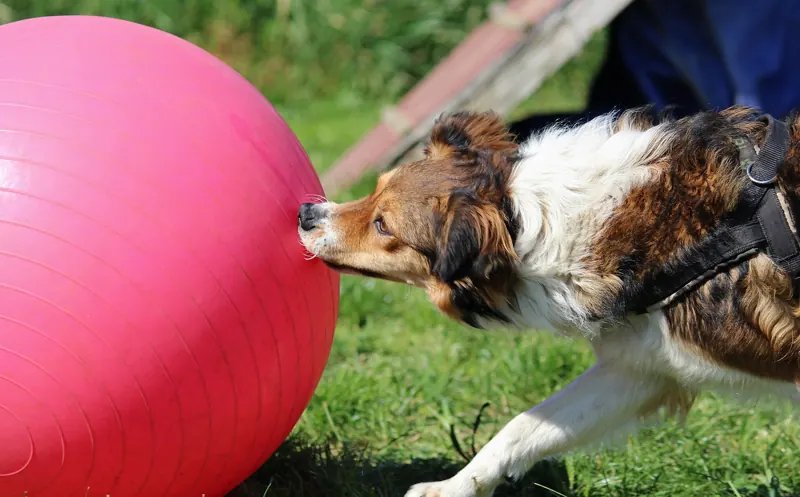
Herding dogs were bred to move livestock: to circle, drive, stop and turn animals much bigger than themselves. In a city apartment or a suburban yard, that drive often leaks out as nipping at running children, circling other dogs, or chasing bikes. A herding ball gives the dog something large and legitimate to move. The dog cannot pick the ball up, so it has to use the same pushing and steering movements it would use on sheep.
That is exactly the idea behind Treibball. According to the Wikipedia article on Treibball, Dutch trainer Jan Nijboer created the sport in Germany in 2005 to keep herding dogs active where real livestock work is not possible, such as in urban areas. The large balls used in the sport are nicknamed rolling sheep. You do not need to compete to benefit, though. A single herding ball in the backyard can turn a restless afternoon into a real job for your dog.
Herding ball play also works the brain as much as the legs. The dog has to judge angles, control speed, and keep the ball going where it wants. For busy breeds, that kind of problem solving is often more tiring than a long walk, and it pairs well with the ideas in our guide on how to mentally stimulate a dog.
Which Dogs Enjoy Herding Balls?
The obvious fans are the herding breeds. The AKC herding program lists the breeds eligible for its herding events, including the Australian Cattle Dog, Australian Shepherd, Border Collie, Collie, German Shepherd Dog and Cardigan Welsh Corgi. These dogs often take to a ball the first time they see it rolling away from them.
But a herding ball is not only for collies. In its article on Treibball, the AKC quotes American Treibball Association president Dianna Stearns saying she has seen Labrador Retrievers, Papillons, Cairn Terriers, Rottweilers and a Pug participate. She adds that herding breeds have a slight edge, but pushing a ball is a trained skill for every dog. Good candidates are energetic, ball focused dogs, dogs with a strong herding drive, and dogs that clearly enjoy having a job.
How to Choose a Herding Ball
Herding balls come in two broad styles, and the right one depends mostly on how your dog plays with its mouth.
Hard plastic herding balls have a thick, rigid shell and are designed to be nudged, bumped and nipped outdoors. They survive teeth far better than inflatable balls, which makes them the usual choice for dogs that grab at things while playing. The trade off is weight and noise: a hard ball rolling into your ankle or a fence is not gentle.
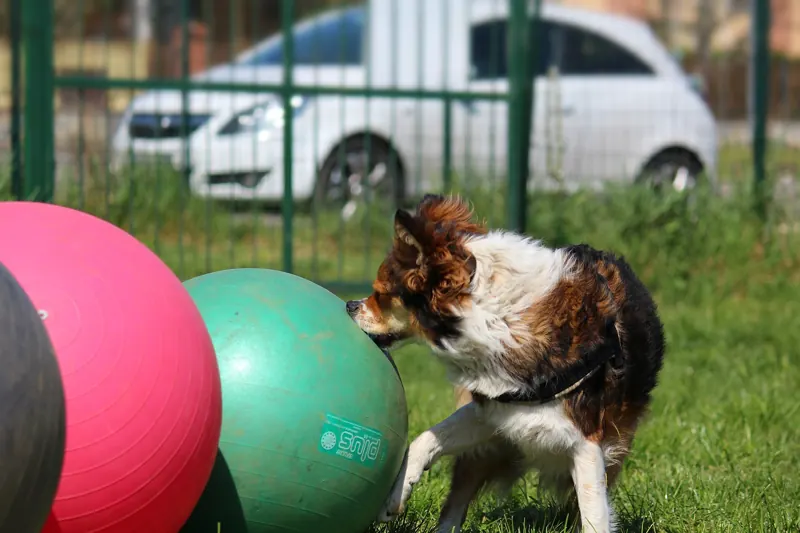
Inflatable exercise balls, the kind people use for fitness, are what many Treibball classes start with. The AKC article notes that competitors drive oversized, inflatable balls. They are light, easy to push, and soft if they bump into anyone, which makes them a good choice for learning. They will not survive a determined bite, so they suit dogs that already push rather than chew.
Whichever style you choose, look for a smooth surface without handles or holes that a jaw or paw could get stuck in, and a finish that is easy to hose down. Keep the ball as a supervised toy rather than leaving it in the yard all day, the same rule our guide to how to choose dog toys applies to anything a dog can damage.
Getting the Size Right
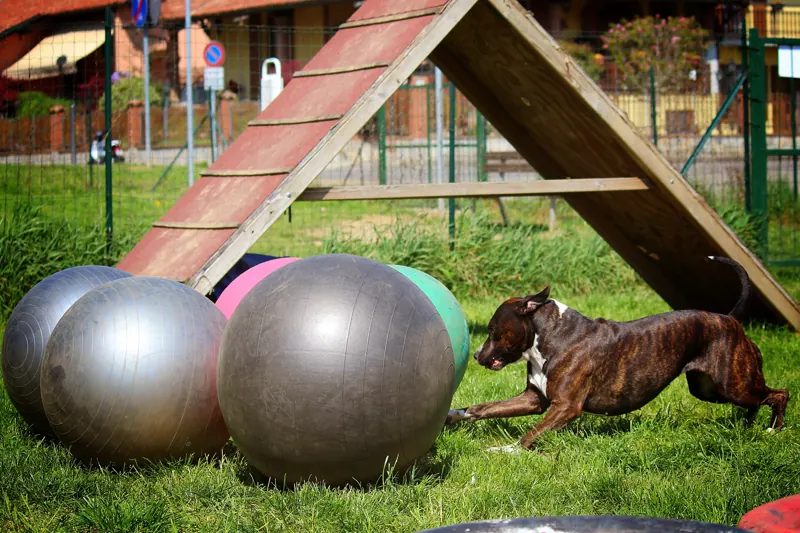
Size is the one decision that affects safety most. A herding ball must be too big for your dog to get its mouth around. If the dog can bite into the curve of the ball, it will try to carry it, which defeats the purpose and puts a lot of strain on the jaw and neck. For comparison, Treibball balls range from 45 to 75 centimeters in diameter, roughly 18 to 30 inches, according to the Wikipedia summary of the rules.
A practical way to size a ball at home is to stand it next to your dog. A ball that is at least as tall as the dog's shoulder is usually hard to grab and easy to push with the chest. Small dogs can still play with the smaller end of the range; large dogs need the bigger sizes so they cannot straddle or crush the ball. If your dog manages to get a tooth hold on the ball, go up a size.
Regular fetch balls are a different toy. They are made to be carried, and a ball that is small enough to fit in the mouth can be a choking risk for big dogs. Our guides to dog ball toys and whether tennis balls are safe for dogs cover those sizes separately.
Teaching Your Dog to Push the Ball
Because pushing with the nose is not a natural move for most dogs, it helps to break it into small steps and reward each one. Short sessions of five minutes or so keep the game fun. Use a food reward or a favorite toy, and the reward based approach from our guide to positive reinforcement dog training.
- Target a hand. Teach your dog to bump your open palm with its nose, and reward each touch.
- Move the target to the ball. Hold your hand flat against the ball, then slowly slide it away so the dog touches the ball itself.
- Reward any movement. When a nose touch makes the ball roll, even a little, reward right away. Soon the dog will bump harder to make it move.
- Add distance. Reward two pushes in a row, then three, then a push all the way to you.
- Add direction. Stand where you want the ball to go and let the dog push it to you. This is the start of driving.
- Add a stop. A reliable down or stand at a distance lets you pause the game and keep it calm.
If your dog starts to bite or dig at the ball, stop and go back a step. Biting usually means the ball is too small, or the dog is overexcited. A short break and a calmer restart work better than repeating the command.
Treibball: The Sport Built on Herding Balls
Treibball turns herding ball play into a precise, handler guided sport. In a competitive run, the dog drives eight large balls into a goal. The balls start in a triangle, a bit like billiards, and the handler stays in one spot near the goal and directs the dog with whistles, words, or hand signals. The balls have to go in a set order, and there is a time limit.
The sport spread to the United States after a 2009 video called Hund mit 8 Ballen went viral. The AKC notes that the sport needs little equipment, can be practiced at home, and is low impact, which makes it suitable for dogs and handlers of different ages, sizes and mobility levels. If you want to compete, the AKC suggests looking for a trainer certified by the American Treibball Association.
Safety Rules for Herding Ball Play
Herding ball games are low impact compared with jumping sports, but a few rules keep them that way.
- Pick soft, open ground. Grass and sand are kind to joints and slow the ball down. Avoid slopes toward roads, pools or drop offs.
- Watch the heat. Driving a ball is hard work, and herding breeds often will not stop on their own. Play in the cool part of the day and offer water often.
- Supervise every session. Put the ball away afterwards, especially inflatable ones that can be punctured.
- Mind other dogs and kids. Some herding dogs guard their ball. Play one dog at a time until you know how they share.
- Check the ball. Retire a ball with cracks, splits or loose pieces that could be chewed off.
If your dog gets so focused that it will not stop, build in breaks with a calm down and a drink. That off switch is part of the training, not an extra.
Fitting Herding Ball Play Into Your Week
A herding ball works best as one part of a varied routine. On days when you cannot get outside, indoor puzzle games keep the same busy minds occupied, and our list of dog enrichment activities has ideas that suit herding breeds. For high energy dogs that also love to chase, a flirt pole is another controlled way to burn energy, and a sturdy set of outdoor dog toys rounds out the backyard.
Most dogs do well with two or three short herding ball sessions a week, plus daily walks and play. Keep the ball special, end each session while your dog still wants more, and you will have a dog that races to the door the moment the herding ball comes out.
Frequently Asked Questions
What is a herding ball for dogs?
A herding ball is an oversized ball that a dog pushes and drives with its nose and shoulder rather than carrying. It gives herding breeds a safe outlet for their drive and is the equipment used in the dog sport Treibball.
What size herding ball should I get?
Choose a ball too big for your dog to grab in its mouth, usually at least as tall as the dog's shoulder. Treibball competition balls range from 45 to 75 centimeters in diameter.
Are herding balls only for herding breeds?
No. The AKC reports Labradors, Papillons, Cairn Terriers, Rottweilers and even a Pug taking part in Treibball. Herding breeds have a slight edge, but every dog has to be taught to push the ball.
Can dogs chew a herding ball?
They should not. Hard plastic herding balls resist nipping better than inflatable exercise balls, but neither is a chew toy. Supervise play and put the ball away afterwards.
How do I teach my dog to push a herding ball?
Start with nose touches to your hand, move the touch onto the ball, reward any push that makes it roll, then build up distance and direction in short sessions.
What is Treibball?
Treibball is a dog sport created in Germany in 2005 in which a dog drives eight large balls into a goal in a set order, directed by a handler who stays near the goal.
Is a herding ball safe indoors?
Only in a large, clear room with soft flooring and nothing fragile nearby. Most herding ball play is better outdoors on grass, where the ball slows down and joints are protected.
Sources
- American Kennel Club: Treibball, not just for herding breeds
- American Kennel Club: Herding
- Wikipedia: Treibball
More ways to keep a busy dog happy
Pair herding ball sessions with tough tug toys and puzzle play. Browse our durable dog toys.
Shop dog toys