Durable dog toys should earn their place through useful, supervised play, not a promise that they will last forever. For a strong chewer, start with the job you need a toy to do. Then examine its construction, decide how you'll clean and store it, and set a clear rule for taking it out of service.
This buying and replacement plan treats toys as a small household inventory. You don't need a cupboard full of reinforced products. You need suitable options for the activities your dog enjoys, plus a way to notice when those options stop being suitable. No toy is a substitute for supervision.
Match the toy to the activity first
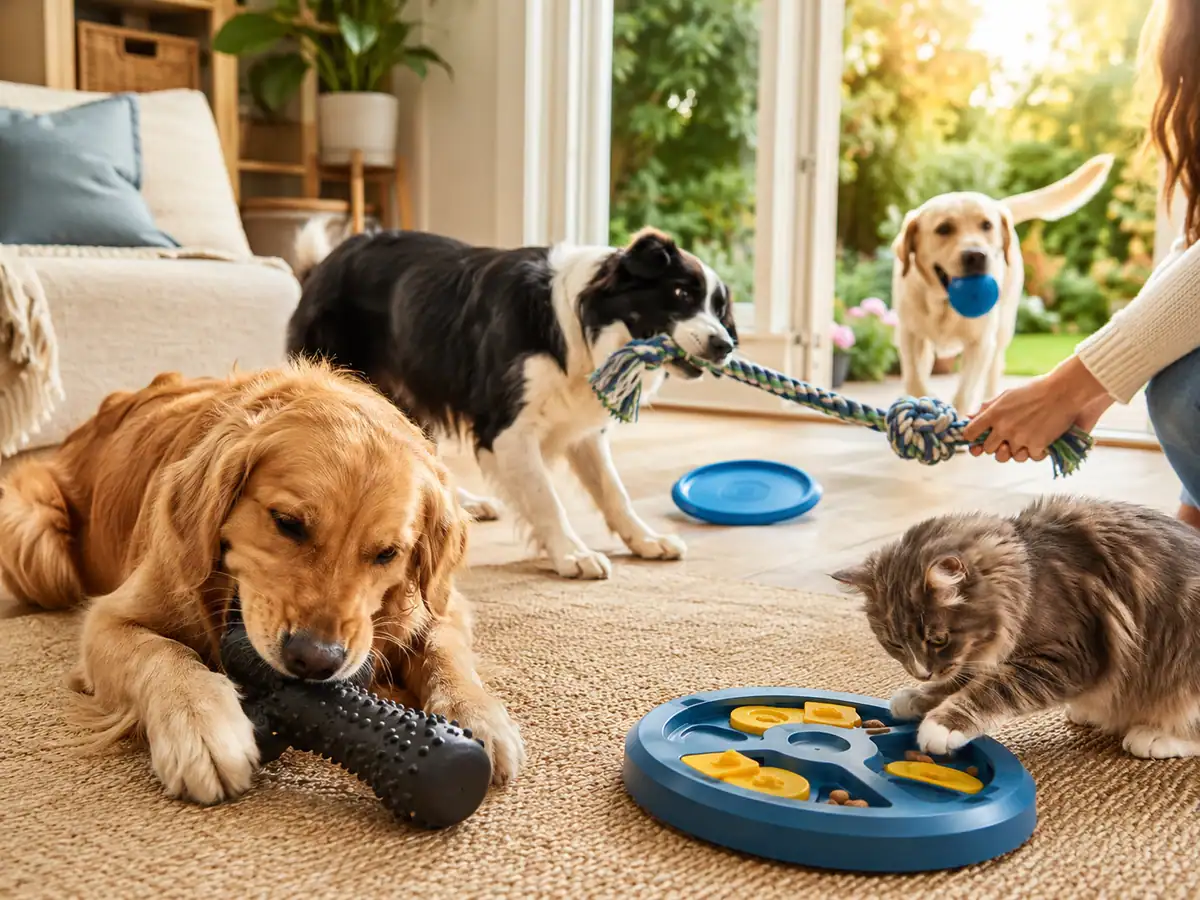
A dog who retrieves a ball and then drops it places different demands on that toy from a dog who settles down to pull it apart. Choose an intended activity before choosing a material. The same dog may need different toys for chewing, fetch, tug and food puzzles.
| Activity | What to look for | Tradeoff to manage |
|---|---|---|
| Chewing | Appropriate size, simple shape, some give | Inspect surfaces for pieces being removed |
| Fetch | Manageable carry size, visible shape, suitable surface | Retrieve it before fetch becomes dismantling |
| Tug | Room for hands, sound joins, clear instructions | Store after the interactive game |
| Food puzzle | Accessible cleaning, secure components, suitable openings | Check that solving doesn't become destructive chewing |
For a food puzzle, the difficulty also needs to match how your dog works. If your dog tries to dismantle a sliding panel rather than move it, that feature may not suit the intended session. A puzzle that is harder to access isn't automatically a better purchase. Choose a format you can observe and clean.
Use the matrix to reject mismatched purchases, not to certify a product as safe. A toy marketed for outdoor retrieval might be easy to rinse but unsuitable for extended chewing. A complex food puzzle might provide an interesting task yet require more cleaning and closer monitoring than a simple one-piece design.
Look at what your dog actually does during each activity. Carrying, shaking, rolling and shredding aren't interchangeable. Humane World for Animals' dog-toy guidance recommends appropriate sizing, supervision around squeakers and toys serving different purposes. A favorite fabric toy can have a carrying role without becoming the household's designated chew toy.
Check where the construction could fail
Examine joins, openings and narrow sections rather than judging durability by the thickest part. Strong-chewer branding tells you little about the small features a dog can grip. The useful shopping question is specific: where could this design start coming apart, and would you notice promptly?
On fabric toys, inspect seams and attached features. A reinforced panel doesn't eliminate a vulnerable join. If your dog deliberately picks at stitching, a fabric toy may be a poor choice for sustained chewing even when the front of the package emphasizes toughness. Exposed filling is a retirement signal, not a challenge to repair.
For hollow or layered designs, consider the core and any internal squeaker. Can you inspect the interior, or would a split reveal a previously hidden component? With shaped rubber toys, examine thin necks, projecting ends and the edges around openings. Those areas deserve attention during inspections even when the main body remains intact.
Rope brings another visible failure pattern: loosening strands and fraying. It shouldn't stay in circulation simply because its knot remains large. VCA's chew-toy selection guide specifically advises retiring frayed rope, broken rubber and toys with showing stuffing. Compare new purchases with the failure patterns you've already seen at home.
Read materials and marketing as separate information
A material name is a starting point, not a durability rating. Rubber products can differ in shape, thickness and flexibility. Fabric construction varies too. Read the full instructions for the exact toy, including intended activity, sizing, cleaning and warnings, rather than assuming every product in a material category behaves alike.
Don't solve repeated destruction by automatically buying something harder. VCA's chew-toy selection advice recommends appropriate sizing and checking whether a material gives under pressure. Resistance to damage is only one requirement. Our tough dog toys and chew-safety guide covers hardness screening in more detail; this article focuses on purchasing and managing the inventory.
Read words such as "indestructible" or "extreme" as marketing claims to investigate, not guarantees about your dog. Check whether the seller explains limitations and replacement conditions. If a listing emphasizes toughness but omits sizing or care instructions, you lack information needed to judge the purchase. A replacement promise doesn't make damaged material acceptable to keep using.
Use a short checklist before buying
Choose the simplest design that meets the intended activity and your household's care routine. That doesn't mean every dog needs the same shape. It means avoiding features you can't inspect or maintain, and refusing a purchase when the instructions leave an important question unanswered.
- Confirm the intended activity and size guidance for the individual dog.
- Check seams, attachments, cores, openings and narrow sections.
- Read washing, drying and storage instructions before purchase.
- Decide who will supervise use and where the toy will be stored afterward.
- Write down the damage that would make you discard it.
When ordering online, look for photographs of the joins and openings, not only the front view. Read the size information rather than estimating from a dog pictured beside the product. Check that the instructions describe the item you are buying, particularly when a listing combines several sizes or designs.
Start with a limited selection so you can learn which jobs are genuinely useful. Puppies need age-appropriate choices rather than a scaled-down adult inventory; see our guide to chew toys for teething puppies. If a toy depends on parts you can't assess, ask the manufacturer before buying instead of filling the gap with assumptions.
Keep an inspection log that changes decisions
A short log helps everyone notice recurring damage instead of repeatedly buying a similar design. Give each toy a recognizable name and record its intended job. Check it before and after supervised use, including areas your dog targets. The point is consistency, not paperwork for its own sake.
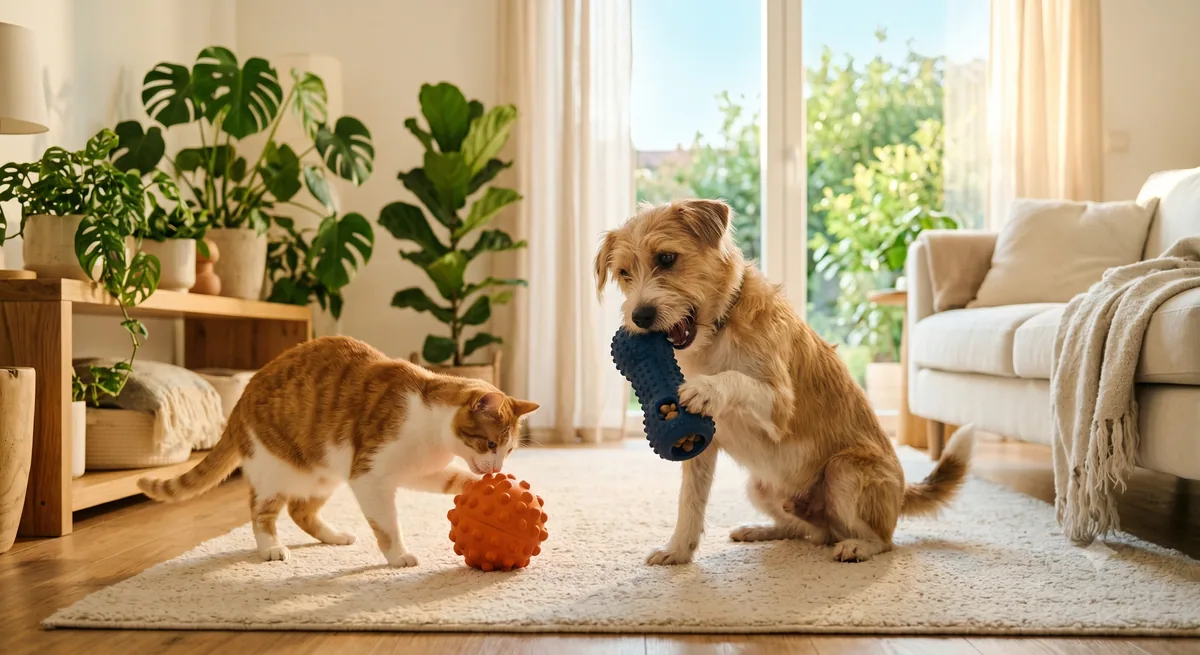
Use this sample entry format: "Toy: blue hollow rubber toy. Job: supervised food puzzle. Before play: record surface, openings and interior condition. After play: record any change. Decision: return to rotation, hold out for assessment, or discard. Checked by: name." These are fields to complete, not reported observations from a product test.
Include the date and make each note specific enough for another person to understand. "Check the neck beside the opening" is more useful than "watch this one." If you remove a toy, note why so a housemate doesn't mistake it for a cleaned item ready to return.
Separate condition from interest. "Ignored during fetch" is a usefulness note, while "split edge" is a condition note. The first can inform your next activity choice; the second needs a removal decision. Don't interpret a long record of undamaged sessions as permission to skip the next check.
If several entries point to the same failure location, change the next purchase specification. A dog repeatedly opening seams gives you a reason to reconsider fabric construction for that job. Repeated damage around a narrow section suggests looking at a different shape. That is more informative than simply buying another toy with a stronger-sounding label.
Build a rotation routine the household can follow
Keep ready-to-use toys separate from items waiting for cleaning or assessment. A basket labeled "ready" should contain only toys you've checked, not everything the dog owns. Put interactive fetch and tug equipment away after play so its intended role doesn't silently change into unattended chewing.
Humane World for Animals recommends rotating toys weekly and making only a few available at a time. Use that as an organization idea, not a promise of longer life. At your rotation check, review condition, clean items as directed and choose a mix of activities. Storage doesn't reverse existing damage.
Assign one person to manage the rotation, while making the removal rules clear to everyone. A family member who finds fraying or exposed filling should take that toy out immediately, not wait for the organizer. Keep questionable items out of reach so they don't accidentally return to the ready basket.
Notice behavior as well as inventory. If destruction happens mainly when your dog is distressed, another purchase may not address the reason. Our dog anxiety toys guide discusses enrichment in that context. Toys can be part of a routine, but they aren't a guaranteed treatment for anxiety.

Follow the care label, then make the discard decision
Cleaning should follow the manufacturer's instructions for the exact item. Don't assume rubber means dishwasher-safe, or that a fabric toy tolerates every wash cycle. For food puzzles, check that you can reach the areas where food collects. Only freeze, heat or use cleaning products when the instructions allow that method.
Let the toy dry as directed before returning it to storage, and inspect it again. If dirt was hiding a split or loose stitching, a clean toy may reveal why it needs retiring. If instructions are missing, contact the manufacturer; don't improvise a treatment that could change the material.
Discard toys with broken rubber, exposed filling, loose detachable parts or frayed rope. Also remove any toy your dog is pulling pieces from. When you can't tell whether a change is acceptable, keep it unavailable while seeking guidance. Don't glue splits, trim away damage or tie loose strands as a shortcut back into use.
Think about value per use, not toughness per price tag
Imagine two suitable toys bought at the same price. One supports a game your household actually plays; the other sits unused because cleaning is awkward or your dog isn't interested. The first provides more value through useful sessions. This is a purchasing thought experiment, not a product comparison or a lifespan prediction.
You can think of purchase cost divided by useful supervised sessions as a rough value measure, but record condition separately. Don't stretch a damaged toy's service just to improve that calculation. Preparation, cleanup and storage also affect whether a purchase fits your household, even without assigning them a monetary value.
Before replacing an item, ask what you're replacing: a useful activity, a design that repeatedly failed, or an unused purchase. Buy again for a successful role; change the specification for a recurring failure; skip a duplicate nobody uses. Keep the activity, inspection and discard decisions linked. That's a practical definition of durability you can manage at home.
Frequently asked questions
Should every toy be labeled for strong chewers?
No. A fetch toy or food puzzle may suit supervised play without being suitable for sustained chewing. Buy for the activity, then put it away when that activity ends. A strong-chewer label still needs checking against your dog's size, behavior and the manufacturer's instructions.
What should I record if my dog ignores a new toy?
Record the activity offered and how your dog responded, rather than calling the toy a failure immediately. A toy ignored on the floor might work during an interactive game. Don't add food, freeze it or alter it unless its instructions permit that use.
Can different dogs share the same rotation basket?
Only if each available toy is suitable for every dog that can reach it. Otherwise, keep separate labeled storage and offer toys individually. A size appropriate for one dog may be too small for another, and competition can change how dogs handle familiar toys.
Does washing reset the replacement decision?
No. Cleaning removes dirt but doesn't restore split rubber, damaged seams or frayed rope. Inspect again after washing and drying, since the clean surface may reveal damage. If the toy has already met a discard criterion, don't return it to the rotation.
Is a replacement guarantee a reason to buy?
It can be a useful purchasing detail, but read the eligibility rules, exclusions and replacement process. A guarantee concerns the seller's response, not your dog's safety. Remove a damaged toy promptly instead of leaving it available while a replacement request is pending.