The cat crazies, also called the zoomies or the midnight crazies, are sudden bursts of wild running, leaping and pouncing that seem to come from nowhere. Behaviorists call them frenetic random activity periods, or FRAPs, and in a healthy cat they are normal. They usually mean your cat has stored up energy and hunting drive with no outlet, and they often hit at dusk, at night or at dawn because that is when cats are naturally most active. This guide explains the causes, how to channel the crazies into better play, and the few signs that deserve a call to your vet, based on guidance from VCA Animal Hospitals, International Cat Care and Cats Protection.
In This Article
- Quick Answer: Why Do Cats Get the Crazies?
- What Do the Cat Crazies Look Like?
- Why Do Cats Get the Crazies?
- Why Do Cats Get the Crazies at Night?
- Do Kittens and Young Cats Get the Crazies More Often?
- How Can You Channel the Crazies Into Play?
- What Daily Routine Calms the Night Time Crazies?
- What Should You Avoid When Your Cat Has the Crazies?
- When Are the Crazies a Sign of a Health Problem?
- What Do Cat Owners Ask Most About the Crazies?
- Sources
Quick Answer: Why Do Cats Get the Crazies?
The cat crazies, or zoomies, are sudden bursts of running and pouncing that behaviorists call frenetic random activity periods. In a healthy cat they are normal. They release stored energy and hunting drive, often at dusk, night or dawn. Daily play that ends in a catch, followed by a meal, is the most reliable way to calm them.
Updated October 3, 2026- It is normal. Frenetic random activity periods are healthy behavior in cats, not a sign of a problem on their own.
- It is stored energy. A cat that sleeps all day while you are out has a lot of hunting drive left over when you get home.
- Timing is natural. VCA explains that cats are crepuscular, most active in hunting and exploration at dusk and dawn.
- Play is the fix. Scheduled play that lets your cat stalk, chase, pounce and catch, followed by a meal, is the most reliable way to calm the crazies.
What Do the Cat Crazies Look Like?
Answer: The crazies look like a sudden burst of play with no obvious trigger. A resting cat sprints through the house, leaps onto furniture, chases invisible prey or ambushes feet, often with a puffed tail and wide pupils. The burst ends as quickly as it began, and the cat usually sits down to groom.
Most owners recognize the crazies the first time they see them. A cat that was asleep a minute ago suddenly sprints down the hallway, skids around a corner, launches up the cat tree, and races back again. The tail may puff up, the ears swivel, and the pupils go wide. Some cats chase invisible prey, ambush feet, or bounce sideways off the sofa. Then, as suddenly as it started, the burst ends and the cat sits down to wash as if nothing happened.
The Wikipedia article on frenetic random activity periods describes them as bursts of energy seen in both dogs and cats, and notes that they are normal and healthy behavior in cats. International Cat Care lists sudden erratic movements and increased energy levels among the signs that a cat is in a playful mood, which is exactly what the crazies are: a big, unplanned play session.

Why Do Cats Get the Crazies?
Answer: Cats are built to hunt in short, intense bursts, and indoor cats still carry that drive without any prey to spend it on. Long daytime naps and a home with little to explore, climb or chase add to the stored energy. When it builds up, it comes out as a sudden sprint around the house.
Cats are built to hunt in short, intense bursts. In the wild, a cat spends a lot of time resting and watching, then explodes into a stalk, chase and pounce. International Cat Care describes the full predatory sequence as search, stalk, chase, pounce, catch and manipulate, and explains that play is how pet cats act out those steps. An indoor cat with no mice to hunt still has the drive. When it builds up, it comes out as the crazies.
Sleep patterns add to it. Cats Protection says domestic cats sleep for roughly 12 to 18 hours a day. A cat that naps through a quiet afternoon wakes up fully charged, and a sprint around the house is how that charge gets spent. Boredom is a big part of the picture too. A home with little to explore, climb or chase gives a cat few other ways to use its energy, so the crazies become the main outlet. Source: Cats Protection, Cats and sleep.
Why Do Cats Get the Crazies at Night?
Answer: VCA Animal Hospitals explains that cats are crepuscular, most active at dusk and dawn, and that many cats rest all day while their owners are out. Their real day starts when the family comes home. Owners who answer night time activity with food or attention also reward it by accident, which keeps it going.
The classic complaint is the midnight crazies: thundering paws across the bed in the small hours of the morning. VCA Animal Hospitals explains this clearly in its guide to nocturnal activity in cats. Many cats spend the day resting while their owners are at work or school, especially only cats. Their day really starts when the family comes home with food, play and attention. On top of that, cats are naturally crepuscular, meaning they are most active in hunting and exploration at dusk and dawn.
VCA lists the typical results as nibbling or attacking ears and toes in bed, walking across sleeping owners, night time vocalizing, and explosive, uncontrollable play sessions across the furniture or the owners during the night or early morning. It also points out that owners often reward the behavior by accident, giving the cat food or attention to quiet it down. That teaches the cat that night time crazies pay off. Source: VCA Animal Hospitals, Cat behavior problems: nocturnal activity.
Do Kittens and Young Cats Get the Crazies More Often?
Answer: Yes. The ASPCA notes that rough play is common and natural in kittens and young cats under two years of age, so frequent bursts are expected. The same energy makes kittens pounce on hands and ankles, so International Cat Care advises using rod toys and never letting a kitten treat fingers or toes as prey.
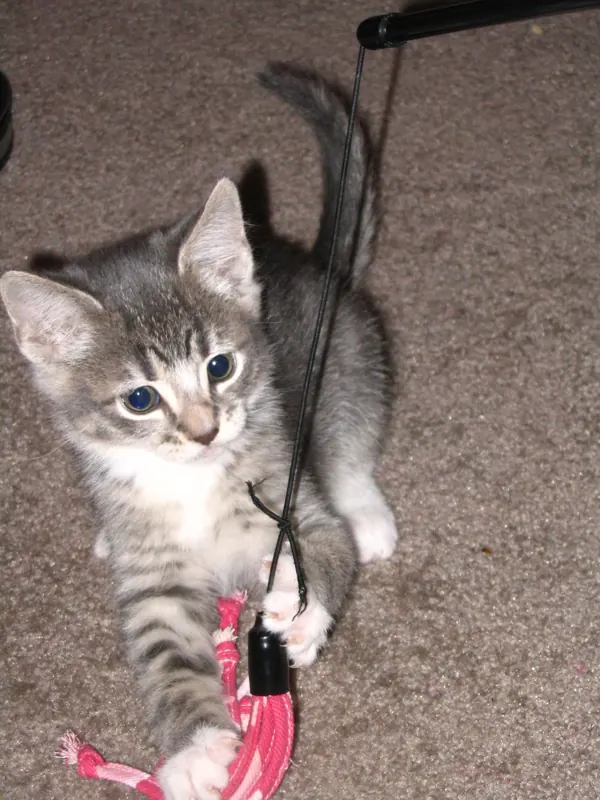
If you have a kitten, expect the crazies often. The ASPCA notes that rough play is common and natural among kittens and young cats under two years of age. The same energy that makes a kitten tear around the living room also makes it pounce on hands and ankles, which can become a real problem as teeth and claws grow.
International Cat Care's advice for kittens is firm: never use your hands or feet as toys, because a kitten learns to treat fingers and toes as prey. Use wand or fishing rod toys that keep some distance between you and the claws, and avoid string, ribbon, pipe cleaners and balls of wool, which can cause serious intestinal injuries if swallowed. If you are setting up for a new arrival, our guides to kitten toys and new kitten essentials cover safe choices.
How Can You Channel the Crazies Into Play?
Answer: Use interactive play that walks your cat through the whole hunting sequence: search, stalk, chase, pounce and catch. Start slow with a wand toy, speed up, let your cat make a real catch, then wind down and serve a meal. International Cat Care warns that games without a catch, like a laser alone, leave cats frustrated.
You cannot stop a healthy cat from having energy, and you should not try. The goal is to move the crazies to a time that suits you and give them a satisfying ending. The best tool is interactive play that walks your cat through the whole hunting sequence.
- Start slow. Drag a wand toy along the floor and behind furniture so your cat can search and stalk.
- Speed up. Let the toy dart away so the cat has to chase and leap. This is the part that burns the most energy.
- Let it win. Allow a real catch. International Cat Care warns that games without a catch, such as a laser pointer on its own, can leave cats frustrated, and suggests switching to a wand toy to finish so the game ends on a positive note.
- Wind down. Slow the toy for the last minute or two so your cat's breathing settles.
- Feed. A meal after the catch completes the hunt, eat, groom, sleep pattern many cats follow.
Good toys for this are a feather or lure on a rod, like those in our guide to the cat wand toy, and feather wand toys for cats. If you do use a laser cat toy, end on a toy your cat can grab. Solo toys matter too, for the hours you are away. Our roundup of interactive cat toys covers tracks, puzzles and motion toys.
The table above follows International Cat Care's description of the predatory sequence. For the search step, a cat puzzle toy works well, and a cat tunnel gives a shy cat a place to ambush from.
What Daily Routine Calms the Night Time Crazies?
Answer: VCA recommends scheduling play and meals during the day and evening, serving smaller and more frequent meals, using foraging toys, and discouraging evening catnaps. A useful pattern is play before you leave, a food puzzle during the day, a longer evening play session, and the last meal right before bed.
VCA's advice for night time crazies is to schedule play and feeding in the day and evening so the cat's timetable matches the household. It suggests several social play sessions with chase toys, some reward based training, smaller and more frequent meals, some meals served in foraging toys, and something new to explore each day. It also recommends discouraging catnaps in the evening, and notes that shifting mealtimes a few hours earlier or later can nudge a cat's schedule enough for it to sleep through the night.
A simple day built on that advice might look like this: a short play session before you leave, a food puzzle or treat dispensing toy during the day, a window perch or cat tree for watching and climbing, a longer play session in the evening, then the last meal right before bed. An automatic cat feeder can serve a small early morning meal so your cat stops waking you for breakfast.
Give it a couple of weeks. Cats are creatures of habit, and a new rhythm takes time to stick. Most owners find the crazies do not disappear, but they move to the evening play session, where they belong.

What Should You Avoid When Your Cat Has the Crazies?
Answer: Avoid feeding or cuddling your cat to stop a night time burst, because VCA warns that this rewards the behavior. Do not use hands or feet as toys, and do not shout, spray or chase your cat, since punishment builds fear. Redirect the energy to a toy and make shelves and cords safe instead.
Some common reactions make the crazies worse. VCA warns that giving food or attention to quiet a cat at night rewards the behavior. Punishment does not help either; it makes cats fearful and does nothing for the energy behind the crazies. Instead:
- Do not feed or cuddle your cat to stop a night time burst. Stay still and quiet, and keep the routine the same.
- Do not use your hands or feet as toys, or let a kitten pounce on them.
- Do not shout, spray or chase the cat. Redirect with a toy instead.
- Do make the environment safe: secure tall shelves, move breakables, and keep cords out of reach.
- Do add climbing, hiding and watching spots so energy has more places to go. Our guide on how to entertain a cat has more ideas.
When Are the Crazies a Sign of a Health Problem?
Answer: Most crazies in young, healthy cats are harmless play. See a vet if bursts come with rippling skin on the back, frantic tail chasing or self biting, which can point to feline hyperesthesia syndrome, or if an older cat turns restless while losing weight, drinking more and yowling at night, which VCA links to hyperthyroidism.
In a young, healthy cat, the crazies are nothing to worry about. A few patterns are worth a vet visit, though, because some medical conditions can look like extra energy.
The first row describes signs associated with feline hyperesthesia syndrome. The Wikipedia summary lists frantic running and jumping, tail chasing, excessive grooming of the lower back and a rippling of the skin over the back, with onset usually around 9 to 12 months and episodes lasting a minute or two. The second and third rows match signs VCA lists for hyperthyroidism in cats: affected cats are usually middle aged or older, with an average age of about 12, and are often restless, lose weight despite eating more, drink more, and vocalize more, particularly at night. Source: VCA Animal Hospitals, Hyperthyroidism in cats (age and signs) and Wikipedia, Feline hyperesthesia syndrome (onset and duration).
If your older cat has suddenly developed the crazies, or the bursts come with any of the signs in the right column, book a checkup rather than assuming it is play. For everyone else, the crazies are a sign of a healthy, energetic cat that needs a little more hunting in its day.
What Do Cat Owners Ask Most About the Crazies?
Answer: Cat owners most often ask what the crazies are, why they happen at night, how to stop them, whether they are normal in kittens, whether a laser pointer helps, and when the crazies signal a health problem. The short answers below summarize guidance from VCA Animal Hospitals, International Cat Care and the ASPCA.
What are the cat crazies?
The cat crazies, also called zoomies or frenetic random activity periods (FRAPs), are sudden bursts of running, leaping and pouncing. In a healthy cat they are normal behavior that releases stored energy and hunting drive.
Why does my cat get the crazies at night?
VCA explains that cats are crepuscular, most active at dusk and dawn, and that many cats rest all day while owners are out. Their energy peaks in the evening and early morning, which is when the crazies usually happen.
How do I stop my cat's midnight crazies?
Schedule play and meals in the day and evening, play an energetic wand toy game before bed that ends in a catch, feed a meal afterwards, discourage evening naps, and do not reward night time activity with food or attention.
Are the zoomies normal in kittens?
Yes. The ASPCA notes that rough play is common and natural in kittens and young cats under two years old, so frequent bursts of energy are expected at that age.
Should I use a laser pointer to tire my cat out?
You can, but International Cat Care warns that a laser alone lets a cat stalk and chase without ever catching, which can cause frustration. Finish the game with a wand toy your cat can catch.
When are cat zoomies a sign of a health problem?
See a vet if the bursts come with rippling skin, tail chasing or self biting, or if an older cat suddenly becomes restless with weight loss, more thirst or night time yowling. These can point to feline hyperesthesia syndrome or hyperthyroidism.
How long do the cat crazies last?
Most episodes are short, often a few minutes of running before the cat settles down and grooms. Regular play and a steady routine usually move them to a more convenient time of day.
Sources
- VCA Animal Hospitals: Cat behavior problems, nocturnal activity
- VCA Animal Hospitals: Hyperthyroidism in cats
- International Cat Care: Playing with your cat
- Cats Protection: Cats and sleep
- ASPCA: Aggression in cats
- Wikipedia: Frenetic random activity periods
- Wikipedia: Feline hyperesthesia syndrome
Give the crazies somewhere to go
Wand toys, kickers and puzzle toys turn wild energy into real play. Browse our cat toys.
Shop cat toys