Separation anxiety is a panic response, not bad behaviour, and that is the distinction everything else rests on. A dog that destroys the door frame while you are out is not protesting; it is frightened in a way it cannot resolve. That is also why the obvious remedies, more exercise, a stern word on the way back in, a crate, a second dog, so often fail or make it worse. This guide covers how to tell real separation distress from boredom, the training that does work, what enrichment can and cannot do, and when to bring a veterinarian or a qualified behaviourist into it.
Quick Answer: What Should You Know About Treating Separation Anxiety?
Separation distress is panic rather than misbehaviour, so punishment and extra exercise do not resolve it. The approach that works is gradual absence training below the dog's panic threshold, paired with managing the dog so it is never left alone for longer than it can cope with. Severe cases need veterinary and behaviourist involvement.
What Treating Separation Anxiety Actually Is, and What It Is Not?
Answer: Separation distress is panic triggered by being left alone, and panic is a physiological state rather than a decision. A dog in it cannot learn, cannot settle and usually cannot eat, which is why owners find the stuffed toy untouched beside a chewed door frame. Understanding that single point changes what you do about it.
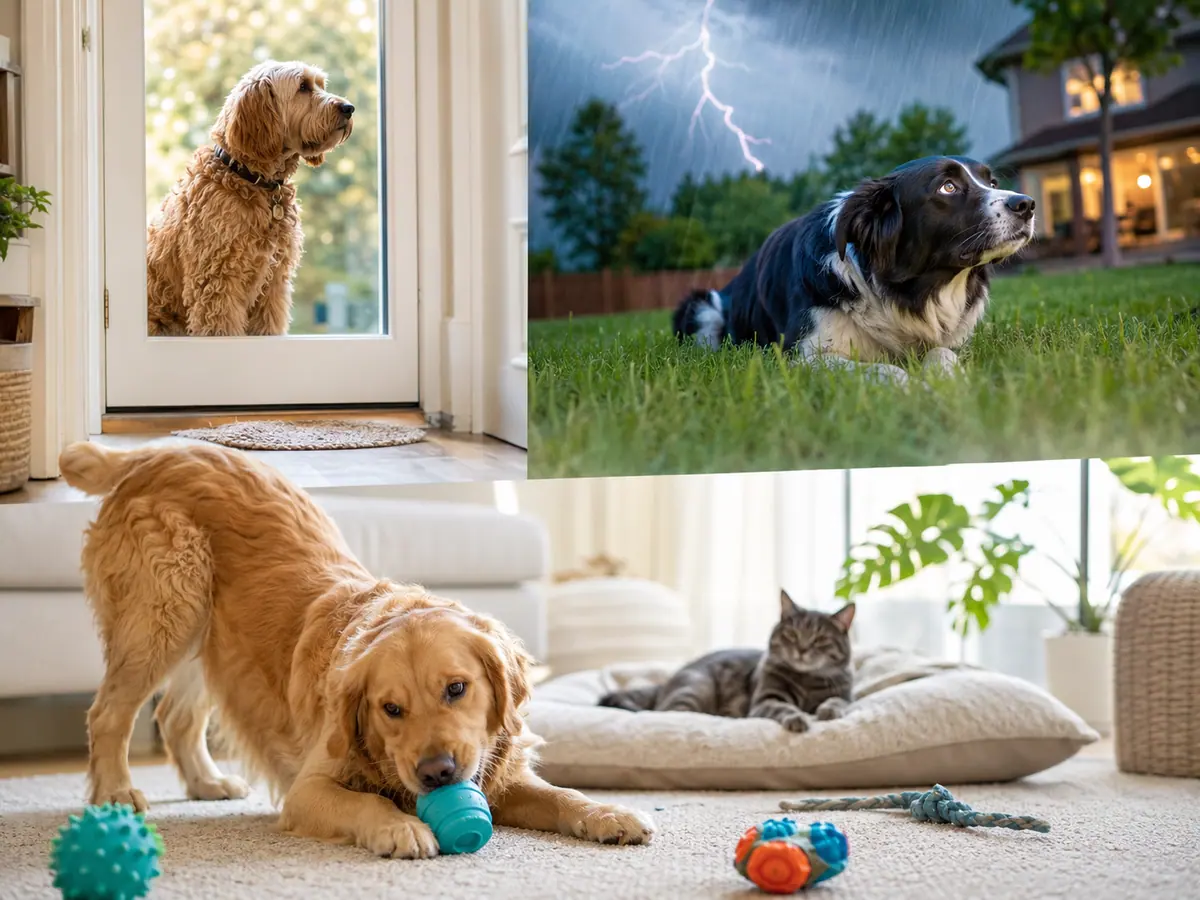
Separation distress is panic triggered by being left alone, and panic is a physiological state rather than a decision. A dog in it cannot learn, cannot settle and usually cannot eat, which is why owners find the stuffed toy untouched beside a chewed door frame. Understanding that single point changes what you do about it.
What it looks like is fairly consistent: vocalising that starts within minutes of the door closing, destruction aimed at exits rather than at random objects, scratching at doors and windows, drooling, pacing a fixed route, and house soiling in a dog that is otherwise clean. Several of these together, beginning soon after you leave, point at distress rather than mischief.
What it is not is a dog getting even with you. Dogs do not plan revenge, and the guilty look owners describe is a response to your body language on arrival, not evidence that the dog knows what it did. Treating it as defiance leads directly to punishment, and punishment on return makes homecomings frightening as well as departures.
How to Tell Real Treating Separation Anxiety From Boredom or Under-Exercise?
Answer: Film it. A phone propped on a shelf or a cheap indoor camera answers the question in one session, and it is the single most useful thing you can do before changing anything. Watch the first part of the absence, because a distressed dog usually starts within minutes while a bored dog potters around first.
Film it. A phone propped on a shelf or a cheap indoor camera answers the question in one session, and it is the single most useful thing you can do before changing anything. Watch the first part of the absence, because a distressed dog usually starts within minutes while a bored dog potters around first and gets into trouble later.
If stress is a concern, our guide to dog separation covers more solutions.
The patterns separate quite clearly. A distressed dog fixes on the exit: the door you left by, the window you walked past, the gap under the frame. A bored or under-exercised dog explores, finds the bin, shreds a cushion in the middle of the room, and sleeps between episodes. One is panic, the other is a dog with nothing to do.
Rule out the other explanations before you commit to a training plan. House soiling can be a urinary or digestive problem. Sudden onset in an older dog can be cognitive decline or pain. Noise sensitivity, a change of household, or a new fear of something outside can all look like separation distress. Those are veterinary questions, and they are worth asking first.
What Should Pet Owners Know About Managing the Dog While You Work on Treating Separation Anxiety?
Answer: Training only works when the dog is not rehearsing panic in between sessions. That means arranging life so the dog is not left alone for longer than it can currently handle, which is the part owners find hardest and the part that decides whether the rest works. Every panicked absence undoes progress you paid for.
Training only works when the dog is not rehearsing panic in between sessions. That means arranging life so the dog is not left alone for longer than it can currently handle, which is the part owners find hardest and the part that decides whether the rest works. Every panicked absence undoes progress you paid for in weeks.
In practice that is a patchwork: a neighbour or family member, a dog walker or sitter, daycare a few days a week, taking the dog with you where you can, and staggering household schedules so somebody is in. None of it is permanent. It is scaffolding that holds while the training catches up.
Be careful with crates. For a dog that already loves its crate, it can be a safe place. For a dog in separation panic, a closed crate frequently makes things far worse, because the dog cannot reach the exit it is fixated on, and dogs have injured their faces and feet trying. If your dog panics in a crate, do not crate it and say so to anyone advising you otherwise.
What Should Pet Owners Know About The Training That Actually Resolves Treating Separation Anxiety?
Answer: The method with the best track record is gradual absence training, and the rule is simple to state and hard to follow: never go past the point where your dog becomes anxious. You find the duration the dog is comfortable with, which for some dogs is a few seconds behind a closed door, and you.
The method with the best track record is gradual absence training, and the rule is simple to state and hard to follow: never go past the point where your dog becomes anxious. You find the duration the dog is comfortable with, which for some dogs is a few seconds behind a closed door, and you build from there in very small increments.
Anxious pets may also benefit from the products in our anxiety in dogs guide.
Start by breaking the association with your departure cues. Pick up your keys and sit back down. Put your coat on and make a cup of tea. Open the front door and close it again. Repeat these until they mean nothing, because for many dogs the panic starts before the door even opens.
Then work on absences themselves. Step out, come back before the dog reacts, and keep both leaving and returning completely undramatic. Vary the durations rather than making every one longer than the last, so the dog cannot predict an escalation. Watch the camera rather than your watch: the dog's body language sets the pace, and a session that ends with a calm dog is the one that counts.
Expect this to take weeks or months rather than days, and expect it to be uneven. Progress goes backwards after a holiday, a house move, or any week where the dog had to be left too long. That is normal, not failure. Go back a few steps and rebuild.
What Toys and Enrichment Can and Cannot Do for Treating Separation Anxiety?
Answer: Food puzzles, stuffed rubber toys, lick mats and snuffle mats are genuinely useful, and they are useful for the wrong problem if you have diagnosed it wrongly. For a bored dog they are often the whole answer. For a dog in real panic they are usually ignored, because a frightened animal does not eat, and.
Food puzzles, stuffed rubber toys, lick mats and snuffle mats are genuinely useful, and they are useful for the wrong problem if you have diagnosed it wrongly. For a bored dog they are often the whole answer. For a dog in real panic they are usually ignored, because a frightened animal does not eat, and an untouched frozen toy is itself a diagnostic clue.
Where they do help with distress is in the early, mild stage and as part of the departure routine. A long-lasting chew given as you leave can bridge the first few minutes, which is exactly the window when panic builds, and that can be enough to keep a mild case below threshold while training does the real work.
Calming aids sit in the same category. Pheromone diffusers, snug wraps, background sound and a settled routine help some dogs a little, and none of them resolves genuine separation panic on its own. Use them as support alongside the training rather than as the plan. If something has made no difference after a fair trial, stop paying for it.
What Not to Do About Treating Separation Anxiety?
Answer: Do not punish on return. Telling a dog off for a mess it made in a panic hours earlier teaches it that your arrival is dangerous, which adds dread of homecoming to dread of leaving. The dog cannot connect the correction to the behaviour, and the look you read as guilt is appeasement at your.
Do not punish on return. Telling a dog off for a mess it made in a panic hours earlier teaches it that your arrival is dangerous, which adds dread of homecoming to dread of leaving. The dog cannot connect the correction to the behaviour, and the look you read as guilt is appeasement at your tone.
For more calming solutions, see our detailed separation anxiety review.
Do not use flooding, meaning leaving the dog alone for long stretches in the hope it gets used to it. Panic that is never allowed to resolve does not fade; it deepens, and dogs injure themselves in the attempt. The same applies to anti-bark devices, which suppress the noise while leaving the fear exactly where it was.
Do not get a second dog as a treatment. It occasionally helps and it frequently does not, because most separation distress is about the absence of a specific person rather than about being alone in general. You may end up with two dogs and the same problem. Wait until the first dog is settled before making that decision for its own sake.
When to Involve a Veterinarian or a Behaviourist About Treating Separation Anxiety?
Answer: Go early rather than late. If your dog is injuring itself, if you cannot leave the house at all, if the behaviour appeared suddenly in an adult or older dog, or if several weeks of careful work have produced nothing, that is the point to bring in a veterinarian and a qualified behaviourist rather than.
Go early rather than late. If your dog is injuring itself, if you cannot leave the house at all, if the behaviour appeared suddenly in an adult or older dog, or if several weeks of careful work have produced nothing, that is the point to bring in a veterinarian and a qualified behaviourist rather than trying another article.
Your veterinarian's first job is to rule out medical causes, because pain, cognitive decline and several conditions affecting toileting all present like this. They can also discuss whether medication is appropriate. Anything in that category is prescription only, is chosen for the individual dog, and exists to lower the panic enough for training to work, never as a replacement for it.
For the behaviour side, look for a credentialled professional who works with reinforcement-based methods and has specific experience with separation distress, since it is a specialism rather than general obedience. Ask what their plan looks like and how they measure progress. Anyone promising a fast fix, or recommending aversive equipment for a panicking dog, is the wrong person.
What Should Pet Owners Know About Common Mistakes Owners Make with Treating Separation Anxiety?
Answer: Skipping the camera is the first, and it is the cheapest one to avoid. Without footage you are guessing at what happens after the door closes, and the training for panic is very different from the fix for boredom. Thirty minutes of recording often reframes the entire problem.
Skipping the camera is the first, and it is the cheapest one to avoid. Without footage you are guessing at what happens after the door closes, and the training for panic is very different from the fix for boredom. Thirty minutes of recording often reframes the entire problem.
Progressing too fast is the second. Owners who are doing everything right still tend to push for a longer absence as soon as a short one succeeds, which takes the dog over threshold and sets the work back. Vary the durations, stay below the line, and accept that boring repetition is the mechanism.
Stopping the management is the third. As soon as things improve, the sitter is cancelled and the dog spends a full day alone, and the first panicked absence undoes months. Keep the scaffolding in place until the dog is reliably comfortable well beyond the length of your normal absences, then remove it gradually.
If you want to dig deeper into the research, the ASPCA dog care library publishes practical, expert-reviewed resources for pet owners.
What Questions Do Pet Owners Ask About Treating Separation Anxiety?
Answer: Separation distress is panic rather than misbehaviour, so punishment and extra exercise do not resolve it. The approach that works is gradual absence training below the dog's panic threshold, paired with managing the dog so it is never left alone for longer than it can cope with. Severe cases need veterinary and behaviourist involvement.
How do I know if my dog has separation anxiety or is just bored?
Record a session and watch the first few minutes. A distressed dog starts quickly and fixes on the exit, vocalising, scratching at the door, pacing a set route, drooling, often refusing food. A bored dog potters first, gets into trouble later, picks targets around the room, and sleeps in between. The two need completely different plans.
Will more exercise fix separation anxiety?
It helps a dog that is under-occupied and it does not resolve panic. A tired frightened dog is still frightened. Exercise and enrichment are worth doing for their own sake and belong alongside gradual absence training, not instead of it. If a long walk before you leave makes no difference, that is itself informative.
Should I crate a dog with separation anxiety?
Only if the dog already genuinely loves its crate. For a dog in separation panic, a closed crate often makes things much worse, because it blocks access to the exit the dog is fixated on, and dogs have injured their faces and paws trying to get out. If your dog panics in a crate, do not use one.
Does getting a second dog help?
Usually not, because most separation distress is about the absence of a particular person rather than being alone in general. You can end up with two dogs and the same problem, and sometimes with a second dog that learns the behaviour. Resolve the first dog's distress before deciding, and get a second dog only if you want one anyway.
How long does it take to treat separation anxiety?
Weeks to months, and progress is uneven rather than steady. It goes backwards after a house move, a holiday, or any week where the dog had to be left too long, and that is normal. The pace is set by staying below the dog's panic threshold, so rushing a longer absence usually costs more time than it saves.
Do calming toys and pheromone products work?
They help some dogs a little and they do not resolve genuine panic on their own. A long-lasting stuffed toy can bridge the first few minutes of an absence, which is the window when panic builds, and that is real value in a mild case. If a dog refuses food while alone, that tells you the distress is past the point a toy can reach.
Is there medication for separation anxiety in dogs?
There are prescription options, and they are a veterinary decision for the individual dog rather than something to choose from a list. Where medication is used it lowers the panic enough for behaviour work to be possible; it is not a substitute for the training. Start with a veterinary consultation that also rules out medical causes.
Should I tell my dog off for the mess it made while I was out?
No. The dog cannot connect a correction to something it did hours earlier, and punishment on return teaches it that your homecoming is dangerous, which adds to the problem. The guilty expression owners describe is a response to your tone and posture, not an admission. Clean up quietly and work on the departure instead.
Browse Calming Toys
Free US shipping on every order. No minimum purchase required.
Browse Calming Toys →