If you are looking for the best mentally stimulating dog toys, this comprehensive guide covers everything you need to know. Whether you are a first-time pet owner or an experienced one looking to upgrade, you will find practical advice, safety tips, and honest comparisons below.
Quick Answer: What Should You Know About Mentally Stimulating Dog Toys?
Choosing mentally stimulating dog toys well comes down to four things: matching the product to your pet's size and daily routine, checking the materials against how hard it will be used, setting it up or fitting it correctly, and inspecting it on a schedule. This guide covers each of those, plus the mistakes owners most often make.
Why a Dog Needs Mentally Stimulating Dog Toys as Much as a Long Walk?
Answer: A tired dog is usually one whose brain has worked, not one who has covered more ground. Chewing, licking, searching and problem solving are mentally demanding, and that demand is what settles a dog. A short scent game often calms a restless dog when another lap of the block does not.
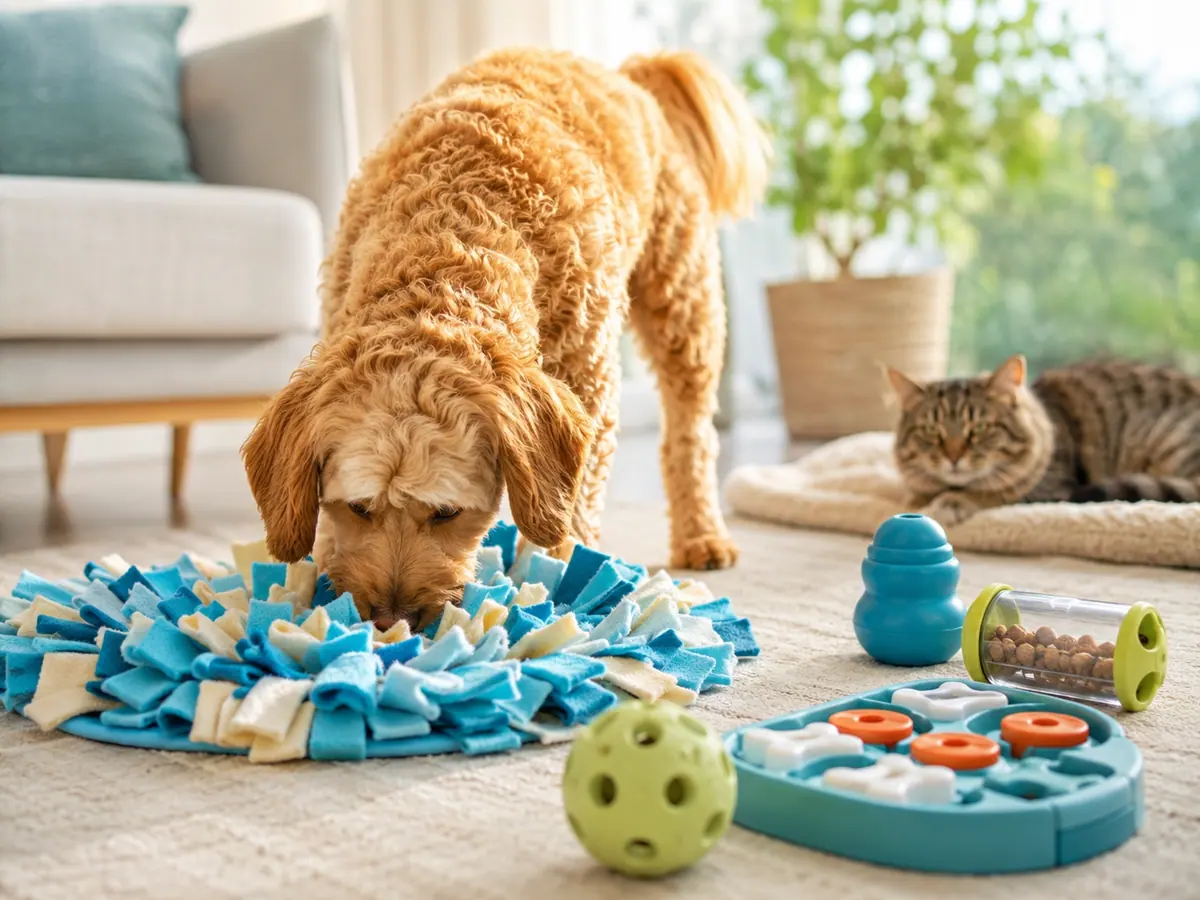
A tired dog is usually one whose brain has worked, not one who has covered more ground. Chewing, licking, searching and problem solving are mentally demanding, and that demand is what settles a dog. A short scent game often calms a restless dog when another lap of the block does not.
Physical exercise alone has a ceiling, and for many working breeds it is a trap. Running a fit collie until it is tired today simply builds a fitter collie for tomorrow, so the distance keeps climbing while the behaviour at home stays exactly the same. Mental stimulation does not work that way. A dog that has solved a hard puzzle does not become harder to satisfy next week, and the same stimulation keeps paying off.
There is a behaviour reason as well. Most of the habits owners dislike, counter surfing, shredding the post, barking at the window, are a dog inventing its own job because nobody handed it one. Giving the dog something stimulating to do before those moments is far easier than interrupting them afterwards, and it is the difference between a dog who waits and a dog who patrols.
None of this makes walks optional. A dog still needs to move, to smell the outside world and to meet other dogs. What a mentally demanding routine does is take the pressure off distance, so a wet morning or a recovery week after surgery stops being a crisis. Ask your veterinarian before changing exercise during any recovery period.
What Should Pet Owners Know About The Real Categories of Mentally Stimulating Dog Toys and What Each One Does?
Answer: Enrichment splits into a handful of jobs, and most households only ever buy one of them. Food puzzles make a dog work for a meal. Snuffle and scentwork ask it to search. Chew and lick items settle it. Shaping and trick training use you. Shredding outlets let it destroy something safely.

Enrichment splits into a handful of jobs, and most households only ever buy one of them. Food puzzles make a dog work for a meal. Snuffle and scentwork ask it to search. Chew and lick items settle it. Shaping and trick training use you. Shredding outlets let it destroy something safely.
If you want even more options, check out our guide to dog tag.
Food puzzles are the broad category on the shelf: sliding lids, spinning discs, wobbling dispensers and treat balls that drop kibble as they roll. They suit a dog that likes to use paws and nose at the same time. The honest limit is that a clever dog learns a given board quickly, and a board stops being stimulating the moment it has been cracked, so one puzzle is a week of novelty while a rotation of three is most of a season.
Snuffle mats, scatter feeding and hidden food games are scentwork, and they are the most mentally expensive thing most pet dogs ever do. Chew and lick enrichment works in the opposite direction. A stuffed rubber toy or a lick mat produces slow repetitive jaw and tongue movement, which is self soothing rather than stimulating, so it belongs before a quiet evening rather than before a walk.
Shaping and trick training cost nothing and are the most underrated option on the list. A few minutes of teaching a chin rest, a spin or a nose target is genuinely stimulating because the dog has to generate behaviour rather than react to it. Destruction outlets matter too: a cardboard box packed with scrunched paper and a scattered handful of food gives a shredder a legal target. A novelty walk, meaning a slow route somewhere the dog has never been, counts as enrichment even though nothing was bought.
How to Match Difficulty So a Dog Stays in the Game?
Answer: Start every new puzzle easier than you think you need to. A dog that fails on the first attempt learns the object is not worth approaching, and that lesson is harder to undo than it was to avoid. Make it harder only once the dog is confident.
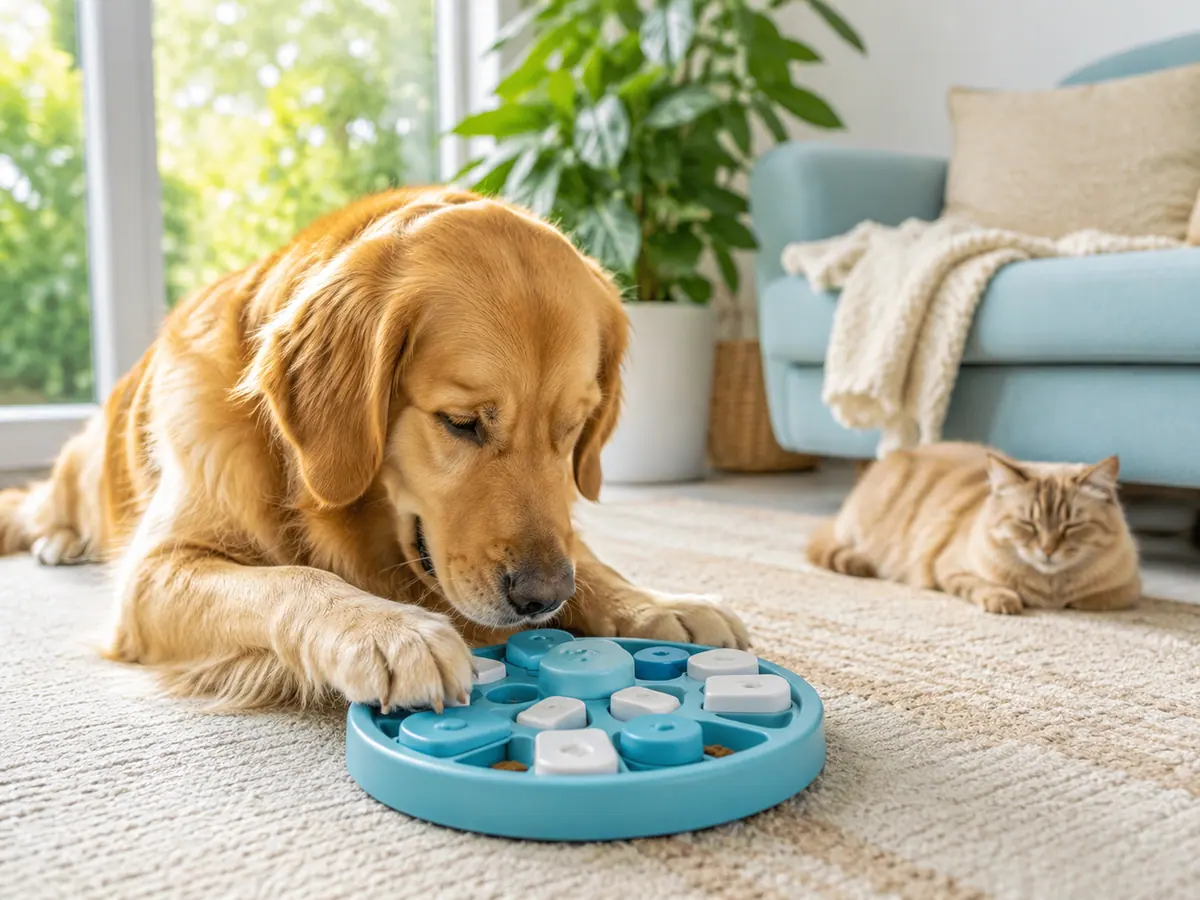
Start every new puzzle easier than you think you need to. A dog that fails on the first attempt learns the object is not worth approaching, and that lesson is harder to undo than it was to avoid. Make it harder only once the dog is confident.
The signs that a puzzle is too hard are specific and easy to read once you know them. The dog barks at it, paws it hard and fast, picks it up and drops it, walks away and lies down, or starts chewing the puzzle instead of working it. Yawning, lip licking and shaking off are the quieter version of the same message.
Difficulty should move in one direction at a time. Either hide the food deeper or add a lid, never both at once. If a dog stalls, drop back a step and let it win twice before you climb again. The aim is a dog that stays with the task for several minutes, not one that solves everything instantly and not one that quits.
Age and body matter as much as brains. An arthritic dog cannot hold a board still with a paw, a flat faced dog tires quickly in a deep snuffle mat because the searching is also breathing work, and a dog with failing eyesight does far better with scent games than with sliding lids. Pick a format the body can manage, then make the mental side as demanding as you like.
How to Build a Daily Routine Around Mentally Stimulating Dog Toys?
Answer: Use the dog's own dinner. The biggest mistake in enrichment is treating it as an extra, which quietly increases what the dog eats and turns a good habit into a weight problem. Measure the day's food in the morning, then let the puzzles, the mat and the stuffed toy come out of that measured amount.
Use the dog's own dinner. The biggest mistake in enrichment is treating it as an extra, which quietly increases what the dog eats and turns a good habit into a weight problem. Measure the day's food in the morning, then let the puzzles, the mat and the stuffed toy come out of that measured amount.
You might also enjoy our recommendations for bowl dog.
A workable pattern is simple. Breakfast goes into a puzzle or gets scattered across the lawn. Part of dinner goes into a snuffle mat. The last handful is frozen into a hollow rubber toy for the evening, or held back for a training session. Nothing extra is bought, nothing extra is eaten, and the dog now has three mentally demanding jobs it did not have before.
Put everything away afterwards. A puzzle left on the floor all day becomes scenery, and dogs walk past scenery. Bringing it out, using it and putting it back is what keeps the response strong, and it also means you handle the thing often enough to notice the day a seam opens or a lid cracks.
Rotate rather than buy. Three puzzles used in turn feel like far more than three puzzles used at once, because the gap between sessions restores the novelty. Keep the set small, keep it out of sight between uses, and put the money you saved toward one durable item instead of another thin plastic board.
Why Scentwork Is the Cheapest Form of Mentally Stimulating Dog Toys?
Answer: Nothing beats a dog's nose for value. Scattering a meal in long grass, hiding portions around a room, or teaching a dog to find a scented cotton bud costs nothing and asks more of the brain than most bought puzzles. Sniffing is self limiting, so a dog stops when it has had enough.

Nothing beats a dog's nose for value. Scattering a meal in long grass, hiding portions around a room, or teaching a dog to find a scented cotton bud costs nothing and asks more of the brain than most bought puzzles. Sniffing is self limiting, so a dog stops when it has had enough.
A sniffing walk is the easiest version to start with. Pick a route with hedges, verges and lamp posts, put the dog on a longer line in a safe place, and let it choose where to stop. You will cover a fraction of the usual distance and come home with a dog that is genuinely ready to sleep. The stimulation a slow sniffing route provides is very hard to match with speed.
Indoors, scatter feeding works on a rug or a doormat. Outdoors, throw a handful into grass long enough to hide it and let the dog work the patch. For a dog that finds this easy, start naming the behaviour, send it to search on cue, and hide food in another room so it has to use its nose rather than its memory. That one change makes the whole game far more stimulating.
Formal scentwork clubs take the same idea further, with dogs searching boxes, vehicles and rooms for a target odour. They suit dogs who struggle in busy group classes, because the work is done one dog at a time with everyone else out of the way. You do not need a club to get most of the benefit: a row of cardboard tubes with one baited tube is a mentally demanding search for a beginner.
What Should Pet Owners Know About Choosing Mentally Stimulating Dog Toys for a Puppy Without Causing Frustration?
Answer: Puppies need the short version of everything. Growth plates are still open, so the safest way to tire a young dog is with its brain rather than with distance or repetition. Keep sessions brief, finish while the puppy is still interested, and stop before it gets stuck.

Puppies need the short version of everything. Growth plates are still open, so the safest way to tire a young dog is with its brain rather than with distance or repetition. Keep sessions brief, finish while the puppy is still interested, and stop before it gets stuck.
For related picks, take a look at our gsd toys roundup.
Frustration is the thing to design around. A puppy has very little tolerance for being stuck, and a puzzle that defeats it produces barking, biting at the toy and a dog that avoids the next one. Leave lids off, leave food half visible, and let the first dozen sessions be almost insultingly easy. An easy task is still stimulating for a puppy, because almost everything in the world is new to it.
Mental work is also the honest answer to the question of how far a puppy should walk. Ask your veterinarian about exercise limits for your breed and age, because the answer varies, and in the meantime fill the gap with searching games in the garden, short training sessions and a stuffed rubber toy at nap time. None of those load a growing joint.
Watch what goes into the mouth. Puppies swallow things, so a puzzle with small removable pegs is a supervised toy rather than a free choice one, and anything a puppy can prise out and carry off should be put away as soon as the session ends. A teething puppy will chew the puzzle itself, so expect to stay closer than you would with an adult dog.
What Should Pet Owners Know About Common Mistakes Owners Make with Mentally Stimulating Dog Toys?
Answer: The most common mistake is starting hard. An expensive advanced puzzle handed to a dog that has never worked for its food produces a frustrated dog and a board with teeth marks in it. Difficulty is built over weeks, and a task only stays stimulating while the dog believes it can win.
The most common mistake is starting hard. An expensive advanced puzzle handed to a dog that has never worked for its food produces a frustrated dog and a board with teeth marks in it. Difficulty is built over weeks, and a task only stays stimulating while the dog believes it can win.
The second is leaving everything out all the time. Toys on the floor stop being events, the dog stops noticing them, and you stop noticing the cracked seam on the one it has been chewing. Pick it all up, keep a small rotation, and the same handful of objects stays interesting for months.
The third is skipping the inspection. Before every use, check a hard puzzle for cracked plastic and splintered edges, check a fabric mat for loose strips and open seams, check a rubber toy for bite sized pieces missing from the rim, and confirm that every removable peg and lid is still accounted for. Anything that has started shedding parts belongs in the bin rather than back in the box.
The last is treating mental work as a replacement for everything else. Enrichment does not substitute for walks, for company, or for veterinary attention when a dog's behaviour changes suddenly. If a settled dog becomes restless, destructive or clingy over a short period, that is a reason to speak to your veterinarian rather than to buy another puzzle.
What Should Pet Owners Know About Getting the Best Value When Shopping for Mentally Stimulating Dog Toys?
Answer: Most of what works costs nothing. A muffin tin with tennis balls over the holes is a puzzle. A towel rolled with kibble in the folds is a snuffle mat. A cardboard box packed with scrunched paper and a scattered handful of food is a shredding outlet and a search at the same time.
Most of what works costs nothing. A muffin tin with tennis balls over the holes is a puzzle. A towel rolled with kibble in the folds is a snuffle mat. A cardboard box packed with scrunched paper and a scattered handful of food is a shredding outlet and a search at the same time.
When you do buy, spend on the things that survive a dishwasher and a determined dog. One solid stuffable rubber toy and one well made fabric mat will outlast a shelf of thin plastic boards. Hollow rubber and silicone are easy to clean, which matters more than it sounds, because anything unpleasant to wash quietly stops being used.
Be careful with electronics. Battery powered treat dispensers and app controlled launchers are the most expensive and least durable part of this category, and plenty of dogs find a cardboard box more stimulating than a gadget. If you want one purchase that will still be in service next year, buy a stuffable rubber toy in the right size and learn to freeze it.
If you are refreshing worn gear anyway, check the chew toys and the walking kit on the same afternoon, since both age quietly and both fail at the seams. Our dog toy range covers the durable end of a rotation, and the recycling bin covers most of the rest.
For more independent, vet-reviewed guidance on this topic, the American Kennel Club expert advice center is an excellent place to start.
What Questions Do Pet Owners Ask About Mentally Stimulating Dog Toys?
Answer: Choosing mentally stimulating dog toys well comes down to four things: matching the product to your pet's size and daily routine, checking the materials against how hard it will be used, setting it up or fitting it correctly, and inspecting it on a schedule. This guide covers each of those, plus the mistakes owners most.
Does mental stimulation really tire a dog out?
It does, and often more reliably than distance. Searching, chewing and problem solving are all mentally demanding and need sustained concentration, which is tiring in a way that trotting beside a bike is not. The practical test is what happens afterwards: a dog that settles and sleeps has had enough, and a dog that is pacing has not.
How long should an enrichment session last?
End it while your dog still wants more. For most adult dogs that means a few minutes rather than half an hour, and for a puppy it is shorter again. Stopping early keeps the next session attractive. If your dog is losing interest halfway through, the puzzle is probably too hard rather than too long.
Can mental exercise replace a walk?
No. Walks provide movement, fresh air, outdoor scents and social contact, and none of that comes out of a puzzle on the kitchen floor. What enrichment does is reduce the pressure to walk further and further. On a day when a long walk is impossible, a search game and a chew will get a dog through comfortably.
How do I know a puzzle is too hard for my dog?
Watch for barking at it, fast hard pawing, picking it up and dropping it, chewing the puzzle instead of working it, or simply walking away. Yawning, lip licking and shaking off are the quieter version. Any of those means drop back a level, make the food easier to reach, and let your dog succeed twice before you increase it again.
What can I use if I have no puzzle toys at all?
A great deal. Scatter the meal across the lawn or a rug. Roll kibble inside a towel. Pack a cardboard box with scrunched paper and a handful of food. Hide portions around one room and send your dog to find them. Teach a new trick for part of the dinner. None of that costs anything.
How much brain work does a puppy need each day?
Less in one go and more often than people expect. Several very short sessions suit a puppy far better than one long one, and the aim is to finish before frustration appears. Because growth plates are still open, mental stimulation is also a safer way to settle a young dog than extra distance, which your veterinarian can advise on.
Do dogs get bored of the same puzzle?
Most do, and quickly. A board that has been solved is no longer stimulating, which is why a rotation beats a collection. Keep two or three items, use one at a time, and store the rest out of sight. Changing where you use them, and what you hide inside, buys more novelty than buying another board.
Are snuffle mats better than puzzle boards?
They do different jobs. A mat is a searching task that nearly every dog understands immediately and that calms most of them down. A board is a problem solving task that needs teaching and that a clever dog will beat. Owning one of each, and alternating, works better than owning two of either.
My dog destroys every puzzle I buy. What should I use?
Move to formats that have nothing to destroy. Scatter feeding, hidden food searches, training sessions and a correctly sized solid rubber stuffable toy all survive a dog that treats plastic as prey. Supervise any fabric item with that dog, and give it a cardboard box as the legitimate thing it is allowed to shred.