If you are looking for the best kong toys, this comprehensive guide covers everything you need to know. Whether you are a first-time pet owner or an experienced one looking to upgrade, you will find practical advice, safety tips, and honest comparisons below.
Quick Answer: What Should You Know About KONG Toys?
Choosing kong toys well comes down to four things: matching the product to your pet's size and daily routine, checking the materials against how hard it will be used, setting it up or fitting it correctly, and inspecting it on a schedule. This guide covers each of those, plus the mistakes owners most often make.
Why the Hollow Shape Behind KONG Toys Works So Well?
Answer: The KONG shape is a food container, not a chew toy that happens to be hollow. That distinction explains everything about it. The dog is not meant to destroy the rubber, it is meant to spend a long time getting something out of the cavity, and the rubber only has to survive the attempt.

The KONG shape is a food container, not a chew toy that happens to be hollow. That distinction explains everything about it. The dog is not meant to destroy the rubber, it is meant to spend a long time getting something out of the cavity, and the rubber only has to survive the attempt.
What makes the format unusually useful is the behaviour it produces. Licking and slow gnawing are repetitive, rhythmic actions, and dogs settle while they are doing them. A dog chasing a ball gets more excited as it goes. A dog working a stuffed chamber gets calmer. That is why KONGs turn up again and again in crate training, in separation work, and in the first hour after visitors arrive.
The erratic bounce is the secondary trick. A KONG will not roll in a straight line, so a dog cannot predict where it goes and a food reward falls out at random intervals. Unpredictable rewards hold attention far better than regular ones, which is the same reason a slot machine is harder to walk away from than a vending machine.
There is one thing the format does not do, and owners regularly expect it to. A stuffed KONG does not teach a dog to be comfortable alone. It makes the first part of being alone pleasant, which buys you time to do the actual training. Give it before the dog is anxious, not after, and speak to your veterinarian or a qualified behaviourist if the distress is severe.
What the Rubber Grades and Colours of KONG Toys Actually Mean?
Answer: The colours are a hardness scale rather than decoration, and picking the wrong one is the commonest buying error. Red is the general purpose KONG rubber that suits an average adult dog. Black is a firmer compound for heavy chewers. Pale pink and blue is softer, for puppies with milk teeth.
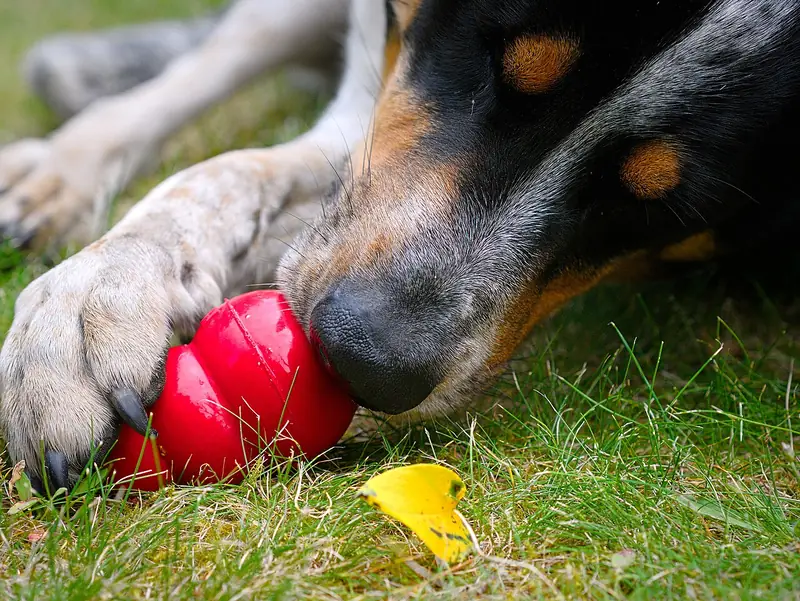
The colours are a hardness scale rather than decoration, and picking the wrong one is the commonest buying error. Red is the general purpose KONG rubber that suits an average adult dog. Black is a firmer compound for heavy chewers. Pale pink and blue is softer, for puppies with milk teeth.
If you want even more options, check out our guide to dog tag.
Purple sits at the other end for senior dogs. Older jaws lose power and older teeth are often worn, cracked or missing, so a dog that managed the firm black KONG for years may need a gentler one later. A softer compound also suits a dog recovering from dental work, though that is a conversation for your veterinarian rather than a guess from a colour chart.
Softer is not automatically safer. A powerful chewer given the puppy grade will take lumps out of it quickly, and lumps are exactly what you are trying to avoid. Match the grade to the mouth that is using it today, test it under supervision, and move up a grade the first time you find a tooth mark that has gone right through the surface.
Beyond the classic snowman, the same rubber appears in several other KONG shapes. There are ridged tug batons, treat dispensing wobblers that stand upright and tip, ball versions with a hole in each end, flying discs in flexible rubber, and squeaky shapes with a fabric body. Only some of those are stuffable, so check the cavity before assuming a given shape will take a frozen filling.
How to Size KONG Toys So a Dog Cannot Swallow or Destroy One?
Answer: Size for the mouth, not the bathroom scales. The toy has to be too large to pass behind the back teeth and too large to be swallowed whole, and weight is a poor proxy for either. A deep chested retriever and a stocky bulldog can weigh the same and need different sizes entirely.
Size for the mouth, not the bathroom scales. The toy has to be too large to pass behind the back teeth and too large to be swallowed whole, and weight is a poor proxy for either. A deep chested retriever and a stocky bulldog can weigh the same and need different sizes entirely.
The practical check takes seconds. The toy should not fit lengthways into the back of the mouth, and the dog should not be able to close its jaw past the widest part. If your dog can carry it in the back of the mouth like a ball rather than holding it at the front, it is too small. When a dog sits between KONG sizes, go up rather than down.
Size also decides durability, because a smaller item concentrates the same bite force onto less rubber. Many owners who conclude that a toy was destroyed too quickly actually bought one size too small. Going larger often fixes a durability complaint without changing the grade at all.
Multi dog households need a rule of their own. Dogs trade toys, and the small dog's item becomes a swallowing hazard in the big dog's mouth within seconds. Either size every KONG in the house for the largest dog, or feed stuffed toys in separate rooms behind a closed door, which also removes the guarding risk that food toys create.
What to Put Inside KONG Toys and How to Build the Difficulty?
Answer: Start loose and open. A first KONG filling should be dry kibble that falls out when the toy is nudged, so the dog learns within moments that pushing the thing around pays. Difficulty comes later, and a dog that has been beaten by its first attempt often will not pick the toy up again.

Start loose and open. A first KONG filling should be dry kibble that falls out when the toy is nudged, so the dog learns within moments that pushing the thing around pays. Difficulty comes later, and a dog that has been beaten by its first attempt often will not pick the toy up again.
You might also enjoy our recommendations for bowl dog.
The progression has three steps. Loose kibble first. Then kibble packed in and held with something soft, so the dog has to lick and work rather than simply tip. Then the same filling frozen solid, which is the hardest version and the longest lasting. Most households jump straight to the last step and wonder why the dog loses interest.
Use the dog's own measured food wherever you can. Soaked kibble, plain canned food, a little plain yoghurt, mashed banana, pumpkin puree and wet food all work as the binder that holds dry food inside a KONG. Take the binder out of the daily ration rather than adding it on top, because a stuffed toy every evening quietly becomes a second dinner.
Some fillings do not belong anywhere near a KONG cavity. Cooked bones can splinter. Grapes, raisins, onion, chocolate and anything sweetened with xylitol are toxic to dogs. Rich, fatty leftovers upset stomachs and leave a greasy film inside the rubber that is difficult to remove. Nut butters need checking for sweeteners before they go in. If you are unsure about a food, ask your veterinarian rather than guessing.
Why Freezing Transforms What KONG Toys Can Do?
Answer: Freezing is the single change that moves a stuffed KONG from a brief snack to a real occupation. A soft filling is gone in moments. The same filling frozen has to be licked out layer by layer, and that slow repetitive licking is exactly the behaviour that settles an unsettled dog.
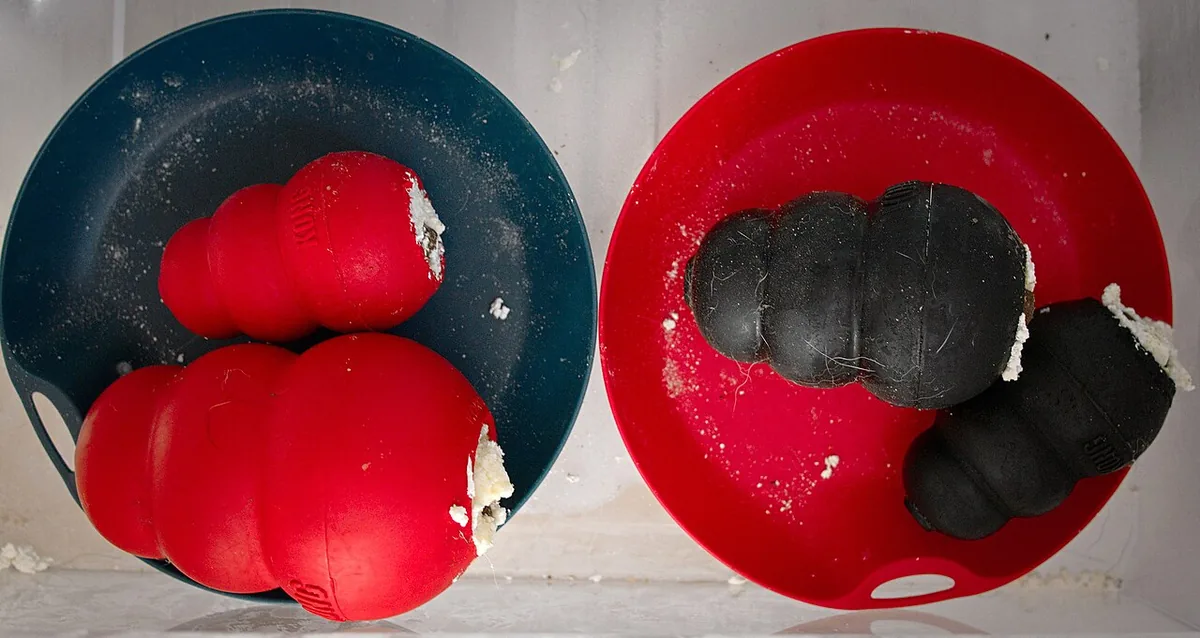
Freezing is the single change that moves a stuffed KONG from a brief snack to a real occupation. A soft filling is gone in moments. The same filling frozen has to be licked out layer by layer, and that slow repetitive licking is exactly the behaviour that settles an unsettled dog.
Batch preparation is what makes it sustainable. Stuff several at once, stand them cavity upward in a mug or a bowl so nothing leaks, cover them and freeze the lot. Having a ready supply in the door of the freezer is the difference between a routine you keep and a good intention you abandon by the second week.
Frozen KONGs suit particular moments: the hour you leave the house, a thunderstorm, a crate settling routine, a long car journey, or the evening of a day when a dog on restricted exercise could not have its walk. A teething puppy gets extra benefit, because cold is soothing on sore gums, and a frozen filling in a softer grade is a safe thing to chew on.
There are two honest cautions. Feed frozen toys somewhere washable, because they drip as they thaw, and a melting filling on a rug is a miserable discovery. And count the calories, since a frozen stuffing is still food. If your dog is gaining weight, take the filling out of the daily ration rather than treating it as free.
How to Clean KONG Toys Before They Turn Rancid?
Answer: This is the part everybody skips, and it is the reason a well loved KONG eventually ends up in the bin. Fat and dairy residue dries into the inside of the cavity where no finger reaches, then goes rancid. The smell is sour and unmistakable, and once it is established, soap alone rarely shifts it.

This is the part everybody skips, and it is the reason a well loved KONG eventually ends up in the bin. Fat and dairy residue dries into the inside of the cavity where no finger reaches, then goes rancid. The smell is sour and unmistakable, and once it is established, soap alone rarely shifts it.
For related picks, take a look at our gsd toys roundup.
Wash it the same day it is used, not when you next remember. Hot soapy water, a bottle brush pushed right into the chamber and a thorough rinse will deal with almost anything. Most solid rubber KONGs are dishwasher safe on the top rack, which is the easiest habit of all because the toy simply joins the evening load.
Drying matters more than people expect. Stand the toy with the large opening downward so water drains out instead of sitting in the narrow end, and let it dry fully before it is refilled. A cavity that is refilled while still damp is the shortest route to a sour toy and a dog that has decided it no longer wants it.
If one has already turned, try a soak in hot water with a little baking soda, scrub the inside and rinse until the smell is gone. Skip bleach and strong detergents, which are hard to rinse out of porous rubber. If the sour smell survives two proper cleans, the honest answer is that the toy has reached the end of its life.
What Should Pet Owners Know About Common Mistakes Pet Owners Make with KONG Toys?
Answer: The first mistake is believing the word indestructible. No KONG is indestructible, and the toughest grade is simply the hardest to break rather than unbreakable. Treat every one as a supervised item until you have watched your own dog work it for several sessions and seen how it holds up.
The first mistake is believing the word indestructible. No KONG is indestructible, and the toughest grade is simply the hardest to break rather than unbreakable. Treat every one as a supervised item until you have watched your own dog work it for several sessions and seen how it holds up.
That leads straight to the second mistake, which is carrying on after the rubber has started coming away. A dog that is removing chunks is swallowing them, and swallowed rubber does not digest. The rule is simple: tooth marks on the surface are normal wear, pieces missing are not. Retire it when the rim is chewed thin, when the walls are split, when a piece of the edge is gone, or when the toy has lost its shape.
The third is handing it over at the wrong moment. Giving a stuffed KONG to a dog that is already barking at the door rewards the barking. Give it a little before the trigger, while the dog is calm, and the association being built is the one you actually want.
The fourth is leaving them lying about. A toy on the floor all week stops being interesting, and a dog that has nothing better to do will chew on an empty one for hours, which is how a chamber gets split. Hand it over full, take it away when it is empty, and wash it. The novelty, and the toy, both last far longer that way.
What Should Pet Owners Know About Getting the Best Value When Shopping for KONG Toys?
Answer: Buy more than one of the same KONG rather than several different shapes. A rotation of identical stuffable toys means there is always a frozen one ready while another is in the dishwasher, and that single change is what turns an occasional treat into a daily routine you can actually keep up.
Buy more than one of the same KONG rather than several different shapes. A rotation of identical stuffable toys means there is always a frozen one ready while another is in the dishwasher, and that single change is what turns an occasional treat into a daily routine you can actually keep up.
Spend the money on the rubber and nothing else. The useful accessories are a bottle brush and freezer space. Ready made filling pastes in a can are convenient and expensive, and for most dogs they do nothing that soaked kibble with a spoonful of plain wet food does not already do.
Watch for very cheap unbranded copies of the KONG shape. The silhouette is easy to mould and the rubber compound is not, so a soft copy sold at a tempting price tends to shed pieces under a chewer. If you are going to supervise anything closely, make it an unfamiliar copy rather than a known grade.
A worn out one still has a last job before the bin. A split toy makes a decent plant pot drainage weight or a doorstop, so retire it from the toy box rather than from the house. If you are rebuilding a rotation from scratch, our dog toy range covers the durable chew and fetch end of it.
Organizations like the VCA Animal Hospitals pet health library also offer trusted, science-backed advice that is well worth bookmarking.
What Questions Do Pet Owners Ask About KONG Toys?
Answer: Choosing kong toys well comes down to four things: matching the product to your pet's size and daily routine, checking the materials against how hard it will be used, setting it up or fitting it correctly, and inspecting it on a schedule. This guide covers each of those, plus the mistakes owners most often make.
Is a KONG really indestructible?
No, and no rubber toy is. The firmer black grade is the hardest to damage, not impossible to damage. Inspect yours before every use, and stop using it the moment pieces are missing rather than merely marked. A dog that removes chunks needs supervision at minimum, and usually a different type of toy altogether.
What size should I buy for my dog?
Big enough that it cannot pass behind the back teeth and cannot be swallowed whole. Weight charts are a rough guide, because two dogs of the same weight can have very different jaws. If your dog can hold it at the back of the mouth like a ball, it is too small. Between two sizes, take the larger.
What can I safely stuff inside one?
Measured kibble, soaked kibble, plain canned food, plain yoghurt, mashed banana and pumpkin puree all work well. Avoid cooked bones, grapes, raisins, onion, chocolate and anything containing xylitol, and check nut butters for sweeteners first. Take the filling out of the daily ration rather than adding it on top.
Why should I freeze a stuffed toy?
Because it changes how long the toy lasts and what it does for the dog. A soft filling disappears in moments; frozen, the same filling has to be licked out in layers, and that slow licking is what settles a dog. Freeze a batch standing upright in a bowl, and serve them somewhere washable because they drip.
How do I get the smell out of a rubber toy?
Soak it in hot water with a little baking soda, scrub the inside with a bottle brush and rinse thoroughly. Avoid bleach and strong detergents, which are hard to rinse out of rubber. Prevention is easier: wash it the same day, dry it opening downward, and never refill a damp cavity.
When should I throw one away?
When the rim has been chewed thin, when a piece is missing, when the walls have split, when it has lost its shape, or when a sour smell survives two proper cleans. Surface tooth marks on their own are normal wear and not a reason to replace anything.
Will a stuffed toy fix separation anxiety?
It helps with the first part of being alone, which is not the same as fixing the problem. The toy makes your departure pleasant and buys time, but a dog that panics once the food is gone still needs a proper behaviour plan. Ask your veterinarian for a referral to a qualified behaviourist if the distress is severe.
Can puppies and senior dogs use the same one?
They should not. Puppies with milk teeth need the softer grade, and older dogs with worn or missing teeth usually need a gentler compound than the one they used in their prime. Softer is not automatically safer either, because a strong chewer will take pieces out of a soft toy quickly.