Top photo: a red and white Welsh Corgi squinting happily indoors. Photo: Kaiwenouyang / Wikimedia Commons, CC BY-SA 4.0 (cropped, resized and converted to WebP).
If you are looking for the best k9ballistics, this comprehensive guide covers everything you need to know. Whether you are a first-time pet owner or an experienced one looking to upgrade, you will find practical advice, safety tips, and honest comparisons below.
Quick Answer: What Should You Know About K9 Ballistics?
Choosing k9ballistics well comes down to four things: matching the product to your pet's size and daily routine, checking the materials against how hard it will be used, setting it up or fitting it correctly, and inspecting it on a schedule. This guide covers each of those, plus the mistakes owners most often make.
Why Chew-Resistant Dog Beds Exist at All?
Answer: Some dogs do not nibble a bed out of idle boredom. They open it, pull the fill out and swallow part of it. For those dogs an ordinary plush bed is a consumable, and the cover fabric has to stop being an afterthought and become the feature. That is the whole reason this category exists.
Some dogs do not nibble a bed out of idle boredom. They open it, pull the fill out and swallow part of it. For those dogs an ordinary plush bed is a consumable, and the cover fabric has to stop being an afterthought and become the feature. That is the whole reason this category exists.
K9 Ballistics is the name most people are reaching for when they search this term: a United States maker whose beds are built from ballistic nylon rather than upholstery cloth. Livehappypet does not sell that brand, and this guide is deliberately about the material and the construction, so you can judge any tough bed on what it is made of instead of on what the listing calls it.
The reason fabric matters more than padding here is mechanical. A chewer does not start in the middle of a panel. It starts at a corner, a seam, a piping cord or a dangling zip pull, gets a thread between its back teeth and pulls, and everything after that is unpicking. A cover that never offers that first thread removes the entire sequence rather than slowing it down.
No bed is indestructible, whatever the listing says. A chew-resistant bed buys hours instead of minutes, and it survives the dog that tests a new thing once rather than the dog that works at it every evening. If your dog destroys bedding regularly, that is usually boredom, distress at being left, or too little exercise, and the ballistic weave is the last part of the answer rather than the first.
What Ballistic Nylon Is and How the Weave Works?
Answer: Ballistic nylon is a heavy plain weave made from thick nylon yarns, developed during the Second World War for flak jackets. The toughness comes from the weave as much as the fiber: fat yarns packed tight in a basket pattern leave nothing proud for a tooth to catch.

Photo: TuckTheNugget / Wikimedia Commons, CC BY-SA 4.0
Ballistic nylon is a heavy plain weave made from thick nylon yarns, developed during the Second World War for flak jackets. The toughness comes from the weave as much as the fiber: fat yarns packed tight in a basket pattern leave nothing proud for a tooth to catch.
If you want even more options, check out our guide to dog tag.
Two separate properties do the work. Abrasion resistance keeps the surface from being worn open by a dog scraping and digging at the same spot every night. Tear strength stops a small puncture from running into a long split. Ballistic weave is strong on both counts, which is why the same cloth turns up in luggage, motorcycle clothing and tool bags rather than only in pet products.
Ripstop is a different solution to the same problem. A grid of thicker reinforcing threads is woven into a lighter cloth at regular intervals, so a tear travels until it reaches the next grid line and stops there. Ripstop is lighter and quieter than a ballistic basket weave and much better at containing damage that has already begun, but the cloth between the grid lines is thin, so it resists the initial puncture less well.
Most of these fabrics carry a polyurethane coating on the back, which is what makes them water resistant and gives the cloth its body. That coating is also the part that cracks with age and with hot washing, and once it starts flaking the fabric goes limp and loses the stiffness that was keeping teeth from getting a purchase. Wash cool and skip the dryer.
In the hand, a genuine ballistic cloth feels dense and slightly slick, it barely stretches in either direction, and you cannot pinch a single thread up off the surface. Upholstery fabrics sold as heavy duty feel softer, show a visible nap, and let you lift a loop with a fingernail. That fingernail test is the quickest check you can run in a store.
How Ballistic Nylon Compares With Canvas, Denim and Vinyl?
Answer: Canvas, denim, vinyl and ballistic nylon fail in different ways, so the right one depends on how your dog does the damage. The cottons are quiet, cheap and breathable, and they tear once a tooth opens a hole. Vinyl wipes clean and punctures. Nylon resists both abrasion and tearing and sleeps warmer.
Canvas, denim, vinyl and ballistic nylon fail in different ways, so the right one depends on how your dog does the damage. The cottons are quiet, cheap and breathable, and they tear once a tooth opens a hole. Vinyl wipes clean and punctures. Nylon resists both abrasion and tearing and sleeps warmer.
Heavy cotton duck, the cloth of workwear and boat covers, is the realistic budget alternative. It takes scraping and digging well, it softens pleasantly with every wash, and it is far nicer to lie on than any coated fabric. Its weakness is the tear, because cotton has almost no give, so a hole a tooth starts will run. It suits a dog that scuffs and digs rather than one that bites and pulls.
Denim is a cotton twill, and the diagonal weave that makes jeans comfortable is also what makes them fray once the surface is broken. It is a reasonable cover for a mild chewer and a poor one for a serious one. Both cottons do have a real advantage over ballistic nylon: they breathe, so a thick-coated dog lying on one all night does not wake up damp underneath.
Vinyl and coated polyester are the kennel answer. Nothing cleans faster, nothing shrugs off urine better, and nothing is less pleasant on a warm evening. A tooth that gets through the surface tears vinyl easily and the damage spreads from there, so vinyl solves hygiene problems rather than chewing problems.
Weight and sound matter more than owners expect. A ballistic cover rustles when a dog turns over, holds heat, and feels cool and slick for the first few minutes. Canvas is quiet and warm from the start. A noisy cover keeps a light sleeper shifting around all night, which is its own kind of failure even if the fabric survives.
Why the Seams and the Zip Fail Before the Fabric Does?
Answer: Almost nobody chews through the middle of a panel. A dog finds an edge: the stitched seam at a corner, the cord inside the piping, or the zip pull hanging free. Thread is weaker than cloth, and a raised seam gives a dog something to grip, so that is where every destroyed bed begins.
Almost nobody chews through the middle of a panel. A dog finds an edge: the stitched seam at a corner, the cord inside the piping, or the zip pull hanging free. Thread is weaker than cloth, and a raised seam gives a dog something to grip, so that is where every destroyed bed begins.
You might also enjoy our recommendations for bowl dog.
Look at the thread before you look at the fabric. Bonded nylon or polyester thread in a lock stitch, sewn twice and bar tacked at the corners, holds when a dog pulls. A single row of cotton thread does not, whatever it is sewing together. Seams folded under so no raw edge is exposed are worth more than another grade of ballistic cloth on the panels.
Zips are the other weak point and the easiest one to inspect. A chunky molded or metal zip, sewn in behind a flap so the slider is covered, with the pull removed or taped down, is close to invisible to a dog. A thin coil zip with a dangling metal pull is a handle. The better chew-resistant beds hide the closure underneath the bed entirely, which is safest of all.
Piping is a cord wrapped in fabric and sewn into a seam, and to a dog it is a rope with a convenient grip. Tougher beds either leave it out altogether or wrap the cord in the same ballistic cloth as the panels and stitch it deep into the seam. Rounded corners help for the same reason, because a square corner is a point a dog can take hold of and a curve is not.
The last line of defense is whatever sits under the cover. A tough outer over a loose bag of fiber still empties itself if the cover is ever opened, so look for an inner liner that also resists tearing, or a solid foam core that cannot be dragged out through a small hole. Swallowed stuffing is a veterinary problem rather than a laundry one, so call your veterinarian straight away if you think your dog has eaten any.
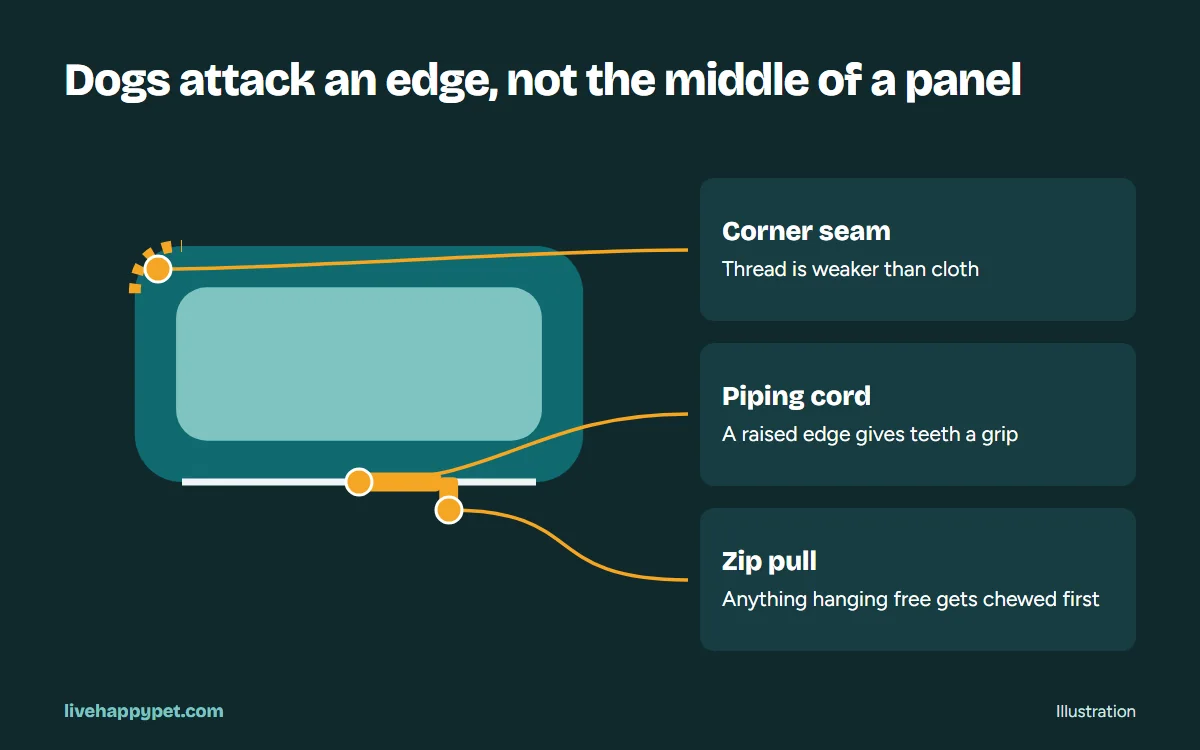
Illustration: Livehappypet
How to Tell a Genuinely Chew-Resistant Bed From One That Just Says Tough?
Answer: Treat the words tough, heavy duty and indestructible as marketing until the listing names the fabric, the thread and the closure. A seller proud of the construction says what the cover is woven from, how the seams are finished and where the zip hides. The rest just write durable.
Treat the words tough, heavy duty and indestructible as marketing until the listing names the fabric, the thread and the closure. A seller proud of the construction says what the cover is woven from, how the seams are finished and where the zip hides. The rest just write durable.
Four details separate the real thing from the claim. A named fabric rather than a vague one. Stitching described as double stitched or bar tacked at the stress points. A hidden, reversed or removable closure. And a written chew warranty with its exclusions spelled out, because a company willing to replace a chewed bed has done the arithmetic on how often that actually happens.
If you can handle the bed before buying, do three things. Run a fingernail across the cover and try to lift one thread. Pinch a seam between your thumbs and pull to see how much daylight appears. Then find the closure and ask yourself whether your dog could get a tooth behind it. A proper ballistic cover fails all three tests for the dog and passes all three for you.
Read the chew warranty rather than the headline above it. Most cover a single replacement, most exclude the inner cushion, and most want the damaged bed sent back. None of that is dishonest, but it tells you the maker expects a proportion of beds to be destroyed, which is a far more realistic picture than the word indestructible printed on the front of the box.
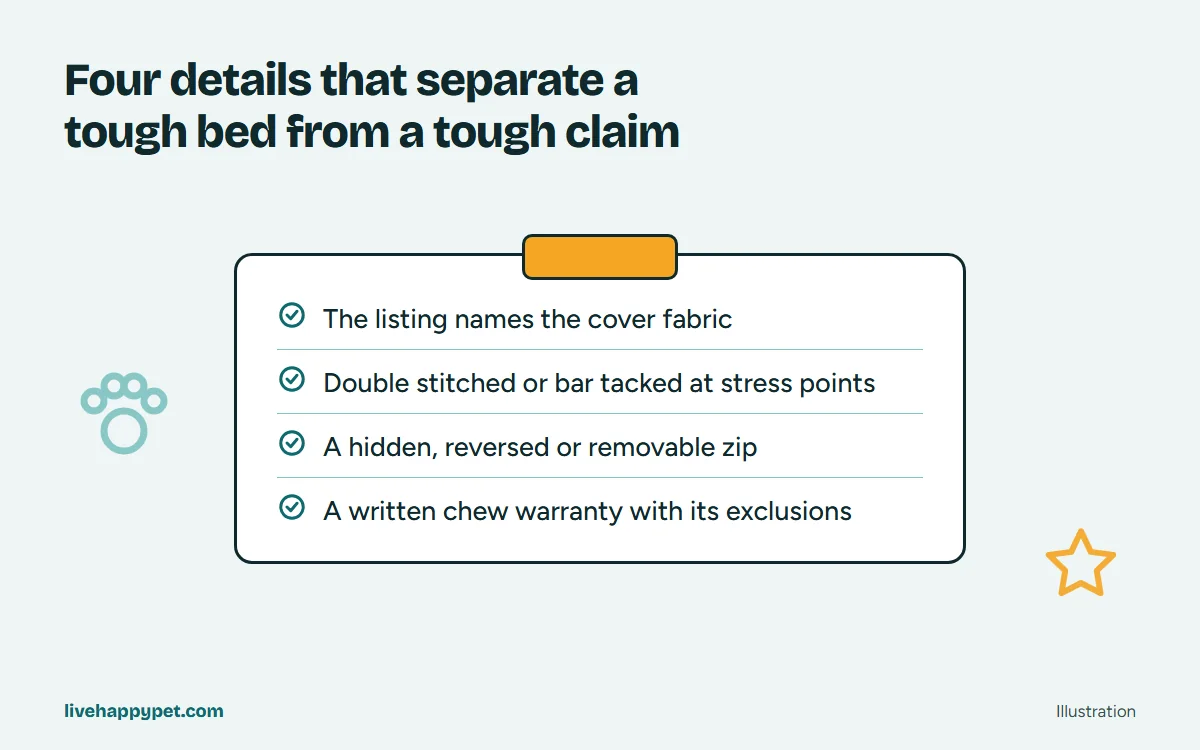
Illustration: Livehappypet
What a Frame and a Taut Deck Add to a Chew-Resistant Bed?
Answer: The toughest design is not a cushion at all. An elevated cot stretches one panel of fabric over a metal frame, so the cover is held under tension, nothing is loose, there is no stuffing to reach and no slack to bunch up and bite. Tension does what thickness cannot.
The toughest design is not a cushion at all. An elevated cot stretches one panel of fabric over a metal frame, so the cover is held under tension, nothing is loose, there is no stuffing to reach and no slack to bunch up and bite. Tension does what thickness cannot.
For related picks, take a look at our gsd toys roundup.
The weak points move rather than disappear. On a cot they are the corners where the deck wraps the rail, the fastenings that hold it taut, and the plastic feet. Frames with the fabric sleeved over steel or aluminum rails outlast molded corner blocks, and a deck that can be bought on its own turns a destroyed bed into a cheap repair instead of a replacement.
A cot runs cooler, hoses clean and keeps a dog off a wet floor, but it offers no cushioning whatsoever. An older or bony dog needs a thin pad on top, which puts something chewable back into the picture, so the usual compromise is a pad while you are at home and a bare deck when you are not.
The same thinking applies inside a crate. A chew-resistant crate pad is thin, carries no exposed piping, and is often fastened at the corners so it cannot be dragged into a ball. A thick plush pad left in a crate with a dog that is anxious about being alone is the single most commonly destroyed piece of bedding in any household.
What Should Pet Owners Know About Common Mistakes Owners Make with Chew-Resistant Bedding?
Answer: The commonest mistake is buying a tougher bed instead of asking why the last one died. A dog that shreds bedding when left alone is telling you something about the hours it spends alone, and a ballistic cover only changes how long that message takes to arrive. Deal with the boredom or the distress first.
The commonest mistake is buying a tougher bed instead of asking why the last one died. A dog that shreds bedding when left alone is telling you something about the hours it spends alone, and a ballistic cover only changes how long that message takes to arrive. Deal with the boredom or the distress first.
The second is leaving a dog unsupervised with a brand new bed. Most beds are tested on the first night, and a dog that gets a result in that first hour has just learned that bedding comes apart. Introduce a new bed while you are in the room, interrupt the first attempt calmly, and swap in something the dog is allowed to chew.
The third is washing a coated fabric hot. Heat cracks the polyurethane backing that gives these covers their water resistance and their stiffness, and a limp cover hands teeth more to work with. Cold water, mild detergent, no softener, line dry.
The fourth is trusting the word indestructible and skipping the daily look. Check the seams and the closure whenever you pick the bed up, because a small opening becomes an empty cover overnight. The fifth is putting the replacement in exactly the same spot and changing nothing else, when the room, the window, or the length of time alone was the real trigger all along.
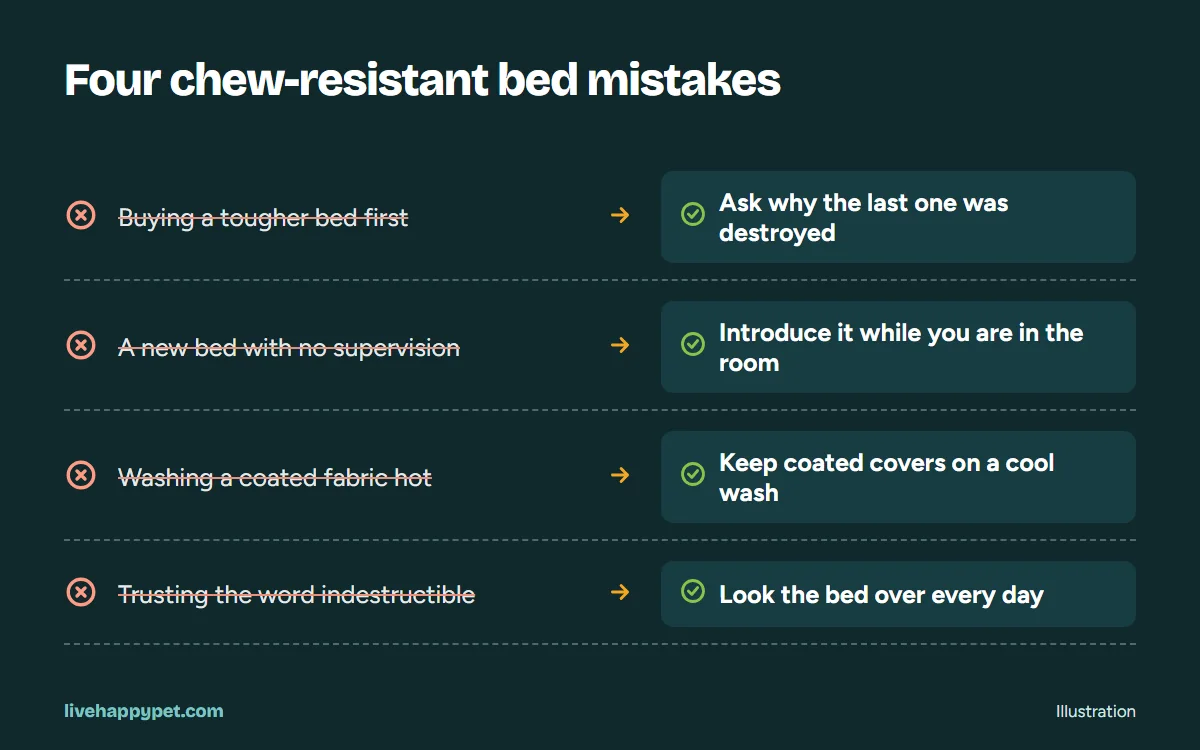
Illustration: Livehappypet
What Should Pet Owners Know About Getting the Best Value From a Chew-Resistant Dog Bed?
Answer: A tough bed costs noticeably more than a plush one, so the arithmetic is how many plush beds it replaces. For a dog that has already destroyed several, one chew-resistant bed pays for itself inside a year. For a dog that opened one once, a cot usually settles it.
A tough bed costs noticeably more than a plush one, so the arithmetic is how many plush beds it replaces. For a dog that has already destroyed several, one chew-resistant bed pays for itself inside a year. For a dog that opened one once, a cot usually settles it.
Spend in this order: the closure, then the seams, then the fabric. A bed with a hidden zip and bar-tacked corners in heavy canvas will outlive a ballistic-covered bed with an exposed pull. Buying a spare cover or a spare deck at the same time is worth more than paying up for the next grade of cloth, because the part that fails is rarely the panel itself.
A cot plus a separate washable pad is usually the cheapest durable combination you can assemble. The deck lasts for years, the pad costs little to replace, and you can simply take the pad away whenever the dog is left alone. Our dog range is a reasonable starting point for the everyday bedding that sits on top of a frame like that.
Finally, keep the bed you already have. A dog that has opened one cover is often perfectly content to carry on using it with a patch sewn over the hole, and a repair costs almost nothing. A square of heavy outdoor fabric stitched over the damage, or a tough iron-on canvas patch, can add a season to a bed that still supports the dog exactly as well as it did before.
Organizations like the VCA Animal Hospitals pet health library also offer trusted, science-backed advice that is well worth bookmarking.
What Questions Do Pet Owners Ask About K9 Ballistics?
Answer: Choosing k9ballistics well comes down to four things: matching the product to your pet's size and daily routine, checking the materials against how hard it will be used, setting it up or fitting it correctly, and inspecting it on a schedule. This guide covers each of those, plus the mistakes owners most often make.
What is ballistic nylon?
A heavy plain weave of thick nylon yarns, developed during the Second World War for flak jackets and now used for luggage, motorcycle gear and tough dog beds. The strength comes from the weave as much as the fiber: the yarns are fat and packed tight, so there is almost no loose thread standing proud for a tooth to catch.
Is any dog bed actually chew proof?
No. Chew resistant is the honest term and the better makers use it. A ballistic cover over a tensioned frame removes the obvious handholds and buys hours rather than minutes, but a determined dog with enough time alone will eventually find the seam, the closure or a corner. Treat the fabric as part of the answer, never the whole one.
Is ballistic nylon better than canvas for a dog bed?
For a dog that bites and pulls, yes, because cotton canvas tears once a hole has been started while nylon resists both abrasion and tearing. For a dog that only scuffs and digs, heavy cotton duck is cheaper, quieter, breathable and far more pleasant to lie on. Match the cloth to how your dog actually does the damage.
Where do chew-resistant dog beds usually fail first?
At the seams, the piping and the zip, almost never in the middle of a panel. Thread is weaker than cloth, and a raised cord or a dangling pull is something a dog can take hold of. Look for bar-tacked corners, bonded thread, piping either omitted or stitched deep into the seam, and a closure hidden behind a flap or underneath the bed.
Does Livehappypet sell K9 Ballistics beds?
No. That brand is sold through its own channels, and this guide is written so you can judge any tough bed on its construction rather than its label. Whoever you buy from, compare the same things: the cover fabric, how the seams are finished, whether the closure is hidden, and whether a replacement cover is sold separately.
How should a chew-resistant dog bed be washed?
Cold water, mild detergent, no fabric softener and no tumble dryer. The water-resistant coating on the back of a nylon cover cracks with heat, and a cover that has gone limp gives teeth more to grip. Line dry it all the way through before it goes back on, and never put a foam core through a machine.
Would an elevated cot be better than a chew-resistant cushion?
Often, yes. A cot holds one panel of fabric under tension over a metal frame, with no stuffing to reach and no slack to bite, which is structurally much harder to attack than any cushion. The trade-off is that it gives no padding at all, so an older or bony dog needs a thin pad on top while you are there to supervise.
Why does my dog destroy its bed only when I leave the house?
Chewing that happens only in your absence usually points at distress rather than boredom, and a tougher bed will not address the cause. Look at what else changes when you leave, build up short absences gradually, leave something the dog is allowed to chew, and speak to your veterinarian or a qualified behaviorist if the pattern keeps repeating.