Top photo: a ginger cat sitting among stuffed toys on a bed. Photo: Libasstref / Wikimedia Commons, CC BY 4.0 (cropped, resized and converted to WebP).
Searches for this phrase almost never mean a toy made of jelly. They mean Jellycat, the London soft toy brand, and the question behind the search is usually whether one of those plush animals is safe for a real kitten. The honest answer is that they are collectables made for people, so what follows is what that means for a kitten specifically, what to check on any soft toy before a kitten gets it, and which alternatives are genuinely built for cats.
Quick Answer: What Should You Know About Jelly Kitten Toys?
Jellycat and similar boutique plush are made and safety tested as toys for people, not for pets. A kitten should not have unsupervised access to one. Choose a soft toy made for cats, with embroidered features, short pile fabric and a single piece of filling, and retire it at the first tear.
What Shoppers Usually Mean When They Search for Jelly Kitten Toys?
Answer: Almost nobody searching this phrase wants a toy made of jelly. They mean Jellycat, the London soft toy company whose plush animals have become a collecting habit, and the real question is whether one of those is safe around a kitten. The honest answer is that it was never built for one.
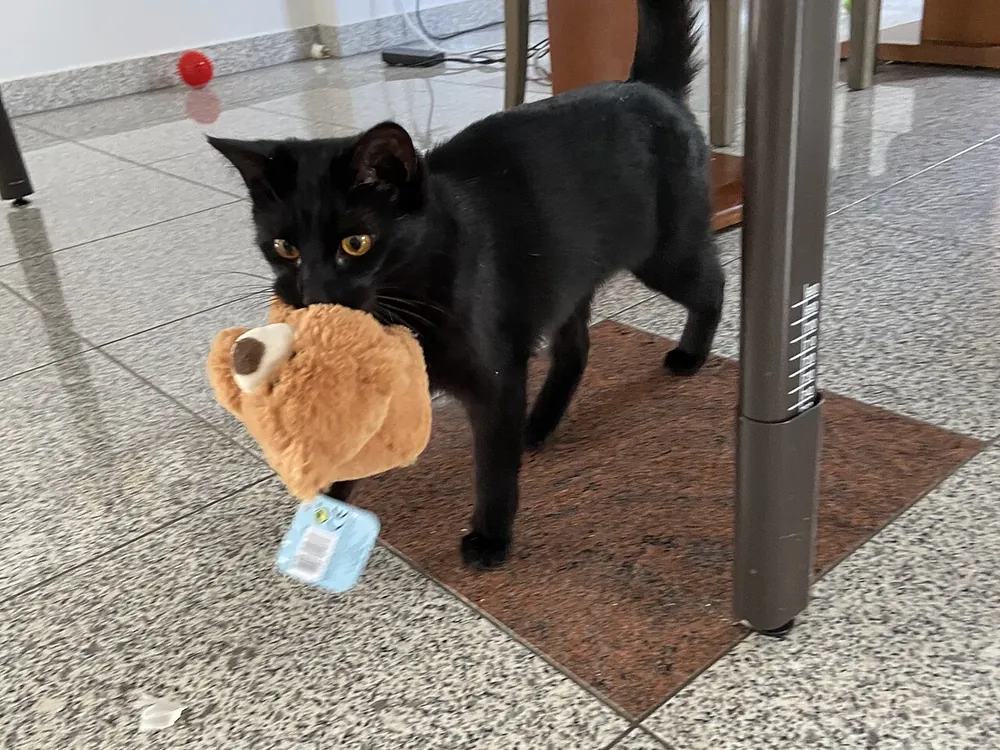
Photo: Sram4511 / Wikimedia Commons, CC BY-SA 4.0
Almost nobody searching this phrase wants a toy made of jelly. They mean Jellycat, the London soft toy company whose plush animals have become a collecting habit, and the real question is whether one of those is safe around a kitten. The honest answer is that it was never built for one.
Jellycat sells soft toys alongside books, bags and blankets, and its designs have built a large online following. The animal shaped ones look like pet toys, feel like pet toys, and are often exactly the size a kitten can carry. None of that makes them pet toys, and the difference shows up the first time a kitten gets its back teeth into a seam.
The company's own safety and care guidance is written around babies and children rather than pets, and that is the point rather than a criticism. A standard written for a child answers how a child hugs, carries and mouths a toy. A kitten brings needle sharp teeth, back claws that rake, and a bite built to pull prey apart.
This matters more for a kitten than for a grown cat. Kittens chew constantly while they are teething, they swallow what they chew more often than adults do, and they are small enough that a modest wad of filling is a serious obstruction. A toy an older cat would merely bat around is a different proposition in a kitten's mouth.
What Separates a Collectable From a Cat Toy in Jelly Kitten Toys?
Answer: A cat rated toy and a boutique collectable differ in four places: the face, the seams, the fill and the fur. Toys made for cats use embroidered features, tight double stitching, one continuous filling and short fibre. Jellycat style plush is built for softness and for looks, which means the opposite on most of those.
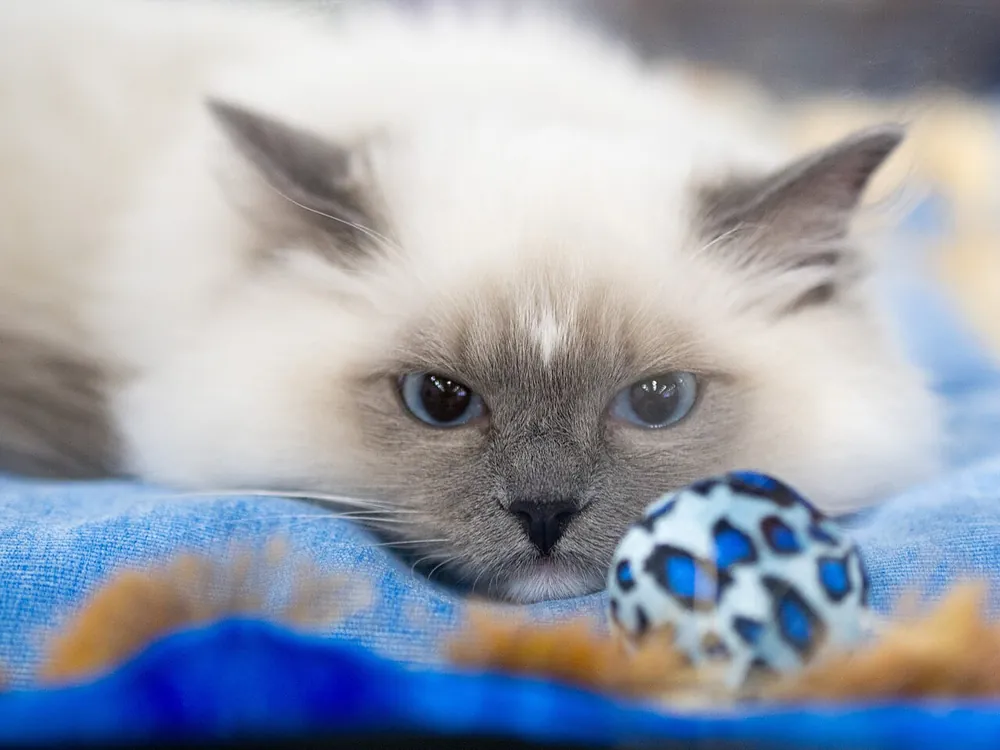
Photo: kishjar? from Moscow, Russia / Wikimedia Commons, CC BY 2.0
A cat rated toy and a boutique collectable differ in four places: the face, the seams, the fill and the fur. Toys made for cats use embroidered features, tight double stitching, one continuous filling and short fibre. Jellycat style plush is built for softness and for looks, which means the opposite on most of those.
Cat parents might also find our cat bowls guide helpful.
Start with the face. Plastic eyes and noses sit on a post with a washer behind the fabric, and a kitten's back teeth will work one loose given a few evenings. Glued felt comes away in a single piece the exact size a kitten swallows. Embroidered features cannot be removed, because there is nothing there to remove.
Then the seams. A toy intended for a cat is double stitched and often has tape inside the seam. A collectable is usually single stitched, and sometimes glued where the shape is fiddly, so it opens along a line rather than tearing. Once a seam is open the filling comes out in handfuls, and that is the point at which most of the risk arrives.
Finally the filling. Many boutique designs use a weighted base packed with small plastic pellets so the toy sits upright on a shelf, and a split bean bag scatters a great many swallowable pieces across a floor at once. Bag charm and keyring versions add metal rings and clips, which belong nowhere near a kitten.
Why Long Pile Fur and Bean Fill Make Jelly Kitten Toys Risky for a Kitten?
Answer: Long pile fur is the hazard people never think about. A kitten that licks and gnaws a shaggy plush takes in loose fibre every session, and unlike a hairball of its own coat, synthetic fibre is not something the gut is built to move along. Short dense pile sheds far less.
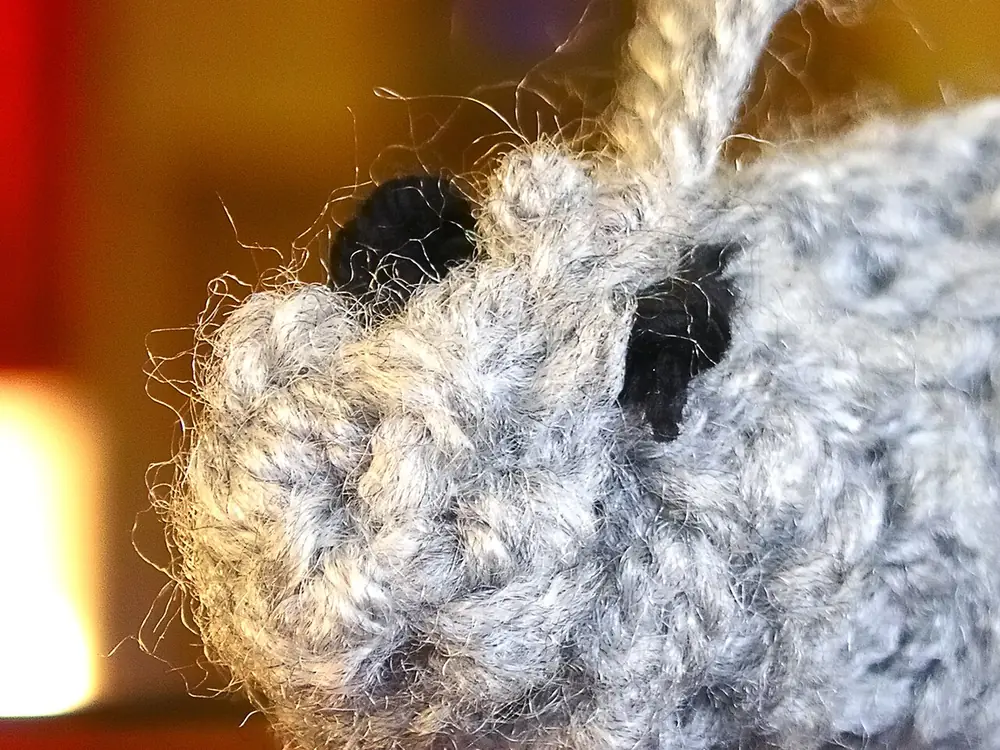
Photo: Mikael Moiner from Gothenburg, Sweden / Wikimedia Commons, CC BY 2.0
Long pile fur is the hazard people never think about. A kitten that licks and gnaws a shaggy plush takes in loose fibre every session, and unlike a hairball of its own coat, synthetic fibre is not something the gut is built to move along. Short dense pile sheds far less.
Bean and pellet fill is the fastest moving risk. One opened seam at the base puts a scattering of hard beads across the floor, and a kitten will chase and mouth them exactly as it would chase an insect. String tails, ribbon bows and sewn on tags fall into the same category: small, loose, and irresistible to something that hunts movement.
Swallowed string and ribbon deserve a warning of their own, because a long thin object behaves differently inside a cat than a lump does. If you can see thread, ribbon or string in a kitten's mouth or hanging from its back end, do not pull on it. Phone your veterinarian the same day and describe exactly what you saw.
If a kitten has swallowed filling, fabric, a bead or an eye, call your veterinarian rather than waiting for symptoms, and take the damaged toy with you so they can see what is missing. Do not try to make a kitten sick unless you have been told to. A small animal has very little margin.
What Should Pet Owners Know About Whether a Kitten Can Safely Have Any Soft Toy at All?
Answer: Yes, a kitten can have a soft toy, and most of them benefit from one. A properly built plush mouse is something to carry, to kick with the back feet and to sleep against, which covers hunting practice and comfort at the same time. The condition is that it was made for a cat.
Yes, a kitten can have a soft toy, and most of them benefit from one. A properly built plush mouse is something to carry, to kick with the back feet and to sleep against, which covers hunting practice and comfort at the same time. The condition is that it was made for a cat.
For more feline-friendly picks, browse our heated cat roundup.
Kicker shapes are the most useful of all, because a kitten can grab one with the front paws and rake it with the back ones, which is the full predatory sequence rather than a sniff and a walk away. Small plush mice suit carrying and fetching. Both should be too large to swallow and small enough to pick up in the mouth.
Size the toy against the kitten rather than against the shelf. Anything that fits entirely inside the mouth is a choking risk, and anything heavier than the kitten can lift will simply be ignored after the first attempt. A kicker roughly as long as the kitten's own body is a sensible starting point.
Expect to replace them. A toy a kitten genuinely loves gets wet, gets chewed and eventually opens, and the right response is a new one rather than a repair. Buying two of the same toy at the outset makes that painless, and it means you have something to offer when you take the damaged one away.
What to Look For in Jelly Kitten Toys Actually Made for Cats?
Answer: Look for four things on any toy you buy for a kitten: embroidered eyes and nose, seams you cannot pull apart with your fingers, a single piece of filling rather than loose beads, and short fibre. If the toy has a tail, it should be stitched in rather than glued on.
Look for four things on any toy you buy for a kitten: embroidered eyes and nose, seams you cannot pull apart with your fingers, a single piece of filling rather than loose beads, and short fibre. If the toy has a tail, it should be stitched in rather than glued on.
Many cat made plush toys carry catnip or silvervine, which is useful to know about. Most kittens do not respond to catnip at all, because the reaction develops with maturity, so a kitten ignoring a catnip mouse is behaving normally rather than rejecting the toy. Refillable versions are better value, because the scent fades within weeks.
Check for bells and rattles and decide whether you want one. A bell crimped onto a loop can be worked off and swallowed, while a rattle sealed inside a stitched compartment is far safer. Either way, treat anything that makes a noise as a part that can come loose, and inspect it whenever you inspect the seams.
Avoid anything with elastic, wire or a long cord attached. A dangling wand with a kitten on the other end is a supervised game rather than a toy left in a basket, because a kitten tangled in cord is a genuine emergency. Wands go in a drawer the moment play stops, every time.
How Supervised and Unsupervised Access to Jelly Kitten Toys Differ?
Answer: The practical rule is simple. A boutique plush is a supervised object, not a toy that lives in the basket. If you are in the room and watching, a kitten can carry one about. If you are asleep, out, or in another room, it belongs back on the shelf and out of reach.
The practical rule is simple. A boutique plush is a supervised object, not a toy that lives in the basket. If you are in the room and watching, a kitten can carry one about. If you are asleep, out, or in another room, it belongs back on the shelf and out of reach.
If your cat needs variety, our cat treats guide has great suggestions.
Kittens do their most determined chewing when nobody is watching, which is exactly when a seam opens and nobody notices for hours. A Jellycat left on a bed overnight is the classic version of this, and the morning after is when owners find filling across the carpet and start working out how much is missing.
Watch what the kitten actually does with it during that first supervised session. Carrying it to a bed is one answer. Lying on its side and raking the seam with the back claws is a very different one, and a kitten doing the second will have the toy open before the week is out.
Inspect it every time rather than occasionally. An open seam, a missing eye, a thinning patch where fur has been chewed away, and a tail that has begun to detach are all signals to retire the toy. A kitten that has found a weak point will go straight back to the same weak point.
What to Do When the Household Already Owns Jelly Kitten Toys?
Answer: Most households are not shopping for a kitten at all. Somebody already owns a Jellycat, the kitten has decided it belongs to them instead, and the family wants to know what to do about it. The answer is to manage access deliberately, because a kitten that has claimed something keeps claiming it.
Most households are not shopping for a kitten at all. Somebody already owns a Jellycat, the kitten has decided it belongs to them instead, and the family wants to know what to do about it. The answer is to manage access deliberately, because a kitten that has claimed something keeps claiming it.
Put the collection somewhere a kitten cannot reach, which is higher than you think and ideally behind a closed door rather than on an open landing. Kittens climb, and a shelf that defeats an adult cat is often reachable from the back of a chair. Overnight and while the house is empty are the moments that matter.
Give the kitten a replacement that is obviously its own. A cat made plush in a different shape, colour and texture, ideally with silvervine or catnip worked into it, is a straightforward swap. Kittens are not attached to a brand, they are attached to a size and a feel they can carry in the mouth.
When the kitten does take one, trade rather than chase. Offer a wand, a treat or its own toy, pick the collectable up calmly and make no fuss about it. Chasing a kitten around a room is the best game it will get all day, and it guarantees the same thing happens again tomorrow.
What Should Pet Owners Know About Genuinely Safe Alternatives to Jelly Kitten Toys?
Answer: The alternatives that actually work for a kitten are unglamorous and cheap. A cat made plush mouse, a kicker toy roughly as long as the kitten, a crinkle ball, a wand with feathers for supervised play, and a cardboard box cover nearly everything a young cat needs.
The alternatives that actually work for a kitten are unglamorous and cheap. A cat made plush mouse, a kicker toy roughly as long as the kitten, a crinkle ball, a wand with feathers for supervised play, and a cardboard box cover nearly everything a young cat needs.
Rotate rather than accumulate. Three toys used in turn and stored out of sight hold a kitten's interest far longer than a basket of them left on the floor permanently, and a small set is one you will actually check over. Put them away after each session the way you would put a wand away.
Play is not optional for a kitten, and no object replaces a person on the other end of a wand. Several short sessions that each end with the kitten catching something are worth more than anything left lying about, and they are what stops a bored kitten hunting ankles instead.
If a Jellycat is what you really want, buy it for the person and buy the kitten something built for cats in the same order. Our cat toy range covers the wands, kickers and crinkle toys a kitten can be left alone with, which is the one thing a collectable can never be.
If you want to dig deeper into the research, the ASPCA cat care library publishes practical, expert-reviewed resources for pet owners.
What Questions Do Pet Owners Ask About Jelly Kitten Toys?
Answer: Jellycat and similar boutique plush are made and safety tested as toys for people, not for pets. A kitten should not have unsupervised access to one. Choose a soft toy made for cats, with embroidered features, short pile fabric and a single piece of filling, and retire it at the first tear.
Are Jellycat toys safe for a kitten?
They are not made for pets. Jellycat describes its safety testing in terms of babies and children, so the eyes, seams and filling assume a child rather than a teething kitten. A supervised cuddle is one thing, but a kitten should never be left alone with one, and a chewer should not have access at all.
Does jelly in this search mean anything other than Jellycat?
Rarely. People searching the phrase are usually looking at Jellycat or a similar boutique plush brand, sometimes after a kitten has adopted one from a shelf. There is no toy made of actual jelly here, and nothing edible, which is worth saying because the name misleads a lot of first time buyers.
My kitten chewed a plush toy and swallowed filling. What should I do?
Call your veterinarian the same day, say what was swallowed and roughly how much, and take the damaged toy with you so they can see what is missing. Do not wait for symptoms. If you can see string or ribbon in the mouth or at the back end, do not pull it.
Can a kitten have a soft toy at all?
Yes, provided it was built for cats. A plush mouse to carry and a kicker toy to rake with the back feet are both genuinely useful for a kitten, covering hunting practice and comfort. Look for embroidered features, double stitched seams, one piece of filling and short fibre, and retire it at the first tear.
What size should a kitten's plush toy be?
Too large to fit entirely inside the mouth, and light enough to be carried. A kicker toy roughly as long as the kitten's own body works well, because the kitten can hold it with the front paws and rake with the back ones. Anything smaller than a mouthful is a choking risk.
Do kittens react to catnip toys?
Usually not, and that is normal. The response to catnip develops as a cat matures, so most kittens walk straight past a catnip mouse that an adult would roll on. There is no harm in offering it. In the meantime, wand play works on every kitten and is far more useful.
How do I stop my kitten stealing the family's Jellycat?
Put the collection out of reach, higher than you think and preferably behind a door, especially overnight and when the house is empty. Give the kitten its own cat made plush in a different shape and texture. When a theft happens, trade for a treat or a wand rather than chasing, which only makes it a game.
How often should I replace a kitten's soft toys?
At the first open seam, missing eye, detaching tail, or thin chewed patch, rather than when the toy finally falls apart. Inspect them whenever you put them away. Buying two of a favourite at the outset means you always have a replacement ready when you take the damaged one off the kitten.