If you are looking for the best great dog harness, this comprehensive guide covers everything you need to know. Whether you are a first-time pet owner or an experienced one looking to upgrade, you will find practical advice, safety tips, and honest comparisons below.
Quick Answer: What Should You Know About Great Dog Harness?
Choosing great dog harness well comes down to four things: matching the product to your pet's size and daily routine, checking the materials against how hard it will be used, setting it up or fitting it correctly, and inspecting it on a schedule. This guide covers each of those, plus the mistakes owners most often make.
Why the Right Great Dog Harness Changes How a Dog Walks?
Answer: A collar puts every pound of a pulling dog against the front of the throat. A well-shaped harness moves that load onto the breastbone and ribcage, which are built to carry it. That single change is why harnesses are the default recommendation for dogs who lunge, for flat-faced breeds, and for any dog with a.
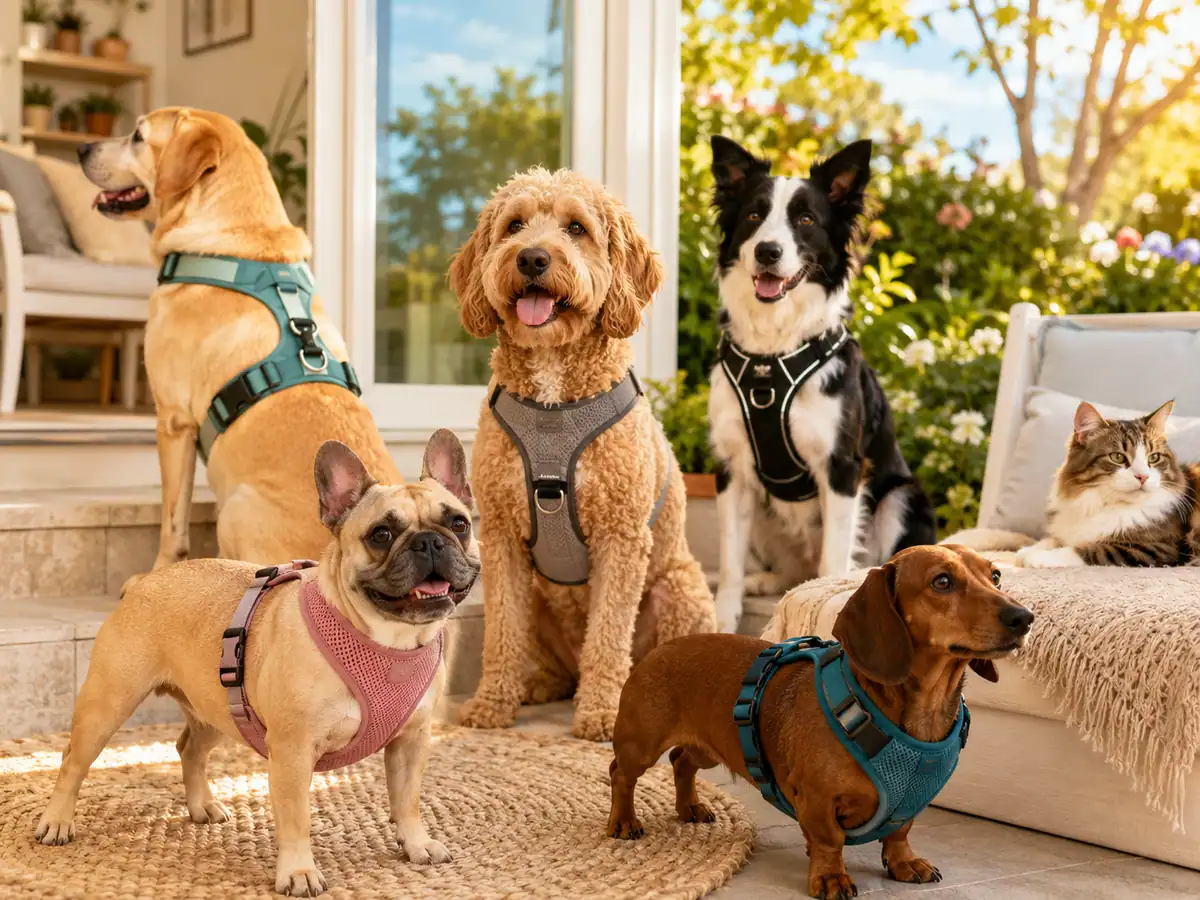
A collar puts every pound of a pulling dog against the front of the throat. A well-shaped harness moves that load onto the breastbone and ribcage, which are built to carry it. That single change is why harnesses are the default recommendation for dogs who lunge, for flat-faced breeds, and for any dog with a collapsing windpipe or a neck injury.
The second thing a harness changes is where the lead meets the dog. A back clip pulls from behind the shoulders, which is comfortable but gives you no steering, so harnesses with only a back ring suit dogs who already walk nicely. A front ring sits on the chest, so when the dog drives forward the line gently turns the chest back toward you. Nothing about that is punishment, it simply removes the reward of moving ahead.
What a harness cannot do is train loose-lead walking by itself. Front-clip harnesses make a walk manageable today, and that calmer walk is what gives you room to reward the dog for staying beside you. Owners who treat the hardware as the whole answer end up with a dog who pulls just as hard once the harness comes off.
What Should Pet Owners Know About Different Types of Great Dog Harness and When to Use Each?
Answer: Five shapes cover almost everything on the shelf. Vest harnesses wrap a broad padded panel around the chest. Strap or H-style harnesses use narrow webbing in a frame. Step-in designs have the dog place its front feet through two openings. Y-front designs leave the shoulder point clear. Lifting and mobility harnesses add a padded handle.
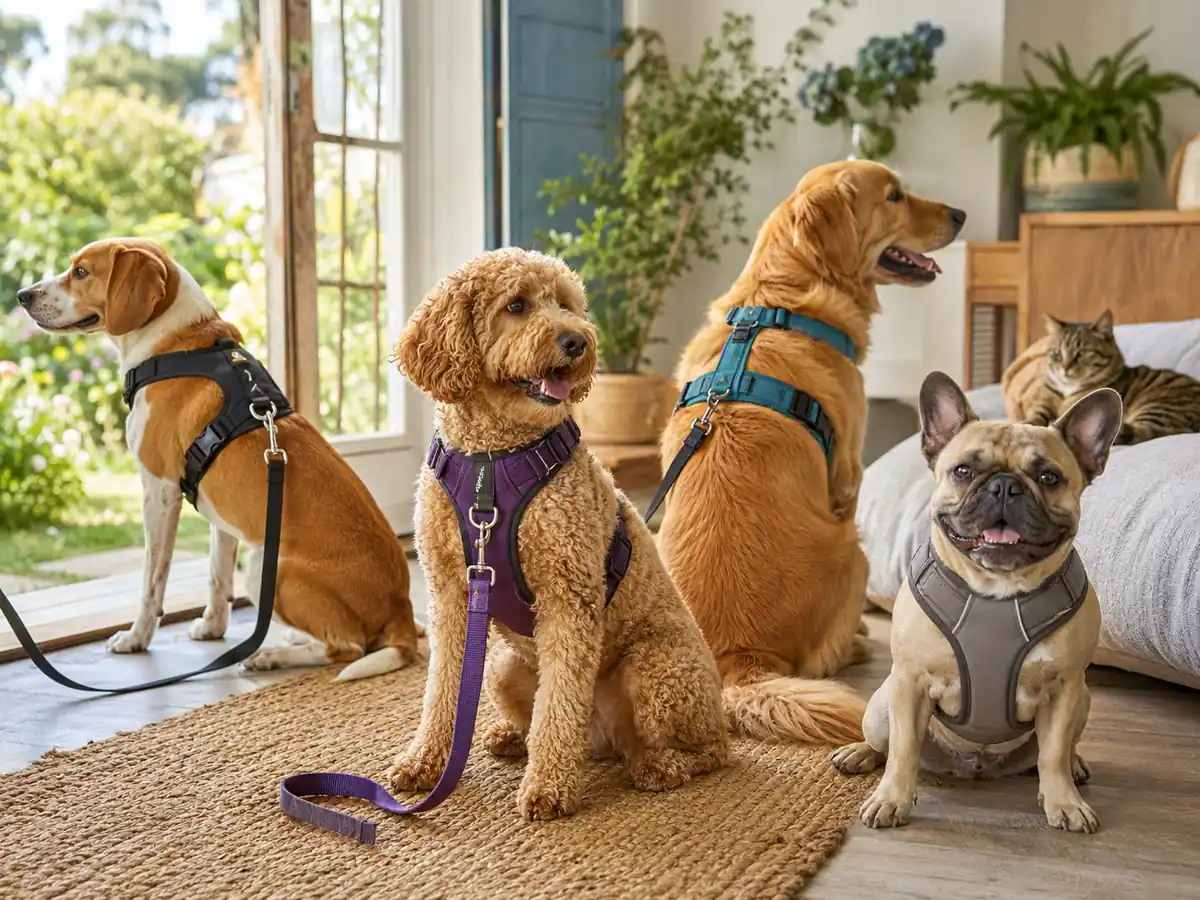
Five shapes cover almost everything on the shelf. Vest harnesses wrap a broad padded panel around the chest. Strap or H-style harnesses use narrow webbing in a frame. Step-in designs have the dog place its front feet through two openings. Y-front designs leave the shoulder point clear. Lifting and mobility harnesses add a padded handle over the hips.
For more expert recommendations, check out our leash guide.
Y-front harnesses deserve special attention because the detail is easy to miss in a photo. A strap that runs straight across the front of the chest, horizontally from one shoulder to the other, sits on top of the shoulder joint and restricts the reach of the front legs. A Y-shape passes to the sides of that joint and leaves the stride alone. Plenty of otherwise well-made harnesses still use the horizontal bar, so check the front shape before anything else.
Vest styles spread pressure over the largest area and are the most escape-resistant, which makes them a sensible first choice for a dog that has already slipped out of something. They also hold heat, so they suit cool mornings better than a hot afternoon. Strap harnesses are cooler and lighter, dry faster after rain, and are easier to adjust at several points, but they leave more gaps a determined dog can work with.
Step-in harnesses avoid pulling anything over the head, which matters for dogs who dislike being handled around the face, though they require the dog to stand still and lift each paw. Rugged outdoor harnesses, the kind sold for hiking and scrambling, add a padded handle on the back, load-bearing stitching and reflective trim. That handle is genuinely useful for lifting a dog over an obstacle and genuinely dangerous if used to haul a dog around by routine.
How to Measure and Fit Great Dog Harness Correctly?
Answer: Measure the chest girth with a soft tape, right behind the front legs at the widest point, and take the neck measurement low where the neck meets the shoulders rather than up by the collar. Then compare against that specific model's own chart, because sizing is not standard between makers and the weight ranges printed.
Measure the chest girth with a soft tape, right behind the front legs at the widest point, and take the neck measurement low where the neck meets the shoulders rather than up by the collar. Then compare against that specific model's own chart, because sizing is not standard between makers and the weight ranges printed on the packet are close to useless.
Once it is on, use the two-finger check at every adjustment point: you should be able to slide two fingers flat under each strap, no more and no less. Check the girth strap sits a short distance behind the armpit rather than pressed into it, since the armpit is where rubbing starts and where you will first see thinning fur or pink skin after a long walk.
Watch the dog move before you decide the fit is right. Walk a few steps in a straight line and look at the front legs from the side. A good fit leaves the stride unchanged. If the dog shortens its reach, paddles, or swings a leg outward, the front of the harness is sitting on the shoulder and the size or the shape is wrong. If your dog falls between sizes, take the smaller one on a model that adjusts outward, and the larger on one that only adjusts in.
How to Stop a Dog Backing Out of Great Dog Harness?
Answer: A frightened dog escapes by flattening its shoulders, reversing, and pulling its head back through the front opening. Two-strap harnesses are the easiest to escape because there is a single band around the ribs and a loop at the neck, and a dog that reverses hard can roll the whole thing forward. A third strap.
A frightened dog escapes by flattening its shoulders, reversing, and pulling its head back through the front opening. Two-strap harnesses are the easiest to escape because there is a single band around the ribs and a loop at the neck, and a dog that reverses hard can roll the whole thing forward. A third strap behind the ribcage removes that path entirely.
You might also find our collars article helpful when shopping.
Test it indoors before you trust it outdoors. With the lead on, let your dog walk a few paces, then apply light steady backward tension and watch what moves. If the frame rotates, if one shoulder comes through, or if the whole thing slides toward the neck, tighten the straps or change style. Most escapes trace back to a harness bought a size too large so it would be comfortable.
For a dog who has already escaped once, run a safety line for a while: a short coupler from the harness ring to the collar, so that if the harness fails the collar still holds. Never rely on the collar alone for a bolter, and never clip a long line to a flat collar on a dog who panics at traffic.
What Should Pet Owners Know About Choosing Great Dog Harness for Small and Flat-Faced Dogs?
Answer: Small dogs need harnesses for the same reason that big ones do, only more so. A small neck carries a windpipe that is easy to injure, and toy breeds are over-represented among dogs with tracheal collapse. For a Pomeranian, a Yorkie, a Chihuahua or a Dachshund, moving the lead attachment off the throat is not.
Small dogs need harnesses for the same reason that big ones do, only more so. A small neck carries a windpipe that is easy to injure, and toy breeds are over-represented among dogs with tracheal collapse. For a Pomeranian, a Yorkie, a Chihuahua or a Dachshund, moving the lead attachment off the throat is not a comfort upgrade, it is the main reason to buy anything at all.
The sizing problem for small dogs is that they are not scaled-down big dogs. Narrow chests, deep rib cages and short necks mean a harness that adjusts only at the girth will gape at the shoulders. Look for adjustment at the neck as well, soft edge binding rather than raw webbing, and hardware that is light enough not to swing against the chest at every step.
Flat-faced dogs such as Pugs, French Bulldogs and Boston Terriers have a further problem: they are already working hard to breathe. Anything that presses across the front of the throat makes that worse, and a harness that holds a lot of heat makes it worse again. Choose a breathable panel or a strap frame, keep walks to the cooler parts of the day, and ask your veterinarian about airway health if your dog snores, snorts or tires quickly.
What Should Pet Owners Know About Hardware and Materials That Decide How Long Great Dog Harness Last?
Answer: The fabric is almost never what fails. What fails is the stitching at the strap junctions, the buckle, and the ring the lead clips to. Look for bar-tack stitching, a box-and-cross pattern where straps meet, and a welded or cast metal ring rather than a split ring or a plastic loop sewn on with a.
The fabric is almost never what fails. What fails is the stitching at the strap junctions, the buckle, and the ring the lead clips to. Look for bar-tack stitching, a box-and-cross pattern where straps meet, and a welded or cast metal ring rather than a split ring or a plastic loop sewn on with a single line of thread.
Looking for more options? Our e collar roundup covers additional top picks.
Buckles divide into side-release plastic and metal. Good plastic buckles are fine for most dogs and much easier to work with cold hands, but cheap ones crack in frost and fail without warning. Metal hardware lasts longer and weighs more, which matters on a small dog. Whatever you choose, squeeze and release the buckle a few times when it arrives and again every few months, because a sticky buckle is one you will stop using properly.
Padding is the part shoppers judge and the part that matters least. Thick foam feels generous in the hand and holds water and grit against the skin after a wet walk. Air mesh and smooth lining dry faster and rub less. Rinse salt and sand off after beach walks, wash on a gentle cycle in a laundry bag, and let everything air dry rather than cooking the webbing in a tumble dryer.
What Should Pet Owners Know About Common Mistakes Pet Owners Make with Great Dog Harness?
Answer: Buying by weight is the first mistake. Two dogs of the same weight can differ enormously in chest depth, and weight charts exist because they are easy to print, not because they are accurate. Measure the girth, check the maker's own chart, and be prepared to return the first one.
Buying by weight is the first mistake. Two dogs of the same weight can differ enormously in chest depth, and weight charts exist because they are easy to print, not because they are accurate. Measure the girth, check the maker's own chart, and be prepared to return the first one.
Leaving it on all day is the second. A harness worn around the clock traps damp against the skin, rubs the same two points for hours, and hides the exact places you should be checking. Take it off indoors, run a hand under the straps, and look at the armpits and the front of the chest while you do it.
Treating the hardware as the training is the third. Front-clip harnesses reduce pulling while they are on, and that is a tool, not a finished dog. Use the calmer walk to reward the position you want. Equally, do not buy a rugged harness with a lifting handle and then use the handle to drag a reluctant dog along; the handle is there for genuine obstacles, not for steering.
What Should Pet Owners Know About Getting the Best Value When Shopping for Great Dog Harness?
Answer: Spend where the load goes and save everywhere else. Reinforced stitching at the junctions, a solid metal ring and a buckle that still works in winter are worth paying for. Reflective trim is cheap to add and genuinely useful on dark mornings. Patterns, branding and thick decorative padding add cost without adding a single useful.
Spend where the load goes and save everywhere else. Reinforced stitching at the junctions, a solid metal ring and a buckle that still works in winter are worth paying for. Reflective trim is cheap to add and genuinely useful on dark mornings. Patterns, branding and thick decorative padding add cost without adding a single useful property.
Expect the first one not to fit. Buy from somewhere with a straightforward returns policy, keep the packaging until you have walked the dog in it twice, and treat the first purchase as a measurement exercise. That is far cheaper than keeping something that rubs and quietly stops being used.
If you are replacing worn walking kit, check the lead and collar at the same time, since the clip, the stitching and the D-ring all age together. Our collar and lead range covers the everyday walking setup, and a harness is only as safe as the line and the clip attached to it.
If you want to dig deeper into the research, the ASPCA pet care library publishes practical, expert-reviewed resources for pet owners.
What Questions Do Pet Owners Ask About Great Dog Harness?
Answer: Choosing great dog harness well comes down to four things: matching the product to your pet's size and daily routine, checking the materials against how hard it will be used, setting it up or fitting it correctly, and inspecting it on a schedule. This guide covers each of those, plus the mistakes owners most often.
Is a harness better than a collar for walking a dog?
For walking, usually yes. A collar concentrates the force of a pulling dog on the throat, while a harness carries it on the chest and ribs. That matters most for dogs who lunge, for small breeds prone to tracheal collapse, and for flat-faced dogs who already struggle to breathe. Keep the collar on for the ID tag and clip the lead to the harness.
Does a front-clip harness stop pulling?
It reduces it while it is on, which is not the same thing. Clipping at the chest means a forward lunge turns the dog gently back toward you instead of gaining ground, so the pulling stops paying off. That gives you a walk calm enough to reward the dog for staying beside you, and the rewarding is what actually changes the behaviour.
How tight should a dog harness be?
Two fingers flat under every strap, checked at each adjustment point. Any looser and your dog can rotate it and reverse out; any tighter and you will see rubbing at the armpits and the front of the shoulders. Re-check the fit after the first few walks, and again whenever the coat changes with the season.
Can a dog back out of a harness?
Yes, and it is the most common failure. A frightened dog flattens its shoulders and reverses until its head comes back through the front opening. Styles with a third strap behind the ribcage close that route. Test it indoors with light backward tension before you trust it near a road, and run a coupler to the collar for a dog who has escaped before.
What is a Y-front harness and does the shape matter?
A Y-front passes to either side of the shoulder joint instead of running straight across the front of the chest. A horizontal chest bar sits on top of that joint and shortens the dog's stride. Watch your dog walk away from you in a straight line: if the front legs shorten or paddle, the harness is sitting on the shoulder.
Should a puppy wear a harness?
Yes, and it is the easiest time to teach one. Introduce it indoors in short sessions paired with food before any walk happens, and check the fit every week rather than every season, because a growing puppy outgrows gear quickly. Expect to buy a second size, and avoid anything heavy on a very young dog.
How do I wash a dog harness?
Rinse mud, salt and sand off the same day, then hand wash or machine wash on a gentle cycle inside a laundry bag. Skip fabric softener, which leaves a residue against the skin, and air dry rather than tumble drying, since heat weakens webbing and warps plastic buckles. Check the stitching and the ring while it is drying.
How often should a harness be replaced?
When the webbing frays, the stitching at a junction starts to open, the buckle sticks or cracks, or the metal ring shows a groove where the clip has worn it. Inspect those four points monthly while you are already handling it. A harness that is merely faded is fine; one with a tired junction is not.
Browse Collars and Leads
Free US shipping on every order. No minimum purchase required.
Browse Collars and Leads →