Search for a GPS dog leash and you will find plenty of listings, but almost none of them are what the name suggests. A leash is attached to you, so a leash does not need to be found. What people are usually looking for is a leash-and-tracker combination that keeps working the moment the leash is no longer attached. This guide covers what exists, what does not, and how to build the setup that solves the real problem.
Why a Leash Alone Cannot Solve a Lost-Dog Problem
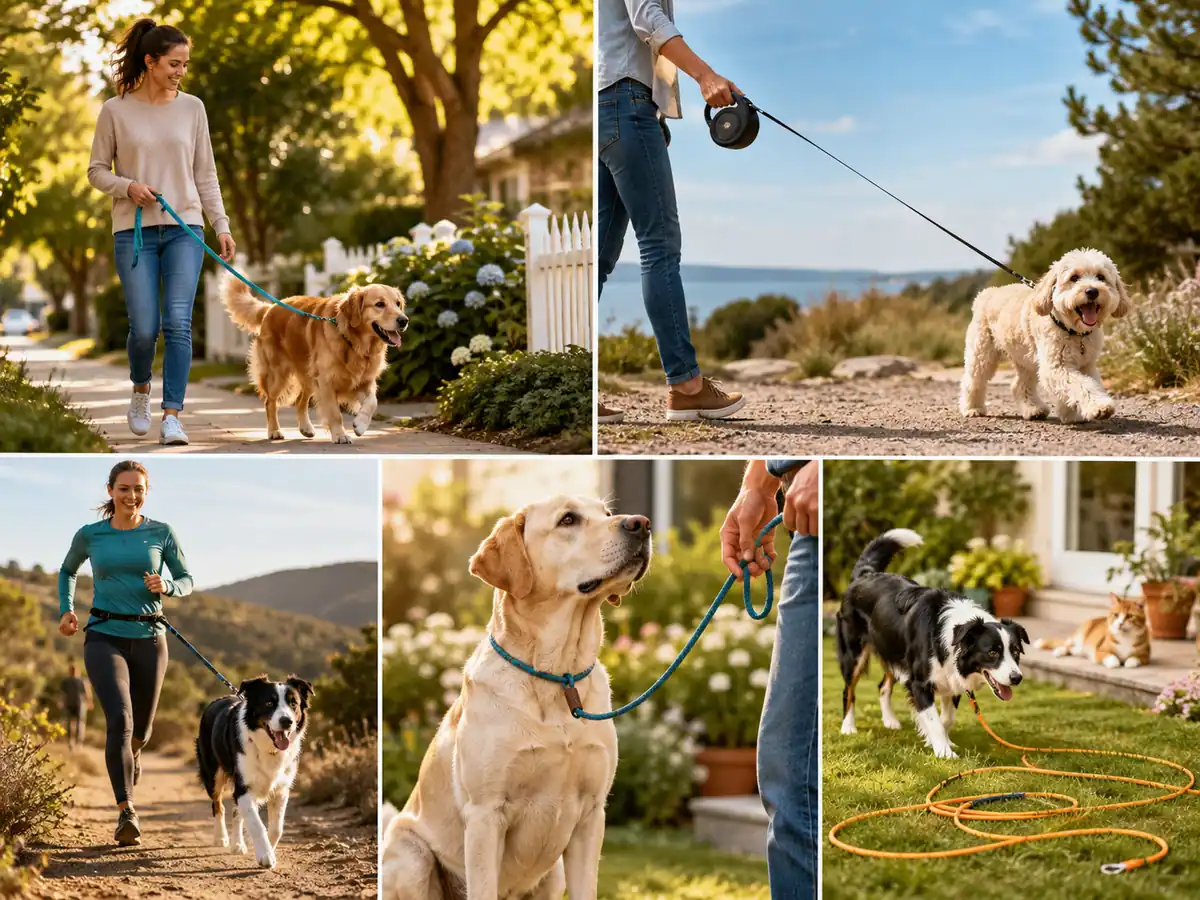
A leash is a physical connection between you and your dog, which means that while it is attached, tracking is redundant. The dangerous moment is the gap: a slipped collar at a busy junction, a clip that fails on a startled dog, a dropped handle when a cyclist passes. In every one of those scenarios the leash is in your hand and your dog is not.
That is why the useful product is not a leash with electronics inside it. It is a tracker that lives on the collar and keeps reporting after the leash is gone. Any product that puts the tracking hardware on the handle end solves nothing, because the handle end stays with you.
Framing it this way also makes the shopping decision simpler. You are choosing two things: a leash and collar that are hard to slip, and a tracker that survives being separated from you. They are separate purchases with separate criteria, and treating them as one bundled gadget is how people end up disappointed.
What Sellers Actually Mean by "GPS Leash"
The most common listing is a leash sold alongside a collar-mounted GPS tracker. This is the honest version of the category, and it is the one worth buying: the tracker is a normal cellular unit and the leash is simply included. Judge the tracker on tracker criteria and treat the leash as a bonus item.
For more expert recommendations, check out our waterproof dog collar guide.
The second type is a leash or harness with a built-in pocket for an AirTag-style tag. These are genuinely useful for finding a dropped leash or a bag, and they are helpful in dense urban areas where other phones are constantly nearby. They are not a lost-dog solution in open country, because a Bluetooth tag reports nothing when no phone is in range.
The third type is the one to walk past: a retractable leash marketed with tracking language that turns out to mean a distance readout or a phone app timer, with no satellite positioning of any kind. If a product page will not name the network the device uses or link to a subscription plan, assume there is no live tracking behind it.
Leash and Collar Safety Before You Add Any Electronics
Most escapes during walks are equipment failures, not GPS failures. Check the hardware you already own: a bent clip gate, a frayed section where the leash rubs the ground, or a stitched loop that has started to open are all more likely to end your walk badly than a flat battery. Replace worn hardware rather than nursing it through another season.
A dog that backs out of a flat collar is a candidate for a properly fitted harness or a limited-slip collar, not for a tighter flat collar. Slipping happens because a dog reverses and the collar clears the skull, and no amount of tightening fixes that safely. Fit the alternative first, then add the tracker to whatever your dog actually wears.
If you clip a tracker to a harness, check where the module sits when your dog pulls. A hard unit trapped between a chest strap and the shoulder rubs quickly, and rubbing on a working harness is far more aggressive than the same module resting on a neck collar. Reposition it above the shoulder blades if the harness design allows.
Choosing by Dog Size and Walking Style

For small dogs, total weight on the neck is the constraint. A leash that is heavy at the clip end pulls the collar down and drags the tracker sideways, which both irritates and degrades reception. Lightweight leash hardware matters more on a four-kilogram dog than the leash length does.
You might also find our shock collar for dogs article helpful when shopping.
For strong, reactive, or high-drive dogs, the priority is redundancy. Two points of attachment, a front-clip harness plus a backup collar connection, means one hardware failure does not end in a loose dog. This is the group where a live cellular tracker earns its subscription, because these are the dogs that cover distance fast once free.
Puppies and adolescents need equipment that can be replaced without regret. They grow, they chew leashes, and they learn to slip collars through trial and error. Cheap, correctly fitted, frequently replaced gear during that phase is a better plan than premium equipment sized for a dog that does not exist yet.
Building a Walk Setup That Keeps Working After a Slip
Test the failure case deliberately. Once, in a safe enclosed space, unclip the leash and confirm that your phone still shows a live position from the collar. Most owners have never done this, and it is the only way to learn that a tracker was paired but never activated, or that alerts were silenced months ago.
Keep the tracker on the collar, not on the leash, and keep the collar on the dog during transport. A surprising share of escapes happen at the car door rather than on the walk, at exactly the moment when many owners have the collar off and in a bag.
Set a saved location for home and for any regular off-lead field so you get an alert when the dog leaves the area rather than having to notice yourself. Alerts fire in seconds, and a person searching a hedge line does not check their phone unprompted.
The Mistakes That Cost People Their Dog
Buying a Bluetooth tag and believing it is a GPS tracker. This is the single most expensive misunderstanding in the category, and it is usually discovered at the worst possible time. If the product does not require a subscription and does not mention a mobile network, it does not track live.
Looking for more options? Our halo collar roundup covers additional top picks.
Attaching the tracking device to the leash instead of the collar. It feels tidier and it defeats the entire purpose. The device has to stay with the dog, which means it belongs on whatever the dog is still wearing when the leash is gone.
Relying on a retractable leash for a dog that lunges. The thin cord offers little control at extension, the brake can slip under a hard pull, and a dropped handle chases the dog. If your dog pulls or reacts, a fixed-length leash with solid hardware is the safer base to add tracking to.
Where the Money Is Actually Worth Spending

Spend on the collar or harness and the clip first. Good hardware is inexpensive relative to a tracker subscription and it prevents the failure rather than reporting it. A well-fitted harness and a solid trigger clip cost less than two months of most cellular plans.
On the tracker, the sticker price matters less than the plan. Work out the three-year total including subscription before comparing brands, and check whether the plan is transferable if you replace the device. Bundles that include a leash rarely change that arithmetic much.
Skip the accessories that duplicate each other. A tag holder sewn into a harness plus a cellular collar tracker plus a second tag on the leash is three devices to charge and maintain for one job. One live tracker on the collar and, if you want it, one cheap tag as a backup is the setup most owners actually keep using.
How to Shortlist the Combination You Need
Start with the escape scenario that worries you. If it is a dog that bolts from the yard, the tracker matters most and the leash is incidental. If it is a dog that has slipped a collar mid-walk, fix the fit and the attachment points before spending anything on electronics.
Then check three specifications you can verify on the manufacturer’s own site: the minimum dog weight for the tracker, the network it uses in your country, and the published subscription terms. Retailer listings routinely omit all three, and all three decide whether the setup will work for you.
Finally, confirm the physical compatibility. Not every tracker fits every strap width, and a mount designed for a twenty-five millimetre collar will rotate on a narrow one. Measure the collar you intend to use before ordering, because a tracker that swings is a tracker with a worse signal and a sore underneath it.
GPS Dog Leash: Feature Comparison
The table below compares the three setups people mean when they search for a GPS dog leash, so you can see quickly which one matches the problem you are trying to solve.
Frequently Asked Questions
Is there such a thing as a real GPS leash?
Not in any meaningful sense. A leash stays in your hand, so putting the tracker on it defeats the purpose. What is sold under that name is either a leash bundled with a collar-mounted GPS tracker or a leash with a pocket for a Bluetooth tag.
Can I just put an AirTag-style tag on the leash?
You can, and it is genuinely useful for finding a dropped leash or a bag left in a park. It is not a lost-dog solution, because those tags only report a position when another phone in their network passes close enough to detect them.
Should the tracker go on the collar or the harness?
The collar is usually better. A module on a working harness can get trapped between straps and the shoulder, which rubs during pulling. If you do mount it on a harness, place it above the shoulder blades and check the skin underneath regularly.
Do GPS trackers work if my dog swims?
Only if the specific unit is rated for submersion rather than splashes. Water-resistant and waterproof are used loosely in listings, so check the rating on the manufacturer page, and rinse and dry the module after saltwater swims.
What leash length is safest for a dog that pulls?
A fixed-length leash of about one and a half to two metres gives you control without the slack that lets a dog build speed. Retractable leashes offer very little control at full extension and the handle can be pulled from your hand.
How do I stop my dog slipping their collar?
A dog that backs out of a flat collar needs different equipment, not a tighter one. A properly fitted harness or a limited-slip collar prevents the reverse-and-clear movement, and you should attach the tracker to whichever of those your dog ends up wearing.
Is a subscription always required?
For live cellular tracking, yes. Every tracker that reports a position from anywhere with mobile coverage needs a data plan. Only Bluetooth tags avoid the subscription, and they trade away the coverage that makes tracking useful.