An electric collar is not the best first choice for dog training. Electronic training collar use can expose a dog to pain, fear, stress, and confusing associations, while reward-based approaches can teach the same practical skills without intentionally adding an aversive stimulus. The American Veterinary Society of Animal Behavior, or AVSAB, recommends reward-based methods for all dog training and behavior modification. This guide explains the welfare concerns, summarizes relevant evidence, and offers practical alternatives. It does not provide shock settings or instructions.
In This Article
What an Electric Collar Is and Why Terminology Matters
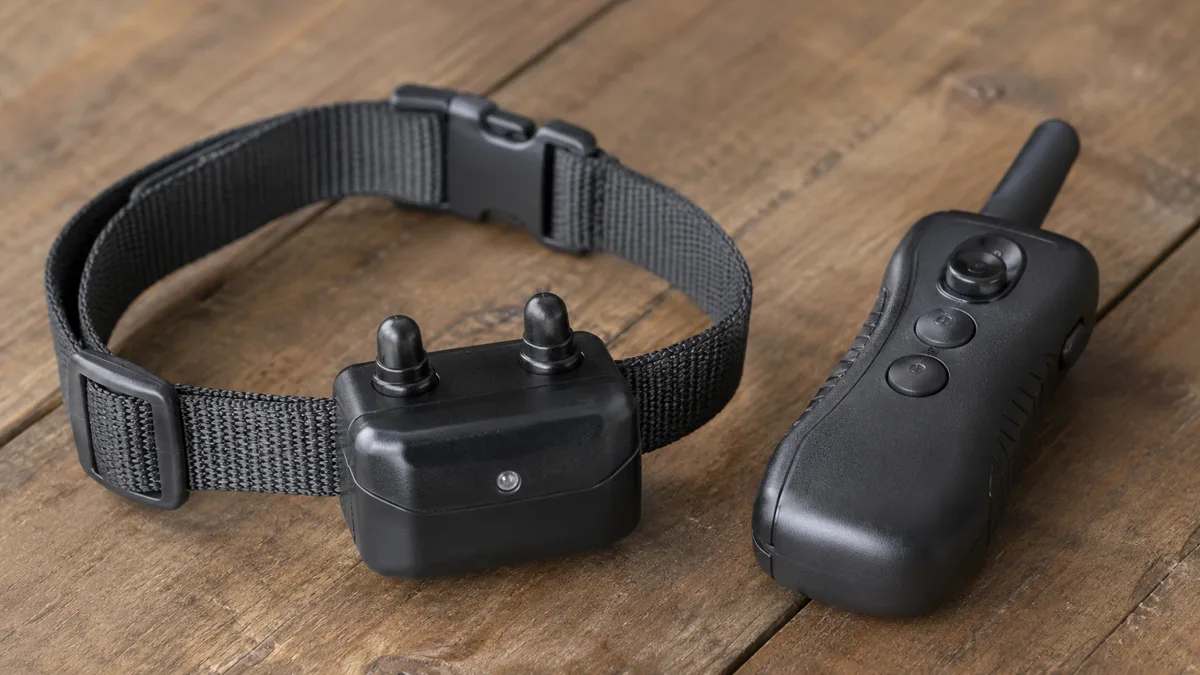
An electric collar, also called an electronic collar, remote training collar, or shock collar, has contact points positioned against a dog’s neck and a receiver capable of producing an electronic stimulus. Some products add tones, vibration, lights, or location features. Marketing language such as “tap,” “stimulation,” or “communication” does not change the dog’s experience. If a sensation is used because the dog finds it unpleasant enough to stop, avoid, or change behavior, it is functioning as an aversive.
That distinction matters because an identification collar, GPS tracker, and electronic containment system may all be described with the broad word “collar,” yet their purposes and risks differ. A passive GPS unit reports location. An identification collar carries tags. An electronic training device delivers a consequence. Owners should evaluate the active function, not rely on a reassuring product name.
Behavior can stop in the moment without the dog understanding what to do instead. A dog might become still because of fear, uncertainty, or behavioral suppression. Stillness is not proof of calm, learning, or improved welfare. Effective teaching builds a repeatable response and a positive history in the real situations where the skill is needed.
Welfare Concerns With Electronic Training Collars
The central welfare concern is straightforward: an electric collar is designed to use an unpleasant event to influence behavior. The dog may show obvious distress, such as yelping or escape attempts, but signs can also be subtle. Stress may appear as freezing, lip licking, turning away, a lowered body, reduced exploration, avoidance of the handler, or reluctance to enter a location associated with the device.
Timing does not remove the underlying risk. Dogs continuously notice people, animals, sounds, surfaces, and scents. If an electronic stimulus occurs as a child approaches, another dog appears, or the handler reaches toward the neck, the dog may connect discomfort with that nearby event. Such accidental associations can worsen fear or defensive aggression. The handler cannot fully control which detail becomes predictive.
Physical considerations also matter. Contact pressure, moisture, friction, poor fit, prolonged wear, and skin sensitivity can contribute to irritation. More broadly, pain elsewhere in the body can change how a dog responds to handling or training. A sudden decline in behavior should trigger a veterinary check rather than escalation of equipment.
AVSAB’s 2021 humane dog training position statement says methods should prioritize the dog’s physical and emotional well-being and recommends reward-based methods. It also explains that aversive methods carry risks without evidence that they are necessary for training or behavior modification. This position applies to routine manners as well as serious behavior concerns.
| What you observe | Likely meaning | What to do next |
|---|---|---|
| Loose muscles, normal breathing, willing approach | The dog appears comfortable and able to learn | Keep sessions brief and reinforce successful choices |
| Lip licking, head turns, lowered posture, slowed movement | Possible stress or conflict | Pause, increase distance, and make the task easier |
| Freezing, tucked tail, trembling, escape attempts | Significant fear or distress | Stop the exposure and move to safety without correction |
| Growling, lunging, snapping | A serious warning and safety concern | Create distance, prevent contact, and seek qualified help |
| Sudden irritability or sensitivity near the neck | Possible pain or medical issue | Stop using neck-worn training devices and contact a veterinarian |
What Research Says About Effectiveness and Welfare
A useful question is not merely whether an electric collar can alter behavior. Many consequences can change behavior. The better question is whether it produces better, more reliable outcomes than humane options and whether any claimed benefit justifies the welfare cost. Evidence should be considered alongside learning principles, the individual dog’s response, and the availability of lower-risk methods.
A 2020 study published in PLOS ONE compared dogs trained for common off-leash problems by electronic-collar trainers, those same trainers without electronic collars, and reward-focused trainers. The authors reported that reward-focused training was the most effective approach in the measures examined and found no consistent benefit from electronic-collar use. The study is especially relevant because electronic collar advocates often argue that poor outcomes result only from inexperienced use. In this research, experienced trainers did not establish a performance advantage.
No single study answers every question. Study populations, trainer behavior, owner follow-through, definitions of success, and follow-up duration all affect interpretation. Still, decisions should not demand proof of catastrophic harm before choosing the less intrusive option. When reward-based methods are effective and recommended by veterinary behavior experts, intentionally adding an aversive requires a justification the current evidence does not provide.
Read the primary materials directly: the AVSAB humane dog training position statement and the PLOS ONE electronic collar training study. Neither source supports shock instructions, and this article intentionally omits them.
How Dogs Learn Skills Without Aversive Tools
Reward-based training starts by defining an observable behavior. “Be good” is vague. “Four paws on the floor when a visitor enters” is teachable. The handler arranges an easy version of the situation, marks the desired choice, and delivers something the dog values. Repetition creates a clear prediction: this action in this context leads to a good outcome.
Management is part of teaching, not a failure of it. A gate can prevent door rushing while calm waiting is learned. Distance can keep a dog under threshold around another dog. A long line can protect recall practice without risking escape. Preventing unwanted rehearsal gives the desired response room to become fluent.
Rewards are not limited to food. Access to sniffing, greeting, play, movement, toys, and rest may all reinforce behavior, depending on the dog and moment. Food is often useful because it is quick and easy to deliver, but the learner decides what is reinforcing. If performance deteriorates, consider distraction level, stress, reward value, and physical comfort before labeling the dog stubborn.
Fear-related behavior requires special care. Gradual desensitization presents a trigger at an intensity the dog can tolerate. Counterconditioning pairs that manageable exposure with something pleasant. Flooding the dog with an overwhelming version can sensitize rather than help. The humane goal is an improved emotional response, not silent endurance.
Humane Alternatives for Recall, Barking, Reactivity, and Boundaries
Different problems need different plans. Recall depends on a strong reinforcement history, careful progression around distractions, and safe containment during practice. Barking may arise from alerting, fear, isolation distress, frustration, boredom, or pain. Reactivity often requires distance and work on the underlying emotional response. Boundary safety is best created with physical containment rather than a consequence delivered after the dog crosses an invisible line.
For recall, begin where the dog can readily turn toward the handler. Reinforce spontaneous check-ins and short returns, then gradually add distance and mild distractions. Practice in fenced spaces or with a long line attached to a suitable harness. A recall cue should predict worthwhile outcomes, and coming when called should not consistently end every enjoyable activity.
For trigger-related barking or lunging, identify the distance at which the dog can notice the trigger without becoming overwhelmed. Pair calm observation and disengagement with valued rewards, then leave before stress escalates. Route choice, parked cars as visual barriers, and quieter hours are legitimate safety strategies. See our guide to a dog with a harness for equipment considerations, while remembering that equipment itself does not change emotion.
| Training goal | Humane first choice | Useful management | Professional help when |
|---|---|---|---|
| Reliable recall | Reinforce check-ins and returns in a fenced area, then use a long line in suitable open spaces | Secure fencing, long line attached to a harness, high-value rewards | The dog bolts, chases dangerously, or cannot work below threshold |
| Less barking | Identify the cause, meet needs, and reinforce quiet or an alternate activity | Block visual triggers, add sound masking, provide rest and enrichment | Barking is sudden, compulsive, panic-related, or paired with aggression |
| Calm around triggers | Create distance and pair the trigger with valued outcomes at a tolerable intensity | Choose quieter routes, use visual barriers, shorten exposure | Fear or reactivity is intense, worsening, or unsafe |
| Boundary safety | Use a physical fence and supervised practice near doors or gates | Double gates, secure doors, leash transitions, identification | Escape behavior persists or the dog has already been injured |
| Loose-leash walking | Reward proximity and voluntary attention in low-distraction settings | Well-fitted harness and fixed-length leash | Pulling is extreme, the handler may fall, or behavior is fear-driven |
Management, Enrichment, and Safe Everyday Equipment
A humane plan includes the dog’s whole day. Adequate sleep, predictable routines, sniffing opportunities, species-appropriate play, social contact suited to the individual, and outlets for chewing or foraging can reduce frustration. Enrichment is not a cure for panic or aggression, but unmet needs can make coping and learning harder. Our dog enrichment guide offers ideas that can be adapted to the individual dog.
For walks, choose a comfortable, well-fitted harness or collar appropriate to the dog’s health and anatomy, plus a fixed-length leash with sound hardware. Equipment is a safety connection, not a substitute for behavior work. Inspect webbing, stitching, adjustment points, and clips before use. Identification should be current, and a microchip registration should carry the owner’s current contact details.
Environmental management can be powerful. Frosted window film may reduce fence or window patrol. A white-noise machine can soften hallway sounds. Baby gates create space around visitors. Covered visual barriers can reduce arousal in a yard. These changes lower exposure while a structured plan builds skills, and some may remain useful permanently.
Record context rather than only counting incidents. Note sleep, location, distance, people or animals present, early body language, what happened immediately before, and recovery time. Patterns help a professional distinguish fear, frustration, pain, guarding, and other functions. Video can help when it is captured safely without provoking the behavior.
When Veterinary or Behavior Help Is the Safest Choice
Contact a veterinarian when behavior changes suddenly, touch near the neck causes sensitivity, mobility changes, sleep is disrupted, appetite shifts, or irritability appears without a clear environmental explanation. Ear disease, dental pain, orthopedic discomfort, skin problems, neurologic conditions, and other medical issues can affect behavior. Training cannot resolve untreated pain.
Aggression, panic, self-injury, severe separation-related distress, repeated escape, or a bite history deserves qualified support. A board-certified veterinary behaviorist can assess medical and behavioral factors and prescribe medication when appropriate. Other credentialed behavior consultants and trainers can implement a plan, but credentials and methods should be examined carefully.
Ask a prospective professional to describe exactly what happens when the dog responds correctly and incorrectly. Look for transparent use of reinforcement, prevention, gradual exposure, and measurable welfare indicators. Avoid guarantees, dominance-based explanations, deliberate provocation, or recommendations to suppress warnings. Growling communicates discomfort. Punishing the warning can leave risk in place while making it less visible.
How to Move Away From an Electric Collar
Owners who already use an electric collar do not need blame. They need a safer next step. Stop using the electronic function and avoid testing the dog’s response. If the neck is irritated or the dog resists touch, remove the device carefully and consult a veterinarian. Replace its practical safety role with physical management before entering challenging situations.
Write down the specific result the device was intended to produce. Then define the desired replacement behavior and the conditions under which it should happen. For example, replace “do not run away” with “turn and return when called,” and use fencing or a long line while building that skill. Replace “stop barking at the window” with a rest station away from the window, supported by visual management.
Expect behavior to vary by context. A skill practiced in the kitchen is not automatically fluent near wildlife. Build difficulty gradually across locations, distances, durations, and distractions. Track successful repetitions and recovery, not just failures. If the dog’s behavior worsens after removing suppression, that does not prove the collar was treating the cause. It may reveal an emotion or skill deficit that now needs proper support.
A Practical Welfare-First Decision Framework
Before choosing any training method, ask five questions. What precise behavior and underlying need are involved? Has a veterinarian ruled out relevant health problems? Can management prevent harm while learning occurs? Does the method teach a clear alternative? What does the dog’s body language show during and after the session? These questions shift attention from rapid interruption to durable, humane outcomes.
Choose the least intrusive effective approach. That usually means arranging the environment, reinforcing desired behavior, meeting physical and behavioral needs, and using gradual exposure for fear. Evaluate progress through reliability, recovery, willingness to engage, and quality of life. A dog who complies but becomes avoidant, shut down, or fearful has not received a successful welfare-centered intervention.
The conclusion is practical rather than ideological. Electric collars are unnecessary for teaching everyday skills, and their aversive function creates avoidable welfare concerns. Reward-based methods offer owners a clear path to communication while protecting trust. For complex cases, veterinary and behavior professionals can make that path safer and more individualized.
Evidence trail: Readers who want to examine the research can compare the controlled remote-collar welfare study archived by the U.S. National Library of Medicine, a 2020 Frontiers study comparing electronic-collar and reward-focused training, and the AVSAB position statement library. These sources support the article's practical recommendation to begin with humane, reward-based methods and veterinary or behavior-professional guidance.
Frequently Asked Questions
What is an electric collar for dogs?
An electric collar is a wearable device that can deliver an electronic stimulus through contact points on a dog’s neck. Products may also include sound or vibration. Because the stimulus is intended to interrupt or reduce behavior, welfare organizations generally classify its electronic function as aversive rather than neutral.
Are electric collars recommended for dog training?
The American Veterinary Society of Animal Behavior recommends reward-based methods for dog training and states that aversive methods should not be used. A qualified reward-based trainer or veterinary behavior professional can help owners choose a humane plan tailored to the dog and the behavior.
Do electric collars work better than reward-based training?
The available evidence does not show a general performance advantage that offsets the welfare concerns. A controlled PLOS ONE study found reward-focused training was effective and reported no consistent benefit from electronic collar training, even when experienced trainers used the devices.
Can an electronic training collar make fear or aggression worse?
It can. A dog may associate an unpleasant event with a person, dog, place, or sound that happens to be nearby. That unintended association can increase fear, avoidance, defensive behavior, or conflict. Sudden behavior change warrants a veterinary assessment.
Is vibration always a humane alternative to shock?
No. Vibration is not painful in the same way, but it can still startle or frighten a dog and can function as an aversive. The dog’s body language and emotional response matter. A cue should be introduced gradually and paired with outcomes the dog values.
What can I use instead of an electric collar?
Use management to prevent rehearsal, rewards to reinforce desired choices, and gradual desensitization with counterconditioning for emotional triggers. A comfortable harness, fixed-length leash, barriers, distance, food, play, and environmental enrichment can support the plan.
Who should I contact for serious behavior problems?
Start with your veterinarian to check for pain or illness. For aggression, panic, severe fear, or a bite history, seek a board-certified veterinary behaviorist or another credentialed professional who clearly uses reward-based methods and can coordinate with your veterinarian.
Choose Comfort and Clear Communication
Explore everyday dog accessories that support safe, reward-based routines.
Browse Dog Accessories →