Top photo: a bone-shaped tag engraved with the name Felix on a red collar. Photo: cogdogblog / Wikimedia Commons, CC BY 2.0 (cropped, resized and converted to WebP).
If you are looking for the best dog name tags, this comprehensive guide covers everything you need to know. Whether you are a first-time pet owner or an experienced one looking to upgrade, you will find practical advice, safety tips, and honest comparisons below.
Quick Answer: What Should You Know About Dog Name Tags?
Choosing dog name tags well comes down to four things: matching the product to your pet's size and daily routine, checking the materials against how hard it will be used, setting it up or fitting it correctly, and inspecting it on a schedule. This guide covers each of those, plus the mistakes owners most often make.
Why Every Pet Needs Dog Name Tags Even With a Microchip?
Answer: A microchip only starts working after somebody has already caught your pet and carried it to a vet or a shelter that owns a scanner. An engraved tag works immediately, from arm's length, for the neighbour who finds your dog two streets away and simply wants to phone you. Rescue groups treat the chip and.
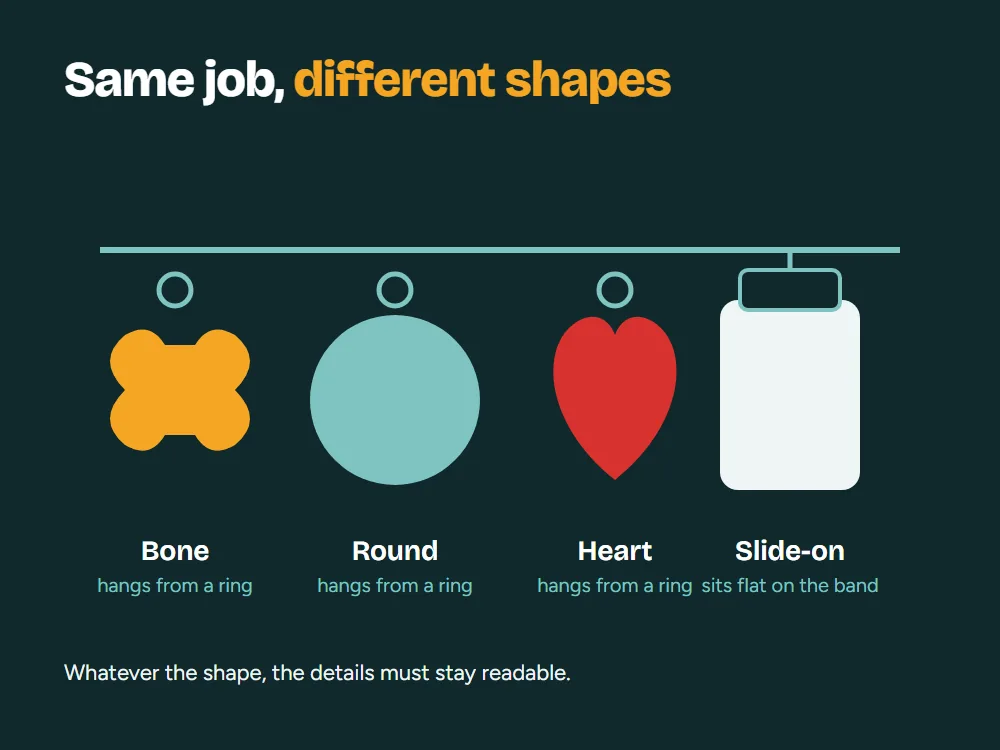
Illustration: Livehappypet.
A microchip only starts working after somebody has already caught your pet and carried it to a vet or a shelter that owns a scanner. An engraved tag works immediately, from arm's length, for the neighbour who finds your dog two streets away and simply wants to phone you. Rescue groups treat the chip and the tag as two halves of one system.
The difference between the two is time. Most loose pets are picked up by ordinary people rather than by animal control, and an ordinary person cannot read a chip. A tag turns a found pet into a phone call that happens the same hour, instead of a shelter intake that happens the next morning. Every hour you remove from that gap is an hour your pet is not loose near traffic.
There is also a paperwork reason. In many United States counties a dog in public is legally required to wear a current rabies tag and a licence tag, and your own contact tag hangs on the same ring as those. The rules differ from county to county, so check your local animal services page rather than assuming one tag satisfies everything.
What Should Pet Owners Know About Different Types of Dog Name Tags and When to Use Each?
Answer: There are four shapes worth knowing, and they fail in completely different ways. A hanging disc swings from a split ring. A slide-on plate threads onto the collar webbing itself. A riveted plate is fixed permanently to the strap. A silicone or rubber-edged tag is a hanging disc wrapped to stop it rattling against a.
There are four shapes worth knowing, and they fail in completely different ways. A hanging disc swings from a split ring. A slide-on plate threads onto the collar webbing itself. A riveted plate is fixed permanently to the strap. A silicone or rubber-edged tag is a hanging disc wrapped to stop it rattling against a bowl.
If you want even more options, check out our guide to dog tag.
The hanging disc is the one almost everybody buys, and it is the one that goes missing. It dangles, it catches on crate wire and undergrowth, and the split ring it hangs from slowly works itself open. Its advantage is that you can move it between collars in seconds and replace it on its own when the engraving wears down.
Slide-on and riveted plates sit flat against the webbing, so there is nothing to snag, nothing to jingle, and almost nothing to lose. Sellers often list the same object as a name badge or a collar badge, so do not assume a badge is a different product. The trade-off is that a plate is tied to one specific collar width, and a riveted badge cannot be moved at all. If your dog has a walking collar and a house collar, you need one on each.
Scan tags carry a code instead of an engraving, and the finder's phone opens a page with your details. They can hold far more than a small disc, including a second contact and medical notes you can edit later. They also depend on a charged phone, a signal, and a subscription that is still being paid. Treat a scan tag as an extra, and keep an engraved one on the same ring as the fallback that never goes offline.
What Information Should Go On Dog Name Tags?
Answer: Put your mobile number on the front, as large as the blank will allow, and put it first. Everything else is secondary to a stranger being able to read a number across a pavement while holding an excited dog by the collar. A second contact number on the back is the single most useful addition.
Put your mobile number on the front, as large as the blank will allow, and put it first. Everything else is secondary to a stranger being able to read a number across a pavement while holding an excited dog by the collar. A second contact number on the back is the single most useful addition, because the first phone is often the one left at home.
The pet's name is the line owners argue about. Printing the name helps a finder settle an anxious animal and makes the plate feel personal, which is why most engravers put the name across the top of a badge. The counter-argument is that a stranger who can call your dog by name can also call it away from you. A reasonable middle position is to engrave the name on the back and keep the front for contact details only.
Leave your home address off. It tells a finder nothing they need and it tells everyone else where an unattended house is. Use the city only if there is room to spare. If your pet needs daily medication or has a condition that changes how it should be handled, a short line such as needs daily meds is worth more than any decorative engraving, because it tells a finder that this is urgent rather than routine.
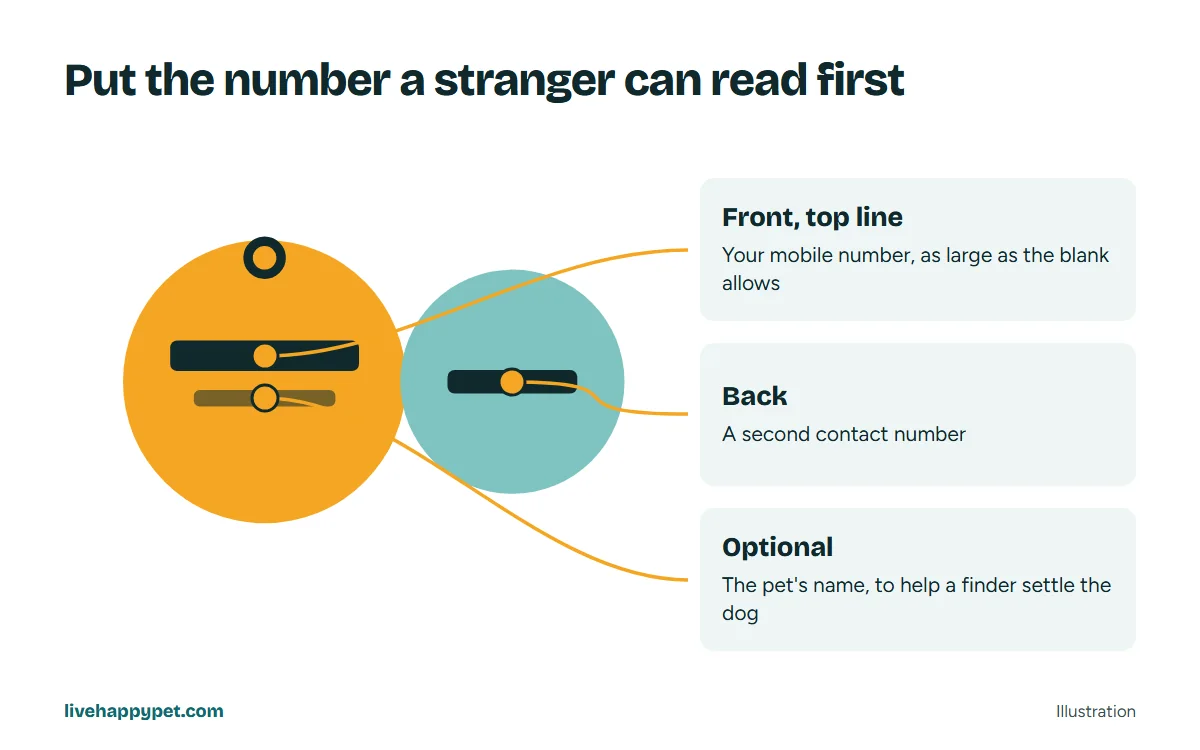
Illustration: Livehappypet
How Material and Engraving Method Affect Dog Name Tags?
Answer: Material decides how long the writing stays readable, and the writing is the only part that matters. Stainless steel is the default for a reason: it resists rust, it survives swimming and salt, and laser-marked stainless steel keeps its contrast for years. Solid brass is close behind and ages to a warm patina rather than.
Material decides how long the writing stays readable, and the writing is the only part that matters. Stainless steel is the default for a reason: it resists rust, it survives swimming and salt, and laser-marked stainless steel keeps its contrast for years. Solid brass is close behind and ages to a warm patina rather than corroding.
You might also enjoy our recommendations for bowl dog.
Anodised aluminium is the lightest option and the cheapest, which makes it genuinely useful for a small dog or a kitten that should not carry weight on a breakaway collar. The coloured coating wears through where the tag rubs against the collar ring, and the engraving goes with it. Treat aluminium as a consumable you replace once a year rather than a permanent plate.
Engraving method matters as much as the metal. Rotary engraving cuts a groove deep enough that you can feel it with a fingernail, and it stays legible even when the surface is scratched. Laser marking is crisper and finer, which looks better on stainless steel but sits shallower. Printed or enamel-filled lettering looks best on the day it arrives and is the first thing to disappear.
What Should Pet Owners Know About Sizing and Attaching Dog Name Tags Without Losing Them?
Answer: Pick the smallest blank that still fits your phone number in a size a stranger can read without squinting. Oversized discs swing harder, catch more, and bang against the bowl at every meal. Undersized ones force the engraver to shrink the digits until the whole point of a visible tag is lost. Hold a candidate.
Pick the smallest blank that still fits your phone number in a size a stranger can read without squinting. Oversized discs swing harder, catch more, and bang against the bowl at every meal. Undersized ones force the engraver to shrink the digits until the whole point of a visible tag is lost. Hold a candidate at arm's length before you order it.
Attachment is where most tags are lost. The thin split ring supplied in the packet gradually opens as it rotates against the collar D-ring, and one day the tag is simply gone. Replace it with a heavier split ring, a locking carabiner style clasp, or a screw-closed ring. Never use an open S-hook, which is designed to come apart.
Cats need a different rule. A cat must only wear a breakaway collar, because a collar that cannot release is a strangulation risk on a fence or a branch. That makes the collar itself the weak point by design, so keep the tag light, check the buckle releases under a firm pull, and treat a chip as the primary identification with the tag as the fast visible backup.
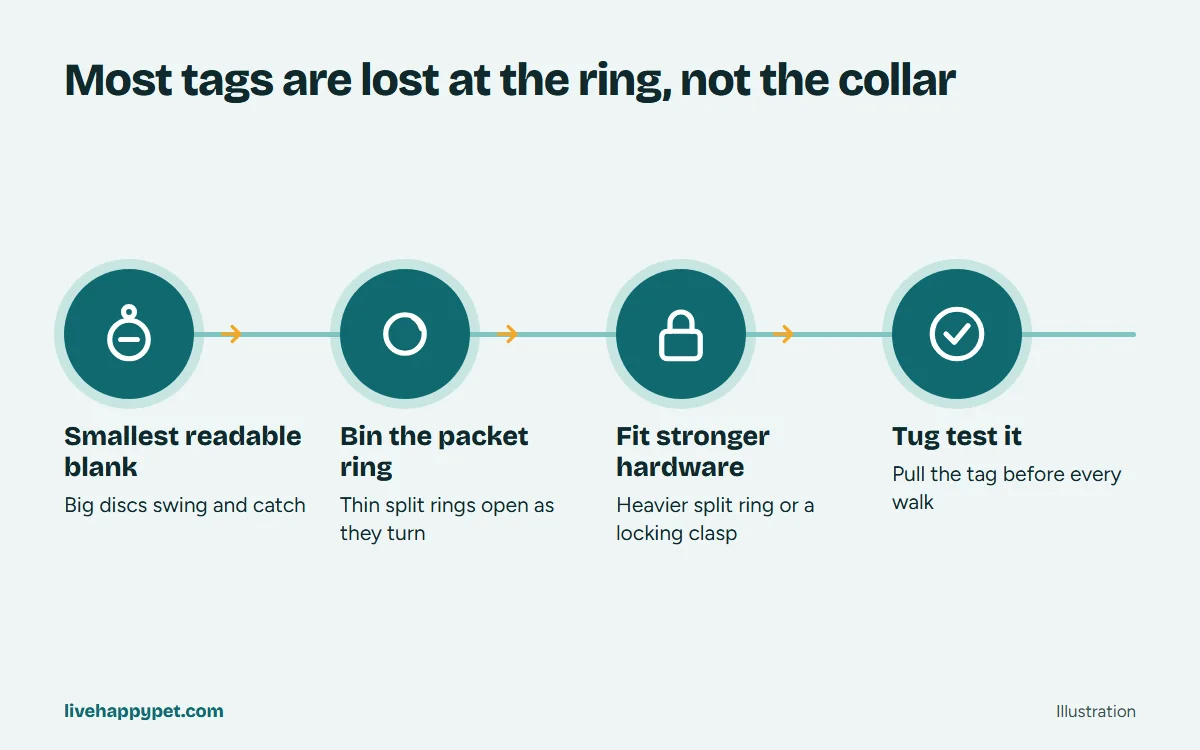
Illustration: Livehappypet
How to Keep Dog Name Tags Readable and Quiet?
Answer: Run a fingertip over the engraving once a month and read it out loud at arm's length. That takes seconds and it is the only check that matters, because a tag wears from the moment it goes on and nobody notices the day it stops being legible. If you have to tilt it toward the.
Run a fingertip over the engraving once a month and read it out loud at arm's length. That takes seconds and it is the only check that matters, because a tag wears from the moment it goes on and nobody notices the day it stops being legible. If you have to tilt it toward the light to read your own number, a stranger in a hurry will not manage it.
For related picks, take a look at our gsd toys roundup.
Jingle is the reason tags get taken off and never go back on. A silicone sleeve around the disc, a slide-on plate instead of a hanger, or a single ring instead of a stack of three all cut the noise sharply. If you are holding several items on one ring, a small tag pouch keeps rabies, licence and contact discs from clattering against each other.
Replace the tag whenever you change your phone number, move house, or rehome the pet, and do it the same week rather than at the next renewal. Wash it when you wash the collar, dry it fully before it goes back on, and keep the old one in a drawer until the new one is on the dog. An unreadable tag is worse than none, because it lets you believe the job is done.
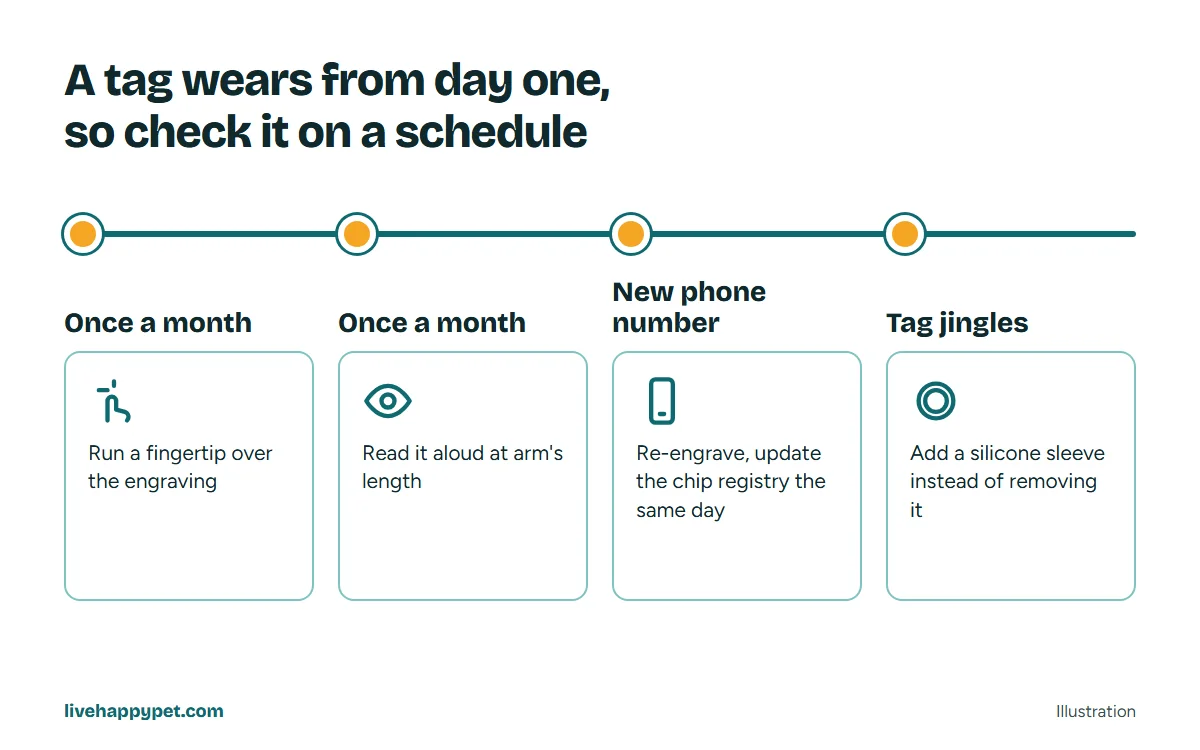
Illustration: Livehappypet
What Should Pet Owners Know About Common Mistakes Pet Owners Make with Dog Name Tags?
Answer: Relying on the chip alone is the big one. A chip is permanent and it is excellent, but it is invisible, and the person standing over your frightened dog on a Sunday evening has no scanner and no idea it exists. The chip gets your pet home from a shelter. The visible identification is what.
Relying on the chip alone is the big one. A chip is permanent and it is excellent, but it is invisible, and the person standing over your frightened dog on a Sunday evening has no scanner and no idea it exists. The chip gets your pet home from a shelter. The visible identification is what stops the shelter being involved at all.
The second mistake is engraving a landline that nobody answers, or a number that changed two phones ago. Registry details go stale the same way, so when you update the tag, log in and update the microchip registry entry on the same afternoon. Both records point at you, and both are useless once they point at an old number.
The third is taking the collar off indoors and forgetting it. Escapes happen through a propped front door, a delivery, or a gate left open by a visitor, which are all indoor moments. If you dislike your dog sleeping in a collar, use a light house collar with a slide-on plate at night and the walking collar during the day, so identification is never the thing that was left on the hook.
What Should Pet Owners Know About Getting the Best Value When Shopping for Dog Name Tags?
Answer: Spend on the engraving and the ring, not on the shape. A deeply cut stainless disc on a heavy ring costs very little more than a decorative one, and it is the combination that survives. Novelty shapes with narrow necks and thin plating look charming in the listing and lose their lettering within a season.
Spend on the engraving and the ring, not on the shape. A deeply cut stainless disc on a heavy ring costs very little more than a decorative one, and it is the combination that survives. Novelty shapes with narrow necks and thin plating look charming in the listing and lose their lettering within a season of real walks.
Buy two of whatever you choose. A spare costs a fraction of the first one when it is engraved in the same order, and it means a lost tag is replaced the same day instead of sitting on a shopping list for a month. Keep the spare with the lead, not in a drawer, so swapping it takes no decision at all.
If you are refreshing the collar at the same time, buy them together and check the D-ring size before ordering the tag ring, since a heavy ring will not pass through a narrow D-ring. Our dog collar and lead range is a sensible starting point when the old collar webbing is already frayed, because a tag is only as secure as the strap it hangs from.
Organizations like the VCA Animal Hospitals pet health library also offer trusted, science-backed advice that is well worth bookmarking.
What Questions Do Pet Owners Ask About Dog Name Tags?
Answer: Choosing dog name tags well comes down to four things: matching the product to your pet's size and daily routine, checking the materials against how hard it will be used, setting it up or fitting it correctly, and inspecting it on a schedule. This guide covers each of those, plus the mistakes owners most often.
Does my pet still need an ID tag if it is microchipped?
Yes, and the two do different jobs. A microchip is permanent but invisible, and it only helps once somebody with a scanner is already holding your pet. An engraved tag is readable instantly by the neighbour who finds your dog, which is how most pets are recovered. Keep both current, and update the chip registry on the same day you reorder the tag.
Should I put my pet's name on the tag?
It is genuinely a judgement call. A name helps a finder calm an anxious animal and is what most engravers put across the top. The objection is that a stranger who can call your dog by name can also call it away from you. A practical compromise is to keep the front for your phone number and put the name on the back.
What is the most durable material for a pet ID tag?
Stainless steel, with rotary or laser engraving, holds up best to water, salt and daily abrasion. Solid brass is a close second and develops a patina rather than rusting. Anodised aluminium is light and inexpensive, which suits small pets, but the coloured coating and the lettering wear off where it rubs, so plan to replace it roughly once a year.
How do I stop my dog's tags from jingling?
Reduce the number of hanging items first, then silence what is left. A silicone sleeve around the disc, a tag pouch that holds rabies and licence discs together, or a slide-on plate that sits flat on the webbing will all cut the noise. A slide-on plate removes the sound entirely because nothing swings.
Is it safe for a cat to wear an ID tag?
Yes, provided the collar is a breakaway design that releases under pressure, since a fixed collar is a strangulation risk if a cat snags it on a branch or a fence. Keep the tag light so it does not drag on the release, test the buckle by pulling firmly, and rely on the microchip as the permanent record.
How often should I replace an ID tag?
Replace it the moment the engraving is hard to read at arm's length, and immediately whenever your phone number or address changes. Check the tag and the split ring monthly while you are already handling the collar. Aluminium tags typically need replacing within a year; stainless steel and brass often last several.
Are QR code pet tags better than engraved ones?
They are a useful addition rather than a replacement. A scan tag can hold a second contact, medical notes and an address you can edit later without reordering anything. It also needs the finder to have a charged phone with signal, and it needs your subscription to still be active. Keep an engraved tag on the same ring as the offline fallback.
What should I never engrave on a pet tag?
Leave your home address off. It gives a finder nothing they need and it advertises an address where a pet, and possibly nobody else, is at home. Skip decorative text that eats the space your phone number needs. If your pet has a medical condition, that short line is worth far more than a slogan.
Shop Pet Supplies
Free US shipping on every order. No minimum purchase required.
Shop Pet Supplies →